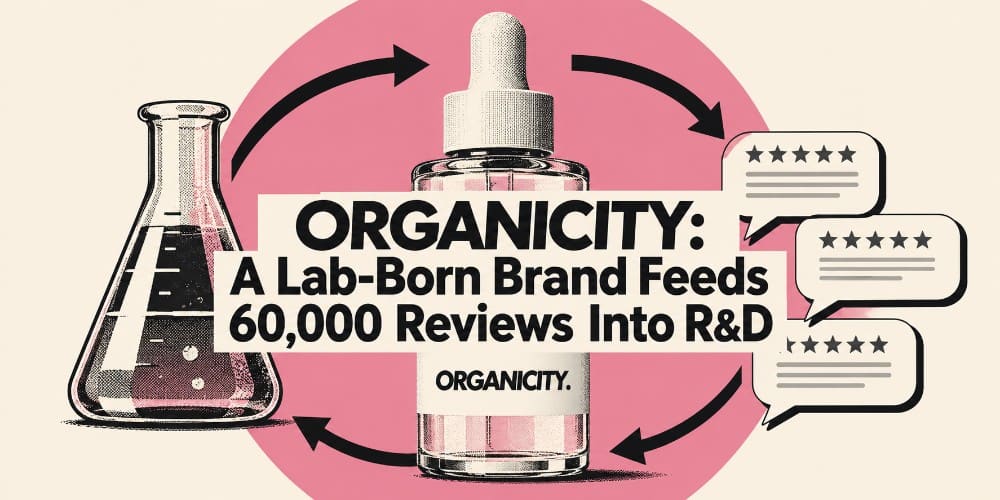
Witten Company, the maker of ORGANICITY, was founded in 2022 by biomedical researchers from KIST, the Korea Institute of Science and Technology, and announced seed funding on November 9, 2026. Its online shop sells single ingredients by the percentage: niacinamide at 5%, 10% and 20%. Its team ran a chatbot proof of concept on about 60,000 customer reviews and consultation records. Most small brands buy attention. This one builds a loop between the customer's question and the lab bench.
Who built ORGANICITY, and who backs it?
ORGANICITY is the consumer brand of Witten Company, a Seoul skincare company founded in 2022 by biomedical researchers from KIST. Song Bo-kyung is CEO, and Kim Seo-yul, a co-founder, serves as director. The founders previously researched neuroimmunology, stem cells, exosomes and neuropeptides in the KIST-UST research program.
On November 9, 2026, an accelerator and SS2 Investment announced an investment in the company through a fund they formed together. A seed round is a company's first outside funding, raised while the business is still proving its model. The accelerator's stated reason for investing was a business structure that connects raw-material research, manufacturing and an own-brand operation.
The company is a tenant of Seoul Bio Hub, a startup center. It uses the center's shared labs and research equipment for formulation development and quality verification, which keeps fixed costs low for a research-led team.
Why does a skincare brand sell ingredients by the percentage?
ORGANICITY calls its approach modular skincare: customers choose ingredients and concentrations according to skin type and concern. The online shop is organized to match. Products can be browsed by ingredient, by concern and by product type, with an ingredient dictionary and an AI routine-design tool alongside the catalog.
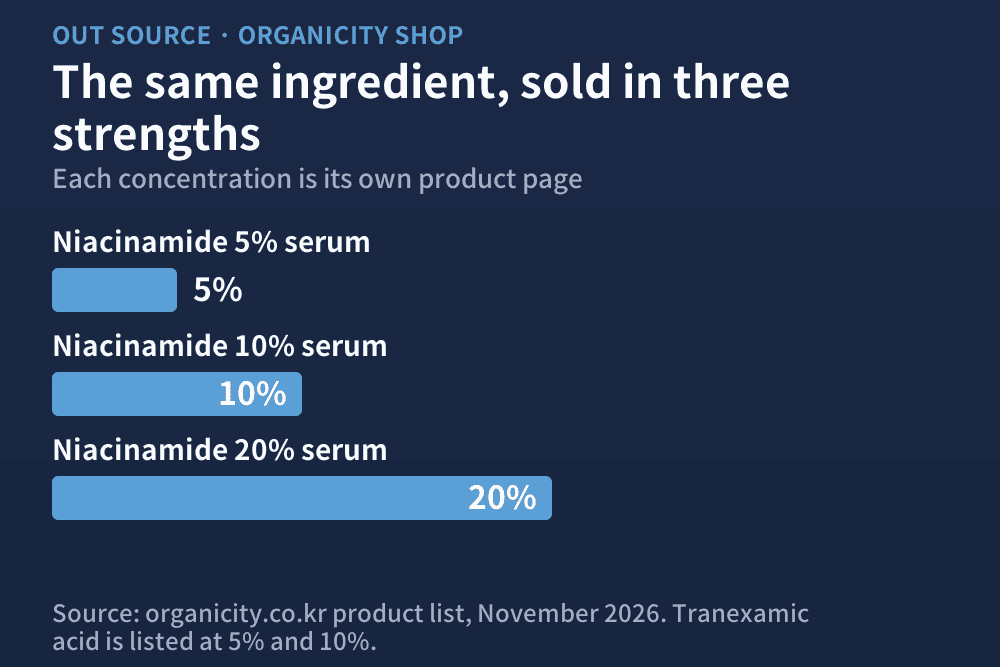
The strength sits in the product name. Niacinamide is sold at 5%, 10% and 20%. Tranexamic acid is sold at 5% and 10%. Dipanthenol is listed at 75%, and a centella extract line carries 100% in its name. Each concentration is its own product page with its own reviews.
That structure moves the choice from the brand to the customer. A brand that hands over the dial has to learn where customers set it, and that is the question the rest of the company is built to answer.
What does a percentage-first catalog change for the brand?
A conventional serum has one formula and one verdict. A percentage-first catalog produces a series of verdicts on the same ingredient at different strengths. Every purchase, review and consultation records a preference at a specific concentration.
Reading across those pages gives the team a dose-response picture drawn from customer behavior: which strength new buyers start with, which strength repeat buyers move to, which questions arrive before the purchase. A brand with one hero product gets one data point. This catalog gets a gradient.
The cost is complexity. More strengths mean more product pages, more stock-keeping units and more customer questions. The consultation channel is where that complexity gets sorted out before the purchase.
What is inside the 60,000 reviews and consultation records?
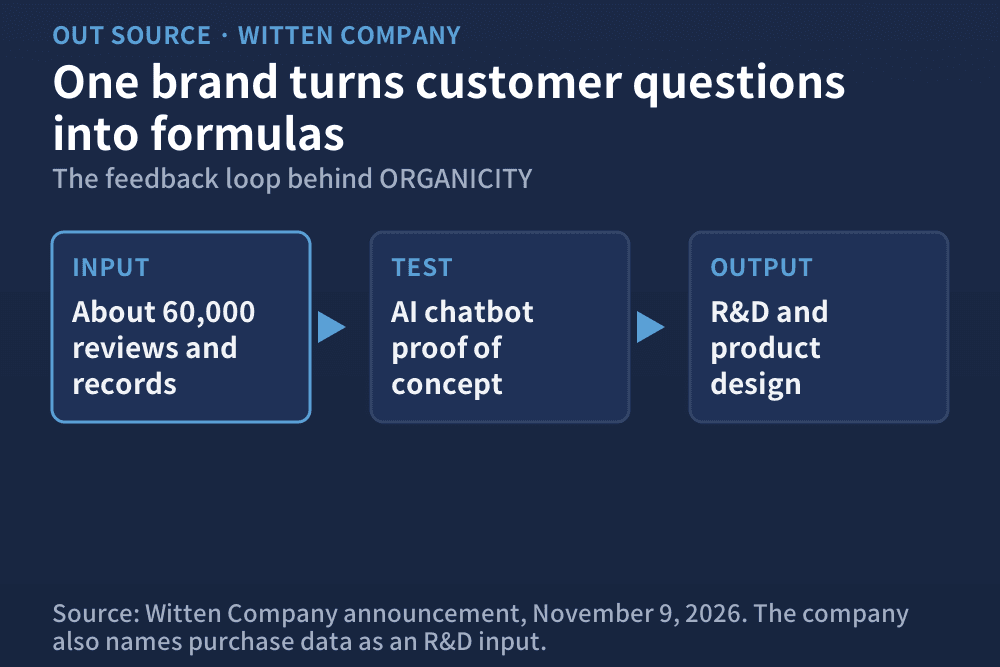
In its announcement, the company said it ran an AI chatbot proof of concept on about 60,000 customer reviews and consultation records. A proof of concept is a small trial built to test whether an idea works before it is built out. The company also said it is developing AI-based personalized skincare curation and plans to extend AI across its internal work.
The consultation records carry more weight than the reviews. A review reports an outcome after use. A consultation records the question before purchase: skin type, concern, the ingredient the customer is considering. A chatbot built on both sees the question and the verdict side by side.
The company states that purchase, review and consultation data guide its product development. The loop runs from question to recommendation, to purchase, to review, and back into the formula.
Why does the research team matter more than the data?
The company's research covers nano delivery systems built on exosomes and liposomes, along with the biology of skin aging. Liposomes are microscopic spheres of lipid used to carry ingredients inside a formula. Exosomes are tiny vesicles that cells release. Liposome appears directly in two ORGANICITY product names, including a ceramide-liposome vitamin C solution.
Data without a laboratory is a marketing database. A laboratory without data is a catalog nobody asked for. Founders who came from research close the gap between a consultation and a formula inside one organization, from raw-material research through formulation, manufacturing and quality control to brand operation.
That is the structure the investor named. The loop only works when the team that reads the customer's question can also change the formula.
How did Japan become the first test of the model?
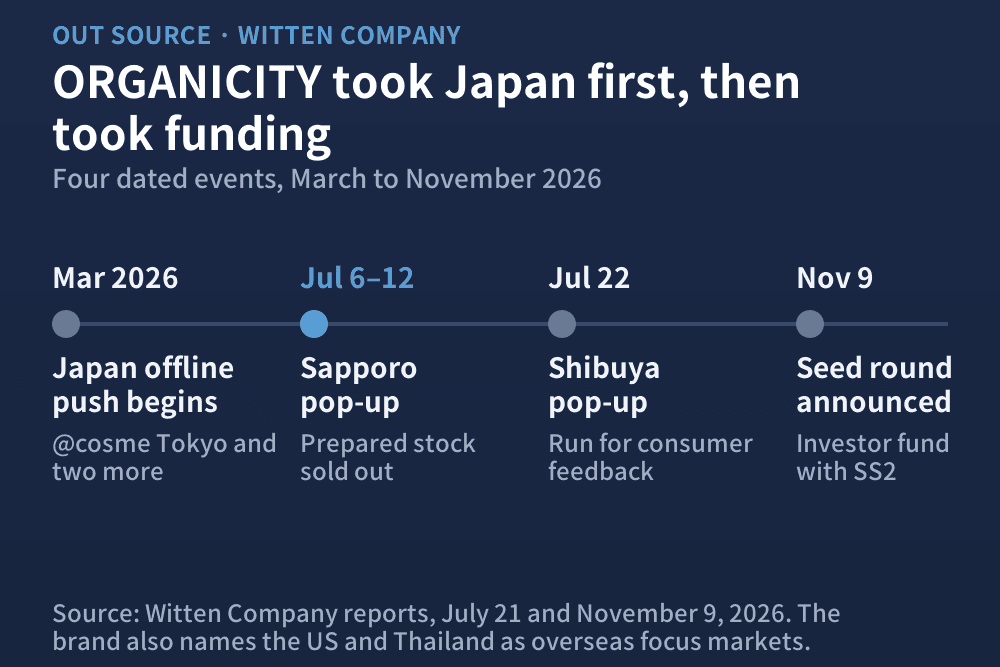
The company began its full-scale push into Japanese offline retail in March 2026. Its partners include @cosme Tokyo, the flagship store of @cosme, Japan's largest cosmetics review platform, along with Hiroseya with @cosme and Mimosa. The retail partner is itself a review platform, which puts a data-driven brand inside a data-driven shop.
From July 6 to 12, the company ran a pop-up in Sapporo, Hokkaido, and sold through all the stock it had prepared. A July 21, 2026 report said a second pop-up was set for Shibuya, Tokyo, on July 22, with the stated purpose of gathering consumer feedback for product development and marketing.
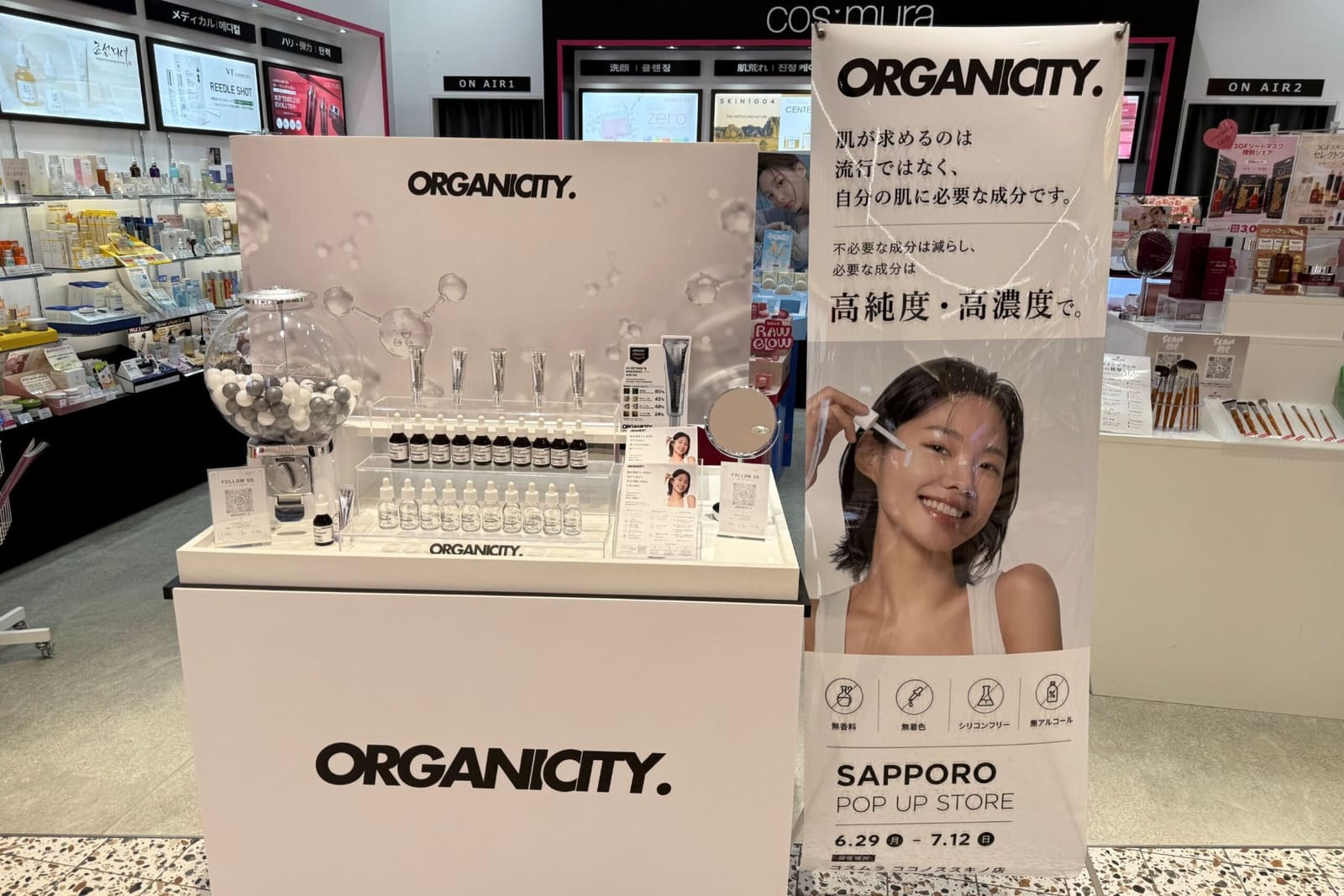
Shoppers in Sapporo focused on key ingredients, concentrations and usage methods tailored to specific skin concerns. Those are the same questions the online catalog is organized around. The November 9 announcement names Japan, the United States and Thailand as the focus of overseas distribution.
What does a sold-out pop-up actually test?
A sell-out reports that demand cleared the stock the team brought. A pop-up is a temporary store, so it measures one week in one city.
The more durable output is the conversation at the counter. Ingredient, percentage, concern: each question a shopper asks in Hokkaido is a labeled data point that arrives without a survey. The Shibuya event was framed around feedback rather than volume.
For a seed-stage company, offline Japan works as a laboratory with a cash register. It converts the online loop into a face-to-face one and tests whether the percentage-first logic travels outside Korea.
How does the brand pay for the loop?
Domestic sales run through Naver and Coupang, two large Korean online marketplaces, plus influencer group buying, a sale in which an influencer collects orders for a limited window.
After the investment, the company was selected for LIPS I, a matching-loan program run by the Small Enterprise and Market Service that pairs policy loans with private investment. The company plans to use the loan for raw materials, production capacity, and domestic and overseas sales channels. It also takes part in the Seoul Startup Hub Gongdeok early-stage batch run by its investor and in a women-focused accelerator run by the Korea Women Entrepreneurs Association.
The capital stack has three layers: a venture fund for equity, a policy loan that adds no new shareholders, and public lab space that lowers fixed costs. Together they fund a research-led brand at seed stage.
What does this structure change for the wider industry?
For manufacturers, an ODM (original development manufacturer, a contract firm that formulates and produces products for brands) loses the formulation role when the brand owns the lab and listens to its own data. The ODM's remaining value is capacity, quality systems and speed.
For brands and buyers, the evidence behind a small brand now includes a feedback loop alongside the product. A retailer that sits on review data, as @cosme does, sees in this model a supplier that speaks its own language.
For investors and regulators, the unit of analysis moves from the formula to the claim attached to each strength. A catalog organized by concentration puts every percentage in front of the customer, and every percentage is a statement to be substantiated.
The question for small brands is no longer who has the best formula. It is who hears the customer fastest and can act on it.