Amorepacific’s Philippine unit booked 7.34 billion won in 2025, flat on the year, on operating profit of 36 million won. Its Indian unit booked 26.5 billion won, roughly triple its 2022 figure. On 30 September 2026 the official Laneige mall in the Philippines stopped taking orders, and the day before, the Indian unit named the head of a new premium division. The company has shut its own storefronts before. The region where it did it first is now its fastest-growing.
What actually closed in Manila on 30 September?
The Laneige Philippines official online mall, run by Amorepacific’s local subsidiary, ended operations on 30 September 2026. Orders stopped, products showed as sold out, and unfulfilled orders were set for refund within 60 business days. The brand’s own help pages said sales would continue through authorised retailers and distributors.
What remains is a list of third parties: Watsons stores, Lazada, Shopee and TikTok, run with local distribution partners. Laneige and Innisfree offline stores in the Philippines were reported closed on 1 July 2026, three months earlier. The subsidiary itself stays registered, and the company says no liquidation decision or timing has been set.
The closure notice posted on the mall was reported in September 2026 as giving the withdrawal of the Philippine operation as its reason. The company’s own statements describe something narrower: a shift from a subsidiary-centred model to one built on local distribution partners, with the Philippines still named as a key market alongside Vietnam and Indonesia. The gap between those two framings is the only place where the internal and external readings of this decision sit side by side.

Why is a closed storefront a weak signal on its own?
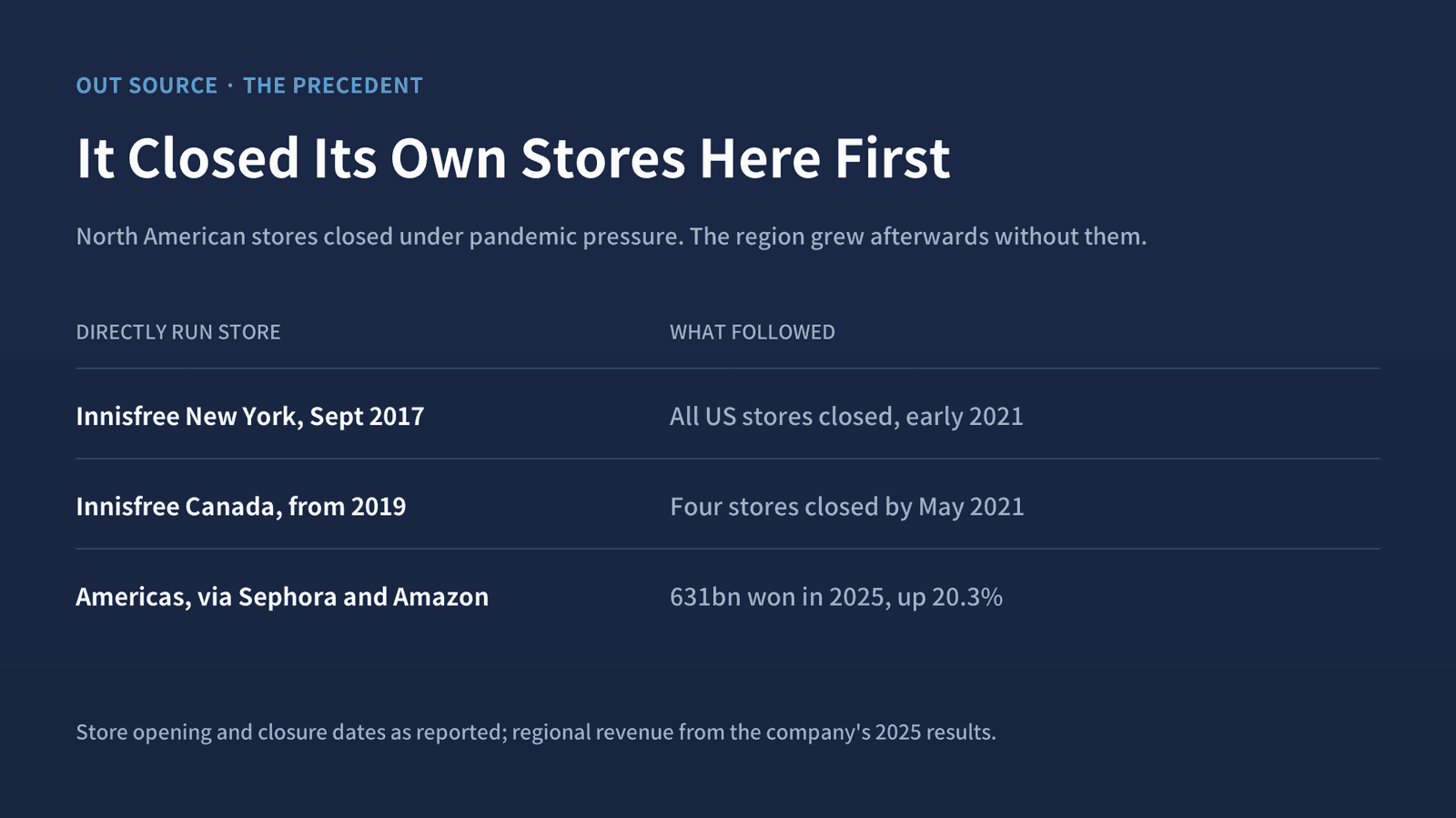
Because this company has run the same move to a known outcome. Innisfree opened a directly operated store in New York in September 2017. All United States stores were closed in early 2021. Four Canadian stores, opened from 2019, were shut by May of the same year, with the brand left on Sephora’s shelves. Those closures happened under pandemic pressure and weak regional results rather than as a clean strategic choice.
What matters is what the region did next without them. The Americas booked 631 billion won in 2025, up 20.3 percent, built on Sephora and Amazon. EMEA booked 241 billion won, up 41.5 percent. The two fastest-growing regions on the company’s books are the two it sells through other companies’ shelves.
So the Manila storefront closing is not, by itself, evidence of anything. A brand without its own shop in a market is a brand on someone else’s shelf, and the company’s own results show that position compounding faster than the one it gave up.
So what was the Philippine business actually missing?
Price tier, not category demand. A United States government market assessment of Philippine cosmetics, published in 2022 and updated in 2024, puts Korean skincare at a 34 percent share of the market, ahead of Japanese products at 20 percent and behind American brands at 35 percent. The same assessment describes a highly price-sensitive market where readily available skincare sells between $5 and $10, and estimates that 2 to 5 percent of a population of 110 million can afford higher-end products.
Laneige is not a $5 to $10 brand. The category it belongs to had already been won in that market, by Korean products broadly, at a price it does not compete at. Innisfree, COSRX and Mise-en-Scène all remain on sale there, which is the point rather than a counterpoint.
The unit’s numbers track that. Revenue moved from 6.1 billion won in 2023 to 7.322 billion in 2024 and 7.34 billion in 2025. Operating profit went 389 million, 215 million, 36 million across the same three years — roughly half a percent of revenue by the end. The company has said the restructuring was not based on a single year’s profitability, and no source links the profit decline and the channel change causally. The shape is still a business that stopped growing and got more expensive to run at the same time.
How far apart are the two subsidiaries’ numbers?
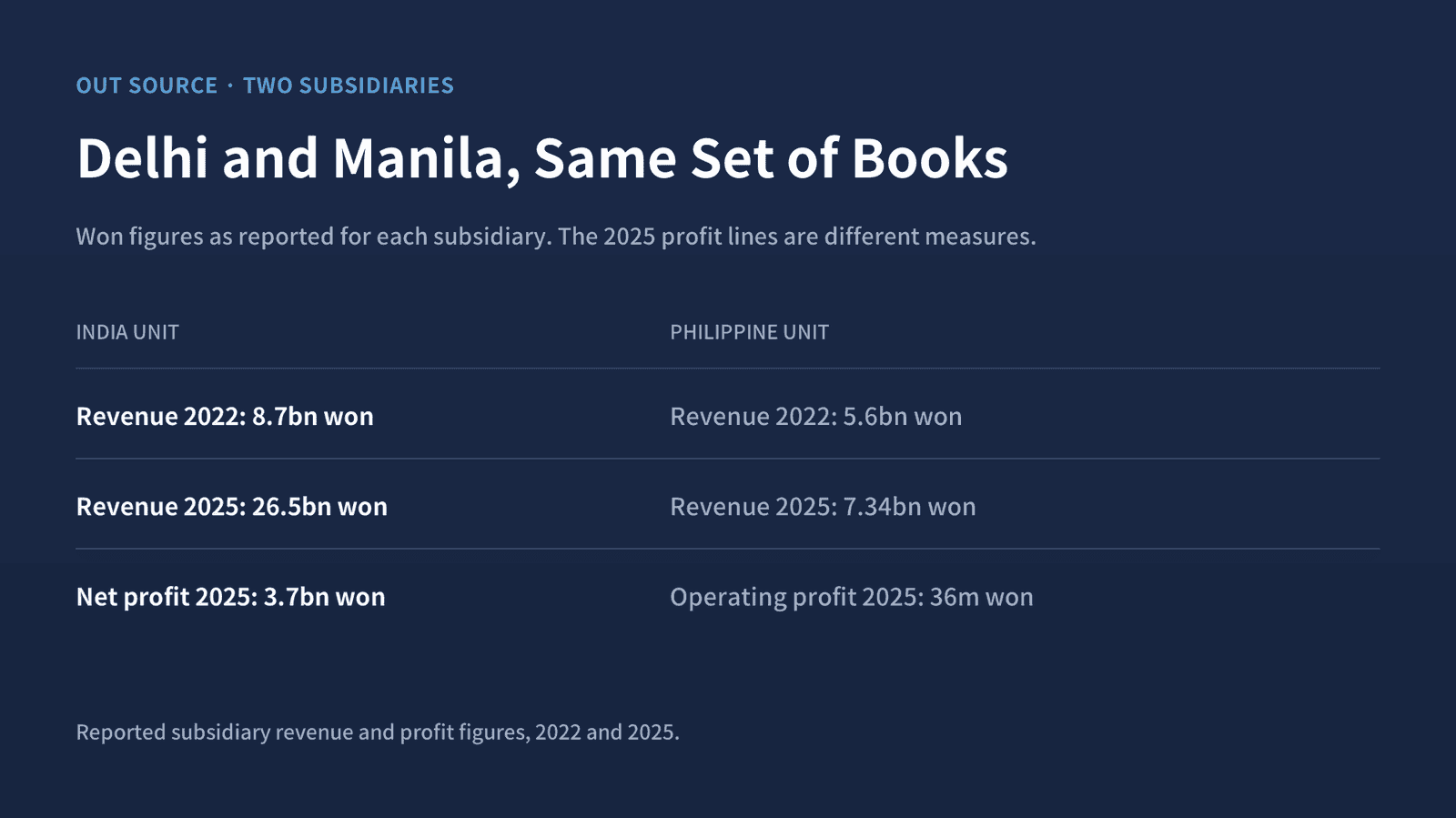
The Indian unit’s reported revenue runs 8.7 billion won in 2022, 11.1 billion in 2023, 17.6 billion in 2024 and 26.5 billion in 2025. It posted a net loss of about 700 million won in 2022, returned to profit at about 800 million won in 2023, and reached about 3.7 billion won in 2025. Converted at 1,340.4 won to the dollar, the rate on 9 October 2026, 2025 revenue is about $19.8 million and net profit about $2.8 million.
The Philippine unit’s revenue over the same period runs 5.6 billion, 6.1 billion, 7.322 billion and 7.34 billion won — about $5.5 million at the end. The 2025 profit figures are not the same measure, net against operating, and nothing here depends on treating them as one.
Neither unit moved the group’s 2025 result. Amorepacific Holdings reported 4.6232 trillion won in revenue, up 8.5 percent, with operating profit of 368 billion won, up 47.6 percent. India is about 5 percent of the Other Asia and APAC line, the Philippines about 1.4 percent. That is what makes the pair readable: these are decisions taken on trajectory, at a scale where being wrong is survivable.
What did Amorepacific build in Delhi instead?
A premium division inside the Indian subsidiary, created to run Laneige and Sulwhasoo under one strategy covering both online and offline. Vidushi Goyal was named to head it, reported on 29 September 2026. Her record is more than fifteen years in Indian beauty, personal care and direct-to-consumer sales, including the founding marketing team at Mamaearth and brand building at Swiss Beauty.
Two details in that sentence do the work. The division is cut by price tier rather than by brand or channel, which is how the company organises itself globally. And it is run by someone whose experience is in Indian mass and masstige direct selling rather than in Korean brand management. India is being staffed as a market with its own portfolio logic, not as an export destination with a local office attached.
Why does Nykaa sit at the centre of the Indian plan?
Amorepacific established its Indian subsidiary in 2013 with Innisfree. Laneige and Etude followed in 2019, Sulwhasoo in 2020, launching on Nykaa and planning placement in Nykaa Luxe stores in Delhi and Mumbai. Mamonde entered in August 2026 with ten products built around its Rose HA and Peony BHA lines, sold exclusively on Nykaa. Offline, the brands sit in TIRA and Sephora India.
The relationship has since moved past distribution. Laneige has begun developing products with Nykaa from the planning stage, including makeup cushions. Etude started producing India-only items in late 2025, including a tint range matched to local skin tones and climate, and Innisfree has launched a hair oil and a BB cream for Indian consumers.
India’s beauty and personal care market was about $24 billion in 2024 and is projected to reach about $45 billion by 2030 at an 11.7 percent compound rate, roughly 5 percent of the global category. That is the reason to be there. It is not the reason a retailer agrees to build product with you.
What is the variable, then?
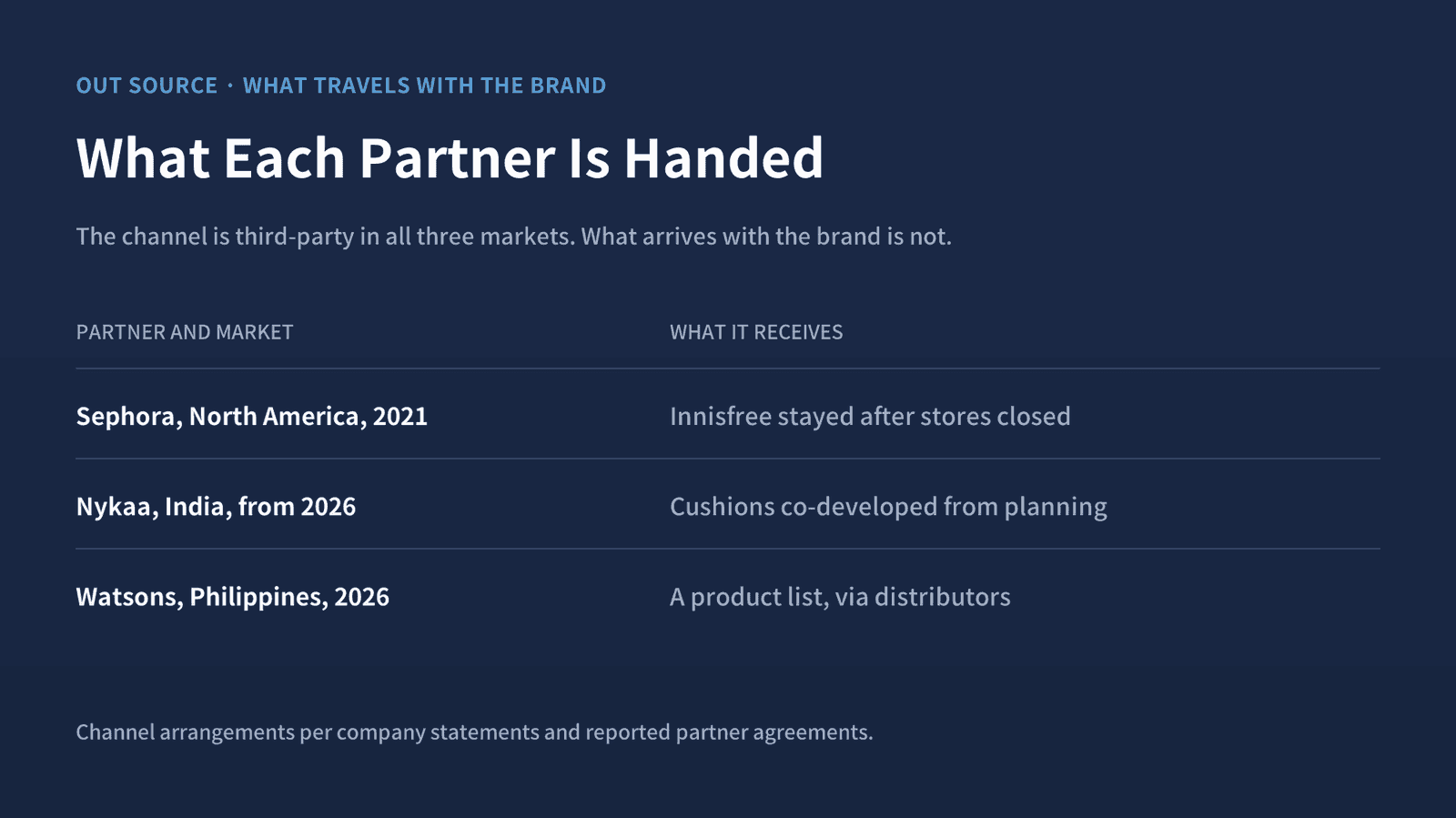
Not who owns the channel. What the brand hands the channel.
Innisfree stayed on Sephora’s shelves after its own North American stores closed because there was demand for the brand to absorb, and the Americas have grown on that basis every year since. Nykaa co-develops cushions with Laneige because Laneige brings formulation and a loyal base in a premium segment Nykaa wants to build. Watsons in the Philippines receives a list of products, in a category where it already stocks several Korean alternatives at prices that clear faster.
Read that way, the Manila closure and the Delhi hire are the same decision applied to different inputs. Where the company has something a partner wants, it leans harder on the partner and spends on the relationship. Where it does not, it stops paying for the infrastructure and takes whatever the partner will give it. The subsidiary structure was never the thing being judged.
What does a decision like this cost to reverse?
Less than the closure makes it look, and more than the company’s North American recovery suggests. The United States came back without stores, but it came back with a product proposition that American shoppers were already searching for. The asset that rebuilt it was demand, and the stores were never what generated the demand.
What is genuinely hard to rebuild is a reason for a partner to care. A distributor’s shelf is allocated by velocity, and a brand that arrives with nothing but a catalogue gets the allocation that implies. Once a market is run entirely on someone else’s read of the shopper, the data needed to build the next proposition is the first thing the brand no longer has.
Closing the storefront is cheap. Closing the reason to stock the brand is not. Those are separate decisions, and only one of them was made in Manila.