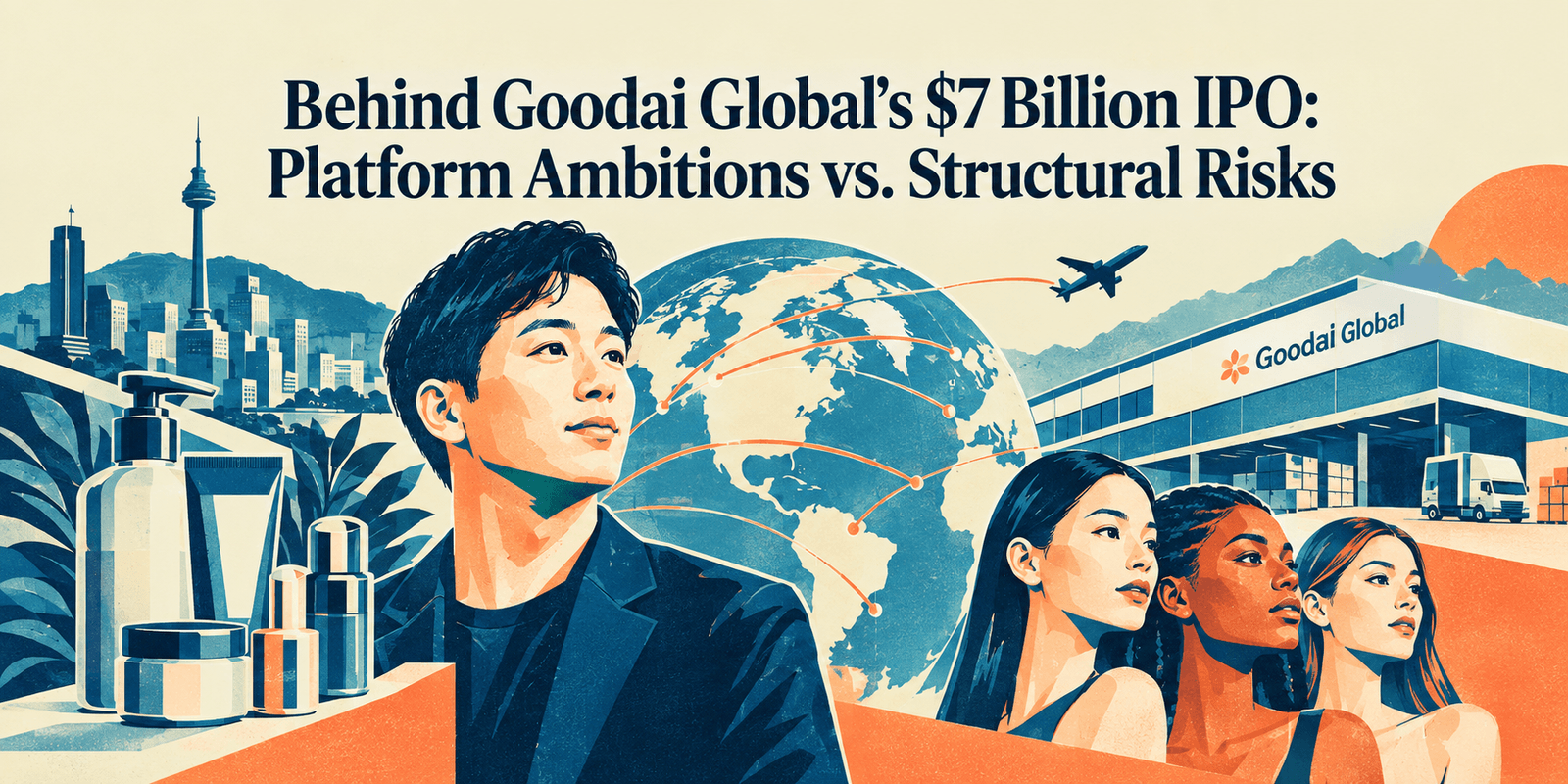
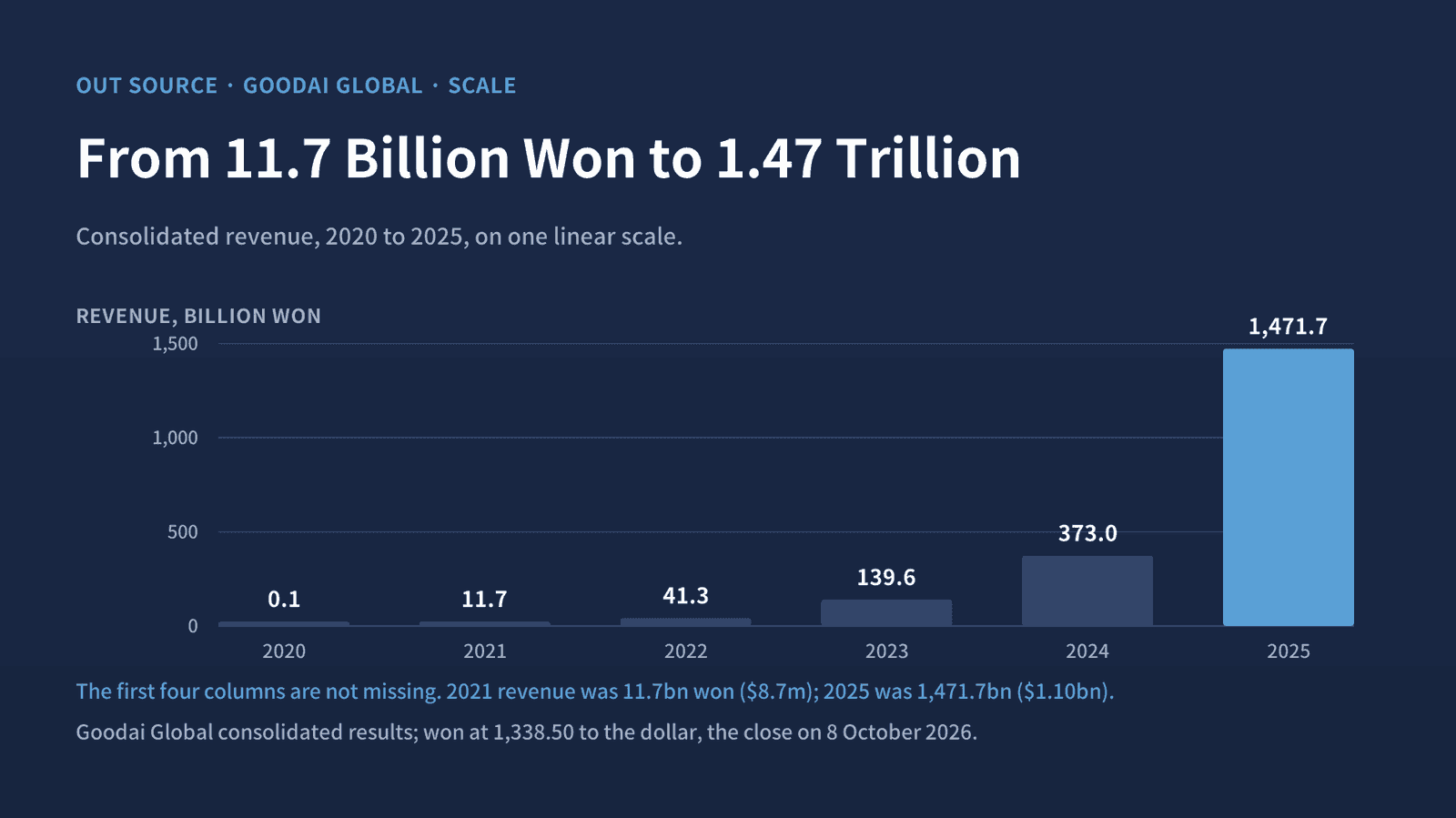
PEACEMINUSONE, the label G-Dragon runs, said on 8 October 2026 that it will build a cosmetics brand called PEACEMINUSONE BEAUTY, for launch in the first half of 2027. The headline is the musician. The interesting party is the partner. Goodai Global booked 11.7 billion won ($8.7 million USD) of revenue in 2021 and 1,471.7 billion won ($1.10 billion USD) in 2025. It got there by buying nine companies and brands, and it has an initial public offering in motion.
What was actually announced?
A brand, a name and a date. PEACEMINUSONE BEAUTY launches in Korea first, then moves to the United States, Japan and other overseas markets in sequence. The product line-up has not been disclosed, and the two companies say the concept will be revealed in stages through their own social channels.
They describe a joint build rather than a licence. PEACEMINUSONE supplies the design language and identity it developed in fashion and art, Goodai Global supplies the beauty operation, and both sides are involved from brand planning through product development. Chun Ju-hyeok, Goodai Global's chief executive, described the result as the company's global beauty capability combined with the label's own worldview, and said the aim is a brand value overseas consumers have not met before.
They also went out of their way to say what it is not: a one-off collaboration. That sentence is doing more work than it looks.
Who is Goodai Global?
A company that started in 2016 doing something unglamorous — handling overseas distribution for Korean cosmetics brands it did not own. It now operates Beauty of Joseon, TIRTIR, skin1004, Round Lab, SkinFood, House of Hur and Laka.
Readers outside Korea know at least two of those without knowing the owner. Beauty of Joseon became an Amazon sunscreen best seller. TIRTIR found Japan before it found Korea. Neither was founded by the company that now banks their revenue.
How fast did it actually grow?
Revenue ran 100 million won in 2020, 11.7 billion in 2021, 41.3 billion in 2022, 139.6 billion in 2023, 373 billion in 2024 and 1.4717 trillion in 2025 — roughly $75,000, $8.7 million, $30.9 million, $104.3 million, $278.7 million and $1.10 billion at 1,338.50 won to the dollar, the close on 8 October 2026 and the rate used throughout this piece.
Operating profit in 2025 came to 273.4 billion won ($204.3 million), up 98.6 percent, on net profit of 233.7 billion won ($174.6 million), up 88.1 percent. Count the acquired subsidiaries for full years rather than from the dates they were consolidated and the pro forma figures reach about 1.75 trillion won ($1.31 billion) of revenue and 401.4 billion won ($300 million) of operating profit.
A roll-up — a company that grows by buying smaller companies in the same business and running them on shared infrastructure — is supposed to look like this on the way up. What it looks like when the buying stops is the question nobody gets to answer early.
What does the buying pattern look like?
Beauty of Joseon in 2019. House of Hur in 2022. Then TIRTIR, which is the instructive one: half the company in 2023 for 10 billion won ($7.5 million) alongside a private equity partner, and the remainder the following year for 150 billion won ($112.1 million). Fifteen times the price for the second half of the same asset, roughly a year apart. That is what being right late costs.
The same year brought Laka, skin1004 and Craver Corporation. In 2025 came SkinFood and Serin Company, which operates Round Lab. In February 2026 Goodai Global agreed to take control of Hansung USA, a distributor that places Korean brands into American offline retail, for around 100 billion won ($74.7 million). Hansung's own revenue had gone from 80 billion won ($59.8 million) to 170 billion won ($127.0 million) in a year.
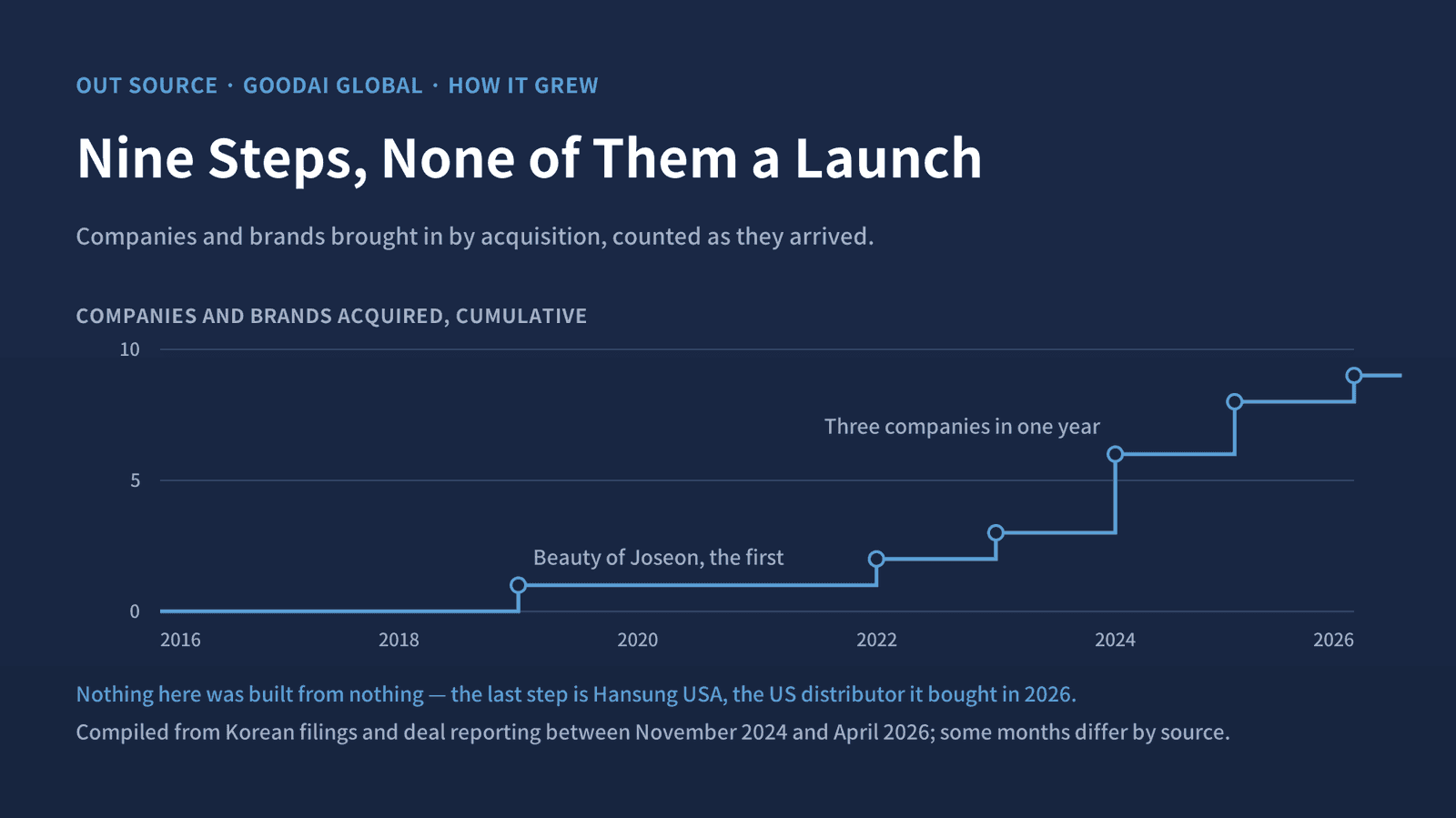
Read the list again and notice what is missing from it. Nothing was started. The growth is a purchase history.
Why does a company heading for an IPO want a brand that launches in 2027?
Because a roll-up's valuation turns on a question acquisitions cannot answer. Goodai Global has begun its listing process with Mirae Asset Securities, NH Investment & Securities, Citigroup Global Markets and Morgan Stanley as underwriters, and bankers have talked about a valuation reaching 10 trillion won ($7.47 billion). That number is an industry expectation rather than a priced deal. At that level, buyers are not paying for seven brands. They are paying for the proposition that the machine produces an eighth.
PEACEMINUSONE BEAUTY contributes nothing to 2026 revenue. What it contributes is evidence, ahead of cost, that the company originates as well as it acquires. A celebrity partnership with a global fashion identity is the cheapest version of that evidence on the market, and it lands while the book is being built.
None of which is a criticism. It is a reason to expect the launch to be properly funded.
What does PEACEMINUSONE get that a solo launch would not?
The plumbing. Regulatory dossiers for Korea, the United States and Japan. ODM relationships, ODM meaning the contract developers who formulate and manufacture a brand's products. Amazon and TikTok Shop operations already running at scale. And, since February 2026, an American distributor that reaches physical stores.
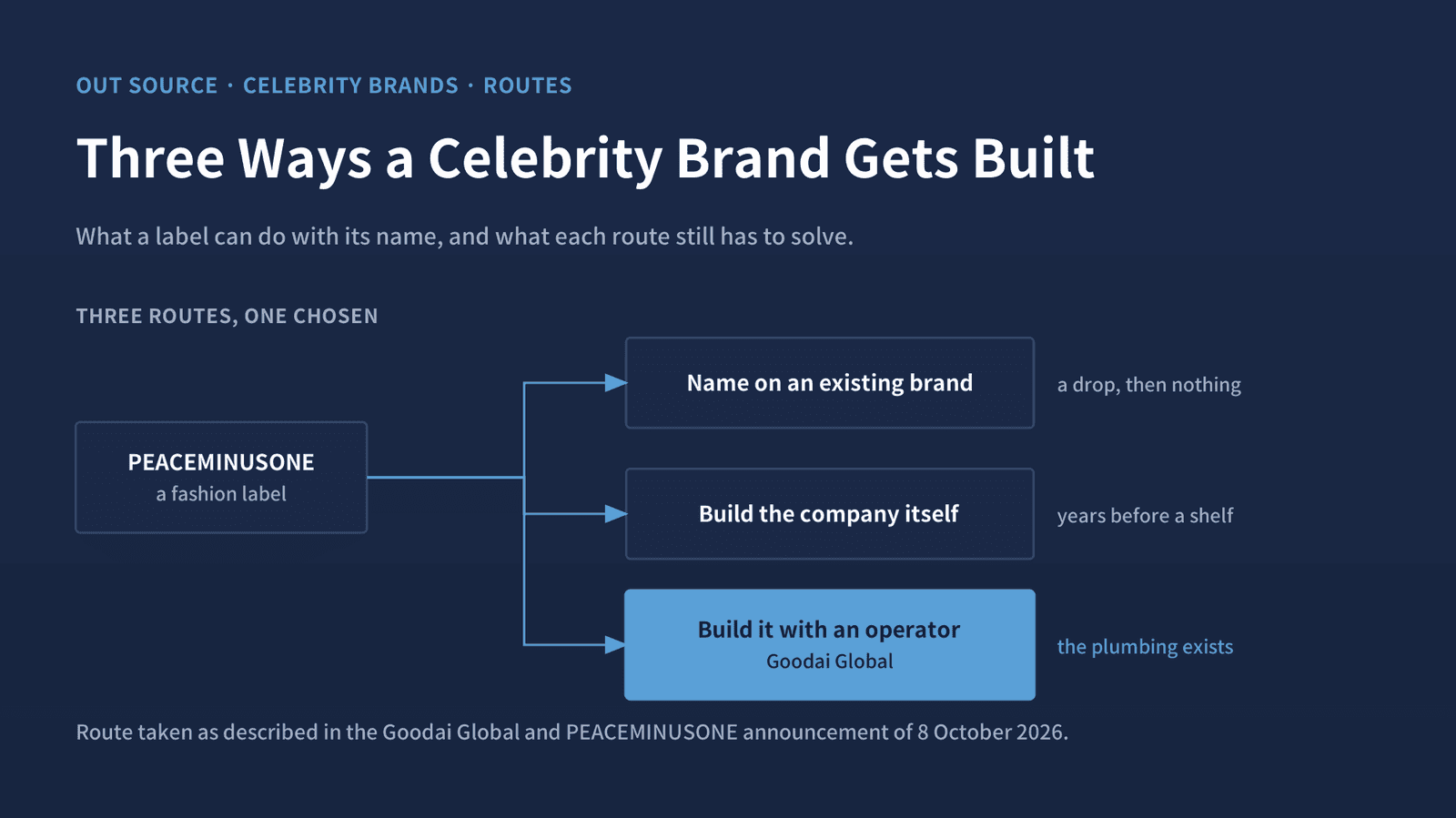
What kills celebrity beauty brands is rarely the product and almost never the launch. It is the second year — when the drop spike flattens, the creator rate card resets, and somebody has to pay for inventory that did not move. Rhode and Rare Beauty cleared that year. Most do not.
A brand inside a 1.47-trillion-won operator pays that bill out of shared overhead. It also reaches an American shelf through a distributor the parent owns, instead of pitching one.
What is the risk on the label's side?
A roll-up optimises a portfolio. It does not optimise your brand.
Warehouse priority, a slot in a buyer meeting, the distributor's attention in Los Angeles — PEACEMINUSONE BEAUTY competes for all of it against Beauty of Joseon and TIRTIR, which carry revenue histories it will not have until 2028. And once a listing prices, the people allocating those resources answer to a shareholder register rather than to a fashion label.
There is a clock on the other side too. The brand arrives in the first half of 2027, which is a long interval in the attention economy a celebrity brand runs on.
What does this tell a Korean indie brand about who the buyer is?
That the buyer changed address. For a decade the exit for a Korean indie brand was a domestic conglomerate or a strategic buyer from Paris or New York. In 2026 the company writing the cheque is frequently another Korean company that was itself an indie five years ago, financed by domestic private equity and heading for a domestic listing.
That changes what a founder should have ready. Not a global corporate-development dossier, but clean sell-through by channel, a cap table without surprises, and a range that slots into somebody else's shelf without eating the brand next to it.
It changes the price too. A buyer who has done nine of these knows what the second half costs when it waits.

Where does this leave the three parties?
Manufacturers and ODM suppliers. A roll-up concentrates demand: one client where there were seven. Order volume rises and so does the damage a single renegotiation does, so price the relationship rather than the batch.
Brands and the buyers who stock them. A celebrity brand arriving with this balance sheet behind it enters retail at a speed a founder-run brand does not match. Judge the pitch by the distribution attached to it, not by the name on the box.
Investors. One number settles the listing argument, and 2026 will not settle it: whether anything in the portfolio was originated rather than bought. The first half of 2027 is when the answer starts arriving.
The celebrity is the headline. The bet is on a company that has grown almost entirely by buying what somebody else started.