On November 5, 2026, iM Financial Group announced a 20 g sun stick and a 100 ml ampoule mist made with No Brand, the private-label line of retailer E-Mart. The announcement names the products, two mascots and a sales network. It names no manufacturer, responsible seller or launch date. Korean labeling rules put the manufacturer and the responsible seller on the package. The launch looks like beauty. The announcement reads like a bank group's brand campaign.
What did iM Financial Group actually launch?
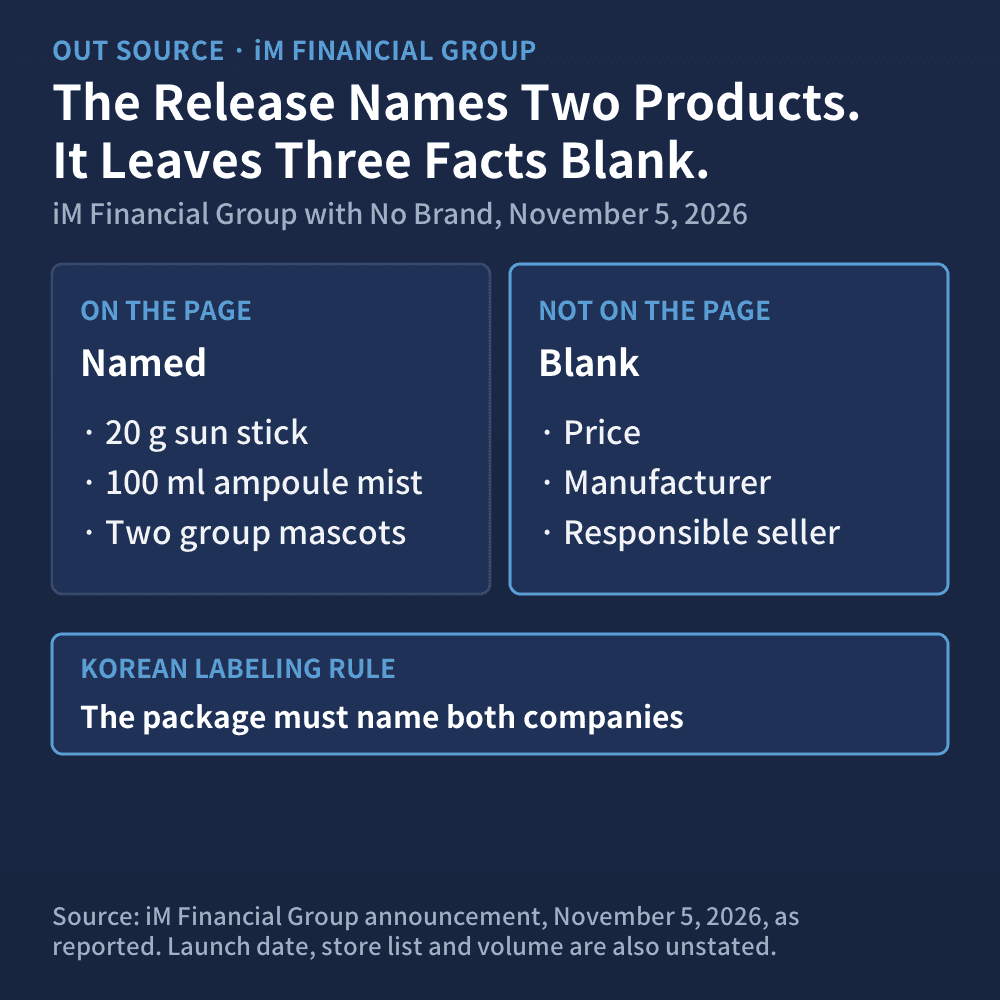
On November 5, 2026, iM Financial Group announced two cosmetics developed with No Brand, the private-label line of the retailer E-Mart. A private label is a product sold under a retailer's own house brand rather than a manufacturer's brand. The products are the iM Cloud Fit Sun Stick, 20 g, and the iM Moisture Jelly Ampoule Mist, 100 ml. A sun stick is sunscreen in a solid stick format.
Both products carry the group's two mascots, Dandi and Ttokdi, and the group's signature color, mint. The group says they sell through No Brand's nationwide online and offline channels, which it presents as a route to customers outside financial channels.
The pitch is symbolic. A group official said the products turn the group's role of protecting customers into something physical, in the way cosmetics protect skin from the environment. The same official said the group wants a friendlier face than the rigid image finance carries.
What does the announcement leave out?
Manufacturer, responsible seller, launch date, store list and sales volume. The announcement and the coverage built on it are silent on all five. No sales target appears either. No report describes an ownership link between the group and E-Mart.
That is a long list for a product that is already announced. It means the public record of this launch is a name, two mascots and a channel. Everything that identifies who made the product, who sells it under Korean law and what it costs sits outside the announcement.
Why does the unnamed party matter on a sun stick?
Korean labeling rules require the package to carry the name and address of the cosmetics manufacturer and of the cosmetics responsible seller, listed separately unless one company holds both roles. The responsible seller is the licensed company that markets a cosmetic in Korea and answers to the regulator for it. The label therefore settles what the announcement does not. The answer appears once the product is in a customer's hand.
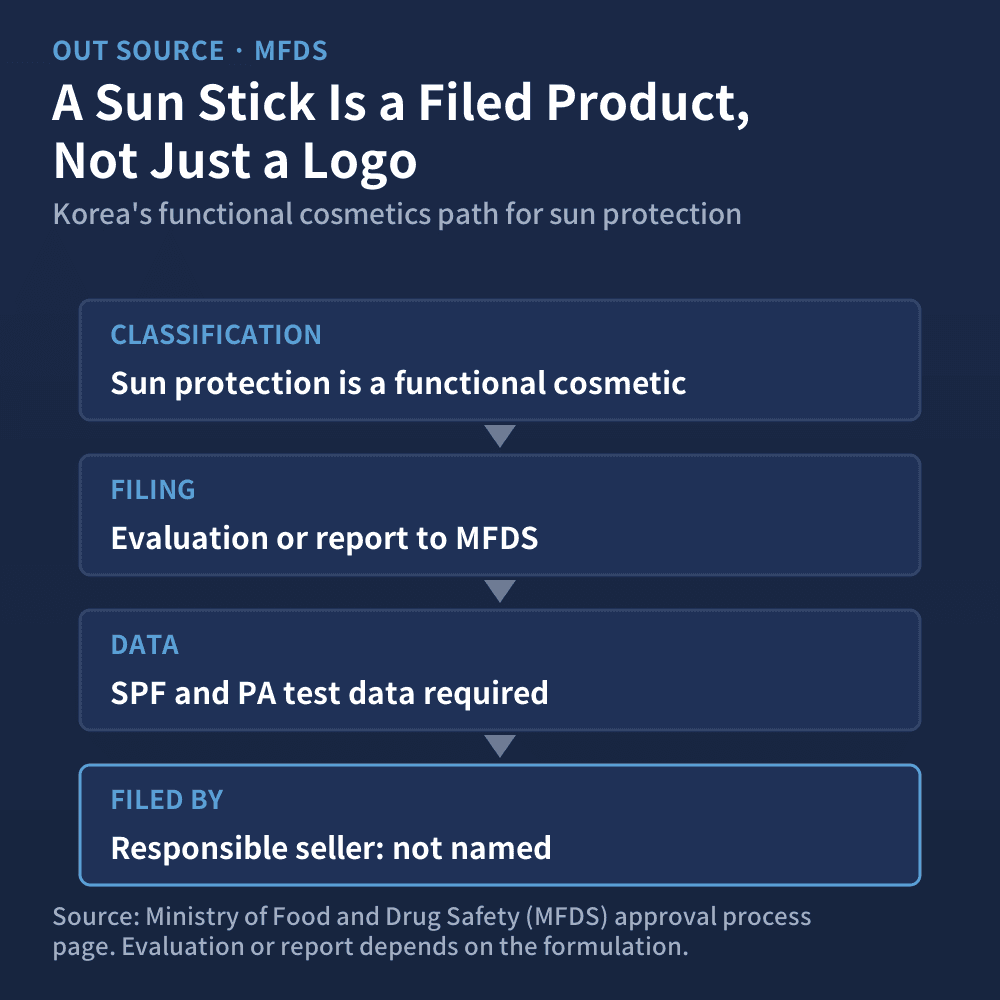
Sunscreen raises the stakes. The Ministry of Food and Drug Safety classifies products that protect skin from ultraviolet rays as functional cosmetics, meaning cosmetics with a defined function such as UV protection, whitening or wrinkle improvement. The ministry's approval page says the responsible seller must have such a product evaluated or file a report on its safety and effectiveness, and that sun products need sun protection factor (SPF) and UVA protection factor (PA) data. Whether a product takes the full evaluation or the simpler report depends on its formulation.
The announcement does not say which route this stick took, and it gives no SPF or PA values. The name on the front of the stick is a bank group's. The name on the back belongs to whichever company holds the responsible-seller license, and the announcement does not say who that is.
What does No Brand supply, and what does iM supply?
No Brand supplies the channel: a nationwide network of online and offline outlets. iM supplies the identity: the group name, the mascots and the mint color. No source states who supplies the formula, the factory or the regulatory filing, and none describes a license fee, a royalty or a revenue split between the group and No Brand.
A responsible seller can contract the making of a product to an ODM, short for original development manufacturer, a factory that develops and produces formulas that other companies sell under their own names. Whether an ODM made these two products is undisclosed.
The visible split resembles a licensing arrangement. One party lends a name and a character set. The other lends shelf access. The party that holds the filing sits behind both.
How did a bank group's partnership reach cosmetics?
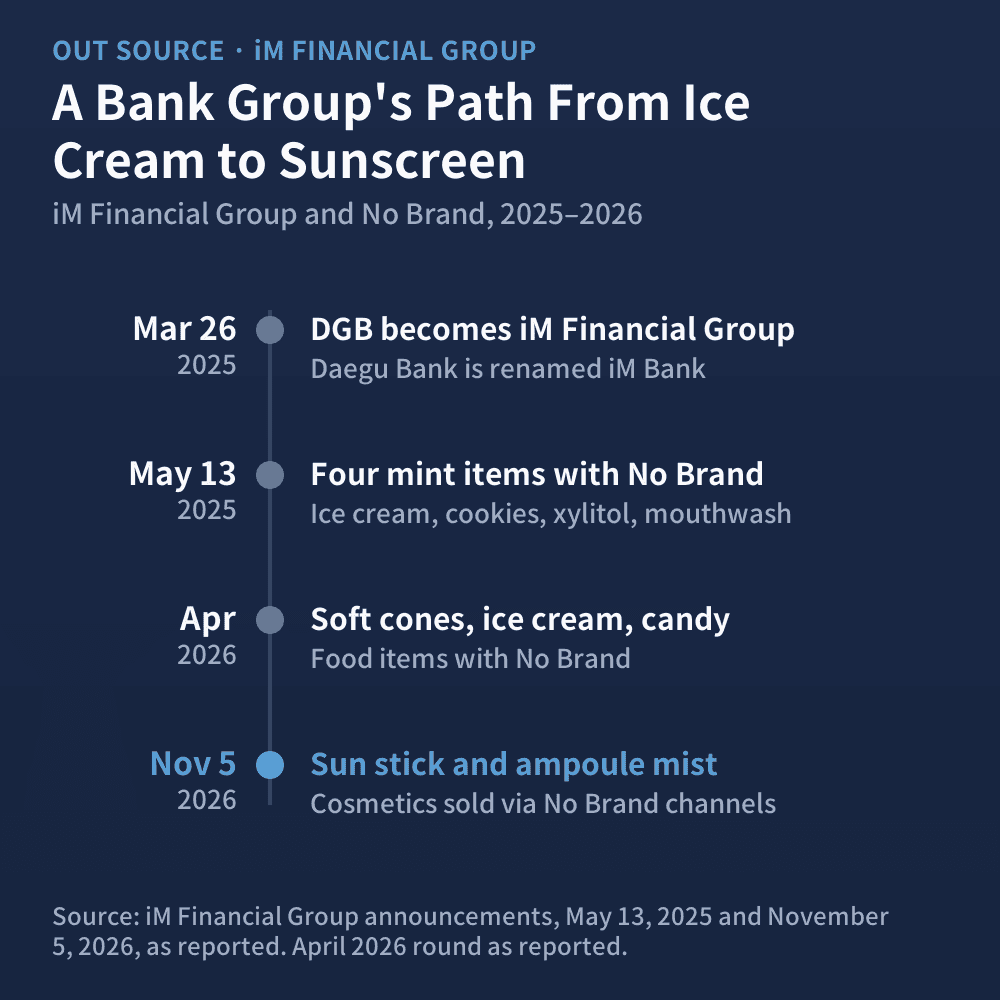
The group was DGB Financial Group until March 26, 2025, when it officially renamed itself iM Financial Group. Its bank arm, formerly Daegu Bank, became iM Bank. Coverage of the group's May 13, 2025 announcement tied the No Brand products to recognition of the new iM name.
That 2025 announcement covered four items sold in No Brand and E-Mart stores: mint chocolate bead ice cream, mint chocolate chip cookies, a xylitol item and a mint mouthwash. The coverage described the goal as brand awareness rather than revenue. The group's spokesperson said the items would also serve as customer giveaways at pop-up stores and other offline events. An Instagram event on the group's official account ran alongside, with commenters on the new mint products entered in a draw to win the mouthwash.
In April 2026 the partnership produced soft-serve cones, bead ice cream and glucose candy. The November 5, 2026 announcement extends it to cosmetics. The first two rounds were food and a mouthwash. The third is a sunscreen, a product class with a ministry filing attached.
Is this a beauty-market entry or a brand campaign?
By the group's own description, it is a campaign. The stated aims are brand awareness across age groups and consumer segments and a smaller psychological distance between customers and finance. The group's spokesperson said it will keep pursuing collaborations that blur the line between finance and other industries using its character IP, meaning the intellectual property rights in its mascots.
The announcement discloses none of the figures that would classify the launch as a beauty-market entry: a sales target, a volume or a store count. A beauty entry is measured in those numbers. A brand campaign is measured in exposure. The record so far supports only the second reading.
A Korean trade report grouped the launch with other entries into beauty by companies from outside the industry. One of them took the opposite route. Hite Jinro, the drinks company, acquired the cosmetics ODM BNB Korea as a wholly owned subsidiary in June 2025, through a special purpose company set up by an affiliate, meaning a vehicle created to hold a single deal. That route buys a factory and its filings. The iM route, as announced, discloses a shelf and no factory.
For the beauty industry, the relevance is structural. A non-beauty company with a recognizable name and a character set can place a regulated product in a retailer's private-label range without building a cosmetics business behind it.
What does the structure mean for the industry?
A buyer weighing a comparable private-label program has three questions the announcement leaves open: who holds the responsible-seller license, who filed the SPF and PA data, and which factory fills the stick. Each answer sits in a document, and none sits in the announcement.
Positions differ by seat. For a contract manufacturer, a co-branded private-label program is volume under someone else's name, and the factory appears on the package only in the manufacturer line the labeling rules require. For a brand or a buyer, the front of the pack is a licensed identity, and due diligence starts with the responsible seller named on the back. For a regulator or an investor, the accountable record is the ministry filing, not the mascot, and a group that announces a consumer product without a single financial figure gives investors nothing to read.
The mascot sells the product. The filing carries the responsibility. The announcement names neither the maker nor the seller.