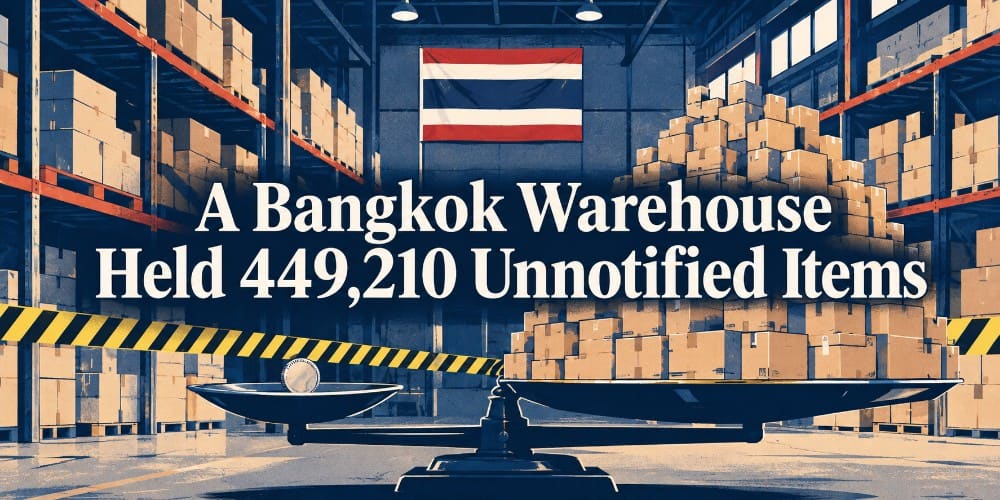
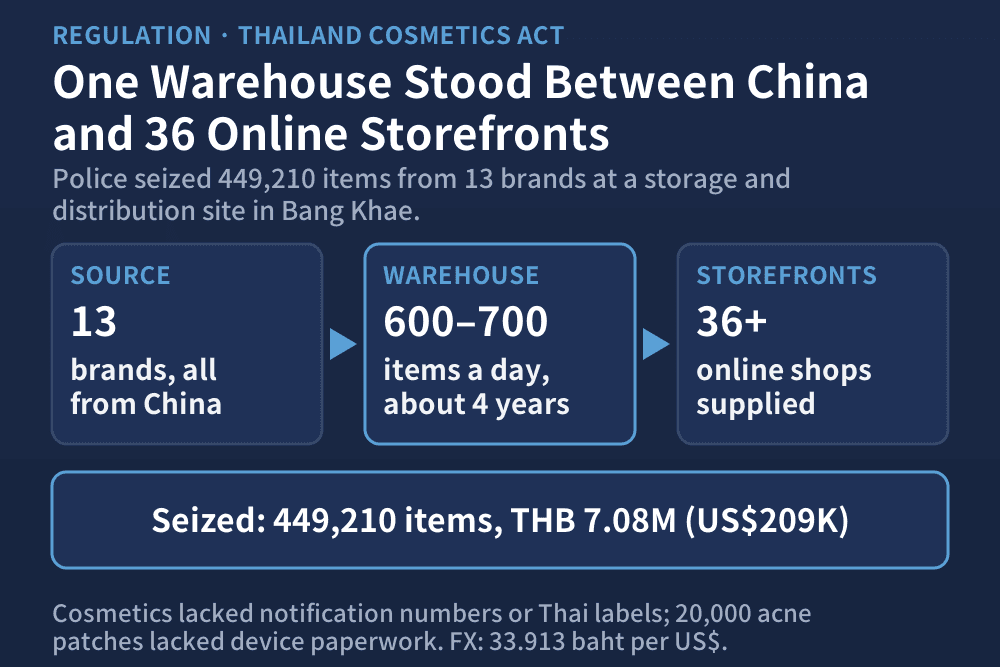
Thai police and the Food and Drug Administration seized 449,210 items from 13 brands in one Bangkok warehouse, in a raid reported on October 28, 2026. The stock, worth more than 7.08 million baht (about US$209,000), fed more than 36 online storefronts at 600–700 items a day for about four years. The ceiling on the fine for selling a cosmetic without notification is 20,000 baht (about US$590), and the stock is worth 354 times that. On paper the penalty is small. In practice it is the inventory.
What did Thai police seize in Bang Khae?
The Central Investigation Bureau, working with the FDA, raided a storage and distribution warehouse in Bang Khae. The haul was 429,210 cosmetics from 12 brands and 20,000 acne patches from a 13th, JAYSUING, whose patches are classified as medical devices. The cosmetics lacked required notification numbers, lacked Thai-language labels, or carried incomplete labels. The patches lacked required registration or notification documents.
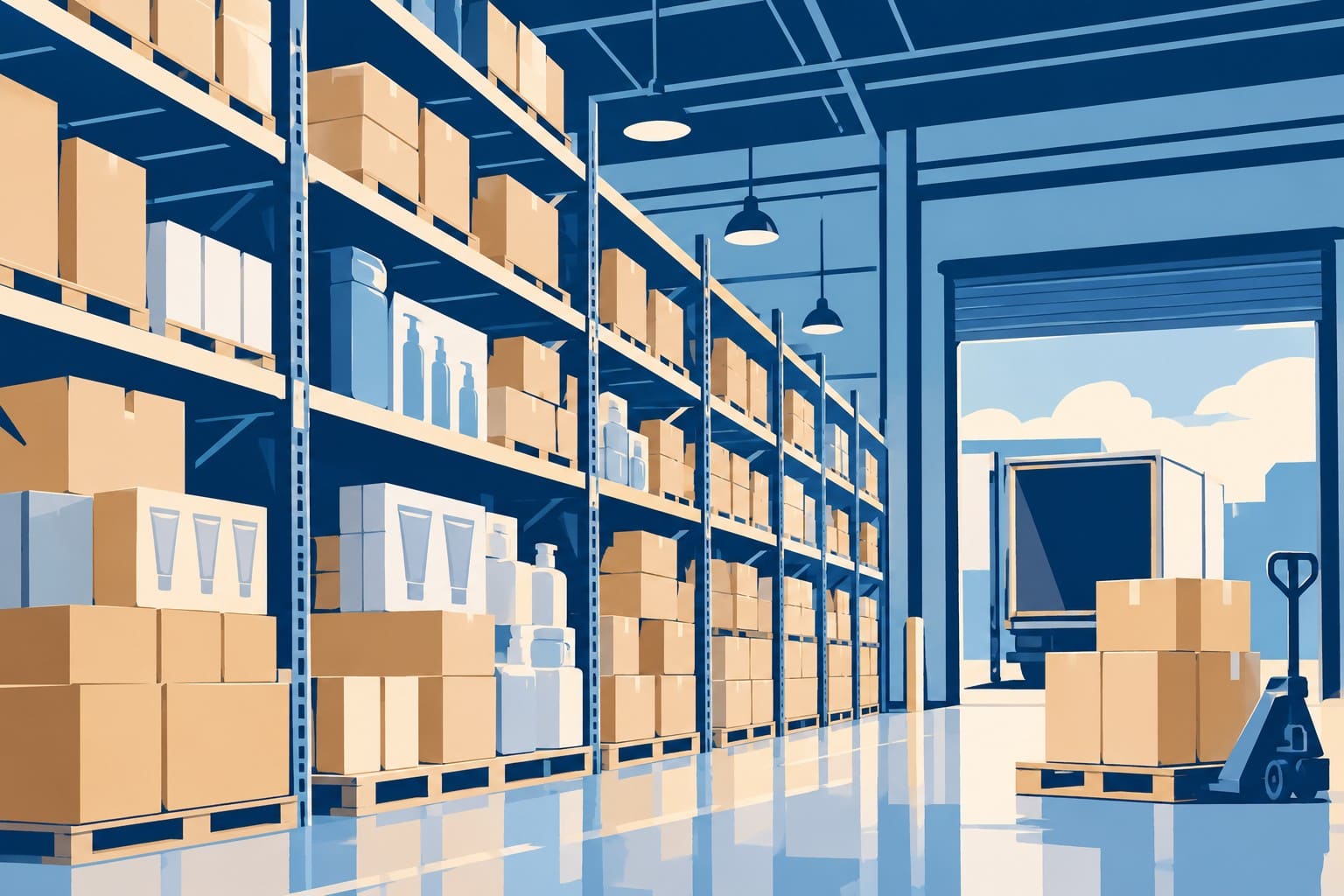
A warehouse administrator told investigators that a Chinese woman arranged for the products to be imported from China. The goods ranged from facial masks and shampoo to sunscreen and clay masks, and they went out through more than 36 online storefronts. Samples are headed to the Department of Medical Sciences for laboratory analysis, and the charges widen if prohibited substances or disease-causing microorganisms turn up. Conversions in this article use 33.913 baht per US dollar, the November 12, 2026 rate.
What makes a cosmetic legal in Thailand?
Thailand regulates cosmetics through notification, a filing system rather than a pre-market approval. A license holder, who must be a Thai national or a Thai-registered company authorized to import cosmetics, submits the product's information through an electronic system. Production or import can begin only after the receipt arrives. The receipt is valid for three years and can be renewed within the six months before it expires.
The license holder answers for the product afterward: its safety and quality, its import, and post-marketing surveillance, which covers adverse-reaction reporting and recalls. A product information file, the dossier behind the notification, sits at the distributor's office and stays open to FDA inspection. The label has to be in Thai and carry the product name, ingredients, directions, distributor and manufacturer details with country of origin, net content, batch and dates, warnings and the notification number. Every claim on it needs supporting evidence.
The number on the label therefore points to a legal person who answers for the product. A cosmetic with no notification number has no license holder on file. The shop selling it has no one standing behind the sale.
How much time did the warehouse hold in stock?
At 600–700 items a day for about four years, the warehouse shipped between 219,000 and 255,500 items a year, close to a million over its life. The seized stock of 449,210 items equals 21 to 25 months of that run rate.
A warehouse holding nearly two years of shipments is a supply chain built for volume, with goods bought in bulk, stored in Bangkok and sent out by the dozen. That design also made it enforceable. Inventory in Bangkok gave investigators one address to raid instead of thousands of parcels to intercept.
What did the price give away?
The 7.08 million baht valuation averages about 16 baht, or US$0.46, per item. SADOER facial masks sold for 1–3 baht each, between US$0.03 and US$0.09. The investigation began when investigators found online shops selling cosmetics at unusually low prices.
A notified product carries costs that a non-notified one skips: a license holder, a product file, a Thai label, a recall duty. Those costs sit inside the shelf price of every compliant product. A seller that skips them can undercut anyone who pays them, and the undercut shows on any marketplace sorted by price.
Some listings also promised that products would reduce wrinkles or dark circles within days. Notification rules require evidence behind label claims. The price and the claim were both visible from outside the warehouse door.
Why is the stock worth 354 times the fine?
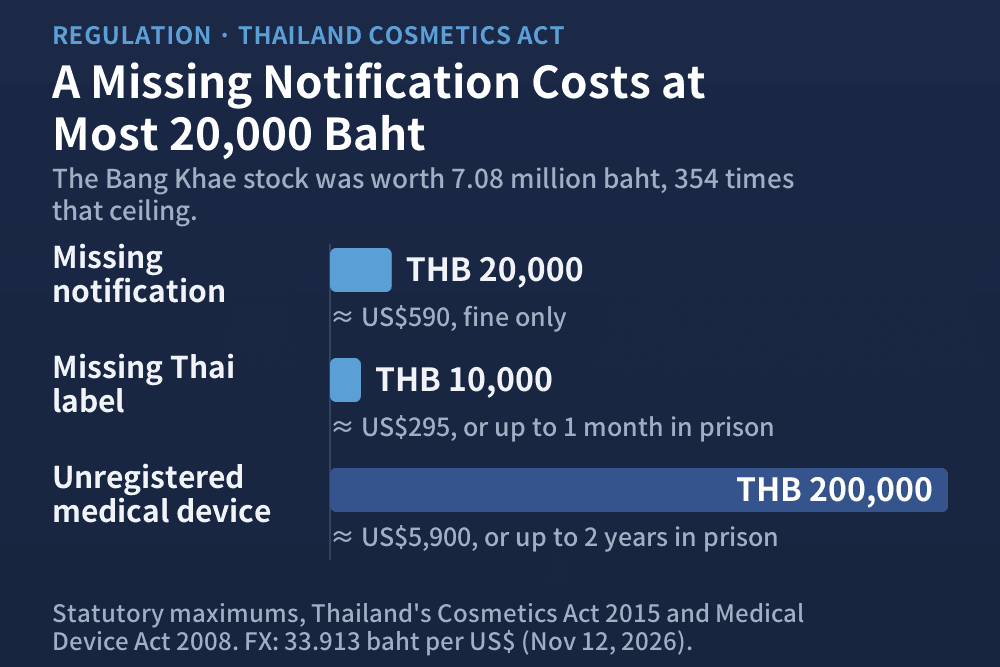
Under Thailand's Cosmetics Act of 2015, selling a cosmetic without the required notification carries a fine of up to 20,000 baht (US$590). Selling one without Thai-language labels carries up to one month in prison, a fine of up to 10,000 baht (US$295), or both. The 7.08 million baht stock is 354 times the first ceiling.
The statutory numbers set the most a court can impose. The seizure set the loss that has already happened: 449,210 items out of circulation, a four-year operation stopped and the supply behind more than 36 storefronts cut. A fine that small does not deter an operation at that scale. A raid does.
Is Bang Khae a one-off?
Bang Khae is the third warehouse raid of 2026 in the reports. A March 9 raid in Pathum Thani covered counterfeit toothpaste and cosmetics and unregistered cosmetics worth more than 6 million baht. An August 13 raid in Samut Prakan seized 83,483 items worth more than 8 million baht, all imported from Japan and lacking Thai labels and required safety checks. That warehouse had operated for more than four years.
The pattern runs across origins. The March goods were counterfeit, the August goods were Japanese and the October goods were Chinese. The common element is the Thai side of the chain: imported stock held in a warehouse without the paperwork that Thai law ties to a product. The raids came about five months apart and then two and a half, with stock values between 6 and 8.3 million baht.
Why do acne patches sit on a different legal shelf?
The 20,000 JAYSUING patches were classified as medical devices, which moves them out of the Cosmetics Act and into the Medical Device Act of 2008. Selling a device without the required notification of its detailed listing carries up to two years in prison, a fine of up to 200,000 baht (US$5,900), or both.
The warehouse, the storefronts and the supply route were the same. The statute was different. The line between a cosmetic and a device depends on how a product is classified in Thailand, not on how it is sold in its home market. Any brand shipping skin-contact patches into Thailand needs to know which side of that line its product sits on before the first pallet ships.
Where does liability sit when 36 storefronts share one warehouse?
The storefronts were many and the warehouse was one. Online shops multiply faster than enforcement can follow them, and each can be closed and reopened under another name. A warehouse cannot. Its stock, its packing line and its address stay put, which is why one raid reached the supply behind all of them.
A ChemLinked recap of October 2026 regulatory updates warned that importers, distributors and online sellers who fail to secure full notification and labeling compliance face platform delisting, criminal penalties and consumer-compensation liabilities. It read the raid as a signal of stricter cross-agency enforcement. The warning widens the exposure from the person holding the stock to every storefront that sold from it.
What does warehouse-level enforcement change for compliant sellers?
It removes stock that carried none of the costs a notified product carries and sold for a fraction of the price. Compliant sellers compete on a shelf with fewer undercutting rivals, and the license holder, the file and the Thai label become the entry ticket rather than the overhead.
In Thailand a cosmetic's legal identity is a number on a Thai label. A supply chain from factory to storefront is exactly as lawful as that number.