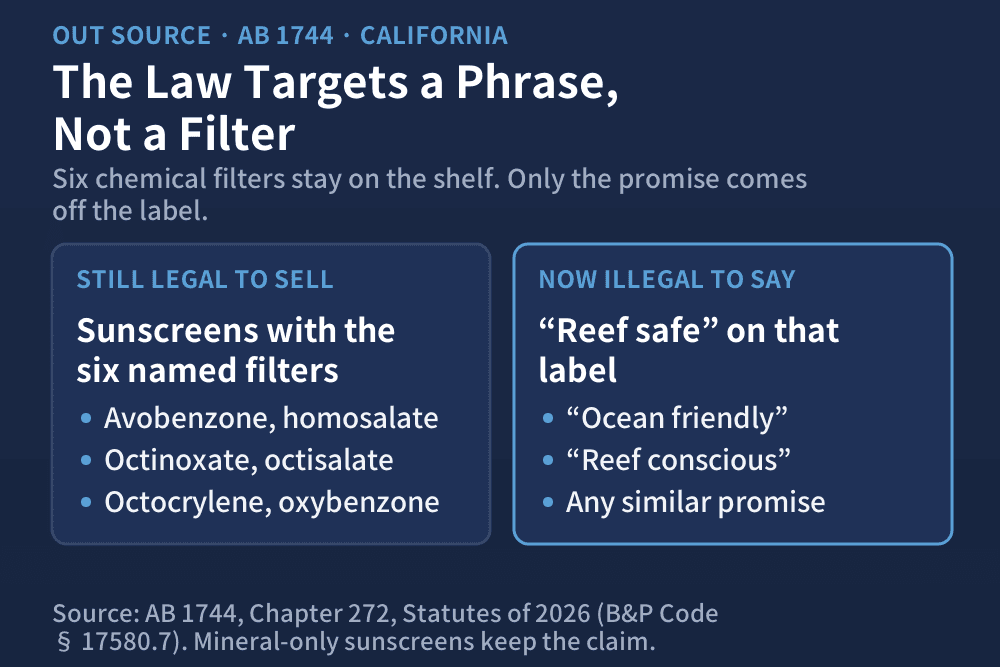
AB 1744, signed on September 18, 2026 as Chapter 272, bans no sunscreen ingredient. Avobenzone, homosalate, octinoxate, octisalate, octocrylene and oxybenzone stay legal to sell in California. What the statute prohibits is the sentence on the label: “reef safe,” “ocean safe” and similar promises on any sunscreen that contains a chemical UV filter. The Assembly passed it 70 to 2, and the rule takes effect January 1, 2027. The compliance cost sits in the copywriting, not in the formula.
What exactly did California prohibit?
AB 1744 adds Section 17580.7 to the Business and Professions Code. It makes it unlawful to represent, in advertising or on a label or container, that a sunscreen is “reef safe,” “reef friendly,” “ocean safe,” “marine safe,” “ocean friendly,” “marine conscious” or “reef conscious.” The ban also reaches any similar term that would lead a reasonable consumer to believe the product does not harm marine ecosystems. The Governor approved the bill on September 18, 2026.
The exception is narrow. A sunscreen keeps the claim only if it contains no chemical UV filters. A chemical UV filter is an organic compound that absorbs ultraviolet radiation, as opposed to a mineral filter such as zinc oxide, which sits on the skin and scatters it. Mineral-only products can still say “reef safe.” Everything else cannot. The statute regulates the representation, so the same restriction applies whether the phrase is printed on a tube, spoken in a video ad or typed into a product page headline.
Which sunscreens does the statute cover?
The statute defines a sunscreen product as any over-the-counter drug regulated by the U.S. Food and Drug Administration (FDA) that is intended to protect against ultraviolet radiation, including lotions, sprays, sticks, gels and solids. In the United States a sunscreen is a drug, so the category is set by regulatory status and not by a brand's own positioning.
The text names six chemical UV filters: avobenzone, homosalate, octinoxate, octisalate, octocrylene and oxybenzone. The list is introduced by “including, but not limited to,” so it is a floor. Each of the six is a legal active ingredient under the FDA's sunscreen rules, and the bill does not ban the sale or use of any of them.
Why did lawmakers regulate the sentence and not the ingredient?
Other jurisdictions went after the ingredient. Hawaii banned the sale of sunscreens containing oxybenzone and octinoxate, and Palau, Bonaire, Key West and the U.S. Virgin Islands followed with chemical sunscreen bans of their own. The bill's sponsor points out that Maui bans all active chemical ingredients. Each of those measures is a sales ban tied to a place.
California chose commercial speech. A 2022 National Academies study found that certain chemical UV filters can harm aquatic life, including corals, and called for a more comprehensive ecological risk assessment. NOAA says the research is ongoing. The Legislature did not have to finish the science. A promise of marine safety on a chemical-filter product claims more than that record supports, and a state can ban misleading commercial speech.
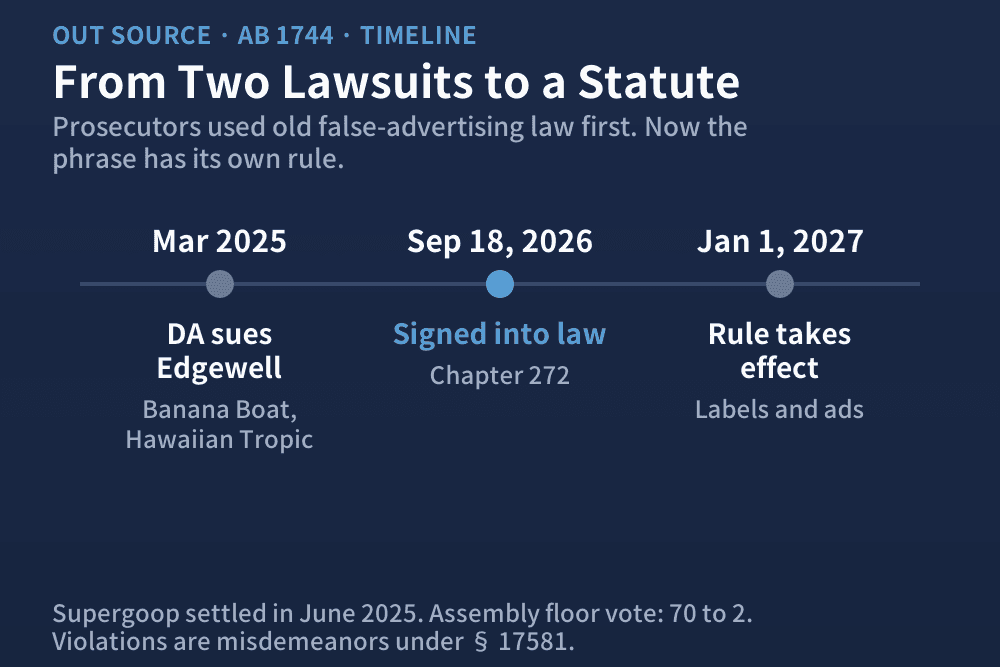
What did two lawsuits do to set up the statute?
In March 2025, the Santa Clara County District Attorney sued Edgewell, the maker of Banana Boat and Hawaiian Tropic, over “reef friendly” advertising. The case settled. A second settlement, with Supergoop, followed in June 2025.
Both cases ran on California's existing environmental marketing law. Section 17580.5 makes untruthful, deceptive or misleading environmental claims unlawful, explicit or implied, and Section 17580 requires any business making a claim such as “environmentally safe” to hold supporting documentation. Under that framework a prosecutor has to prove one claim misleading, one brand at a time.
AB 1744 replaces the proof with a rule. A chemical-filter sunscreen that says “reef safe” violates the statute on its face. The McClatchy High School Eco Club sponsored the bill, Assemblymember Dawn Addis carried it, and Consumer Reports and the Surfrider Foundation supported it. Addis framed the principle in one line: if a product is advertised as protecting our environment, it must actually do so. The Assembly floor vote was 70 to 2.
What does a violation cost, and when does it start?
A violation is a misdemeanor. Under existing Section 17581, a violation of the environmental marketing provisions carries up to six months in county jail, a fine of up to $2,500, or both. The statute also keeps the old duties alive: subsection (c) states that nothing in the new section exempts anyone from the substantiation requirements of Sections 17580 and 17580.5. A brand that clears the new line still has to document every other environmental claim it makes.
The misdemeanor classification matters for a second reason. It places the new claim inside the same enforcement channel as existing environmental marketing violations, so the district attorneys who already pursued Edgewell and Supergoop work with the same office and the same tools.
The rule takes effect January 1, 2027. Fewer than seven weeks remain for label, listing and advertising changes.
Where does a hybrid formula land?
The exception is binary: no chemical UV filters, or no claim. A hybrid sunscreen that pairs zinc oxide with a single organic filter falls on the restricted side. The mineral share, however large, does not rescue the phrase.
Because the six-filter list is open-ended, a filter outside the list carries no safe harbor either. The statute's test is the category, chemical UV filters, and not membership on the list. A reformulation that swaps octocrylene for another organic filter leaves the claim barred. The word “reef safe” is now available to mineral-only products and to nobody else.
For a product developer the test shrinks to one question per SKU: does the ingredient list contain an organic UV filter? If it does, the claim column is closed, and no amount of mineral content, packaging design or third-party certification reopens it under this statute.
Why does a California statute reach sunscreens made in Seoul?
The statute attaches to the product sold in California and not to the place it is made. South Korea's cosmetics exports to the United States reached US$1.701 billion in 2024, ahead of France at US$1.263 billion and Canada at US$1.022 billion, according to a Bloomberg report carried in Korea.
Sunscreen is the category where regulatory systems diverge most. The United States treats it as a drug. South Korea treats it as a functional cosmetic. In April 2025, The Washington Post listed Korean sunscreen among eight items Americans were stockpiling, citing strong UV protection and a light texture. Shoppers who buy on texture also read the claims on the page, and a Korean sunscreen listed with “ocean-friendly” copy inherits the California rule regardless of where the formula was developed.
The exposure rarely sits on the carton. It sits in marketplace bullet points, retailer data feeds, influencer scripts, social posts and old packaging inventory. The statute covers advertising as well as labels, so every one of those is a place the phrase has to disappear.
What does the rule change for the industry?
Environmental claims move from a subject of litigation to an item on a compliance checklist. Contract manufacturers face the first question, because every client formula now sorts into a mineral-only column or a chemical-filter column, and the claim follows the column. Brands and retail buyers face the second, because a claim that cost nothing to write now costs a misdemeanor to leave in a catalog. Regulators and investors get a template: a bright-line claim rule is cheaper to pass and cheaper to enforce than an ingredient ban, and the 70 to 2 floor vote shows the politics.
California did not decide whether chemical filters harm reefs. It decided who is allowed to say they do not.