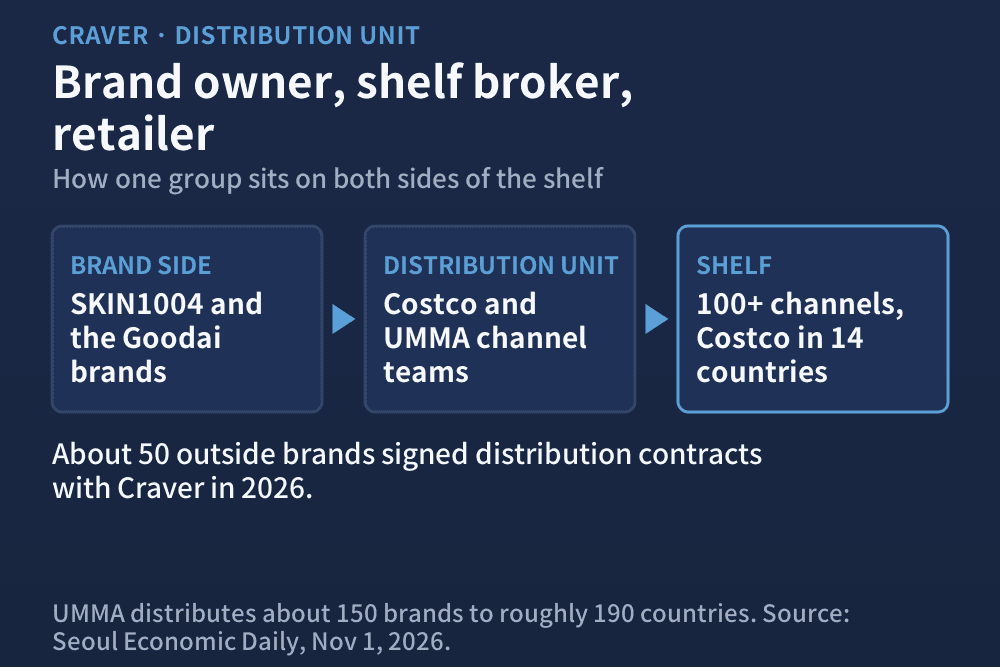
In March 2026, Craver, the operator of SKIN1004, merged the distribution units scattered across the company into one division with a Costco team and a UMMA team. In 2026 about 50 outside K-beauty brands signed distribution contracts with it. A brand company now sells the one thing its own brands depend on, access to the retail shelf, to other brands that want the same shelf. Its parent, Goodai Global, applied for a KOSPI listing review on November 13.
What did Craver build in March 2026?
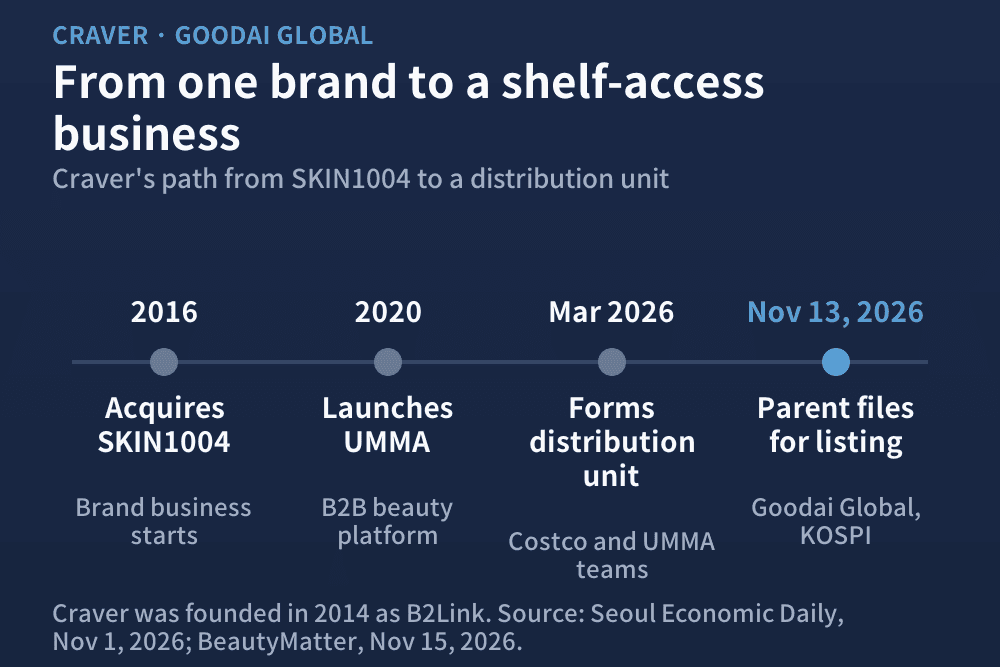
Craver reorganized in March 2026, consolidating distribution units that had been spread across the company into a single distribution division. The division is organized by channel: a Costco team and a UMMA team, alongside a brand strategy team and an operations strategy team. UMMA is the B2B beauty distribution platform Craver launched in 2020.
The mandate is wider than moving cartons. The teams cover brand discovery, shelf-entry strategy and local marketing, which makes the division closer to a sales organization for other people's brands than to a freight forwarder. A Craver official described the global distribution business as one of the company's main segments, alongside the brand business.
How large is the shelf Craver now controls?
Craver has more than 100 global distribution channels. Its Costco networks operate in 14 countries, and UMMA distributes about 150 brands, SKIN1004 among them, to roughly 190 countries. About 50 K-beauty brands signed new distribution contracts with Craver in 2026.
The retailer list spans North America, Europe, the Middle East, Latin America and Oceania: Ulta Beauty and the Alshaya Group, iHerb, H&M Beauty and Gold Apple in Europe, Ripley in Chile, InRetail in Peru and Oz Hair & Beauty in Australia. Craver also obtained vendor status with Boots in the United Kingdom.
The map has breadth and depth. Breadth is UMMA's reach into roughly 190 countries. Depth is Costco in 14 countries and a vendor record at Boots. A platform that reaches 190 countries is a catalog, and a vendor registration is a seat at the buyer's table. A shelf-access business needs both, because the catalog finds the brands and the seats place them.
Why organize a distribution division around retailers instead of brands?
Retailers buy through their own calendars, forms and approval gates. A team built around Costco learns one buyer's rhythm and serves every brand that wants that account. A team built around UMMA learns one platform's customers. The org chart copies the retailer's, because the retailer is the scarce counterparty.
Brand-side teams work the other way. They learn one product deeply and approach many retailers, and each approach starts with no relationship. A channel team spreads the cost of each relationship across every brand it carries, which is why the cost per brand falls as the roster grows.
What is vendor status worth to a brand?
Vendor status is an approved-supplier registration that lets a company sell to a retailer directly. Craver obtained it at Boots, and it sits with Craver, not with the brands Craver carries.
A brand that reaches the Boots shelf through Craver rents a credential it does not hold. The credential is durable, because it survives the departure of any single brand, and the intermediary that holds it can offer the same access to the next brand in line. That is the economic core of a shelf-access business: the retailer relationship is the inventory, and the brands are the demand.
How did a brand company become a distributor?
Craver was founded in 2014 as B2Link, acquired SKIN1004 in 2016 and launched UMMA in 2020. It took the Craver name in 2022 and came under Goodai Global in 2024. The platform arrived four years after the first brand.
SKIN1004 gave the company something a pure distributor lacks: a product with a record on the shelf. Craver reported 2025 sales of more than 678 billion won, about US$508 million at 1,335 won per dollar on November 16, 2026, more than double the prior year.

What does an outside brand give up, and gain, by signing?
A brand that signs with a channel-organized division gains a retailer relationship it would otherwise build account by account, along with the division's shelf-entry strategy and local marketing. It gives up direct control of the account, because the retailer's buyer knows the intermediary first and the brand second. That is the standard trade of any distribution contract, and it sharpens when the intermediary is also a brand owner.
The size of the trade depends on how many accounts a brand needs. A brand with one target retailer can build the account directly. A brand targeting a dozen countries is buying a map.
What does the US distributor add to the group?
Goodai Global USA, formerly Hansung USA, joined the group in February 2026 and supplies large US retailers. Craver's own channel map reaches the same country through Ulta Beauty and iHerb. Two distribution assets in one market give a brand a choice of route and give the group a choice of which route to offer first.
Choice of route is also a pricing decision, and it sits inside the group. A brand entering the United States through either asset deals with the same parent on both sides of the quote.
Whose brand gets the next buyer meeting?
A buyer meeting is a finite slot. A group that owns brands and carries other brands into the same retailers allocates that slot every time it schedules one. Goodai Global and its US arm, Goodai Global USA, which was formerly Hansung USA and joined the group in February 2026, invited Ulta Beauty buyers to Seoul to discuss 13 K-beauty brands. In that format the intermediary assembles the portfolio, and the buyer sees the group's curation.
Goodai's own portfolio includes Beauty of Joseon, Tirtir, Round Lab, SKIN1004, Torriden and Skinfood. That puts a group with brands of its own on both sides of the table, and every outside brand has a stake in how the sequence of meetings is set. The structure does not settle that question. The contracts do.
How does the listing application change what this division is?
Goodai Global applied for a preliminary listing review with the Korea Exchange on November 13, 2026, the first formal step toward a listing on the main KOSPI board. A listed group reports segments, and the distribution division becomes a line that investors price against the brand lines.
The two lines carry different economics. A brand line sells its own product and keeps the margin on it. A distribution line sells access, and its revenue grows with the number of brands on the roster and the number of retailers on the map, not with the success of any single brand. A diversified roster smooths that revenue in a way one brand cannot.
What does a shelf-access business change for the industry?
It changes who holds the retailer relationship. In Craver's structure the relationship sits with a group that also owns brands, and it is offered to other brands one by one.
Retailers get a curated assortment from a single counterparty. Brands get access without building an account team in every country. The group gets two revenue lines that move on different drivers. Each party gains something, and each pays in a different currency: control for the brand, neutrality for the group, choice for the retailer.
The shelf has become a product. The groups that sell it also decide what stands beside it.