On July 10, 2026, Veramore announced a pre-Series A round led by Rakuten Capital, with Strong Ventures following. The Seoul skincare brand sells through its own mall, Naver, Coupang and Olive Young, and in Japan. Rakuten named it a strategic brand, which opens collaboration across the group, including Rakuten Ichiba, Japan’s largest e-commerce platform. A small brand took an investor that runs the channel it wants, and Japan became the base for Asia.
What does Veramore sell, and who built it?
Veramore is an early-aging skincare brand. Its philosophy is “Glow Longer, Age Slower,” and in March 2026, on its fourth anniversary, it restructured its identity around Skin Studio, a framework that links products, routines and customer experience and tracks early signs such as pore changes, uneven tone, skin heat and dryness.
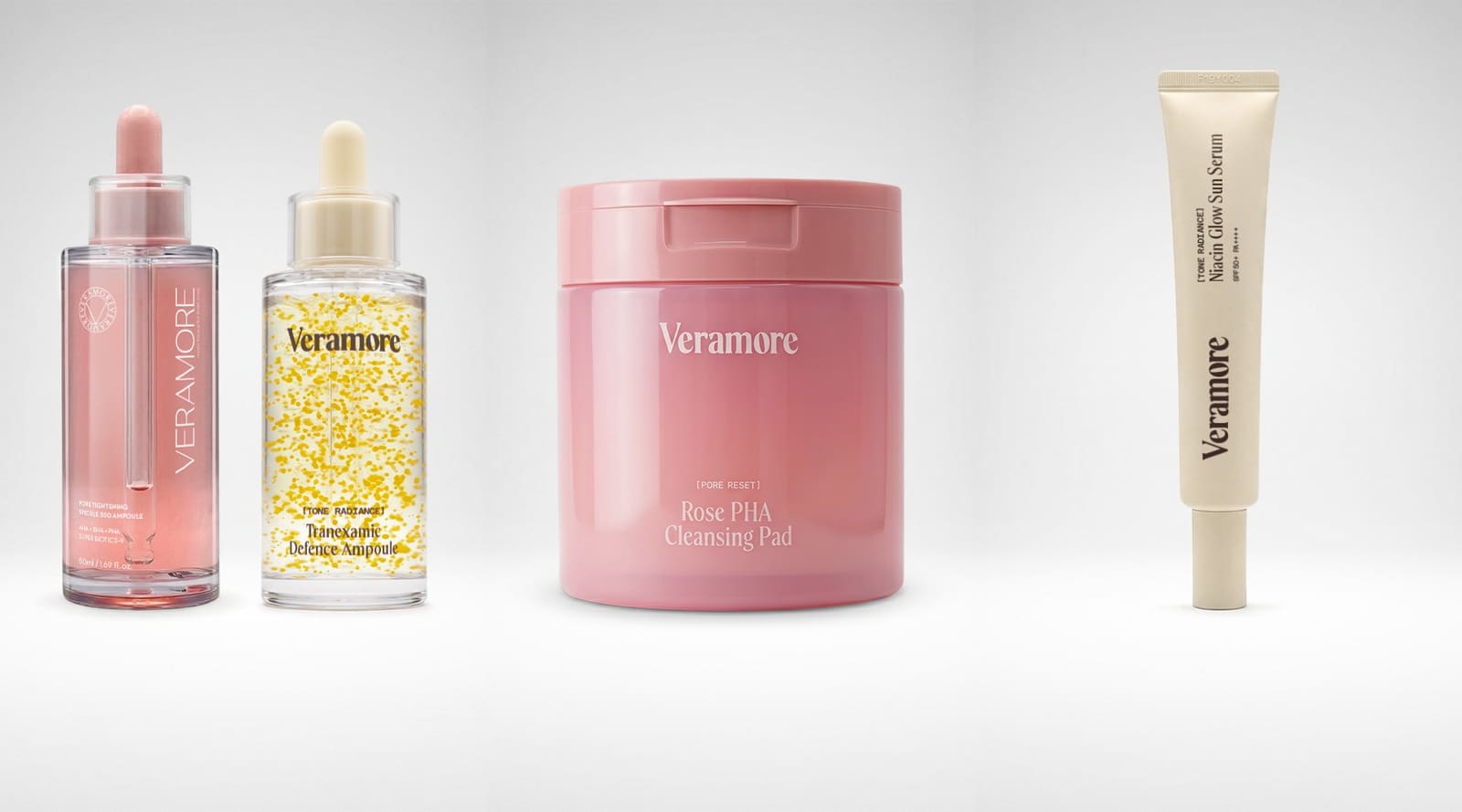
The operating company, Veramore Inc., was incorporated in September 2021 under the name Elleroy and took the Veramore name in July 2024. The CEO is Lee Yu-ju, who also founded the company.
In December 2024 Lee said the seed round would let the company build a new market for early well-aging beauty and push product development for women worldwide who worry about aging.
Why did a seed-stage brand take money from a beauty-data fund?
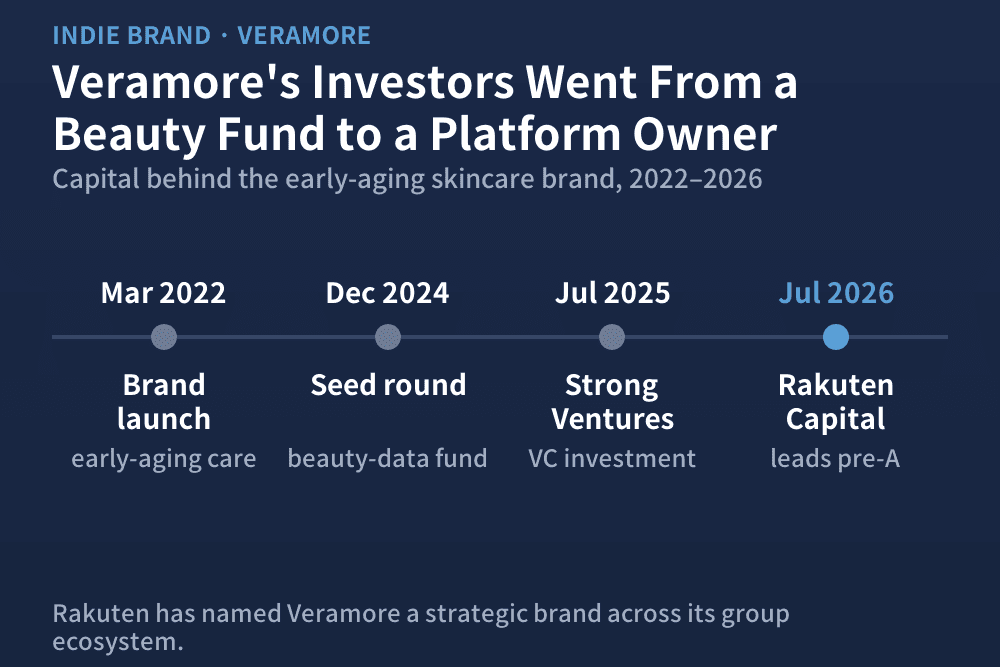
In December 2024 Veramore closed its seed round with a fund built for K-beauty startups, operated by Mark & Company and Solid One Partners. The announcement described a fund that combines a beauty-industry data system with an investment team’s judgment.
At that point the company reported growing sales in China, Taiwan, the United States, Europe and the Middle East, about three years after its founding. The early investor bought into data and breadth: a brand selling across five regions.
The later rounds narrowed the story to one market. By July 2026 the announcement named Japan as the place where Veramore had built brand strength.
What did Strong Ventures add in 2025 and 2026?
Strong Ventures invested in July 2025 and joined the July 2026 round as a follow-on investor. A repeat check is a stronger signal than a first one, because the investor has already lived with the brand for a year.
Rakuten Capital led the 2026 round. The 2026 round therefore held two kinds of money: a financial investor with a year of history in the company and a strategic investor with a marketplace. The sequence of a beauty-fund seed, a venture round and then a channel owner leading the pre-A shows the capital stack moving from financial support toward commercial access.
What is a strategic investor, and why did Rakuten call Veramore a strategic brand?
A strategic investor puts in money and brings a business relationship that the company can use. Rakuten Capital is the investment arm of the Rakuten group, whose businesses include Rakuten Ichiba, Japan’s largest e-commerce platform.
Rakuten named Veramore a strategic brand and said it plans to expand collaboration across the group’s ecosystem, including Ichiba. Jang Su-jung, senior partner at Rakuten Capital, described Veramore as a brand with a clear target, clear positioning, growth potential in Japan and data-driven scalability, and said Rakuten’s ecosystem will support its continued growth.
The phrase strategic brand is a commercial status, not a financial one. It places Veramore inside the group’s own channels. The announcement expects commercial synergies across Rakuten’s platforms, so the relationship pays both ways: Rakuten gains a brand with a Japanese track record for its marketplace, and Veramore gains the marketplace.
Why did Veramore rebuild around routines instead of a hero product?
In March 2026 the company said the Skin Studio shift reflects consumers’ growing preference for structured routines over single products. Skin Studio presents a brand that designs the journey of early aging care together with customers, and the CEO described skincare as a process of designing changes in the skin, not simply using products.
The company also said new well-aging product lines aligned with Skin Studio will arrive through ongoing research and development. A routine is a sequence of purchases, and a brand that sells a sequence earns repeat orders that a single hero product does not.
That structure suits the investors who arrived afterward. A beauty-data fund and a marketplace operator both value a customer who comes back, because a returning customer is the unit their own systems measure.
Why is Japan the base?
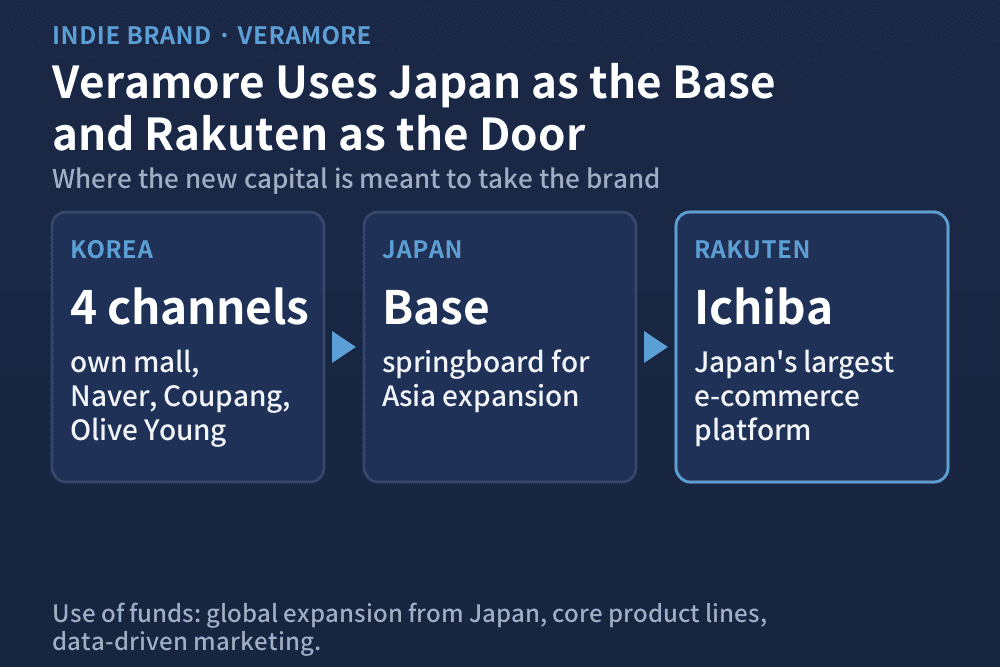
The announcement lists Japan as the market where Veramore has built brand competitiveness and names it as the base for expansion into Asia and other global markets. The use of funds has three lines: global expansion with Japan as the base, stronger core product lines, and data-driven marketing.
In March 2026 the brand named recent expansion in Japan and Southeast Asia as part of the reason for the Skin Studio restructuring. The July round put capital behind a direction the company had already announced.
A brand that enters Japan through a distributor negotiates for shelf space marketplace by marketplace. A brand that enters through an investor that runs the largest marketplace starts inside it.
What does data-driven marketing buy at this size?
Data-driven marketing is the third line in the use of funds. It ties the 2024 fund, built around a beauty-industry data system, to the 2026 round, and it ties both to Skin Studio, which tracks skin signals through routines. Three separate documents describe the same asset from different sides: information about how customers use the brand.
Jang listed data-driven scalability among the brand’s strengths. For a company at the pre-A stage, that asset is cheaper to build than a factory or a flagship store, and a platform investor can put it to work inside its own channels.
What do the four Korean channels say about the brand’s stage?
At home Veramore sells through its own mall, Naver, Coupang and Olive Young. The own mall gives the brand its customer data, Naver and Coupang give search and delivery reach, and Olive Young adds the country’s best-known beauty specialty retailer.
A four-channel Korean base with a Japanese market behind it is the footprint of a brand past its first product and short of a regional business. The home market is covered, one overseas market has proof, and the next step needs a partner that opens doors rather than a fund that writes checks.
How do small brands now get into large markets?
Brands read the round as an access story: the check matters less than the channel behind it. Platforms read it as a sourcing story: a brand with a clear target and a tested market is cheaper to back than a category to build from scratch.
Investors read it as a sequencing story. Veramore’s first round came from a fund built around beauty data. Its latest came from an investor that runs the marketplace. The sequence shows what each stage buys: data first, validation second, access third.
Capital buys a runway. A channel owner’s capital buys the road.