hy, the company formerly known as Korea Yakult, is preparing a skincare brand called IOCELL built on its proprietary probiotic strain HY7714. Electronic Times reported it on September 28, 2026, and hy says the launch date is undecided. hy's consolidated operating result was a loss of 27.4 billion won (US$21 million) in 2023, 64.5 billion won (US$49 million) in 2024 and 54.6 billion won (US$41 million) in 2025. The parent company alone earned 55.0 billion won (US$42 million) in 2025. The brand is a bet made from a profitable core inside a loss-making group.
What has hy announced about IOCELL?
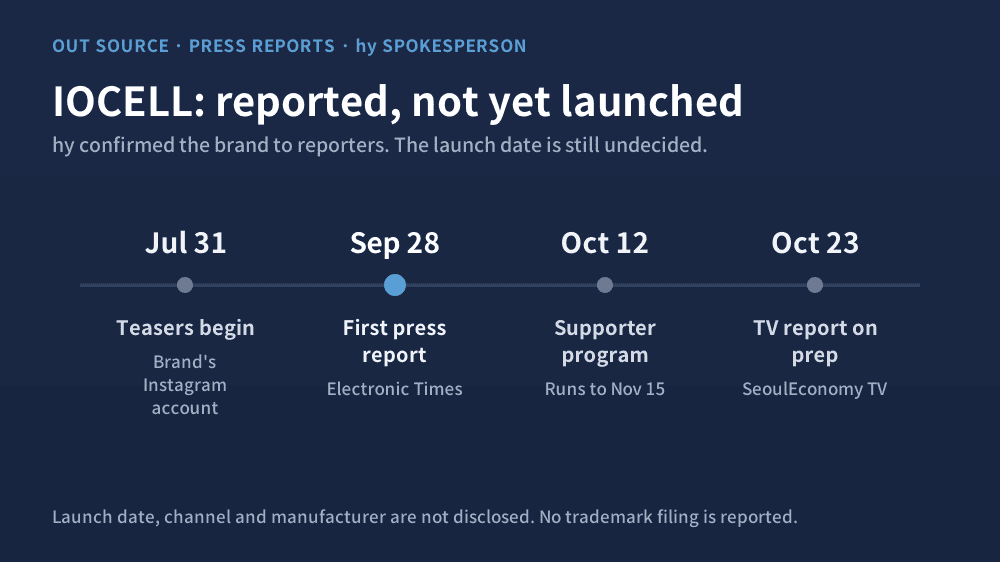
Nothing in a formal release. hy has no public newsroom, and no IOCELL press release is in circulation. The brand reached the press through four outlets in a month: Electronic Times on September 28, Fashionbiz on September 29, Consumer News on September 30 and SeoulEconomy TV on October 23. The Seoul broadcaster's report is the latest, not the first.
The reports agree on the outline. IOCELL is positioned as premium beauty with a wellness theme and an inner-beauty link. Its core ingredient is HY7714, a strain hy says it selected through seven screening stages at an in-house unit it calls IOCell Lab. hy told Consumer News that IOCELL is a separate brand from Fredit Beauty, its earlier skincare line. A first cohort of 20 supporters runs from October 12 to November 15, and the brand's Instagram account has reportedly posted teasers since July 31.
What is still unknown?
The launch date is undecided, hy told reporters. No source names a sales channel. None mentions hy's Fresh Manager door-to-door network, its Fredit online mall or offline retail as the route. No source states whether hy makes the product itself or hires a contract manufacturer. No price has been given.
No trademark filing for the name IOCELL has been reported. The only hy beauty-related filings on the public record are B.on.B in Nice class 3, which covers cosmetics, and B.on.H in class 5, which covers supplements and probiotics, both filed on April 21, 2026. hy said at the time that no product plan was fixed. No source ties either name to IOCELL.
What is HY7714, and what does the evidence cover?
HY7714 is a strain of Lactiplantibacillus plantarum isolated from human breast milk and deposited as KCTC 12400BP on April 9, 2013. hy's patent on it, KR101492003B1, was filed on April 29, 2013 and covers its use for skin wrinkle inhibition and moisturizing. The patent record shows expiry in 2033.
Its regulatory standing is in food, not cosmetics. hy lists HY7714 as a Korean individually recognized health functional food ingredient, number 2015-1. In the United States it holds a new dietary ingredient notification and a self-affirmed GRAS status. A notification is a filing with the FDA, not an approval. No Korean functional-cosmetics approval for a product containing HY7714 has been verified.
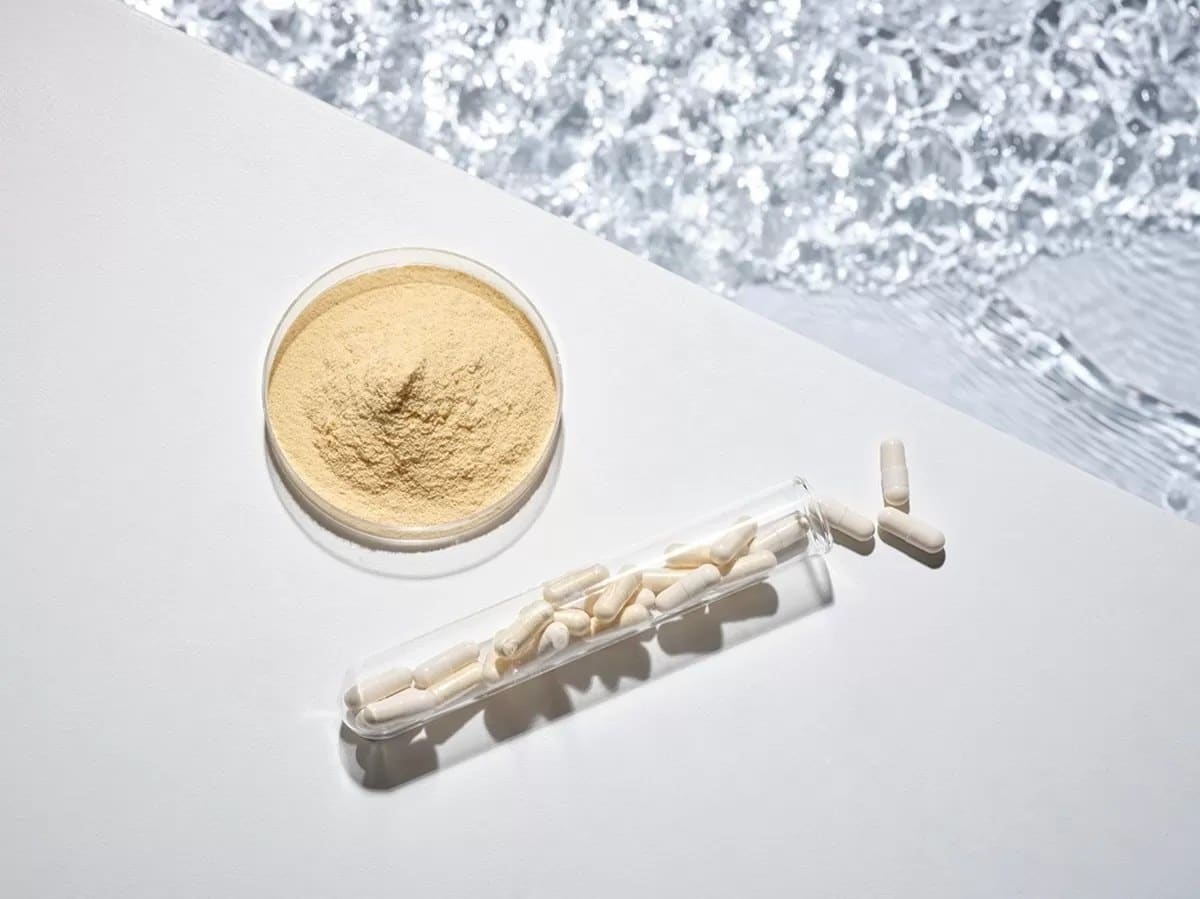
The best-known human study is a randomized trial of 110 women aged 41 to 59, taking the strain orally at 10 billion colony-forming units a day for 12 weeks, run by Korea Yakult scientists and published in 2015. It tests a capsule, not a cream. Efficacy figures on hy's own pages are company claims, and this article does not repeat them. hy also reported on July 16 that NutraIngredients USA named its skin-care HY7714 ingredient of the year in the inner-beauty category.
What happened to Fredit Beauty?
hy launched Fredit Beauty, named after its Fredit online mall, in May 2023 with the NK7714 Hyper Boosting Ampoule. A cream followed in September 2023, then sun care and a cleanser. hy held a pop-up in Seoul's Seongsu neighborhood from September 5 to 8, 2024 and said cumulative sales passed 75,000 units of four products by September 2024.
The brand has shrunk. SeoulEconomy TV reports that some products were discontinued. Consumer News reported on September 30 that only a modeling mask is still sold. Yet hy's own website still lists Fredit Beauty among its 21 brands. The accurate description is scaled back, not discontinued. The Fredit mall's current catalog was not available for inspection.
Is hy losing money?
On a group basis, yes. Per Korean media readings of hy's DART audit filings, consolidated operating results were a loss of 27.4 billion won (US$21 million) in 2023 on revenue of 1.52 trillion won (US$1.15 billion), a loss of 64.5 billion won (US$49 million) on 1.68 trillion won (US$1.27 billion) in 2024, and a loss of 54.6 billion won (US$41 million) on 1.72 trillion won (US$1.30 billion) in 2025. Dollar figures here use 1,323.7 won per dollar, the Seoul close on October 27, 2026. Net losses run six years straight from 2020.
The parent company on its own is profitable. Separate-basis operating profit was 68.4 billion won (US$52 million) in 2023, 58.2 billion won (US$44 million) in 2024 and 55.0 billion won (US$42 million) in 2025. The difference sits in subsidiaries. hy had 17 in 2025 against eight in 2021, and 11 posted net losses. Mesh Korea, the delivery operator Vroong that hy bought a 66.7% stake in for about 80 billion won (US$60 million) in April 2023, lost 19.2 billion won (US$15 million) at the operating line in 2025 on revenue of 327.8 billion won (US$248 million). hy's delivery app Knock shut down in December 2025.
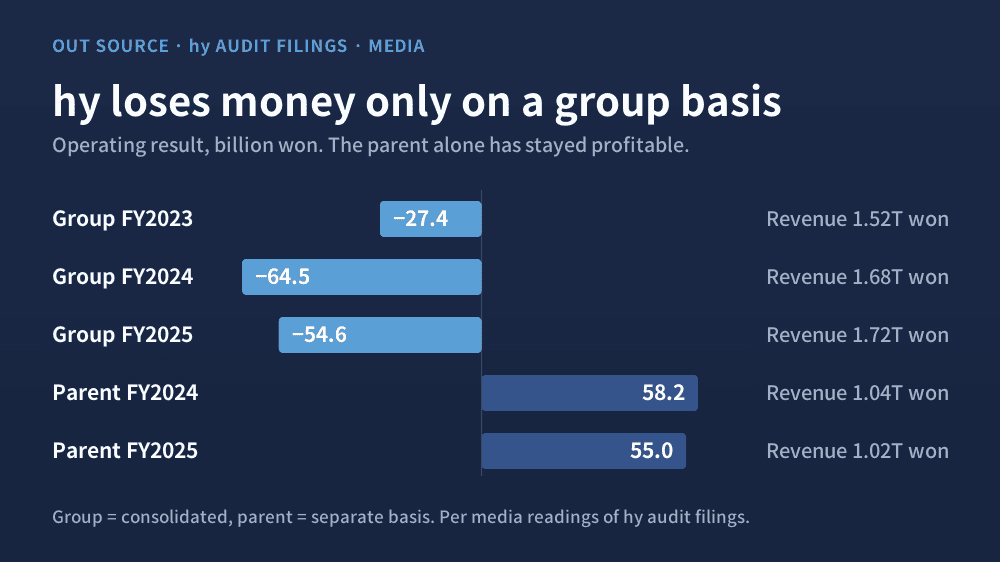
The 2025 loss narrowed from 2024. No 2026 interim consolidated figures have surfaced. A cosmetics brand is a small decision inside this structure. The parent company is the profitable unit.
Why does a probiotics company enter skincare again?
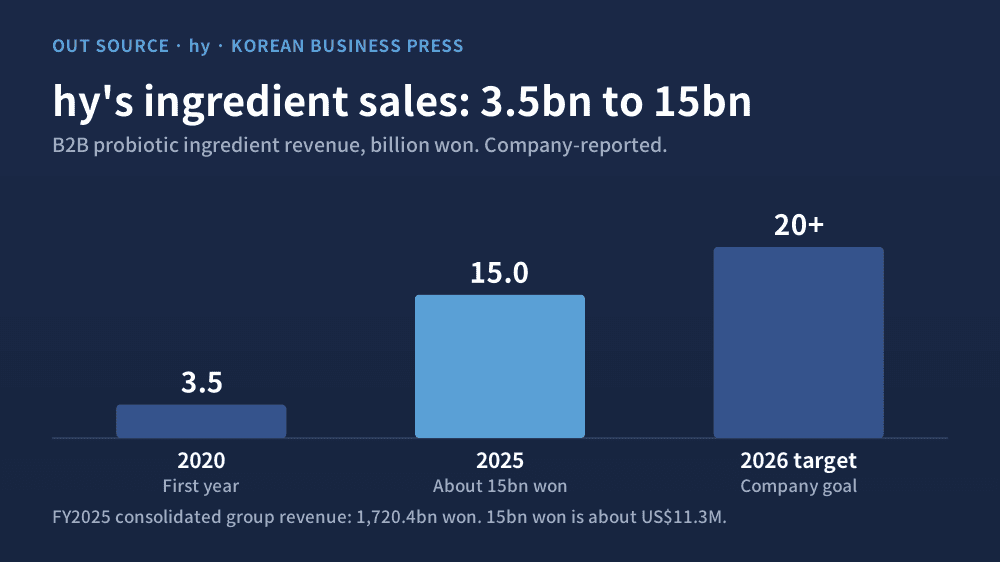
The ingredient business is the engine. hy sells probiotic strains to other companies. Company-sourced reports put revenue at 3.5 billion won (US$2.6 million) in its first year, 2020, and about 15.0 billion won (US$11 million) in 2025, up 27% to 29%. The 2026 goal is more than 20.0 billion won (US$15 million). hy sold a record 18 tons in 2025, clients rose from 16 to 26 and the ingredients sold from three to 14.
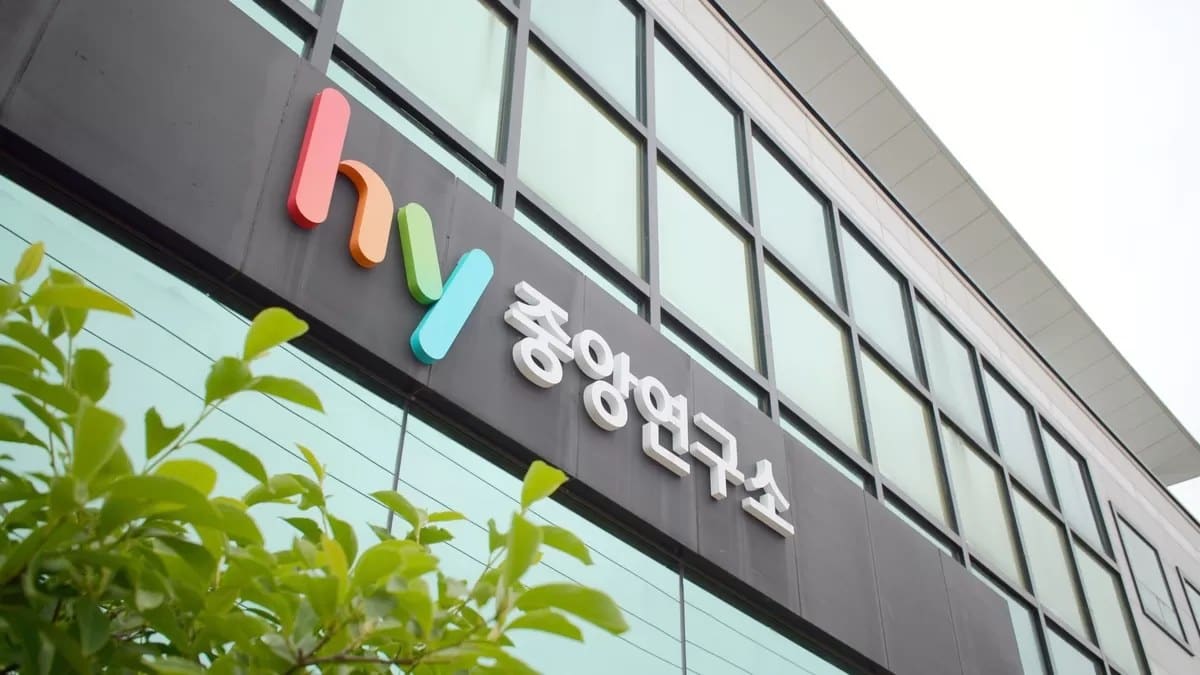
The scale is small against the group. At 15.0 billion won (US$11 million), ingredient sales are under 1% of 2025 consolidated revenue of 1,720.4 billion won (US$1.30 billion), a ratio worked out here from the two reported figures. hy's research base is the asset it sells from: a central research institute founded in 1976, and, by its own count, more than 5,100 strains and 126 registered patents. A skincare brand turns that library into a consumer story.
Which other food companies are entering cosmetics?
Several, with different entry routes. Dongwon HomeFood was named conditional preferred bidder for the cosmetics maker Charmzone on September 22, 2026, with the price undisclosed. Charmzone reported 2025 revenue of 18.1 billion won (US$14 million) and an operating loss of 5.3 billion won (US$4 million). Nongshim signed an agreement in March 2026 with the collagen brand Arocell to supply collagen peptide for cosmetics, an ingredient route rather than a brand.
Orion added cosmetics brand licensing to the business purpose of its subsidiary Orion Jeju Yongammul in October 2025. Shinsegae Food invested as a limited partner in a fund holding the cosmetics maker C&C International, with no operating control. Seoyoung E&T, linked to Hite Jinro, acquired the cosmetics manufacturer B&B Korea in October 2024. The push factor is margin: first-half 2026 operating margins were 6.7% at Nongshim, 3.6% at Dongwon F&B and 2.5% at Pulmuone.
What would confirm that IOCELL is real?
Six facts would. A launch date, a sales channel and a manufacturer from hy. A trademark filing under the name IOCELL. A functional-cosmetics report or approval for the formula, if hy claims a function. A first sales figure. None exists today.
What exists is a brand name, a supporter program, a strain with a patent and a food-ingredient recognition, and a group that has lost money on a consolidated basis for three straight years. That is a preparation, not a launch.
What does the pattern mean for the industry?
Food and dairy groups are entering beauty because their core margins are thin and their research libraries hold ingredients they can sell. The three sides read it differently.
Manufacturers see new brand owners who arrive with ingredients and ask for formulas, which is steady contract work. Brands and buyers see competitors with a distribution network but a record of scaled-back lines, and they ask what hy changed since Fredit Beauty. Regulators and investors see a food-ingredient recognition used as the base for a cosmetic, and a consolidated loss that a skincare line does not fix.
hy's evidence is a strain and a patent. Its test is a product on a shelf.