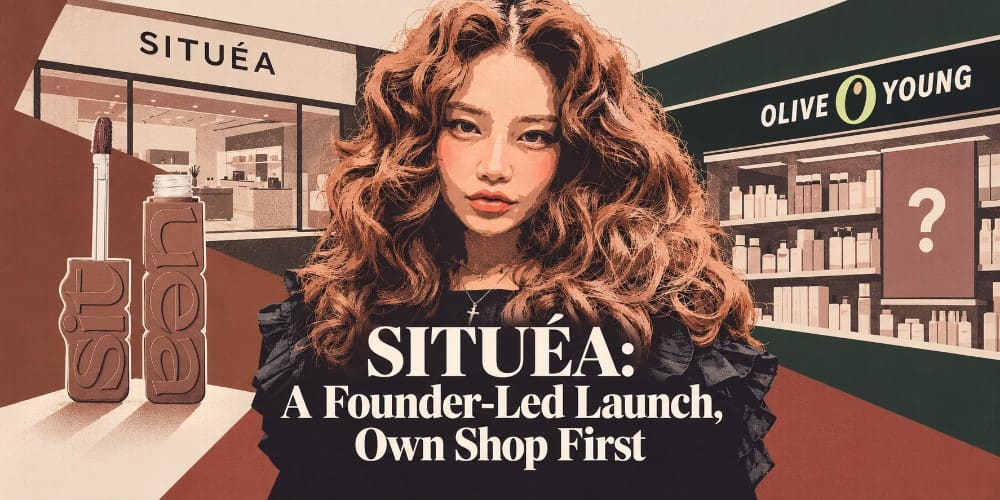
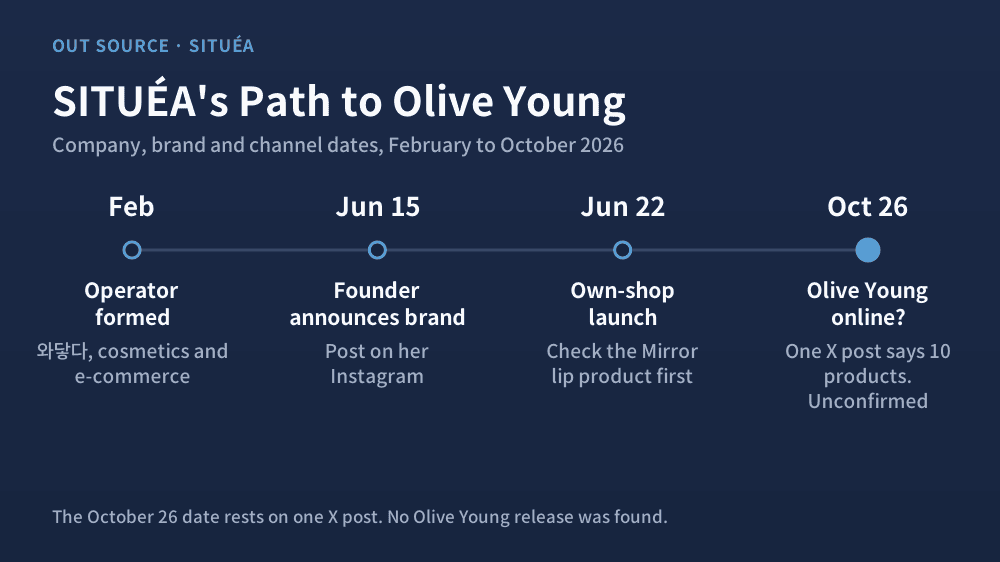
SITUÉA went on sale on June 22, 2026 at its own online shop, led by a lip-and-cheek product with a mirror built in. Its founder, Kim So-hee, sold Stylenanda, which includes 3CE, to L'Oréal in 2018 for a reported 600 billion won (US$449 million). The company behind SITUÉA was formed in February 2026. One post on X says the brand reached Olive Young's online mall on October 26, and nothing else confirms it. The founder's deal is documented. The brand's scale and channel terms are not.
Who is behind SITUÉA, and what did she sell in 2018?
Kim So-hee founded Stylenanda, an online fashion shop, and then built the 3CE makeup line inside it. In 2018 L'Oréal bought Stylenanda, 3CE included, from her. Reports put the price at 600 billion won (US$449 million) and say she sold her entire stake. Dollar figures in this article use 1,335.3 won per dollar, the Seoul Money Brokerage Services rate on October 30, 2026.
The price belongs to the whole company. Some social posts attach the figure to 3CE alone, and the reporting does not support that. L'Oréal bought a fashion-and-beauty business, and 3CE was part of what it received.
Kim stayed on after the sale as creative director and left in 2021. SITUÉA is her return to beauty after about five years away.
What did the brand launch with?
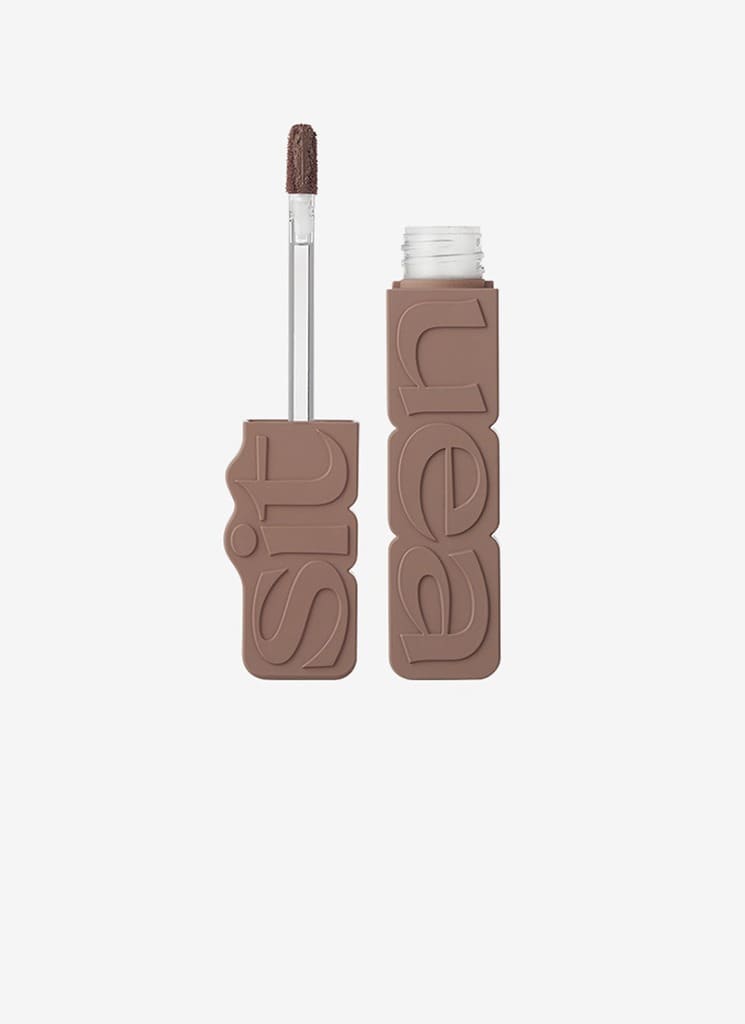
A single product and a slogan. Kim announced the brand on June 15 on her own Instagram account, tagging the brand's official account. Sales opened on June 22 at the official website, and the reports name no other retailer. The brand's Instagram handle is @situea.cosmetic, and its slogan is Check the mirror. The first product is Check the Mirror, a lip-and-cheek product with a hand mirror built into the case, smaller than a palm. A dedicated keychain turns it into a keyring.
The name is French and points to being situated, or staying put. The brand's stated idea is makeup that is comfortable in every situation. Reports call SITUÉA a makeup brand and a color cosmetics brand, aimed at people with busy days. The reports at launch name one product. The shop page, four months later, lists a dozen product families.
Who runs the company, and who backs it?
The operating company was formed in February 2026 and is described as a cosmetics manufacturing and e-commerce business. That is the full corporate record in the reports reviewed, all published between June 15 and July 10. None of them names a manufacturer, an outside investor, a revenue figure or a funding round.
None describes a stake, contract or non-compete tie to L'Oréal either. The absence is not evidence of either answer. It means the founder's 2018 exit tells a reader how she has done before and nothing about how much this company has raised or sold.
What does the brand's own shop sell, and at what price?
More than makeup. The shop at [situea.com][13] offers Korean, English, Japanese and Chinese versions and lists lip products, mists, an eye patch, a spot product and mirror accessories. The page loaded only in part, so the listing is a minimum, not a full range.
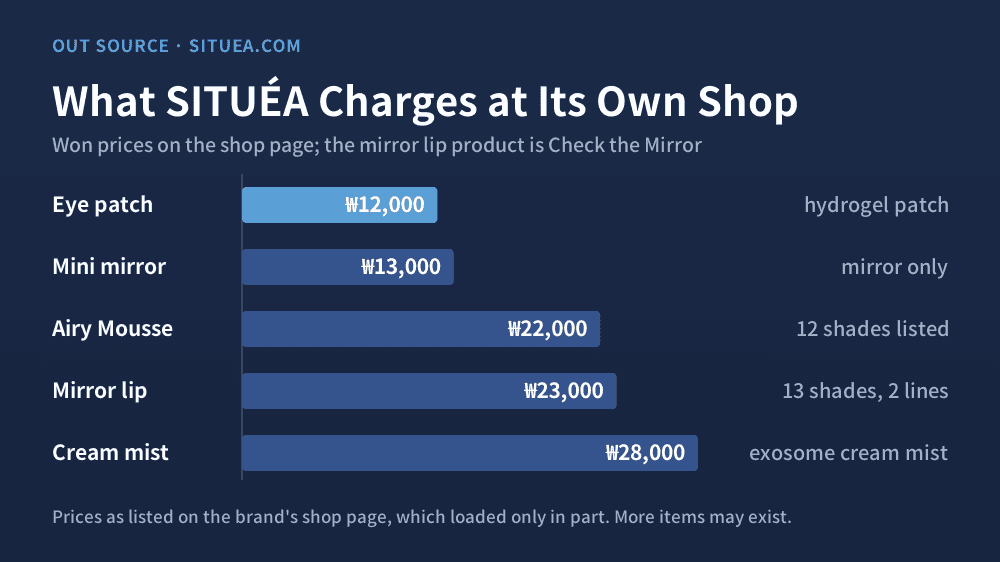
Two lip products sell at 22,000 won (US$16.48): Airy Mousse Velvet, with 12 shades listed, and Glint Lip Glaze, with four. Check the Mirror sells at 23,000 won (US$17.22) across 13 shades in two named lines, Cloud Clay and Glass Melt. The signature hand mirror is 18,000 won (US$13.48), the mini mirror 13,000 won (US$9.74) and the keychain 15,000 won (US$11.23). The exosome cream mist and the hydro mist are 28,000 won (US$20.97) each, and the hydrogel eye patch is 12,000 won (US$8.99).
A pair of one Airy Mousse and one Glint is 44,000 won (US$32.95), with a sale price of 37,400 won (US$28.01). That is 15% off the two products bought separately. The mirror alone sells for 13,000 won (US$9.74) with no makeup in it, which says the object is part of the product. Reports call SITUÉA a color brand, yet the shop also carries two mists, an eye patch and a spot product, all outside makeup.
What is actually confirmed about Olive Young?
Very little. The only source is one post on X from a personal account named Dreams0ng!. It says ten SITUÉA products entered Olive Young's online mall on Monday, October 26, and names two Olive Young-exclusive shades: 114 Tan Apricot in the Airy Mousse Velvet and 212 Bourbon Nude in the Glint Lip Glaze.
The shop listing is consistent with the exclusivity claim. It runs to shade 113 for Airy Mousse and shade 205 for Glint, and neither 114 nor 212 appears in it. That is an observation about a page that loaded only in part, not proof.
No Olive Young release or news report confirming the listing was found, and Olive Young's own pages did not load. The listing date, the product count and the exclusive shades are a social-media claim until Olive Young or the brand says so.
Why do exclusive shades matter in a crowded marketplace?
Because the marketplace is crowded. A count at the start of June found 852 distinct brands on Olive Young's online mall, or 1,529 listings when brands in more than one category are counted separately. That count was compiled by a trade outlet, not by Olive Young. Either way, a listing is one of hundreds.
An exclusive shade gives a shopper a reason to choose that page. It also removes a comparison: a shade sold in one channel cannot be price-checked against the same item elsewhere. For a brand with its own shop, the exclusive shade is the tool that keeps the two channels from competing on price.
What does launching on its own shop first change?
It moves the order of operations. A brand that sells at its own shop first sets the price, holds the customer record and tests shade demand before a retailer sees it. SITUÉA's shop sold for four months before the reported Olive Young date.
The shop's four-language setup shows the same intent. A brand that expects overseas buyers builds for them on day one. That is a design fact. It is not a sales figure.
What does the sequence tell the industry?
The sequence is documented. The outcome is not. The three positions read it differently.
Manufacturers see a founder-led brand whose maker is unnamed, so the first question is who holds the capacity and the minimum order terms. Brands and buyers see a launch that went own shop first, then marketplace, with channel-exclusive shades as the bridge. Investors and regulators see a company with no disclosed revenue, funding or manufacturer, and a founder whose last company sold for 600 billion won (US$449 million).
Three facts would change the picture: the manufacturer, the funding and a confirmed Olive Young listing with its terms. None is public. A founder's name opens a door. It does not fill a shelf. Sell-through does.