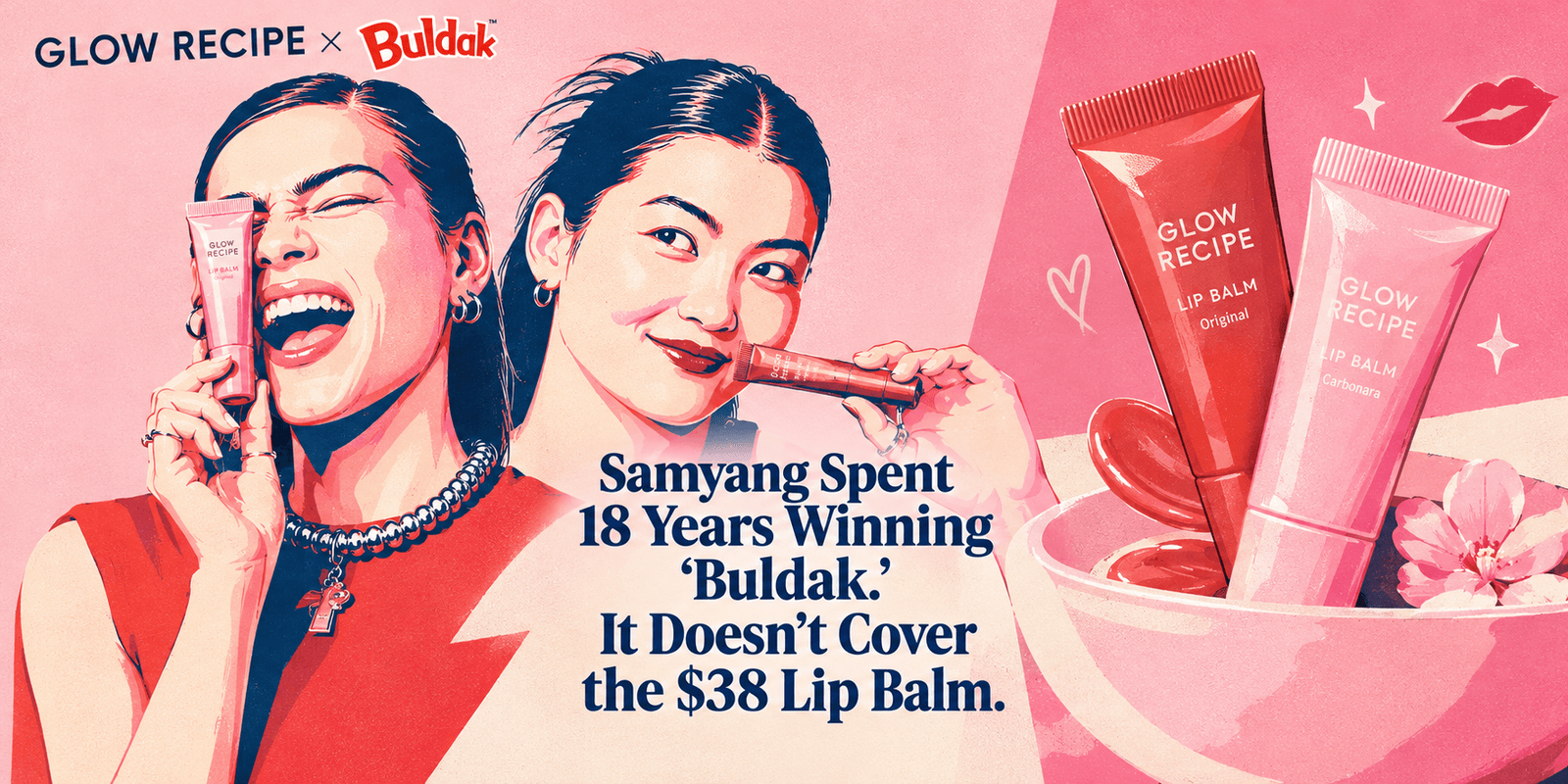
Samyang Foods secured registration of Buldak as a trademark in Korea in June 2026, eighteen years after its first application was refused on the ground that the word was a common noun no single company could own. Four months later a US$38 lip balm duo carrying that name went on sale in the United States. The registration, as reported, covers ramen and sauces. A lip balm is neither. The thing Samyang spent eighteen years winning does not, on its reported scope, reach the product now wearing the word.
What did Samyang actually register, and what did it leave out?
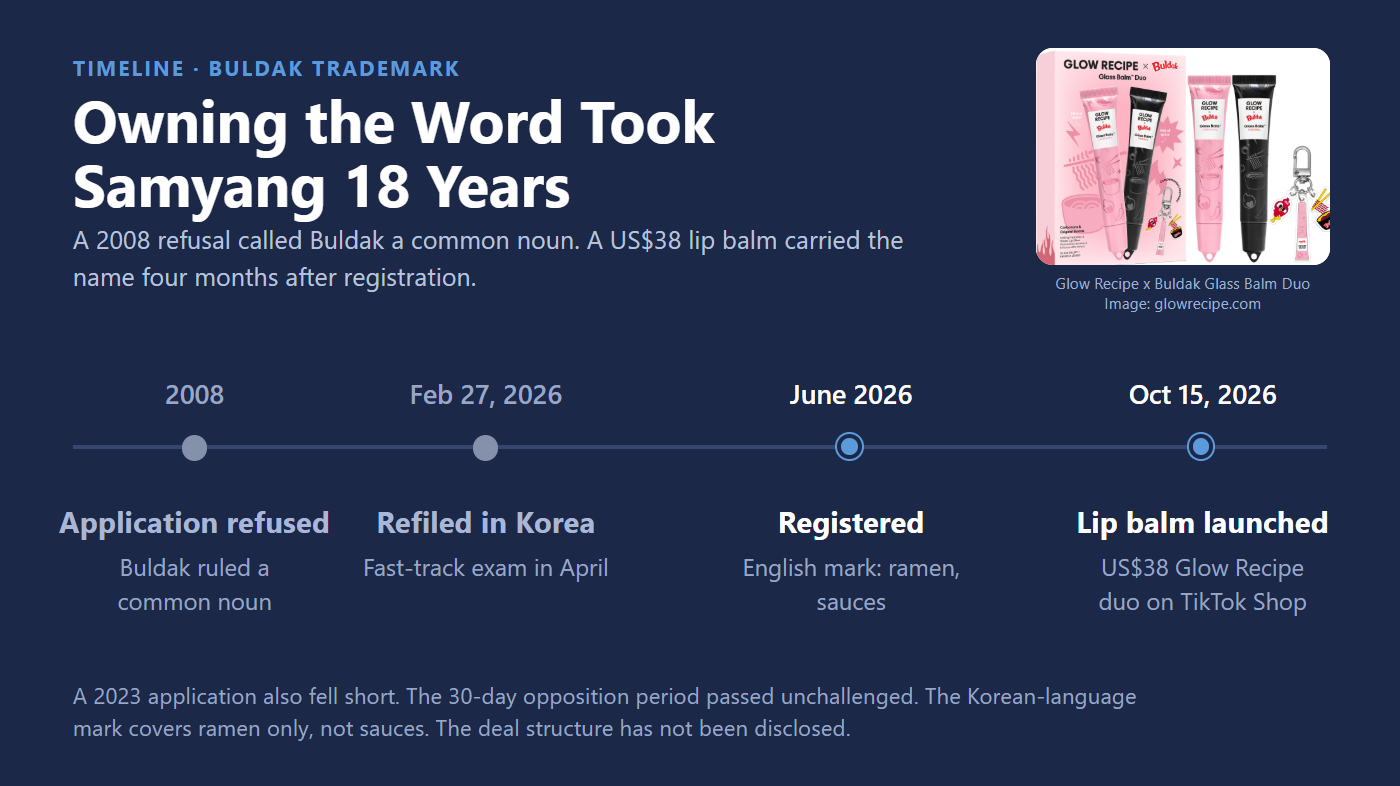
Samyang filed on February 27, 2026 with Korea's intellectual property office. The application was selected for fast-track examination in April, a first examination result came 35 days later, and the applications were published on May 4, 2026. A 30-day opposition period passed without challenge, and approval followed in June. Standard registration in Korea runs over a year; fast-track review runs two to three months.
Two marks came out of that process with two different scopes. The English-language mark covers ramen and sauce products. The Korean-language mark covers ramen only, with sauces treated as generic and excluded. Neither the filing reports nor the registration reports mention cosmetics, which is the first thing worth noticing about a lip balm named Buldak. What Samyang holds in cosmetics classes, in Korea or elsewhere, has not been published.
Why did a single word take eighteen years to own?
A trademark is a registered right to stop others from using a name on specified goods. It is granted per category of goods, and it is refused when the word is merely descriptive. Samyang's 2008 application failed on exactly that ground: authorities found Buldak was a common descriptor used across food sectors since the early 2000s, and a court treated it as a common noun. A further application in 2023 also fell short. The word was selling product in dozens of markets while remaining unprotected in the company's home market.
The gap had consequences abroad. By January 2026 Samyang held registrations in 88 countries and was in trademark disputes in 27 of them, according to Vice Chair Kim Jung-soo. Look-alike products using the word had surfaced in China, Southeast Asia, the Middle East, Europe, Africa and the United States. The company framed the registration in defensive terms, with an official saying that securing the trademark was ultimately about enhancing the global competitiveness of the Samyang brand. The practical uses cited were takedowns at online marketplaces, customs enforcement, and opposition to unauthorized foreign filings.
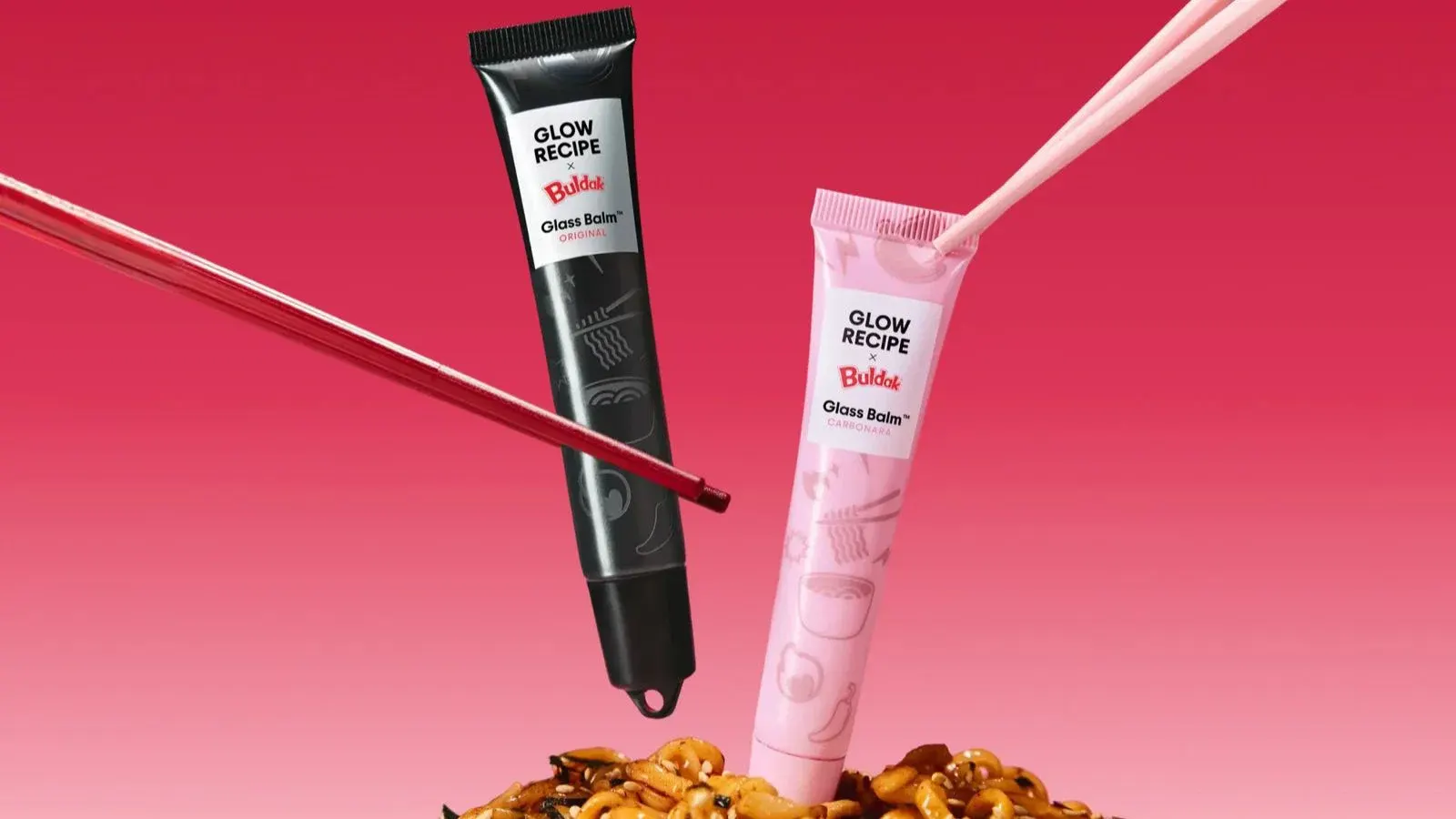
Who is Glow Recipe, and why does the label matter here?
Glow Recipe is a US-based skincare company founded by Sarah Lee and Christine Chang. North Castle Partners announced a strategic investment and partnership on October 1, 2021, with terms undisclosed. The brand is routinely filed under K-beauty on the strength of what it sells and who founded it, not where it is incorporated or where its revenue is booked.
For a trademark story that distinction is operative rather than pedantic. The balm is a Korean food name appearing on an American company's product, sold through American channels, to American shoppers. Reading it as a Korean beauty launch inverts the direction of travel. The Korean asset in the transaction is the word.
What does the rollout order say about who the product is for?
The duo reached TikTok Shop on October 15, 2026, sephora.com on October 23, and Sephora stores on November 2. Prestige beauty launches conventionally run the other way: retailer first, where the fixture, the tester and the staff recommendation do the explaining, with social commerce following once awareness exists.
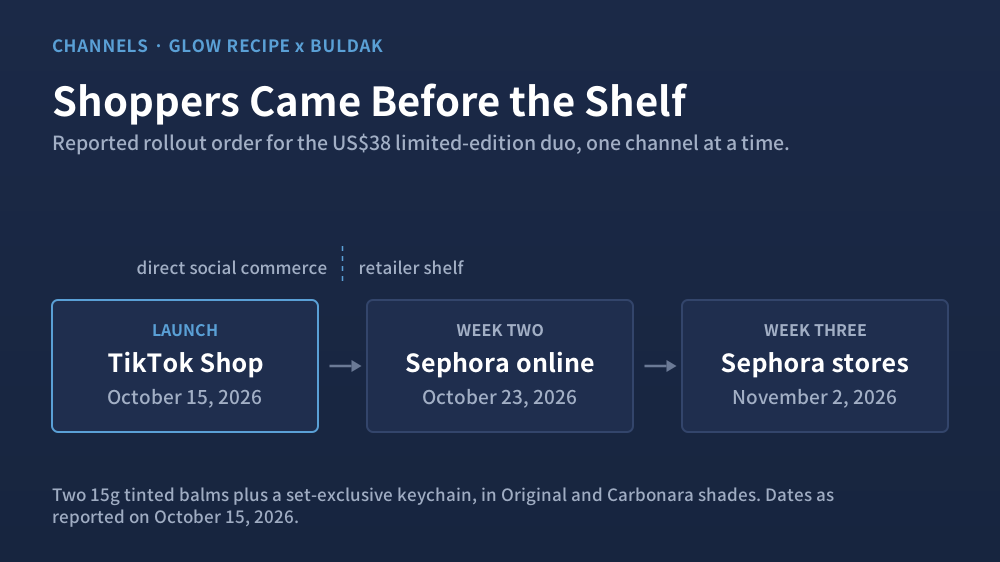
Inverting that order is a statement about where the reference already lands. A shopper who recognizes Buldak Carbonara from a noodle package needs no fixture to explain why a cherry blossom pink balm carries that name. A shopper who does not recognize it is being sold a US$38 lip product on the strength of the formula alone. The sequence sorts those two audiences and reaches the first one first.
Is a Buldak beauty product actually new?
No. Tonymoly launched a five-product Buldak limited edition in September 2018 — a cover cushion, a lip tint, a blusher, a lip care stick and a lip sauce tint — built on the ramen packaging and its character. Aekyung's 2080 brand followed in 2020 with toothpaste and oral care sets featuring the Buldak character Hochi. Both were Korean domestic launches, and both happened while the name itself sat unregistered in Korea.
What changed in 2026 is not that Buldak appears on a cosmetic. It is that a registered mark now stands behind the name when it does, and that the venue moved from a Korean drugstore chain to US prestige retail at four times the typical price of a mass lip balm.
What is the structure of the deal, and what is not known about it?
Not disclosed. Neither company has published licensing terms, royalty arrangements, approval rights or the identity of the manufacturer. Trade coverage described the launch as a collaboration without characterizing it as a license, and the product page calls it a limited-edition collab. Until the structure is published, the commercial question — who captures the margin on a US$38 set of two 15g balms and a keychain — has no answer in the public record, and anyone describing the economics is describing an assumption.
A useful contrast sits in the same aisle. e.l.f. Cosmetics launched pickle-inspired lip balms at US$9 each in August 2026, in three shades, with no food brand partner named and no licensing arrangement described: the reference was to a generic food, which belongs to no one. e.l.f. states that the earlier version sold out in eight minutes, a figure from its own press release. The difference between the two launches is the difference between borrowing a category and borrowing a name. A generic reference is free. A brand reference needs a counterparty, and registration is what makes a company able to be one.
How large is the business the name now carries?
Samyang Foods reported 2025 revenue of 2.35 trillion won (US$1.75 billion), up 36 percent, with operating profit of 523.94 billion won (US$391 million), up 52 percent, and net profit of 387.56 billion won, up 43 percent. Those figures come from the company's own release rather than a regulatory filing. The company also puts cumulative Buldak sales since the 2012 launch at more than 9 billion units and more than 5 trillion won; both are company figures. Won amounts here are converted at 1,341.6 won per US dollar, the rate on October 15, 2026.
The 2026 reporting shows the same direction. Second-quarter revenue reached 770.3 billion won (US$574 million), up 39.3 percent, with overseas sales of 645.8 billion won, the company's first quarter above 600 billion won. First-half revenue reached 1.4847 trillion won, up 37.2 percent.
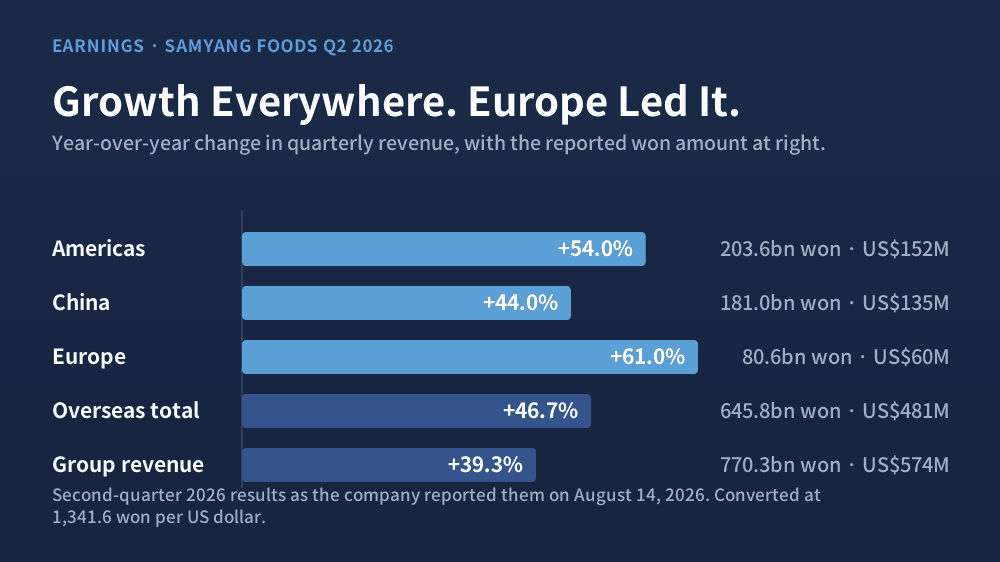
Regionally, the Americas produced 203.6 billion won (US$152 million), up 54 percent; China 181.0 billion won, up 44 percent; Europe 80.6 billion won, up 61 percent. Europe grew fastest from the smallest base. The Americas remained the largest overseas region, which is where the balm went.
Why was the United States the place to test the name?
Samyang America recorded revenue of US$419 million in 2025, against roughly US$50 million in 2023, and Buldak moved from about 15,000 US retail locations to about 30,000 over the same stretch, with Walmart, Costco, Target and Amazon among the named accounts. Headcount went from 18 to around 100. Those figures come from the subsidiary's chief executive, Shin Yong-sik, in an interview published May 6, 2026, and from the reporting around it rather than from an audited disclosure.
Thirty thousand doors is the condition that makes a US$38 lip balm legible rather than obscure. Shelf density at that level means the reference arrives already understood, and a limited-edition beauty set does not have to spend its marketing budget introducing the thing it refers to. That is the asset registration protects: not the sauce, not the formula, but recognition that was built by distribution and can be copied by anyone until a mark says otherwise.
What does a registered word buy, and who pays for it?
Three positions sit differently on the same facts.
- Manufacturers and ODMs. An undisclosed structure is an undisclosed brief. When a food mark crosses into cosmetics, the formulator inherits category rules the food owner has never worked under — ingredient restrictions, claim substantiation, labeling requirements that differ by market. Nothing in the public record says who is carrying that obligation here.
- Brands and buyers. The scarce asset in this transaction is a name with registered rights behind it, not a flavor. Food brands with recognition but no registration can be referenced without being paid, as the pickle balms demonstrate. Registration is what converts recognition into a negotiating position.
- Regulators and investors. A registration in food classes does not travel into cosmetics on its own. Scope is the whole question, and in this case the published scope and the product on sale do not overlap. Anyone valuing an IP-extension story needs the class list, not the headline.
The eighteen-year fight was about stopping other companies from using a word. The balm is a test of what else that word can do. Those are different businesses. The registration proves the first one. It does not prove the second.