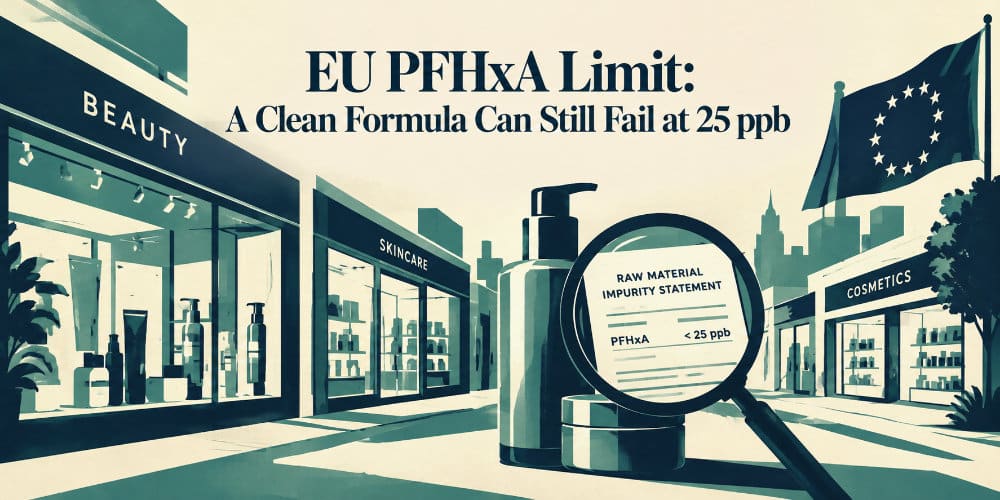
France's proposal to restrict octocrylene triggers at 0.001% of a finished cosmetic's weight, while the EU Cosmetics Regulation allows the filter at up to 10%. That is a gap of 10,000 times. ECHA's two scientific committees backed the limit in 2026 and confirmed it on October 30. The stated target is aquatic harm, not consumer safety, which moves the decision from the cosmetics rulebook into chemicals law. For sunscreen formulators, the proposal reaches the formula, not the label.
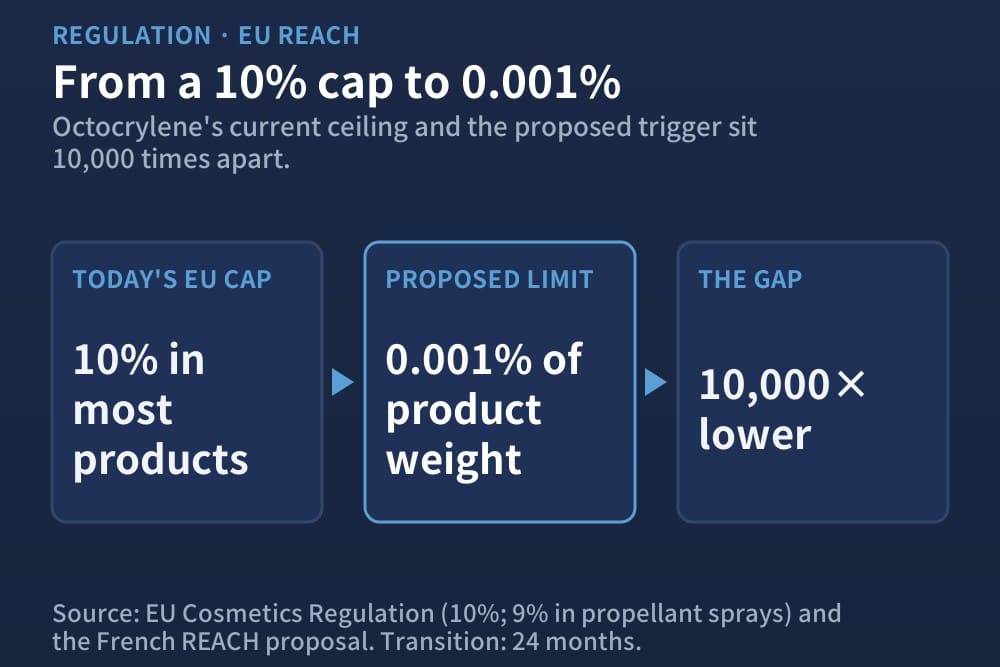
▲ The EU caps octocrylene at 10% in most cosmetics today. The French proposal triggers at 0.001%, a limit 10,000 times lower.
What does the proposed restriction actually ban?
Octocrylene is a UV filter, a chemical that absorbs ultraviolet light so a sunscreen can reach its protection rating. It also stabilizes other filters, which is why it appears in makeup, day creams, and fragrances as well as in sunscreens. France's proposal, prepared by the French agency ANSES, targets finished cosmetic products placed on the EU market that contain octocrylene at 0.001% w/w or more. The unit w/w means weight of the ingredient per weight of the product.
The scope is the finished product, so imports sit inside it. A sunscreen made in Korea and shipped to Warsaw or Paris meets the same limit as one made in Lyon. The proposal gives manufacturers 24 months from the restriction's entry into force to comply, and the clock starts at that date, not at the committee opinions.
Why is an environmental rule reaching into a cosmetics formula?

▲ The Norwegian Environment Agency reported on November 6, 2026 that ECHA committee recommendations on octocrylene were sent to the European Commission. Image: Miljødirektoratet
The proposal runs under REACH, the EU's chemicals regulation (Registration, Evaluation, Authorization and Restriction of Chemicals). A REACH restriction is written into Annex XVII of that regulation. The Cosmetics Regulation, No 1223/2009, governs a different question: whether a product is safe on skin. It lists octocrylene as a permitted UV filter, and the EU's consumer safety committee, SCCS, has re-confirmed the filter's safety in sunscreens.
ANSES builds its case on what happens after the product leaves the skin. Residues enter wastewater and sewage sludge, and swimmers release them directly into lakes, rivers, and coastal waters. ANSES describes risks to aquatic species and to soil organisms. A filter can pass the test on the skin and fail the test downstream, and the two tests sit in two different laws.
How far below today's limit does 0.001% sit?
The Cosmetics Regulation caps octocrylene at 10% in most products and at 9% in propellant sprays. The REACH proposal triggers at 0.001%. Ten divided by 0.001 is 10,000, so the new threshold sits four orders of magnitude under the current ceiling. A formulator who has used the filter at 6% or 8% to reach an SPF target gains nothing by trimming the dose.
At that level the effect is removal, not reduction. The line is drawn at a trace, so octocrylene leaves the ingredient list of any finished cosmetic sold into the EU. INCI, the International Nomenclature of Cosmetic Ingredients, is the naming standard that label lists follow, and a sunscreen with Octocrylene on its INCI list falls under the restriction.
Where does the proposal stand on the path to law?
ECHA opened a public consultation on the French dossier on September 24, 2025, and comments closed on March 24, 2026. The Risk Assessment Committee, RAC, adopted its opinion supporting the restriction on June 4, 2026. The Socio-economic Analysis Committee, SEAC, adopted its final opinion on September 15 and 16, 2026, and ECHA confirmed support from both committees on October 30. On November 6, the Norwegian Environment Agency reported that the recommendations had gone to the European Commission.
The opinions are not binding. The Commission decides whether to draft an amendment to Annex XVII, any proposal then goes to the REACH Committee of member-state representatives, and the European Parliament and the Council scrutinize it before the Commission takes the final decision. The restriction is not law today, and no date is set for the Commission's step.
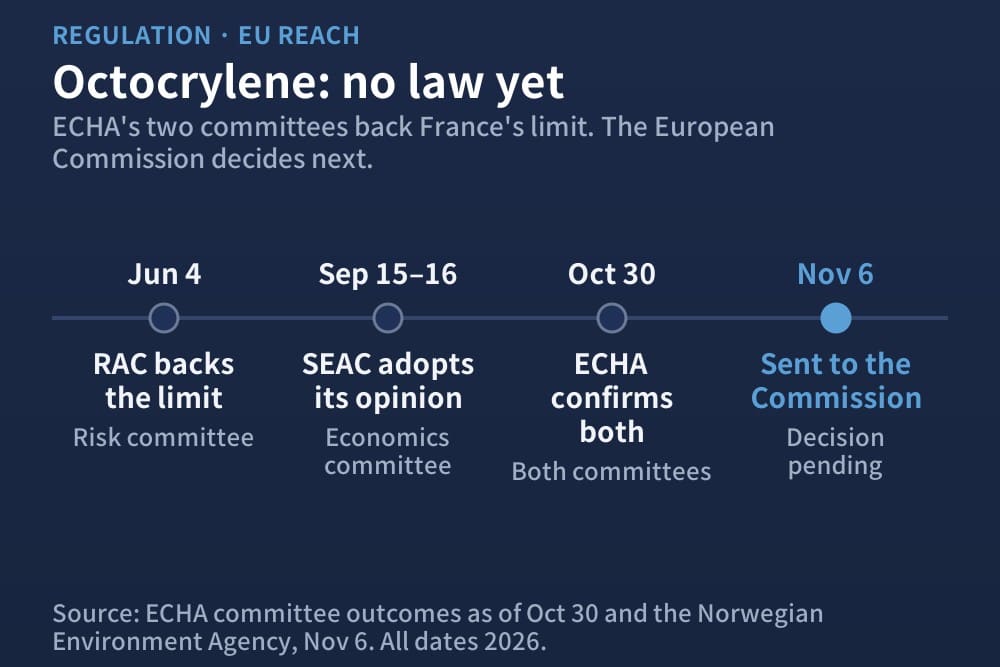
▲ Both ECHA committees have backed the limit. The European Commission, the REACH Committee, the Parliament, and the Council still stand between the opinions and a legal text.
Why does the 24-month clock decide formulation plans before the law exists?
The 24 months run from entry into force, so the Commission's decision is the starting gun and its date is open. Formulation work cannot wait for it. Replacing a UV filter changes SPF, texture, and water resistance, and each reformulated sunscreen returns to testing before it ships.
ODMs, the original development manufacturers that formulate and make products under another company's brand, schedule that work ahead of the brand's launch calendar. A sunscreen formulated now for an EU launch is formulated before the rule's date is known, which makes the proposal a design input today and a legal obligation later.
Why does the Korean export map make this a Korean story?
Korea's cosmetics exports reached US$11.4 billion in 2025, and Poland, up 115.1%, and France, up 73.2%, were among the fastest-growing destinations. In the first half of 2026, exports to Europe totaled US$1.5246 billion against US$1.4908 billion to North America, the first half-year in which Europe led. First-quarter exports to Europe rose 53%.
Sun care sits inside that growth: Korean sunscreen production rose 9.4% in 2025. Korea regulates sunscreens as cosmetics, and its permitted UV-filter list runs to 38 entries, so Korean formulators work from a wide palette. Europe is no longer a side market for Korean sunscreen. It is where the growth sits, and the filter France targets is on the list that formulas must clear to stay there.
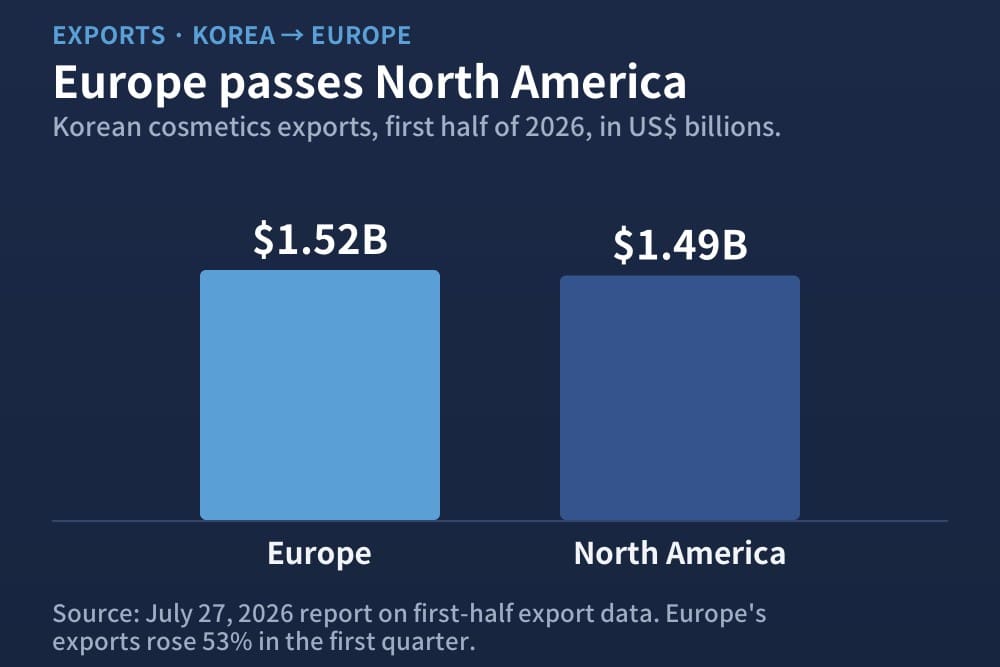
▲ Korean cosmetics exports to Europe reached US$1.52 billion in the first half of 2026, ahead of the US$1.49 billion shipped to North America.
What does the US filter approval do to the same formulas?
On August 9, 2026, the FDA's approval of bemotrizinol took effect, the first new sunscreen active ingredient in the United States since the late 1990s. Until then, US-bound sunscreens relied on chemical filters such as avobenzone and octocrylene, or on mineral filters such as zinc oxide and titanium dioxide. Bemotrizinol was already widely used in Europe, Australia, and Asia.
The two markets converge from opposite sides. The United States opens to a filter Europe already uses, while the EU moves against a filter the United States relied on. A single formula for Korea, the US, and the EU becomes more reachable without octocrylene than with it. Supply sets the pace: DSM-Firmenich, which applied for the approval, holds exclusive US supply rights to bemotrizinol for 18 months from August 9, and the ODMs Kolmar Korea and Cosmax expect more premium sunscreen orders as a result.
Who carries the reformulation cost?
ANSES judged that moderate reformulation costs can be absorbed by manufacturers. The agency also cites a survey of more than 7,000 consumers in six European countries that showed strong willingness to pay for octocrylene-free products that protect aquatic ecosystems. Both points shift the cost question from the factory to the shelf.
Cosmetics Europe, the industry association, has worked with environmental experts on evidence defending continued use of the filter. That position keeps the opinions from being the last word, and the Commission step is where the two cases meet.
How does each side read a rule that is not yet law?
Manufacturers read it as a scheduling problem. The 24-month window is generous against a formulation cycle only if the work starts before the entry-into-force date is published, and ODMs hold the formulation capacity that every sunscreen brand needs at the same time.
Brands and buyers read it as a claims problem. An octocrylene-free sunscreen is a product that can say so on the shelf, and the consumer survey ANSES cites points to a price premium for that statement. Regulators and investors read it as precedent: an ingredient can pass the cosmetics safety test and still be restricted through the chemicals law on environmental grounds, and the next filter on that path faces the same two-law structure.
The cap on today's label is 10%. The line in the proposal is 0.001%. Formulas get built to the second number.