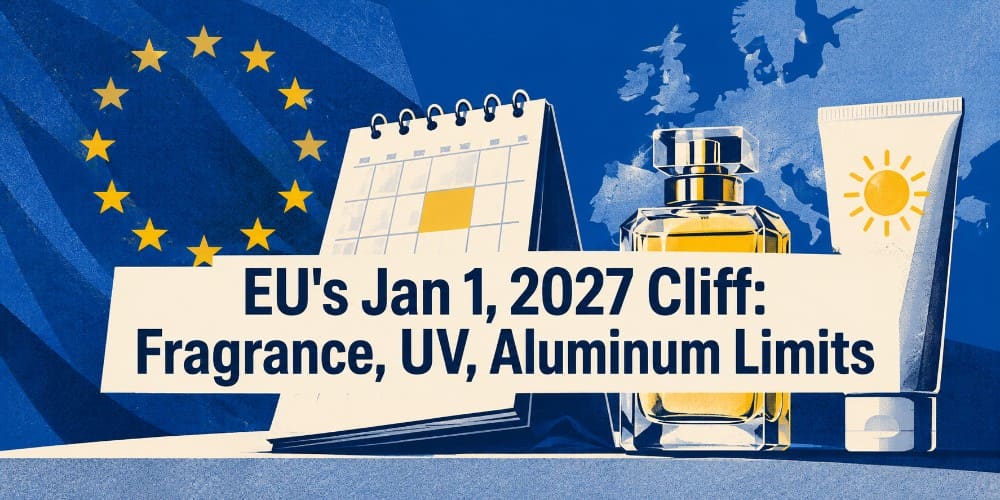
On October 22, 2026, the European Parliament voted 477 to 59, with 41 abstentions, to approve Omnibus VI, a package that halves the withdrawal clock the Commission proposed for cosmetics containing newly banned CMR substances, from 12 and 24 months to 6 and 12. The shorter clock is the headline. The consequential detail is that there are two clocks, and they bind different parties: the first stops new product from entering the market, and the second sets the date the last unit leaves the shelf.
What did the European Parliament approve on October 22, 2026?
Omnibus VI is a package that simplifies EU rules on chemicals, including the cosmetics regulation. Parliament's vote formalized a provisional agreement with the Council of the EU reached in June. The text enters into force 20 days after publication in the Official Journal, the EU's gazette of record.
The cosmetics provisions concern CMR substances, meaning ingredients classified as carcinogenic, mutagenic or toxic for reproduction. CMR substances are barred from cosmetic products unless a narrow exemption applies. Until now the rules set no staggered transition for products containing a newly banned substance. Omnibus VI writes one in, and the schedule depends on how the substance is judged.
Why does a regulatory clock matter more as Korean exports to Europe grow?
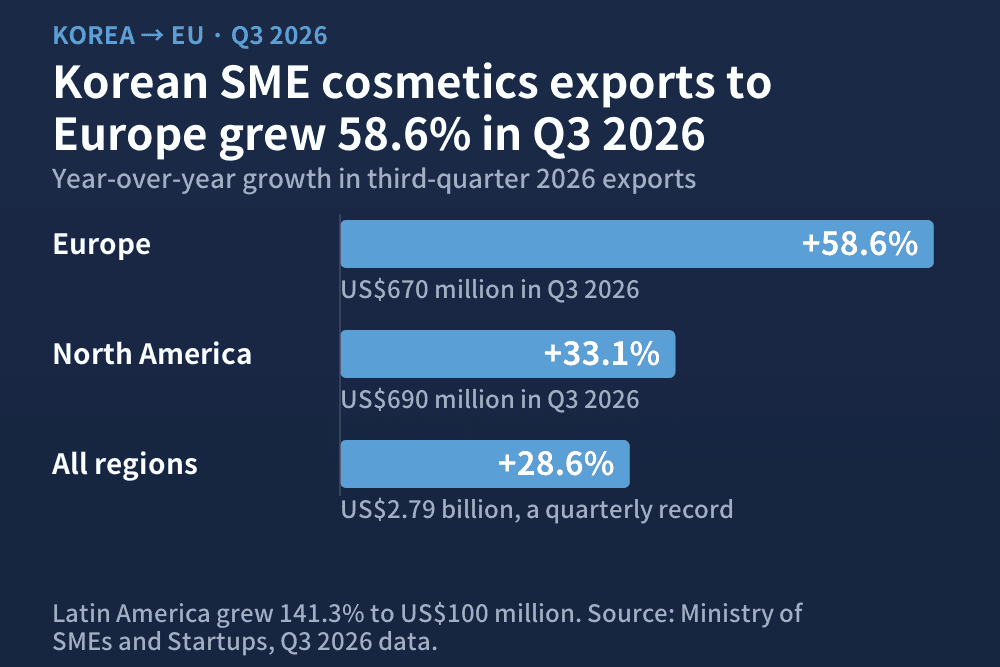
Korean small and mid-sized companies exported US$2.79 billion of cosmetics in the third quarter of 2026, a quarterly record and 28.6% more than a year earlier, according to the Ministry of SMEs and Startups. Europe took US$670 million of that, up 58.6%, which put it within US$20 million of North America at US$690 million, where growth was 33.1%.
Growth at that pace is physical inventory. Each additional point of export growth is a pallet in an importer's warehouse or a unit in a retailer's backroom, and each of those units carries the date on which it becomes illegal to sell. A withdrawal rule matters in proportion to the stock exposed to it, and the stock in Europe is growing faster than in North America, the only region that is larger.
How do the new deadlines work?
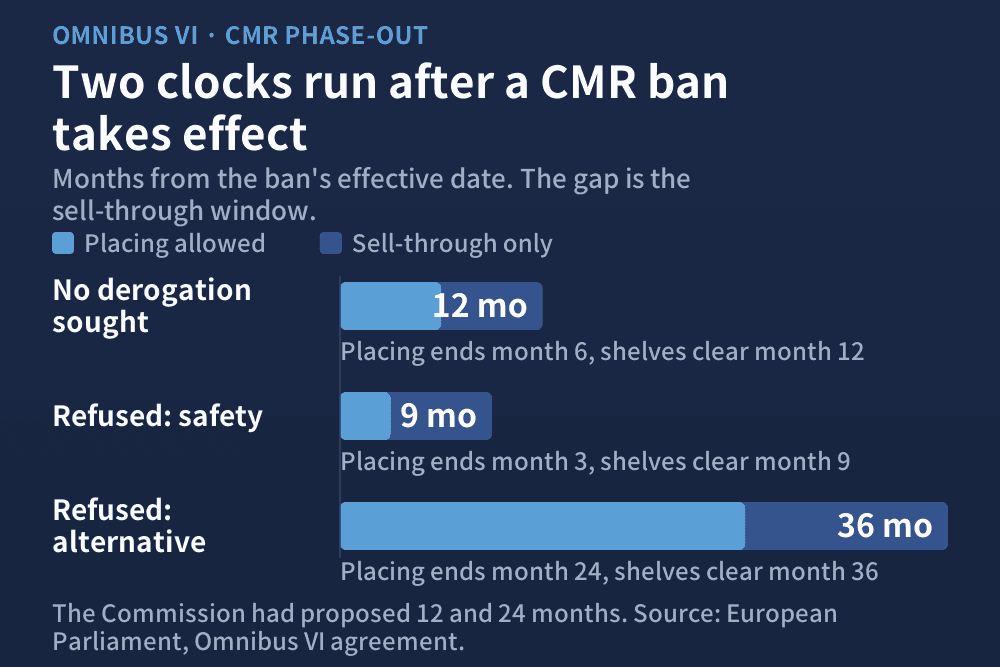
The structure runs on three tracks. A company that does not seek a derogation, a formal exemption that lets it keep using a banned substance in a defined product, gets 6 months after the ban takes effect to stop placing affected products on the market and 12 months before they can no longer be made available at all. The Commission had proposed 12 and 24.
A company that requests a derogation and is refused on safety grounds gets 3 months and 9 months. A company refused because a suitable alternative substance exists gets 24 months and 36 months. A request in progress holds the clock still: the phase-out starts only once the request is decided.
Where the refusal rests on safety, the clock is shortest. Where the substance is not judged unsafe and is refused only because a substitute exists, the clock is longest. The schedule therefore carries a message about the substance itself, not only an administrative grace period.
What is the difference between placing a product on the market and making it available?
The EU cosmetics regulation, Regulation (EC) No 1223/2009, defines both terms in Article 2. Making available is any supply of a cosmetic product for distribution, consumption or use on the Union market. Placing on the market is the first making available. The first supply into the Union is placed, and every later supply down the chain is made available.
The two roles map to the two clocks. The importer, the entity established in the EU that brings a product in from a third country, answers to the first deadline, the one at month 6 in the base case. A distributor, which the regulation defines as anyone in the supply chain other than the manufacturer or the importer, handles stock that is made available, so retailers count. The second deadline, month 12, governs that stock.
In practice the first clock disciplines the pipeline's entry and the second disciplines its exit. The gap between them is the sell-through window, and it differs by track: six months in the base case, six months when a refusal rests on safety, and twelve months when a refusal rests on a substitute.
Where does the sell-through window sit in an export chain?
Take a product that travels from a formulator in Korea to an EU importer, then to a distributor, then to a retailer. Units the importer has brought in before month 6 are placed on the market and keep moving downstream until month 12. Units still in the exporter's warehouse at month 6 cannot be placed at all. Every shipment decision in the final stretch becomes a bet on whether the unit clears the second deadline.
The Commission's proposal gave that window 12 months. The agreement gives it 6 in the base case. A distributor that restocks in month 5 holds product with seven months of legal life left and needs a sales velocity to match. A distributor that reorders in month 7 can draw only on units already placed.
The arithmetic is blunt. A product that sells through in a quarter clears twice inside a six-month window. A product that sells through in nine months does not clear once.

Who carries the inventory risk inside that window?
A deadline is a date on a product. The cost of missing it is a line in a contract. The regulation attaches the date to the product, and whoever holds the product when the date arrives holds the cost unless an agreement says otherwise.
A distribution agreement answers the question in three places: the stock rotation terms, the return and buyback terms, and the regulatory-change clause, which says what happens to unsold stock when a law makes it unsellable. That clause decides whether the brand buys the stock back, the distributor writes it off, or the two split the cost of destruction.
With European exports growing 58.6% in a quarter, the inventory sitting under such clauses is growing with it. Each clause that is silent about a legal withdrawal date is an unpriced liability held by whichever party the dispute reaches first.
Why does the derogation path leave distributors in the dark?
A derogation request freezes the clock until it is decided, and the decision selects one of three schedules: 6 and 12 months if no request is filed, 3 and 9 if it is refused on safety grounds, 24 and 36 if it is refused because a substitute exists.
The formulator knows whether a request was filed and what the evidence looks like. The importer, the distributor and the retailer know the ban date, not the request. Three parties downstream hold stock without knowing which schedule applies to it, because the information sits upstream of the inventory.
The Commission will publish guidance on analyzing alternatives one year after the legislation enters into force. That guidance shapes the refusal that carries the longest clock, so it shapes how much shelf time a refused substance gets.
What does month 6 demand from a formulator?
For a brand that does not seek a derogation, month 6 is the date after which no new unit containing the banned substance can enter the EU. Reformulating to meet it requires a new safety assessment, stability data and an updated notification in the Cosmetic Products Notification Portal, the EU's central registry where every product is declared before launch.
Those steps run in sequence on the formulator's side while the importer's pipeline keeps filling on the other. The six months that Omnibus VI removes from the Commission's proposal come directly out of the time a reformulation has to be finished before a replacement product has to be on the water.
Contract manufacturers that develop formulas for several brands, known as ODMs for original design manufacturers, see the effect first, because one ban date triggers the same reformulation in every client file that uses the substance.
What does the shorter clock change for the industry as a whole?
Manufacturers and formulators read Omnibus VI as a scheduling problem. The ban date is public in advance, the first clock is short, and the capacity to reformulate is shared across every client that used the substance.
Brands and buyers read it as a contract problem. A six-month window forces the question of who owns the stock at month 12 into the open, and the answer has to be written before the ban date, not argued after it.
Regulators read it as a risk-scaling instrument, with the fastest exit for the substances with the weakest safety case. Investors in consumer-health and beauty groups read it as a balance-sheet line, since unsellable stock is a write-off with a date attached.
Two clocks, one window. The party that treats it as a single deadline is the party holding the stock when the second one stops.