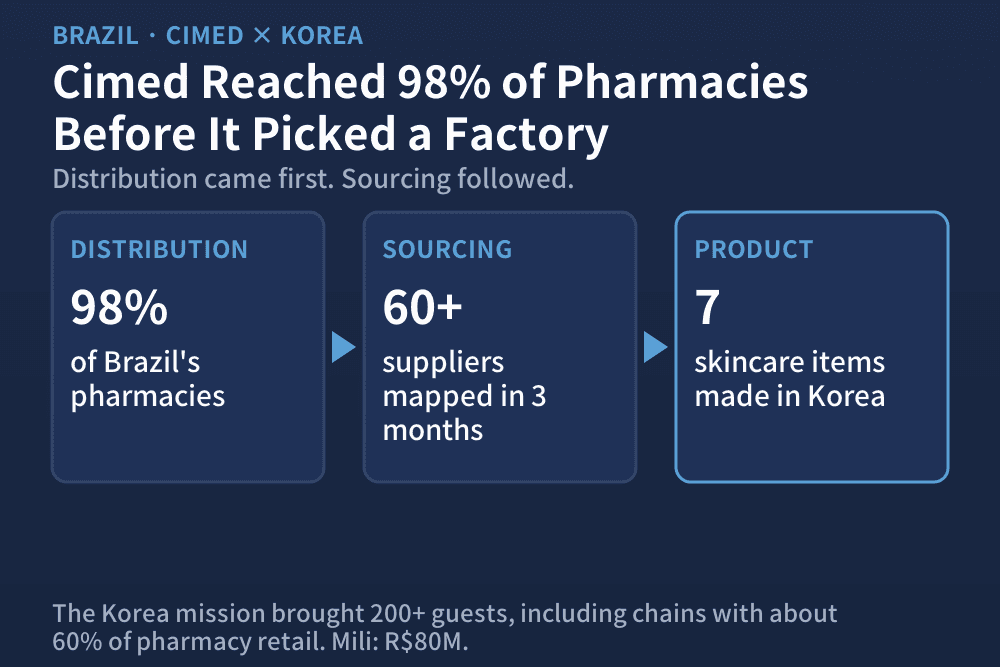
Cimed, a Brazilian pharmaceutical company, presented its first skincare brand, Mili, on October 12, 2026. Seven products are made in Korea, the investment is R$80 million, and the first-year target is R$150 million. The company did not start with a formula. It started with distribution: its products sit in more than 98% of Brazilian pharmacies. The usual K-beauty export story has a Korean brand searching for a distributor. In Mili’s case the distributor went searching for a Korean factory.
What did Cimed present on October 12, 2026?
Mili is Cimed’s first skincare brand. The line has seven products: a cleanser, toner, mist, serum, cream, eye cream and a concentrated shot, all sold under the Exo prefix. Every product is built on an exosome active called METAexosome L55 combined with a peptide complex. Exosomes are nanoscale vesicles released by cells, and they are the shared technology claim across the whole line.
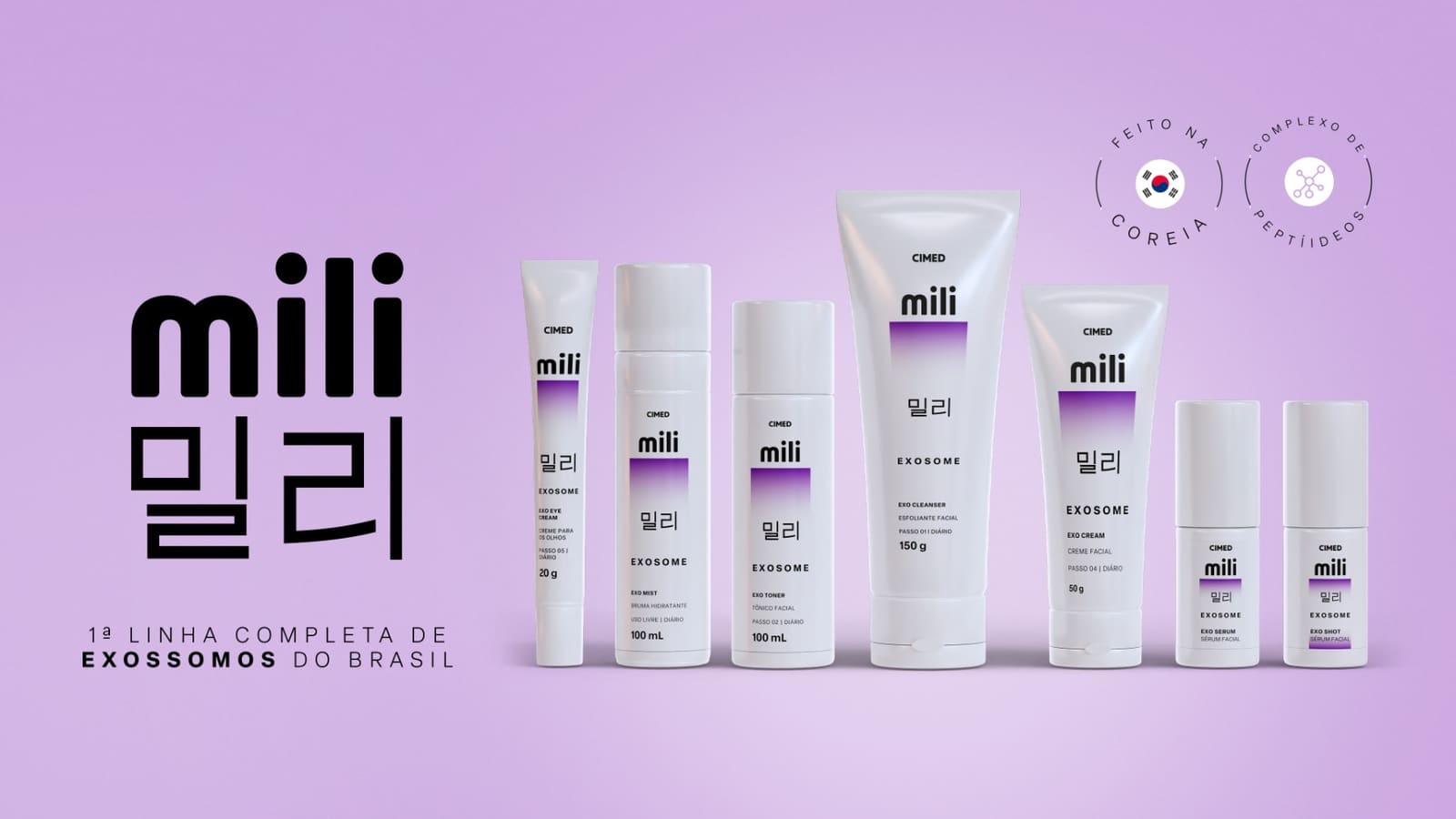
Cimed puts the investment at R$80 million (about 18.9 billion won, or US$14 million at 1,342.1 won per dollar, the November 5, 2026 close) across creation, development, production, point of sale and marketing, and the first-year revenue target at R$150 million. The line was developed exclusively for Cimed, produced in Korea and adapted to Brazilian consumers and to the rules of Anvisa, the Brazilian health regulator. Prices run up to R$200.
Cimed is a pharmaceutical company. Medicines make up about 60% of its revenue and consumer products about 40%, and the company turns 50 in 2027.
Why does a drug company start with the pharmacy network instead of the formula?
Cimed’s products are present in more than 98% of Brazilian pharmacies, and the company supplies more than 90,000 points of sale directly. CEO João Adibe said a great product is worth little if it does not reach the consumer. Mili is built on that sentence: the shelf is the asset and the product is what goes on it.
Mili targets pharmacy retail and perfumeries, positioned between cheaper products and premium, often imported brands. Adibe said Cimed does not aim to be the cheapest, but to offer value for the price.
A beauty brand usually spends its first years buying access to retail. Cimed already owns that access, so its launch spending goes to product and shelf presence. Its risk is the reverse of a startup’s: distribution is solved, credibility in skincare is not.
What did three months in Asia buy?
Cimed ran a program it called Missão Coreia 2026, a three-month immersion in Asian markets across 18 cities in South Korea, China, Taiwan and Japan. The team mapped more than 60 suppliers, attended sector fairs and congresses, and chose a Korean manufacturer. All Mili production stays in Korea.
The trip carried the customers too. More than 200 people went, including representatives of pharmacy chains that together account for about 60% of Brazilian pharmacy retail. Adibe said the aim was to show them the technology, processes and production behind the category, so that Korean-style skincare reads as familiar and less tied to high prices.
Taking the buyers to the factory is a sales method. By the time Mili reaches the shelf, the chains that decide shelf space have seen where it is made.
Why does Cimed describe the model as fast fashion?
Adibe used the term to mean speed in identifying trends, not low quality. He said Cimed looks at Korea because many of the changes that reach the Brazilian consumer start there, and that the goal is to understand the trend behind a product and turn that knowledge into products and experiences for Brazil.
That makes Korea the trend source and the production base at once. The Korean ecosystem, as the company describes it, covers formulation, development and innovation in skincare, and Cimed pairs it with distribution that reaches almost every pharmacy in the country.
The model separates two things K-beauty brands usually bundle: the trend and the reach. Cimed supplies the reach, and Korean manufacturers supply the trend and the formula.
How large is the Korean flow into Brazil right now?
Korean cosmetics exports to Brazil reached US$54.36 million in 2025, according to Korean customs data. Sales to Brazil in the first half of 2026 rose 237.4% year on year, according to South Korea’s Ministry of SMEs and Startups.
Pharmacies are where the flow lands. Nissei, the eighth-largest pharmacy chain in Brazil, launched 31 items from the Seoul brand Prettyskin in its Avenida Paulista beauty store and online. RD Saúde, the country’s largest chain, opened a premium beauty concept store in August 2026 featuring Korean and Japanese brands. Drogaria Araujo began selling Korean products in Belo Horizonte.
The two approaches differ. Nissei’s 31 items come from Prettyskin, a Seoul brand that has operated for about ten years and sells in Myeongdong, with QR codes on the packaging for ingredients and usage. Mili was developed exclusively for Cimed. One pharmacy chain imports an existing brand, and the other builds a new brand on Korean production.
Circana’s data on premium beauty retail shows Korean skincare brands’ revenue up 67% in the first half of 2026 while traditional luxury brands fell nearly 10%. Circana does not track pharmacies, so the channel where Cimed and Nissei sell sits outside that count.
What does Milimetric show about Cimed’s Korean bet?
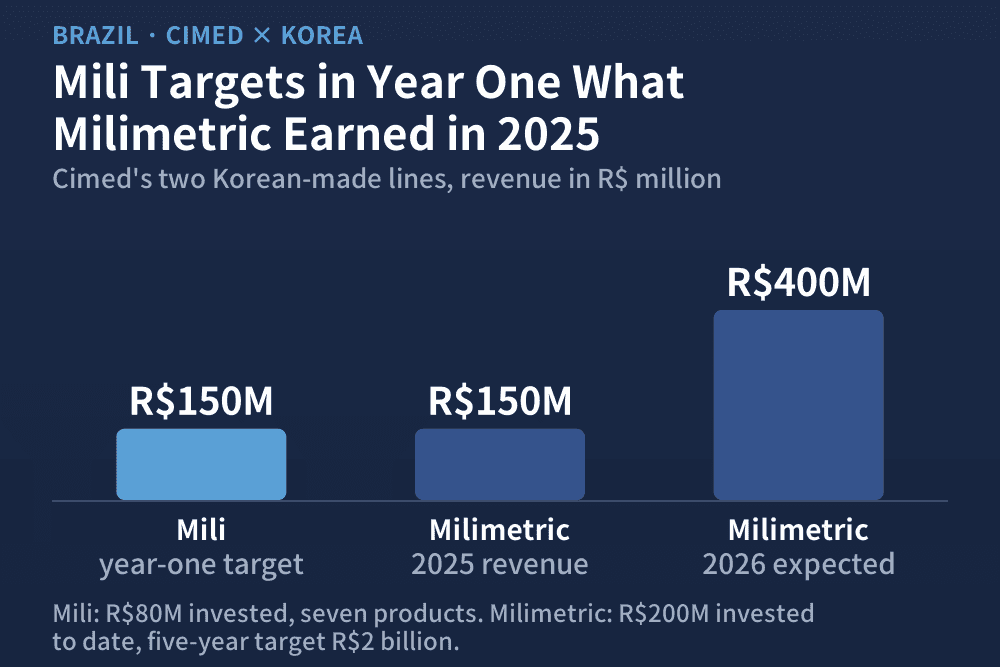
Milimetric is Cimed’s aesthetic injectables brand, a Korean-made line of fillers and injectables. It earned R$150 million in 2025 and is expected to reach R$400 million in 2026. Cimed has invested R$200 million in it so far, plans R$50 million more in 2027 and projects R$2 billion in revenue over five years.
Milimetric currently makes up about 10% of Cimed’s revenue, and the company sees it reaching 20% within that horizon. Carmed, the lip balm brand, accounts for about 15%.
Mili’s year-one target of R$150 million equals what Milimetric earned in 2025. Cimed is asking Mili to open at the level Milimetric had reached in 2025, with an R$80 million investment against Milimetric’s R$200 million to date.
What does the Cimed model change for everyone who sells into pharmacies?
A brand that sells into Brazilian pharmacies now meets a distributor with its own Korean-made skincare line, seven products priced up to R$200 and placed on the same shelves.
Manufacturers see a new kind of customer: a distributor with reach that buys formulas, not a brand that needs help finding retail. Brands and buyers see a competitor that already controls the shelf. The pharmacy chains that traveled to Seoul see a supplier that arrived with the product finished.
Korean skincare reaches Brazil through whoever owns the pharmacy relationship. In Mili’s case that owner is a drug company, and Korea supplies the formula and the factory.