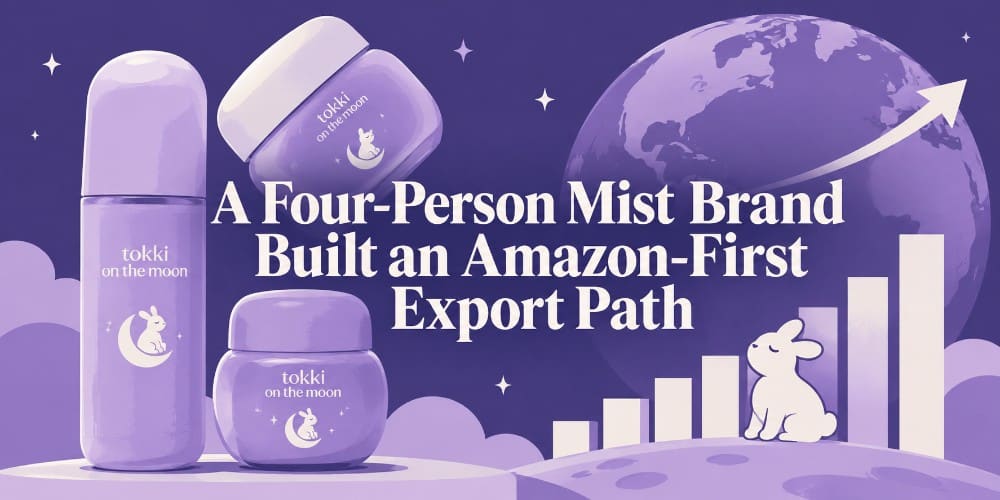
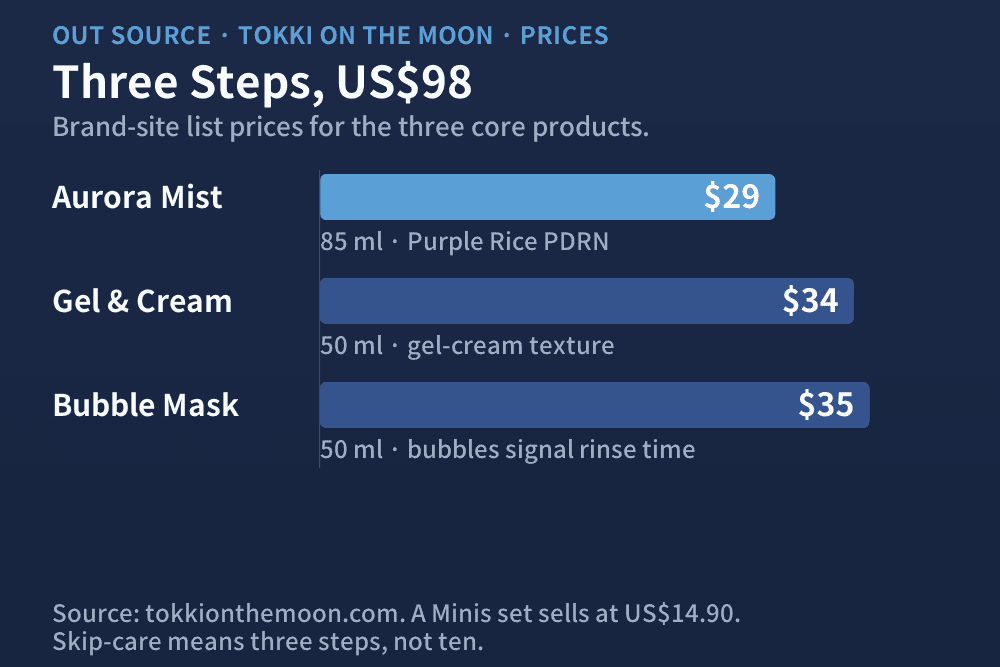
Tokki on the Moon, a Korean skincare brand run by a four-person team at Over the Moon Global, reached Amazon's top 100 in the mist category about six months after launch, and founder Yura Kim says Olive Young Global lists it in its top 20 for skincare with no separate marketing. The brand sells three core products on its own Shopify site at US$29, US$34 and US$35. It did not start with a retail shelf. It started in the two places where a ranking is public.
Who runs Tokki on the Moon?
Yura Kim founded Over the Moon Global in 2025 after 11 years in business development and marketing at Hyperconnect, Taling, Creatrip and the K-beauty brand Biodance, where she ran North America. Kim says Biodance's Amazon sales grew from zero to 60.8 billion won (US$45.3 million at 1,341.5 won per dollar, the November 4, 2026 closing rate) in 2024 under her watch. The brand she built afterward inherits that operating knowledge.
The team has four people: a branding director, a designer and two marketers, all of whom had worked with Kim or with one another at earlier jobs or internships. Kim names problem-solving as the first hiring criterion. A four-person company cannot staff specialists, so every seat carries a function.
Kim's stated goal is a cosmetic she would want on her own vanity. Her read of the market explains the goal: Korean brands have strong technology, and too few of them make people want to own the product. Tokki on the Moon is built to close that second gap through design, character and a short routine.
Why did the founder start with Amazon and TikTok Shop?
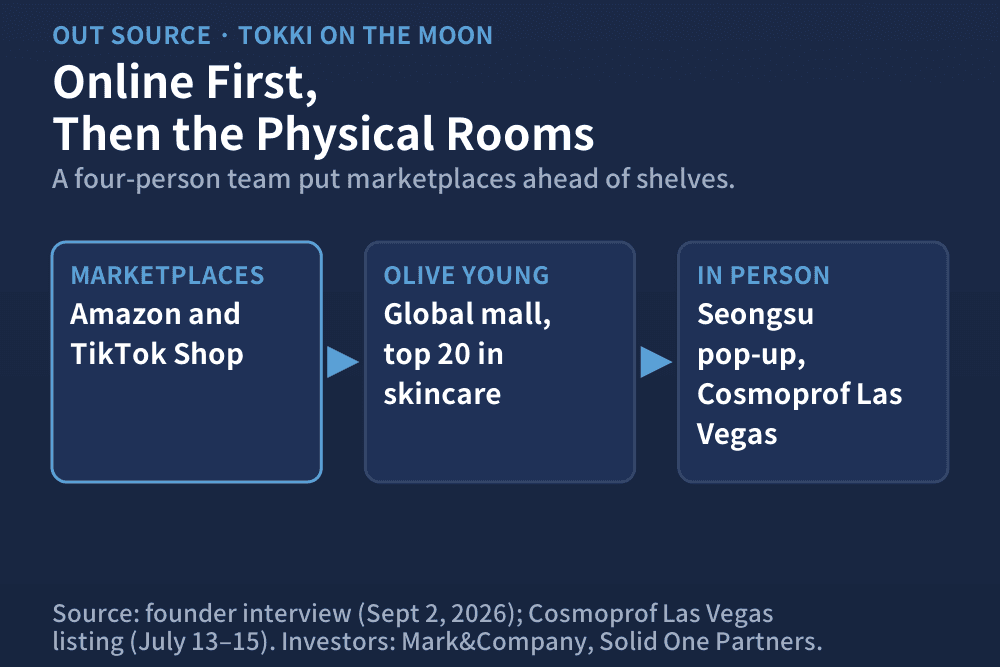
A marketplace is a measuring instrument. Category rank, review count and sales velocity are public numbers, and a buyer at a retailer can read them without calling anyone. Kim ran that instrument at scale at Biodance, and she opened Tokki on the Moon on the same two platforms: Amazon and TikTok Shop. About six months after launch, the brand's mist reached Amazon's top 100 in the mist category.
Korea-based channels followed the marketplace result. Kim says Olive Young Global, the Korean retailer's overseas online mall, placed the brand in its top 20 for all skincare with no separate marketing. Physical rooms came third: a small joint pop-up in Seongsu, a booth at Cosmoprof Las Vegas on July 13–15, 2026, and offline channel talks in North America. A U.S. customer who watched an influencer video, then visited the Seongsu pop-up and bought only the product, shows the order of events in one purchase.
What does a four-person team do with a ranking?
It converts the ranking into inbound demand. Influencer collaboration proposals ran at more than 10 a day at launch and now arrive at dozens a day. The team takes them through a form and selects the creators that fit the brand, which turns an open inbox into a screening step.
That conversion is the quiet payoff of marketplace-first. A rank on a public chart keeps working after the launch spend stops: creators, buyers and investors find the brand without an introduction. The same chart that counts as proof for a retail buyer counts as an audition for a creator.
Why is a US$29 mist the entry point?
The brand site lists Purple Rice PDRN Aurora Mist, 85 ml, at US$29, Purple Rice PDRN Gel & Cream at US$34 and Purple Rice PDRN Bubble Mask at US$35. A Minis set sells at US$14.90. PDRN, short for polydeoxyribonucleotide, is a DNA-fragment ingredient that K-beauty brands market for barrier and repair claims. Tokki on the Moon builds its version from rice PDRN, made from upcycled rice bran, and pairs it with purple rice extract, which ties the ingredient to the brand's purple color.
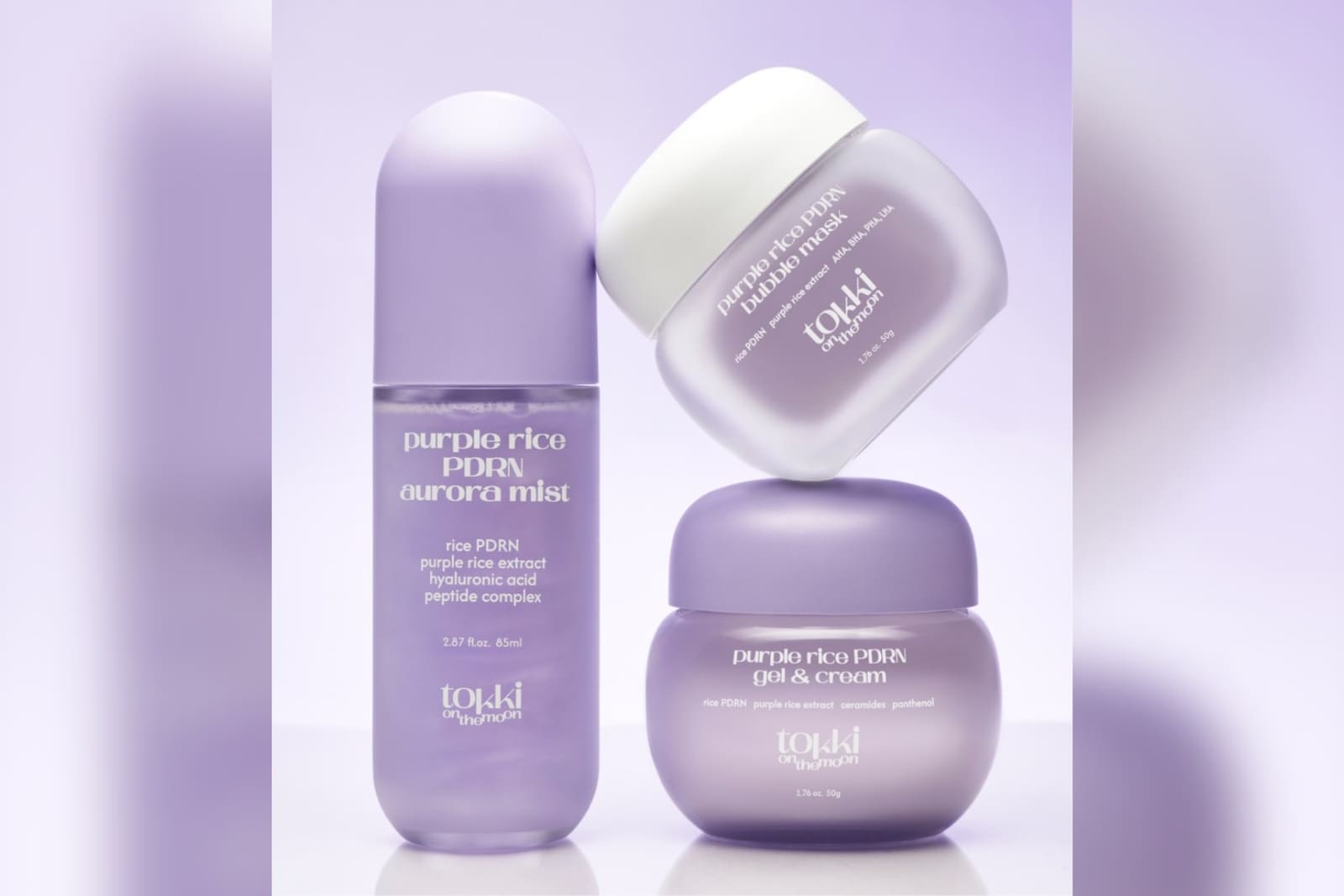
A mist is the lowest-friction product in the line. It needs no routine and no commitment, and at US$29 it costs less than any other full-size product the brand sells. The mist is where a shopper meets the brand, and the gel-cream and mask are where the basket grows.
What does skip-care do to the catalog?
Skip-care is the brand's concept: fewer steps, maximum efficacy. Kim judged that a long multi-step routine weighs on customers outside Korea, so the line is built around three products used in three steps, not ten. Kim named a cleanser in the rice PDRN line and an intensive-care serum as the next launches.
Rice PDRN is also a sourcing statement. Upcycling rice bran turns a by-product into the hero ingredient, so the story carries a sustainability line without an extra claim.
A short catalog concentrates everything a marketplace rewards. Each listing collects its own reviews, each creator video points at one of three products, and each ad dollar lands on a page that already ranks. A brand that sells ten products splits that signal ten ways.
Why did a trademark dispute improve the name?
Kim wanted to use the company name, Over the Moon, for the brand. A trademark problem blocked it, and the brand became Tokki on the Moon. The Korean word tokki means rabbit, and the moon rabbit of Korean folklore became the brand's narrator character.
The detour solved a positioning problem. A Korean word in the name carries the origin without a “K-beauty” label, so the brand does not have to announce where it comes from. Kim describes the ethos as going all the way to the moon for a good product, and the name now says that sentence by itself.
What do investors and pop-ups add that ads cannot?
Mark&Company and Solid One Partners back the company. Kim met both through acquaintances and chose them for their willingness to grow beauty companies, their understanding of the beauty market and their networks. Their practical contribution is introductions to distributors, a place at offline events and links to government support programs. A four-person team cannot staff any of the three.
Pop-ups play a different role than ads. They convert viewers who already know the brand from a video into buyers who already trust it, and they produce the offline results that retail buyers ask for. The expansion list shows where the next conversations are: Singapore, Japan and the Middle East are in talks, and Europe is at the pre-entry stage while licensing is prepared.
What does the order say about indie export?
A conventional export path wins a retail shelf first and a marketplace ranking second. Tokki on the Moon reverses the sequence. The ranking comes first because a ranking is cheap to earn, public to read and portable to any buyer, and the shelf comes later because the ranking already answered the buyer's first question.
An export path is a sequence of proofs. The marketplace proves demand, the Korean platform proves the brand's origin, and the pop-up proves the product in person. The brand that orders those proofs by cost, cheapest first, reaches the expensive channels with a file of evidence in hand.
The team's size sets the limit. Four people can run a marketplace, a creator inbox and a pop-up, and they cannot run a national retail rollout. Investors who open distributor doors fill that gap, and the channel order leaves room for them.