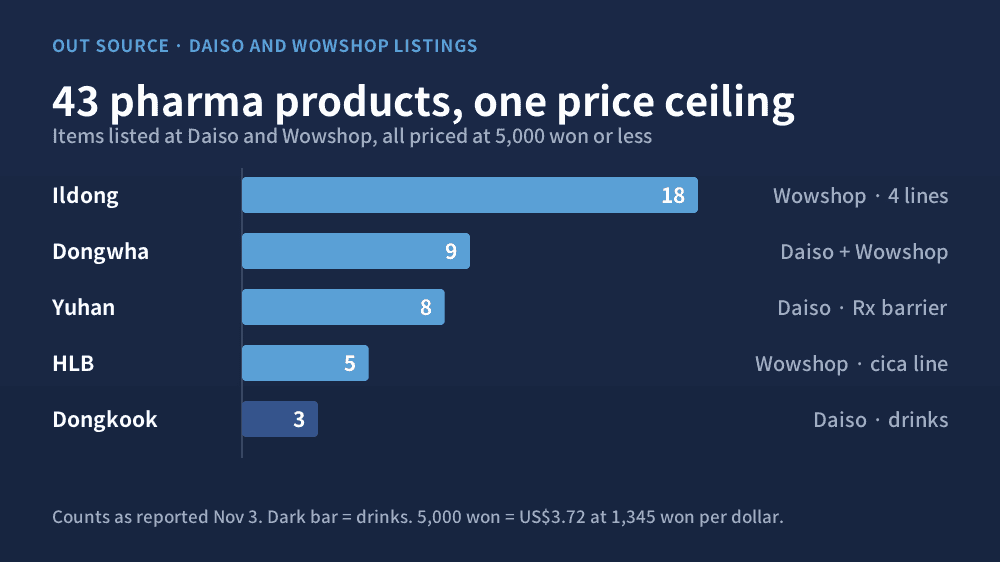
Five Korean drugmakers now sell products where nothing costs more than 5,000 won (US$3.72): Yuhan 8 skincare items at Daiso, Ildong Healthcare 18 at Emart's Wowshop, HLB Life Science 5, Dongkook 3 drinks, Dongwha 9 at 2,000–3,000 won (US$1.49–2.23). Daiso runs about 1,600 stores and booked 4.54 trillion won (US$3.37 billion) in 2025 revenue. The usual assumption is that pharmacist trust protects a price. These listings run the opposite test: the trust travels to the shelf, and the shelf sets the price.
What did five drugmakers put on the shelf?
The listings, as reported on November 3, 2026, cover five companies and 43 products. Yuhan launched 8 items under Dermapuramin Rx, its sensitive-skin barrier brand, exclusively at Daiso. Ildong Healthcare placed 18 dermocosmetics, skincare positioned between mass cosmetics and prescription care, in the H&B corner of Emart's Wowshop. H&B is Korean retail shorthand for health and beauty. The 18 items span four lines: moisturizing, brightening, soothing and sun care.
HLB Life Science put 5 Tetraforce cica products into Wowshop, from toner to clay mask. Cica is centella asiatica extract, the standard soothing ingredient in Korean skincare. The company announced the listing on October 26, 2026, and the products entered the stores on October 22. Dongkook sells 3 push-type drinks at Daiso. Dongwha launched 9 Daiso-exclusive products in 2026 at 2,000–3,000 won (US$1.49–US$2.23) and has now added a Wowshop display, the only one of the five present in both channels.
Daiso is piloting a beauty specialty store, and beauty, fashion and pharmaceutical companies all develop Daiso-exclusive products for it. The categories differ. Yuhan, HLB and Dongwha sell skincare or makeup, and Dongkook sells ingestibles. The common thread is the price. Every item in the reported listings sits at 5,000 won or less.
Why do Daiso and Wowshop count as one channel?
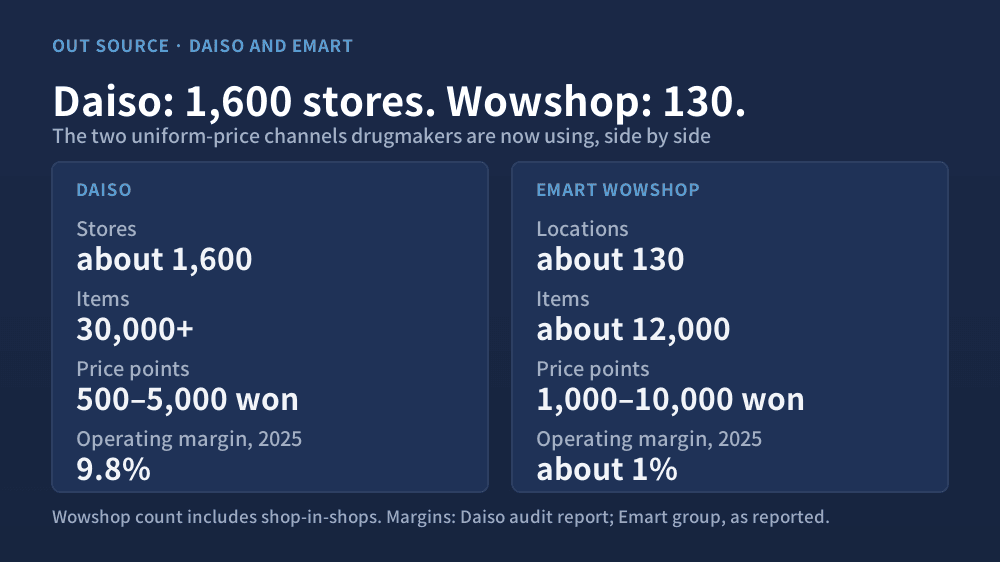
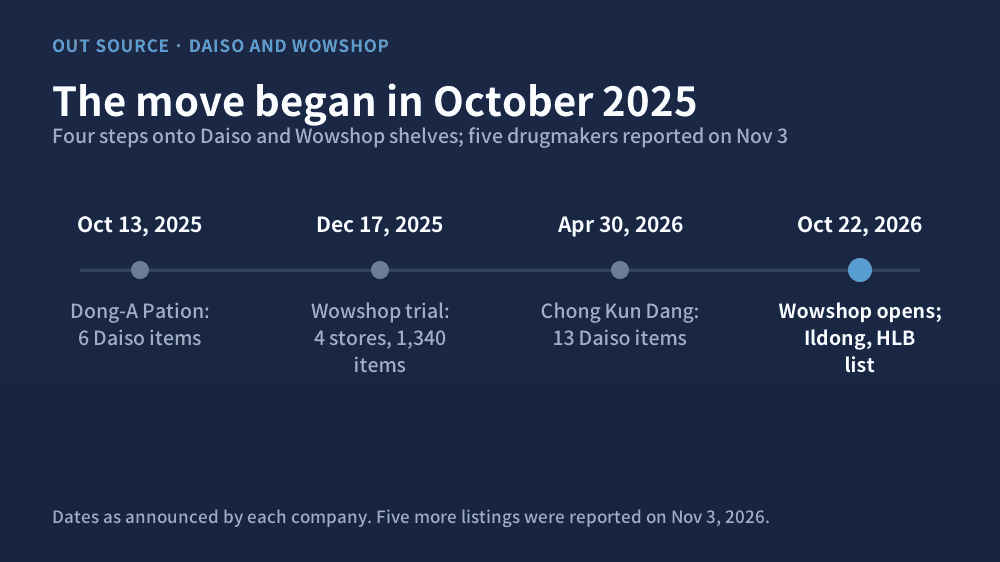
Daiso is Korea's uniform-price chain. It operates about 1,600 stores and carries more than 30,000 items at six price points from 500 to 5,000 won (US$0.37 to US$3.72). Wowshop is Emart's answer to it. Emart, the hypermarket arm of Shinsegae, began with a four-store trial on December 17, 2025 that offered about 1,340 items at 1,000–5,000 won.
The full format opened on October 22, 2026 at Emart's Wolgye and Eunpyeong stores, about 100 pyeong (330 square meters) each, with more than 12,000 items at fixed prices up to 10,000 won (US$7.44). Wowshop currently counts about 130 locations, including shop-in-shops, which are small units inside existing Emart and Emart Everyday stores. Emart plans five standalone stores by the end of 2026. Ildong and HLB both listed at the two October 22 openings.
All conversions here use 1,345 won per dollar, the November 3, 2026 close.
What does a 5,000 won ceiling do to a pharma brand?
US$3.72 has to cover formula, container, carton and the retailer's margin. A brand that sells at that price is built backward from the ceiling, and the Daiso-exclusive labels say so. Dongwha's Daiso items are priced at 2,000–3,000 won, which is under US$2.23. Yuhan's 8 items were developed for Daiso alone.
What survives the ceiling is the ingredient story. Yuhan's lead barrier line lists panthenol at up to 5%, plus cica-derived lactic acid bacteria and PDRN, a DNA-fragment ingredient used in skin-repair products. Those are the company's own formulation claims. Dongwha's list runs from a panthenol sherbet cream to a glow-fitting cushion, a makeup compact, so the range stretches from soothing to color. A drugmaker cannot sell service at 5,000 won, so it sells credentials on the label.
Does a pharmacist's trust travel to a shelf with no pharmacist?
In a pharmacy, a person recommends the product. At Daiso and Wowshop, the shopper picks alone. The recommendation has to move onto the pack: the company name, the brand name, a clinical-sounding formula. Dermapuramin Rx carries a prescription signifier on a product priced under US$4.
That is a bet that the drugmaker's badge is portable. The reported listings contain no repeat-purchase data, no unit sales and no revenue by line, so the bet is currently unmeasured.
Why are drugmakers moving into non-drug channels now?
An industry official said cosmetics and general products earn better returns than medicines, which is pushing companies toward non-drug sales channels. The demand side is visible at Daiso. Daiso's beauty sales rose about 70% in 2025 and about 30% in January–April 2026 against the same period a year earlier.
Daiso's audit report puts 2025 revenue at 4.54 trillion won (US$3.37 billion), up 14.3%, with operating profit of 442.4 billion won (US$329 million), a margin of 9.8%. The move is also older than this week. Dong-A Pharmaceutical's Pation put six Daiso-exclusive products on shelves in October 2025. Chong Kun Dang listed 13 health-food products on April 30, 2026. The November 3 listings extend a pattern.
What does Emart get out of Wowshop?
Emart operates 397 stores nationwide as of the second quarter of 2026, and reported an operating margin of about 1% for 2025, against Daiso's 9.8%. A format that must hold 5,000-won price points on that margin needs traffic, and traffic needs brands that arrive with their own demand. Daiso has spent years collecting them. Wowshop has about 130 locations and about 12,000 items against Daiso's 1,600 stores and 30,000.
Drugmaker brands solve part of that gap. They carry a known name into a new format without Emart funding the brand. Ildong and HLB are in the first two standalone stores. For a retailer building a beauty shelf from zero, that is the cheapest credibility available.
Can one SKU sit in both a pharmacy and a 5,000 won shelf?
No. The ceiling forces a separate SKU, a separate pack size and a separate price architecture. A SKU, or stock-keeping unit, is one sellable item in one size. Yuhan's and Dongwha's Daiso lines are exclusive to Daiso. Each company now runs the range it already had and a second range built backward from 5,000 won.
The two ranges share a name. They do not share a purpose. The pharmacy range sells the brand to a shopper who asks for advice. The Daiso range sells the brand to a shopper who does not ask. When the same name sits at both prices, the cheaper shelf sets the reference price in the shopper's mind.
What does the split mean for everyone else in the chain?
For manufacturers, a sub-5,000-won SKU is a volume contract with a fixed ceiling on unit economics. Capacity fills when the shelf sells, and the manufacturer carries the cost pressure every time raw materials move.
For brands and buyers, a price ceiling turns brand equity into an entry ticket. The drugmaker name opens the door. The shopper's second purchase decides whether the name keeps its value outside the pharmacy.
For regulators and investors, the reported counts say nothing about revenue. Reading a drugmaker's cosmetics line now requires the split by price tier. The 5,000 won tier grows units. Whether it grows profit is the number nobody has published.
The shelf sets the price. The brand has to survive it.