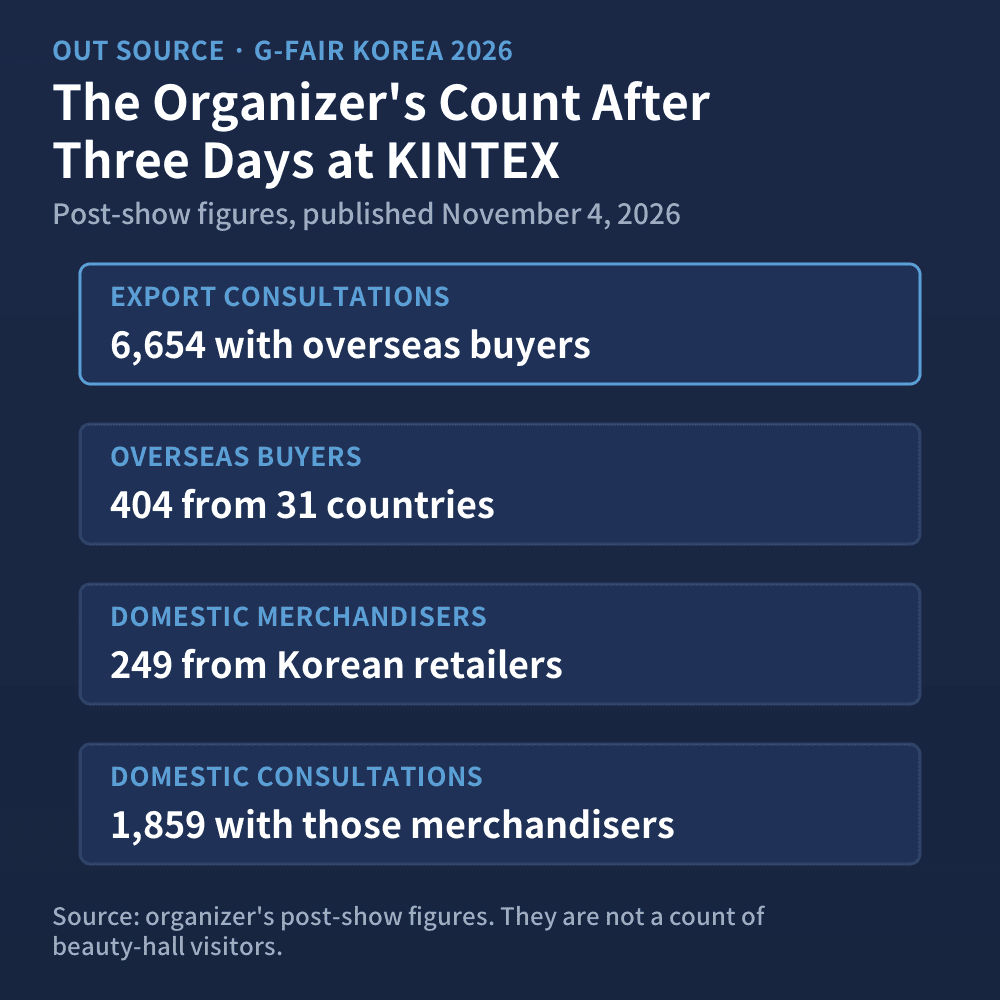
The organizer of G-FAIR KOREA 2026 reports 6,654 export consultations with 404 overseas buyers from 31 countries across three days at KINTEX, October 29–31. I walked the beauty hall, and the aisles felt thin to me. The booth that held my attention sold sleeping packs in triangular pouches. Foreign buyers showed interest, and its staff said customer response has been very good. A show can post large totals and still feel thin on the floor. The totals and the floor measure different things.
What did the organizer count, and what did I count?
The organizer's figures for the show are 6,654 export consultations with 404 overseas buyers from 31 countries. Those buyers were invited for export consultation sessions, so the number counts meetings, not foot traffic. Across three days it averages out to about 16 consultations per buyer.
I counted something else: how many people were standing in the aisles. In the beauty hall they felt thin to me. My own photos complicate that impression, because they show visitors at the Judaan and KMP Cosmetics booths and a tasting zone with most seats taken. Both things are true. Thin beside K-Beauty Expo is not empty, and a meeting schedule fills a calendar without filling a hall.
The organizer's figures also cover the whole show, which spans four product categories: beauty, food, living and technology. They do not isolate the beauty hall, and I will not guess at its share.
What did a two-hour talk teach me before I saw a booth?
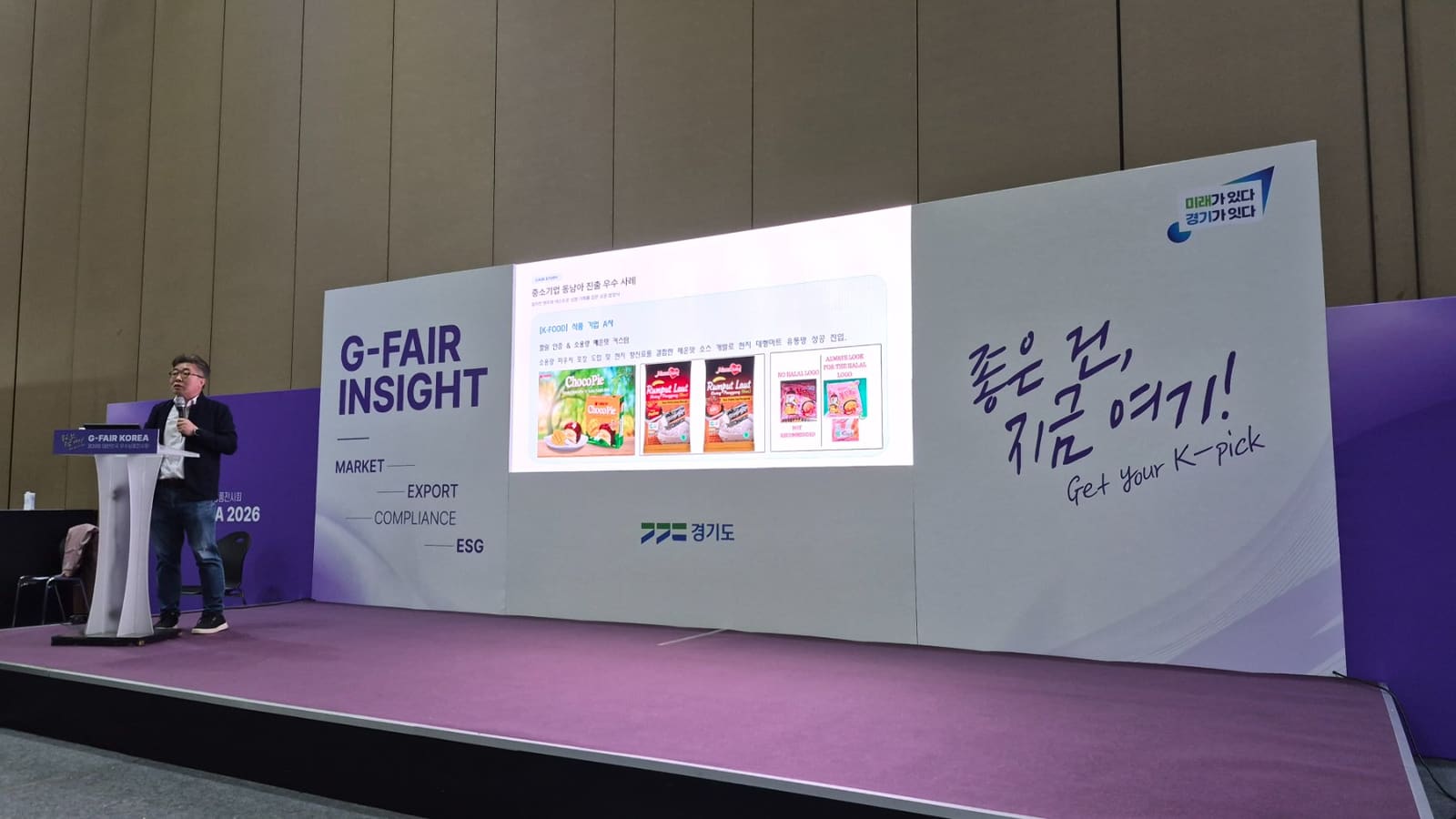
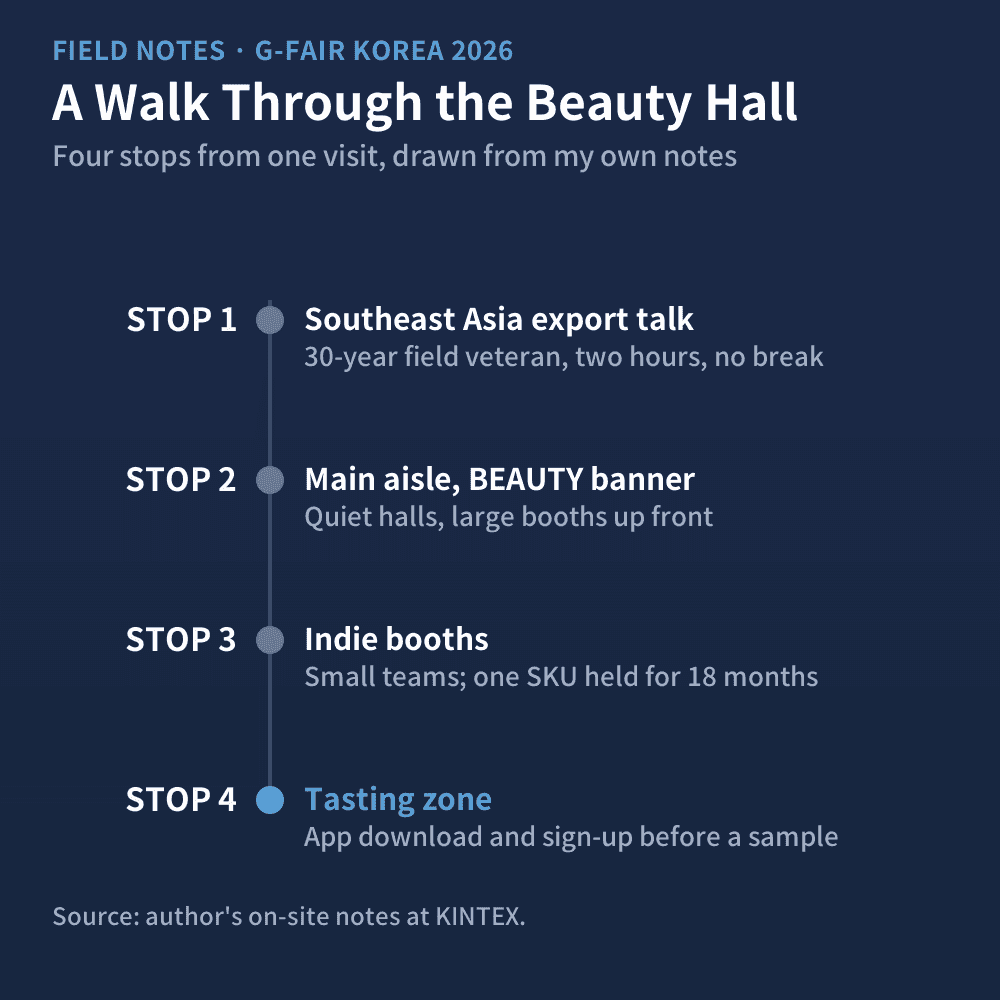
My first stop was a seminar on selling Korean consumer goods in Southeast Asia. It ran two hours without a break, and it never dragged. The speaker, who stood at a podium in front of a backdrop reading G-FAIR INSIGHT, had spent thirty years in export work, all of it in the field. The backdrop listed four tracks: Market, Export, Compliance and ESG.
His method was the opposite of a slide deck. Days before a trade show opens, he arrives on site and leaves his business cards at the restaurant where buyers eat breakfast. I had never heard that from a large-company expatriate.
One slide shows how concrete the talk was. Titled in Korean as outstanding cases of small and midsize companies entering Southeast Asia, it profiled a K-food company. It listed halal certification, small-size packaging and a localized spicy flavor. Beside the product shots sat a second image labeled NO HALAL LOGO, NOT RECOMMENDED and ALWAYS LOOK FOR THE HALAL LOGO. On that slide, a mark on the pack sat next to flavor and size as a market-entry decision.
Why did a thirty-year field veteran carry more weight than a big-company posting?
A short time earlier I had sat through a talk by someone who worked at an overseas branch of a large conglomerate. The two experiences were different in kind. The branch employee had been a gear in a machine with an assigned role. The veteran had made his own calls, taken responsibility for the results, and survived the variables of the field.
A large company has no reason to hand out cards at a breakfast restaurant. Its name does that work. A small exporter has no such name, and the veteran's habit is what that absence looks like in practice.
How did the beauty hall compare with K-Beauty Expo?
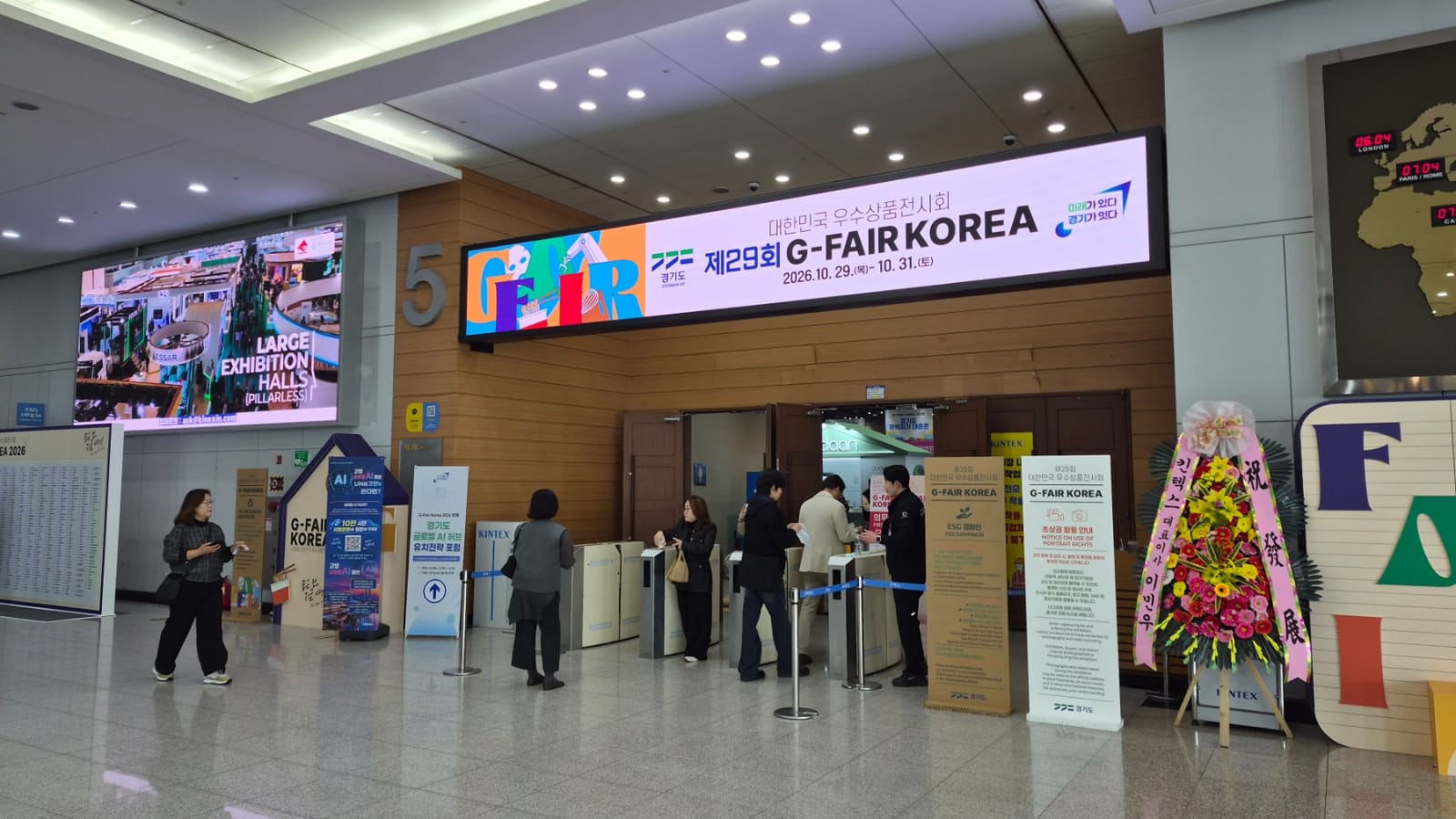
I came in through gate 5, under an LED sign announcing the 29th G-FAIR KOREA, October 29 (Thursday) to October 31 (Saturday). Turnstiles, a portrait-rights notice, an ESG campaign stand and a congratulatory flower wreath filled the lobby.
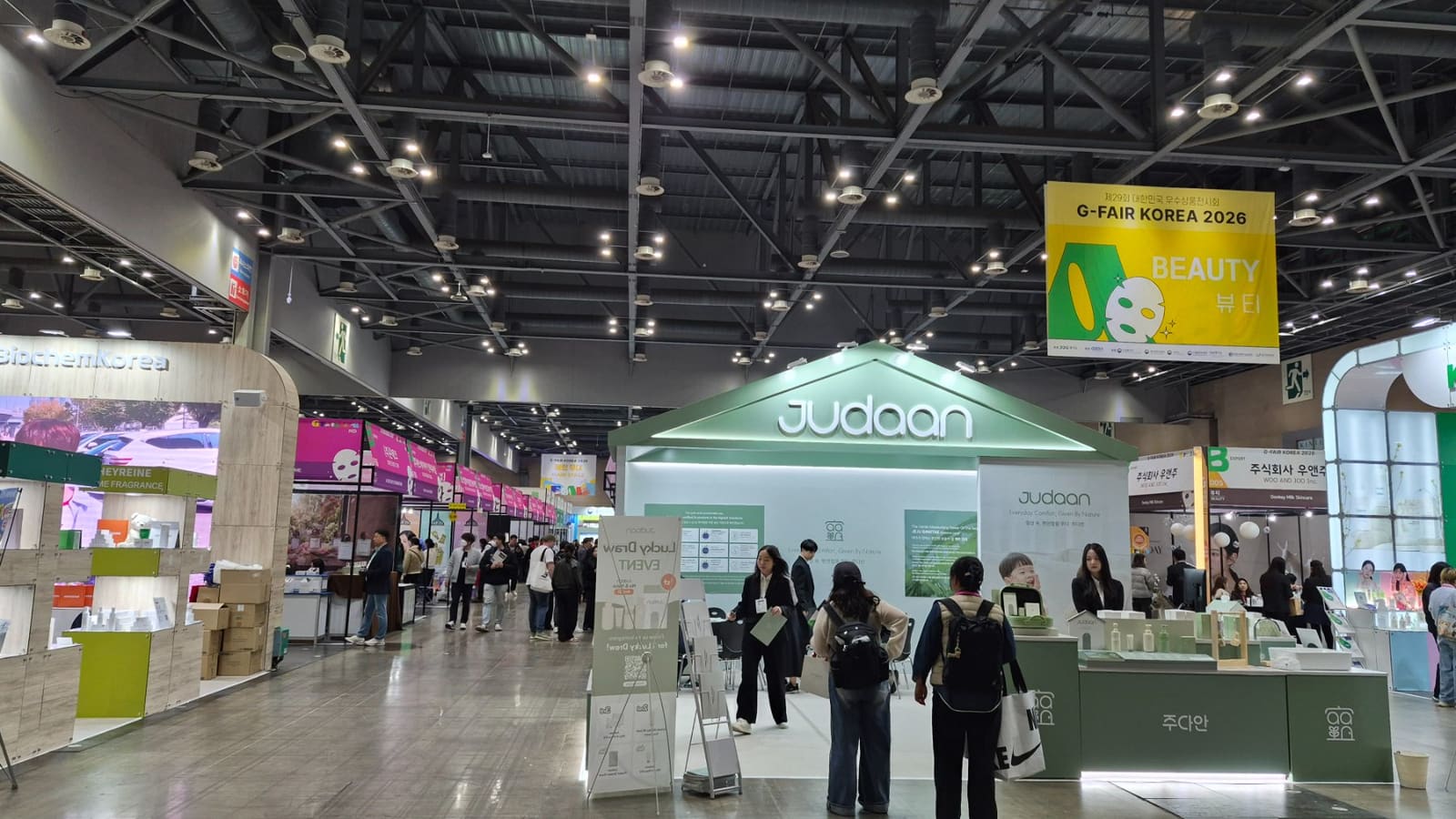
Inside, a large BEAUTY banner with a sheet-mask graphic hung over the front of the hall. Below it stood Judaan in a sage-green house with a peaked roof, and across the aisle the green-and-white KMP Cosmetics booth. Visitors stood at both. The aisle beside BiochemKorea held a fair number of people. Even so, the beauty aisles felt thin to me. The K-Beauty Expo I attended earlier was loud and crowded by comparison. This was a different temperature.
Two structural facts explain it. Participation is restricted to companies based in Gyeonggi Province. And the show is a general exhibition, not a beauty-specialist event, so beauty is one hall among several categories and the identity of the show is spread thin.
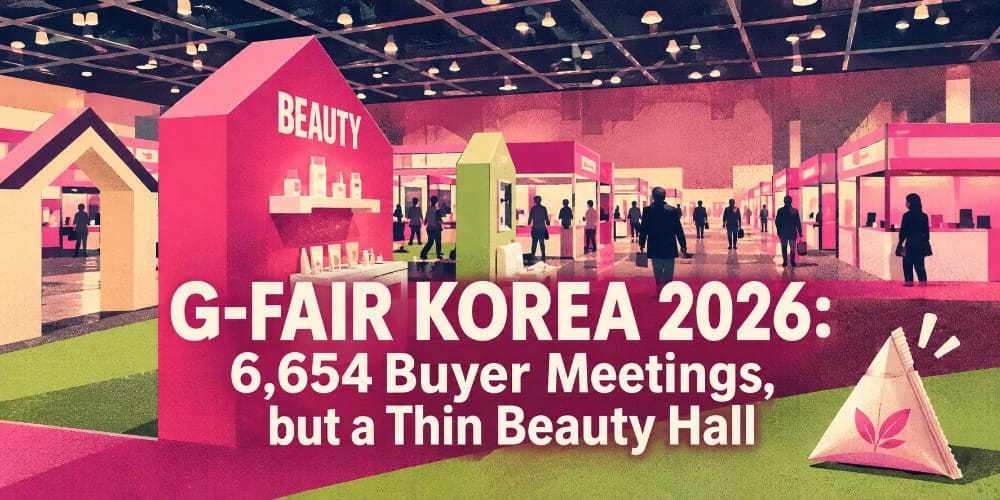
The floor was dressed like a village. The G-FAIR Showroom set house-shaped BEAUTY, FOOD and LIVING pavilions on artificial turf. A wall of the pink BEAUTY house carried the line: A quiet moment of care, a softer mood, and that feeling of being ready for whatever the day brings. Beyond it, magenta fascias marked export booths, among them HYETO and The EL Group. A blue heart-shaped photo zone read G-FAIR KOREA 2026, and Yongin City ran an export promotion booth for its YOGO brand next to BalanceRX.
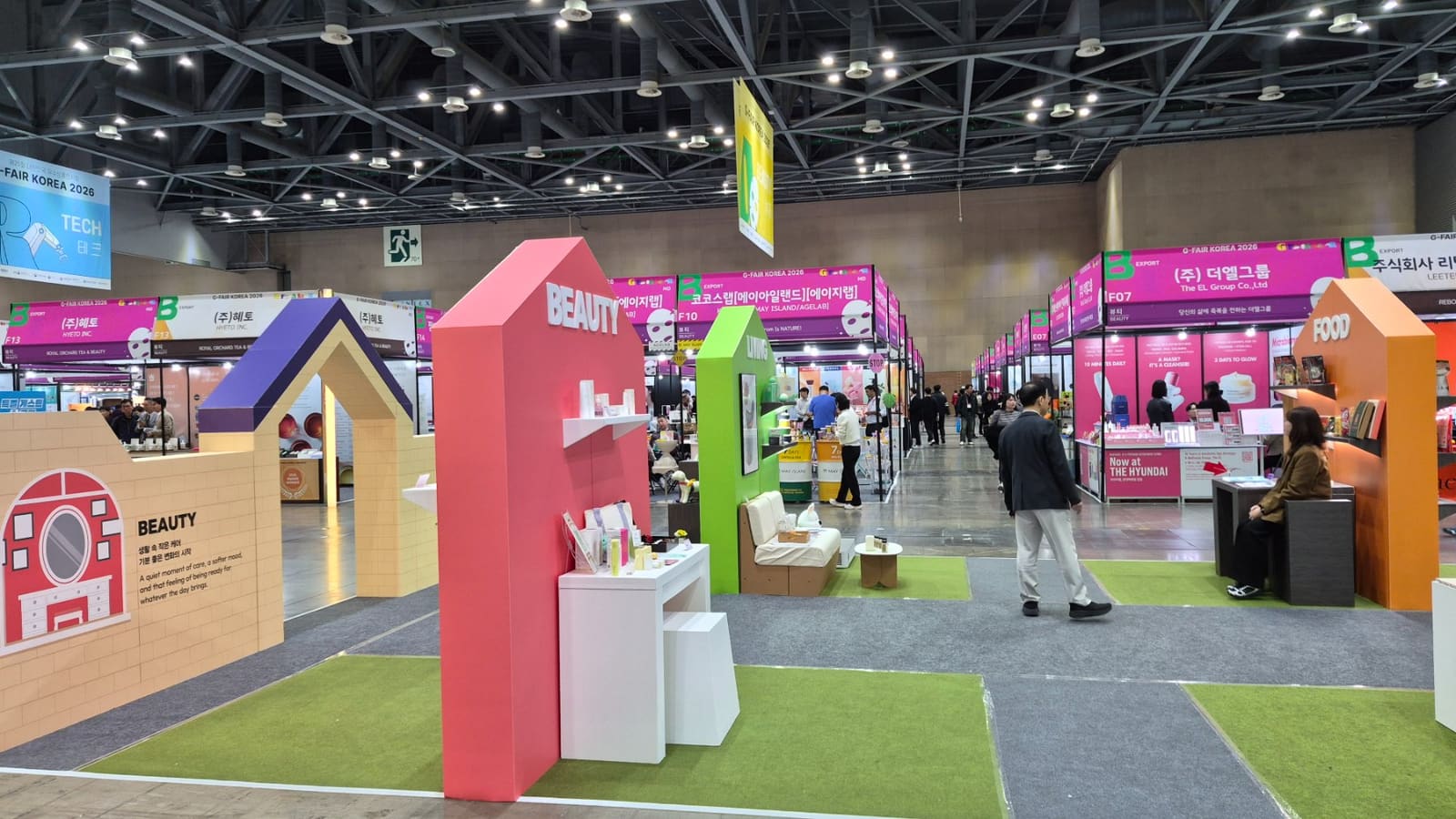
One irony stayed with me. The seminar speaker had said he never attends general trade shows. He was giving that talk on the stage of one. A pop-up showroom under the slogan "Get Your K-pick" and hanging banners for Gyeonggi's trade-crisis response zone and the main stage sat above a floor that did not match their energy. Under the banners, TikTok for Business QR stands faced a turf-floored seating area.
Who was actually standing in the booths?
Among the independent beauty booths, most were run by one person or a team of three or fewer. Capital is the constraint, and light organizations and stubborn survival are the answer. One founder told me she lasted eighteen months on a single SKU before launching a second product. A year and a half with one product carrying the whole company is a heavy thing to hear across a booth table.
When I offered encouragement, she smiled and said many of the founders at the show were on a similar path.
The larger booths were mostly run by companies that operate their own manufacturing plants and run an own brand alongside. They met overseas buyers with two offers at once: their own finished products for export, and OEM or ODM work. OEM means a factory builds a product that another company sells under its name, and ODM means the factory also designs it. The dual model is how a plant owner fills a booth.
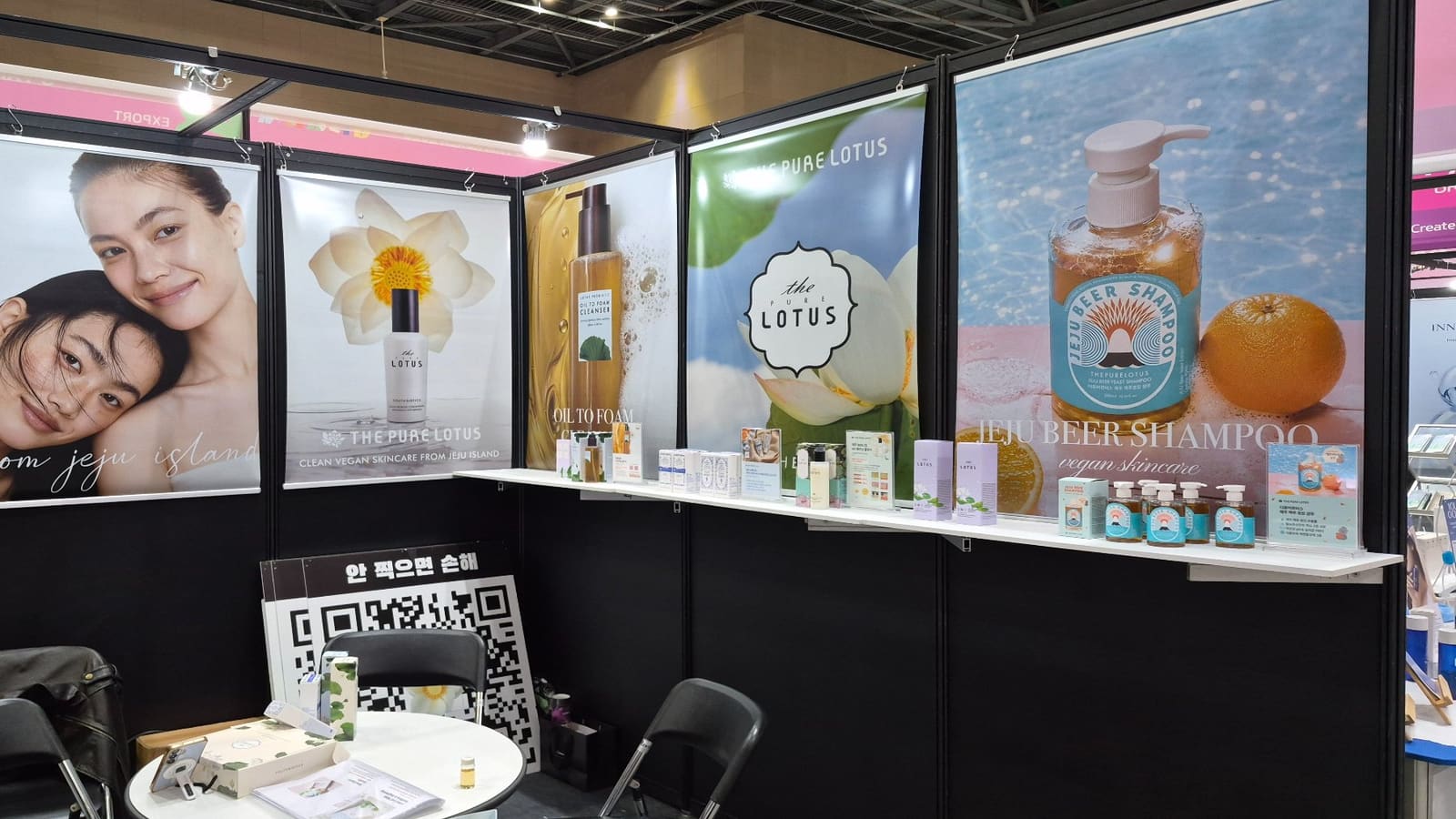
Small details showed how each booth fought for attention. At the Pure Lotus booth, which showed vegan skincare from Jeju including a Jeju beer shampoo, a QR sign on the floor read, in Korean, that you lose out if you do not scan it. On another table, a caffeine hair-care line promised 10,000 ppm of caffeine on its display card, beside colorful sachet masks printed with Study all night! and Relieve hangovers!
Why did I walk away from the tasting zone?
Past the beauty hall sat the G-FAIR KOREA tasting zone, built to look like a campsite: artificial turf, wood frames, string lights, camp chairs. Most of the seats under the string lights were taken, and recycling bins stood at the edge of the turf. It looked good.
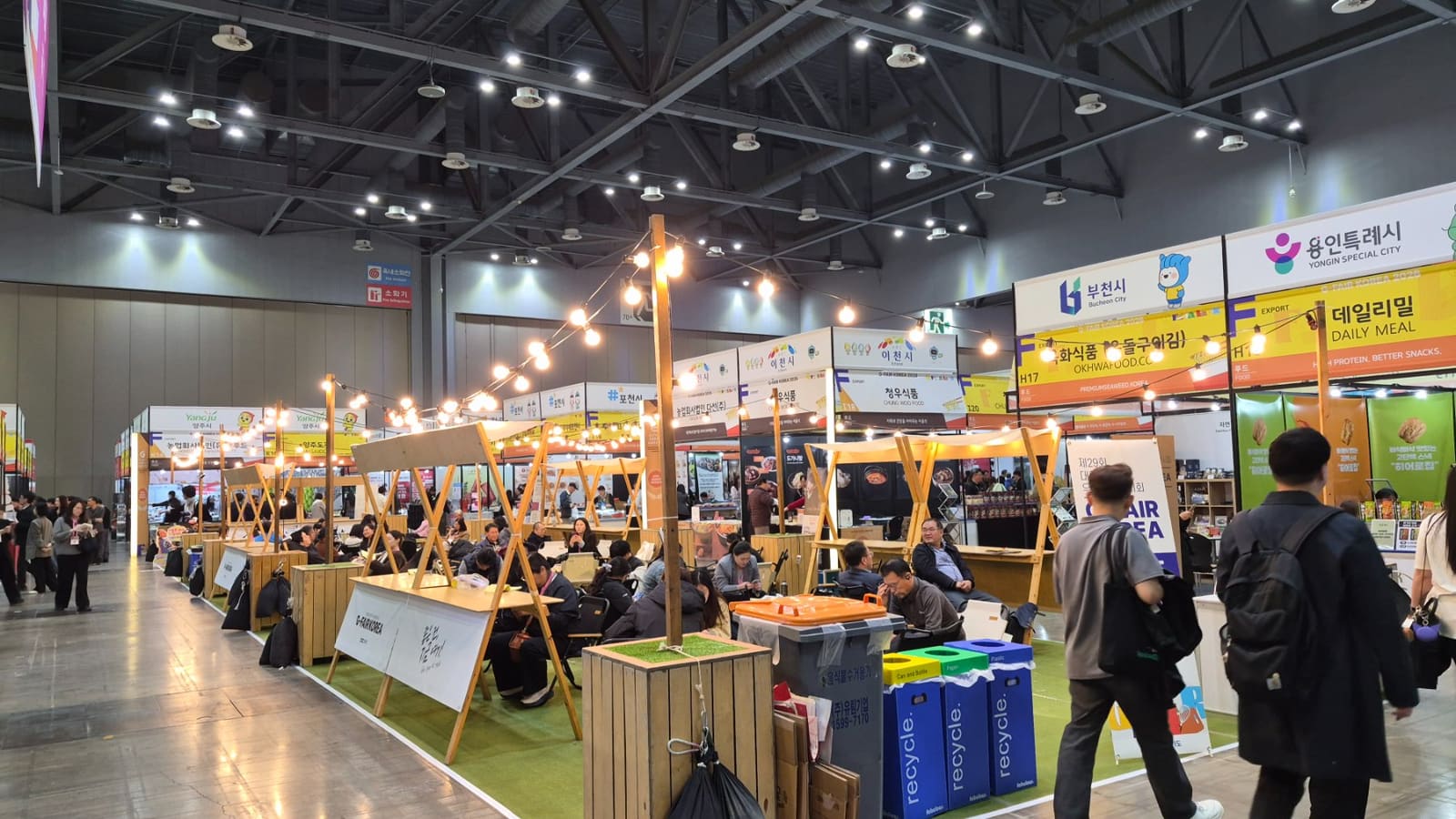
Some exhibitors required a visitor to download a dedicated app and complete a membership sign-up before tasting a single item. However tempting the sample, the barrier at the point of experience was too high. I never tried the app. I turned around.
The contrast was the Greece Food Expo, where I once took part. Buyers there were given food and wine freely, and the product entered their hands before any sales conversation began. I cannot say whether the app wall at G-FAIR KOREA was thrifty design or deliberate marketing. A sample behind a registration form is a different thing from a sample in a hand.
What made one booth in the hall stand out?
The booth that caught my eye belonged to May Island. Its products were a sleeping pack, a scrub and an ampoule, each sold in a triangular pouch. Of everything in the beauty hall, the shape was what I noticed first.
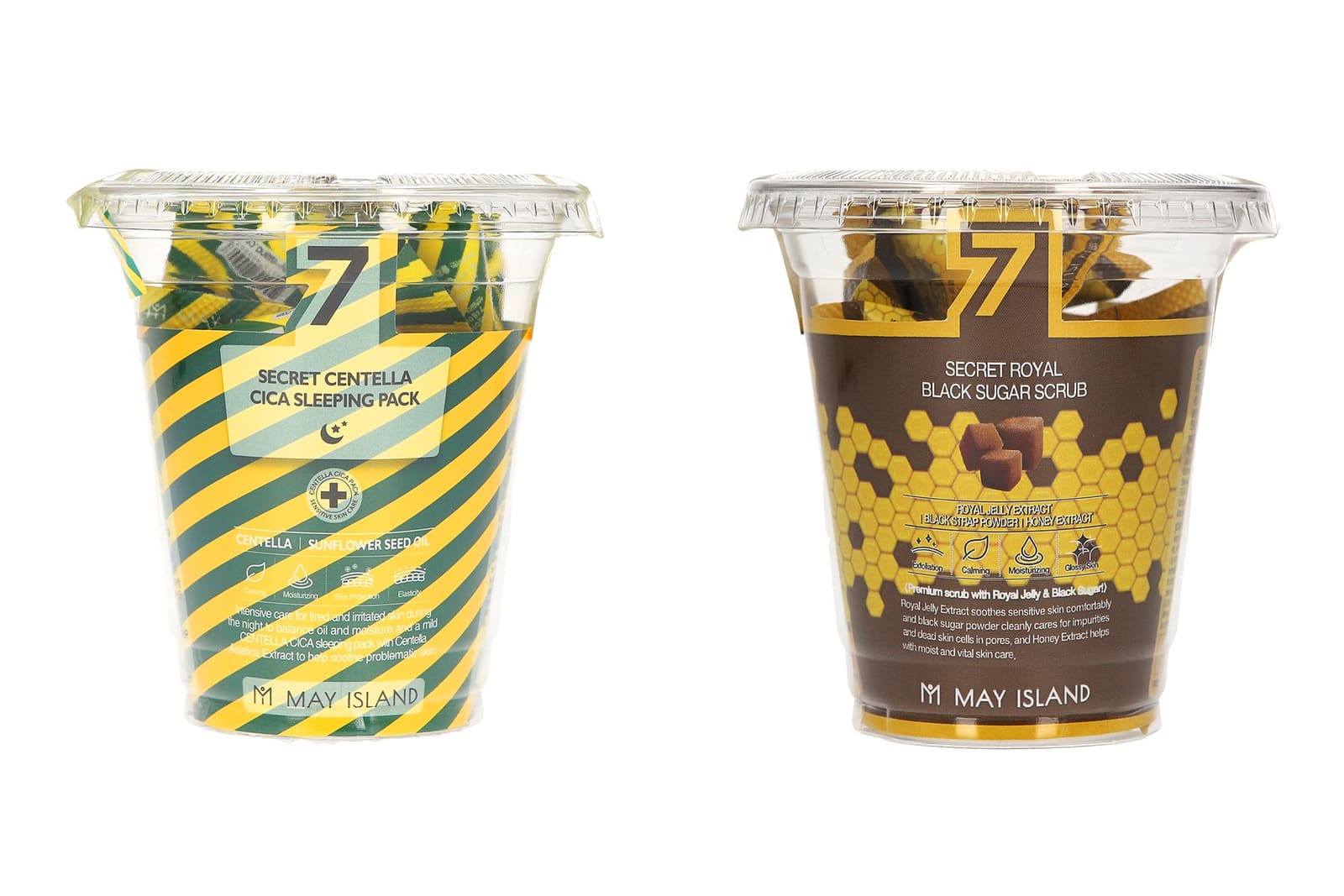
The booth was F10, under a magenta fascia that listed Kocoslab, May Island and Agelab in Korean and English. I read nothing into that relationship beyond what the banner states. Cafe-style folding tables stood inside. A yellow SLOW sign and a hazard-striped MAY ISLAND sign hung from the frame, and they echoed the diagonal stripes on the pouches.
Foreign buyers showed interest in it, and the booth staff told me why the company chose the format. In the staff's account, the pouch is a pre-emptive response to tightening packaging rules such as the EU's PPWR, and customer response has been very positive.
Does a pouch answer a packaging regulation?
PPWR is the Packaging and Packaging Waste Regulation, Regulation (EU) 2025/40, the EU rule that sets requirements for the design, recyclability, recycled content, reuse and labeling of packaging placed on the EU market. It entered into force on February 11, 2025, and generally applies from August 12, 2026. The recyclability performance requirements start in 2030 and tighten in 2038.
A shape is not a grade. Recyclability is judged on the whole packaging unit and its materials, not on how the container looks. Compliance guidance for cosmetics lists tubes, composite pouches and small samples among the formats that need attention first. From a booth I cannot see whether a pouch is a single material or a laminate, and the material decides the outcome.
The stage slide had already listed halal certification and small-size packaging among one company's market-entry choices. So I do not claim that May Island's pouch complies with PPWR. The claim I can make is narrower and still useful. A brand in this hall says it read the packaging rules early and built its pouch line around them, and buyers noticed.
Why should shows like this keep running?
Measured against its budget and promotion, this show left exhibitors with modest results. The thin aisles, the app wall and the hanging banners all point the same way. I left with mixed feelings.
The case for the show does not rest on those results. An indie brand with one product and no capital has no showroom, no buyer relationships and no breakfast-restaurant campaign. A local-government show gives it a floor to stand on and a buyer who has already been invited.
Programs like this need to run every year. For the smallest brands, the alternative is not a better show. It is no show.