In 2024 ATHOME built an overseas team, spent a year running it, and produced nothing. The chief executive’s own word for that year is failure. Twenty months later the same company’s device holds the top weekly spot in TikTok Shop’s US Skincare Tool category at about $300, in a ranking where most products sell between $15 and $150. What changed in between was not the device. The device was already finished.
What did it cost to build the product nobody asked for?
ATHOME started in 2018 with LED masks and grew on small home appliances sold under the brand Minix. The move into beauty was not an adjacency anyone in the market was waiting for, and the company has been open about how it was received. Chief executive Yang Jungho puts development of the first THOME device at 3 billion won, or US$2.26 million, over one year and ten months.
The bill arrived before the product did. ATHOME swung to an operating loss that year. Team members Yang describes as the people he valued most began leaving. A company with a working appliance business had spent almost two years and its profitability on a category it had no standing in.
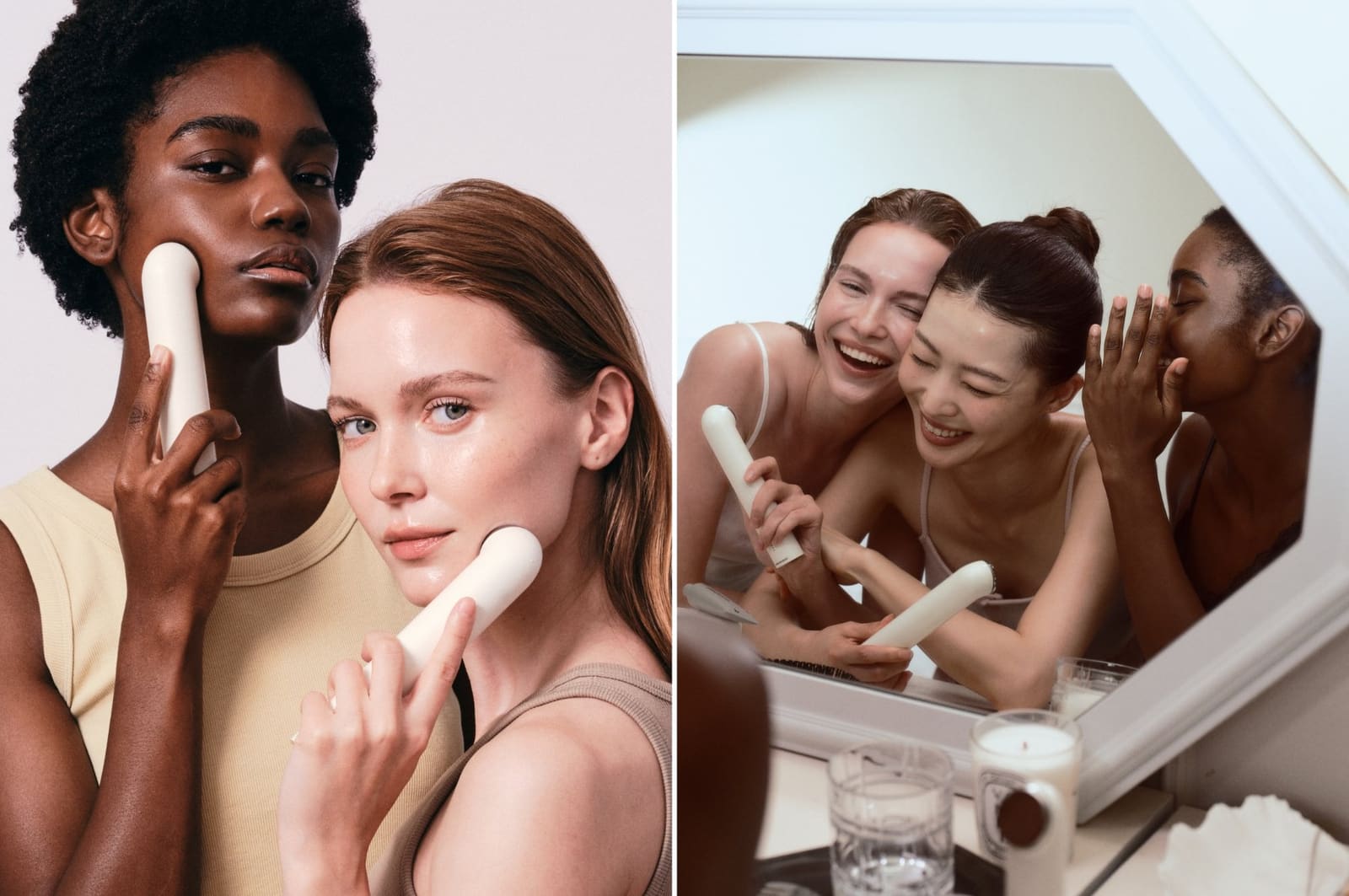
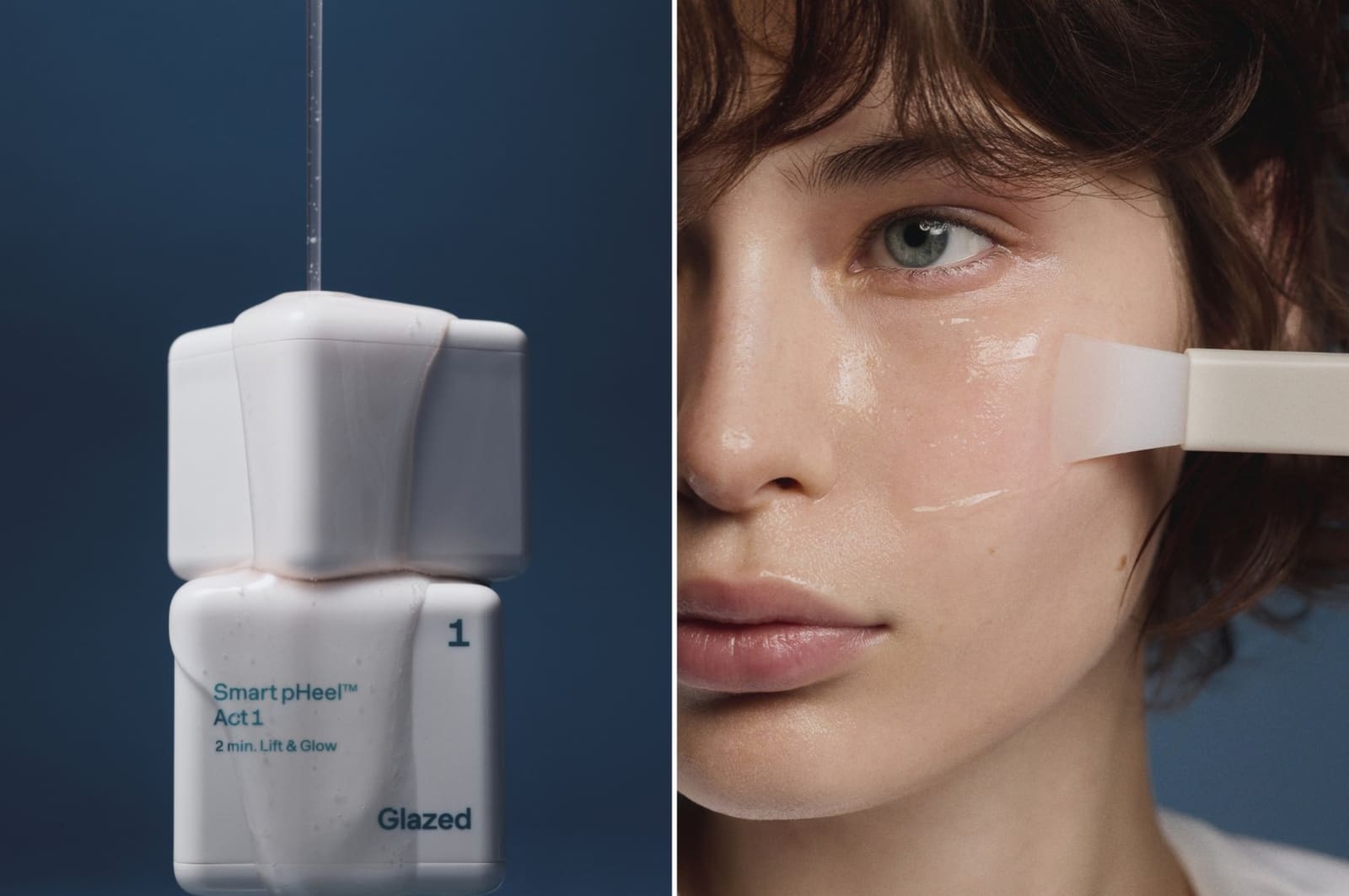
The Glow, the device that came out of it, is a water-droplet ultrasonic handpiece. Ultrasonic here means it transmits high-frequency vibration into the skin rather than heat or current; THOME runs two frequencies, 3 MHz and 10 MHz. The Glow Signature weighs 137 grams and sets its head at 110 degrees. It is a finished piece of hardware, and in 2024 it sold nowhere outside Korea.
What actually happened on the first attempt to go abroad?
The overseas team was founded in 2024 and ran for a year without a result. Yang’s account names the reason without softening it: no product adapted to the market, no strategy, no infrastructure, no team built for the job. Money went out and nothing came back.
This is the part of the story most companies do not publish, and it is the part that makes the rest of it legible. The device that ranked first in three American channels in 2026 is the device that sold nowhere outside Korea in 2025. The hardware was never the variable.

What did ATHOME rebuild in the year after?
Yang lists six things the company reworked before trying again: product, strategy, organization, certification, supply chain, operations. The relaunch date is specific. Devices went overseas on May 29, 2026.
Five of those six are invisible from outside the company. A buyer looking at the shelf in August 2026 sees a Korean brand that appeared from nowhere and went straight to the top of a category. What the buyer cannot see is a year of conformity files, factory line conversion, freight and customer-service design. That year is the asset, and it is the part of this case that does not transfer by being admired.
Why does certification sit on a founder’s list next to supply chain?
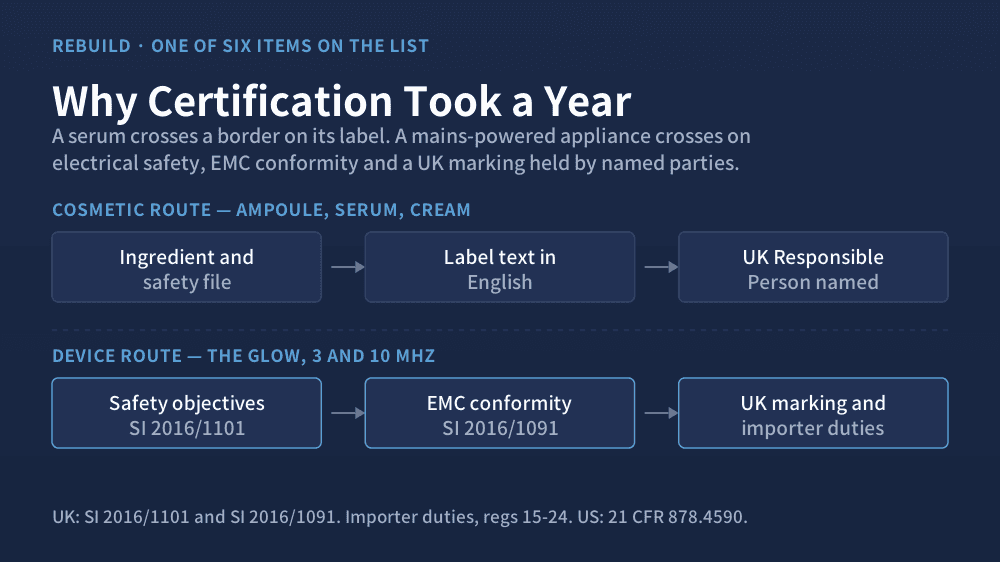
Because a powered appliance and a serum do not cross a border the same way, and a cosmetics company’s paperwork does not carry over.
A cosmetic entering the United Kingdom needs a responsible person — a named party established in the UK who holds the product information file and answers to the regulator. A mains-powered device needs a different file held by different people. The Electrical Equipment (Safety) Regulations 2016, SI 2016/1101, require the manufacturer to design to the safety objectives, prepare technical documentation, run a conformity assessment, issue a declaration of conformity and apply the UK marking. Regulations 15 to 24 place separate duties on the importer: identifying itself on the equipment, supplying instructions and safety information, and retaining the technical documentation and the declaration. The Electromagnetic Compatibility Regulations 2016, SI 2016/1091, add proof that the device neither emits interference beyond limits nor fails in the presence of it.
The United States draws its line with words rather than with wiring. Under 21 CFR 878.4590, a focused ultrasound stimulator system for aesthetic use is a Class II device, product code OHV, intended to apply focused ultrasound energy to the body to achieve temporary changes in physical appearance. That classification requires a 510(k) — a premarket notification establishing substantial equivalence to a device already on the market — before anything ships. The alternative sits one sentence away: FDA’s revised General Wellness Policy for Low Risk Devices, issued January 6, 2026, places non-software products intended solely for healthy-lifestyle purposes under enforcement discretion, and names what forfeits that position — referencing a disease or a diagnostic threshold, claiming clinical equivalence or medical grade, prompting specific clinical action.
ATHOME has not published which position The Glow occupies in the United States, and no coverage of the launches names a classification. What the list of six does establish is that the company treated this as a year of work rather than a form to file. Brands that skip it are the ones that discover in month three that their shipment is sitting at a port.
What did the relaunch produce in four months?
On Olive Young’s US mall, which the company puts at 400 brands and 5,000 SKUs, THOME became the brand that held the number one ranking longest. On August 20, 2026 it launched into Sephora as one of 19 brands in the Olive Young K-Beauty Edit. Sephora’s release puts that launch at more than 500 stores; the company puts it at about 580. Within 24 hours THOME reports taking the number one bestseller spot in Sephora’s beauty device category.
Forbes Vetted selected six expert-approved picks out of the collection’s 100-plus products, and The Glow Signature is the first of the six. Carolyn Bojanowski, executive vice president of merchandising at Sephora, is quoted there calling it a "high-performance, truly effective skincare device that targets the skin barrier to improve hydration," and describing it as an example of Korean skincare innovation.
TikTok Shop is the result that is hardest to buy. THOME launched there in June 2026, took the weekly number one spot in Skincare Tool in July, and has held it since. In one week it climbed 25 places to 32nd in the whole skincare category, among the K-beauty names that have been working that channel for years. Its seller tier moved from Tier 3 in August to Tier 4 in September.
How does a $300 device win an aisle built on $15 products?
Everyone told them it would not. Yang reports that TikTok Shop’s own North American staff advised that the price point would be difficult, and the advice was reasonable: the category runs on products between $15 and $150, it already had an established leader, and a Korean brand nobody in the United States recognized was going to run it from Seoul on an inverted clock.
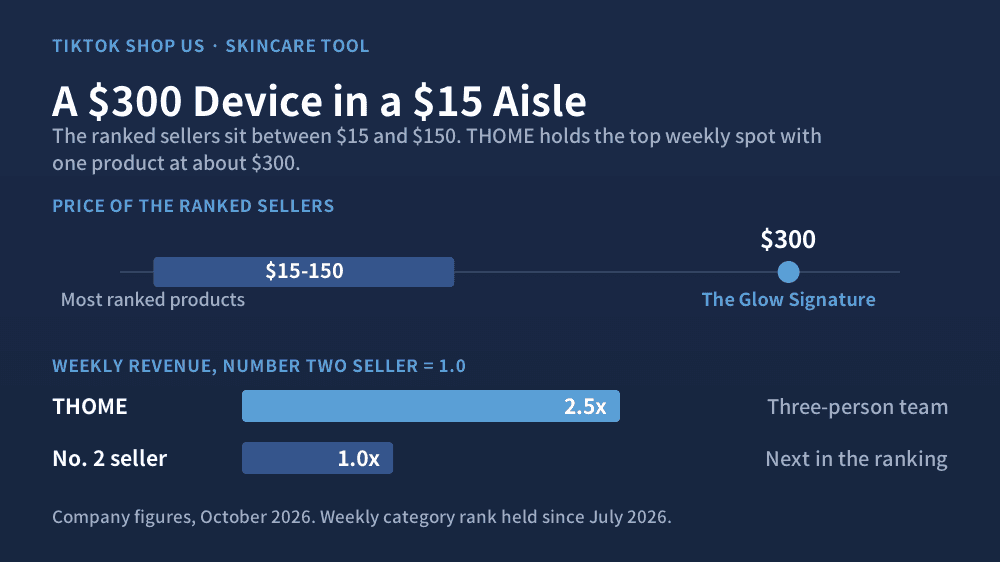
The team that did it is three people. Their account of how is specific enough to be useful. They stopped explaining the device and started proving it, leading with the Olive Young and Sephora rankings on the view that a shopper facing an unfamiliar $300 purchase is answering a suspicion, not a question about features. They put everything behind one SKU, The Glow Signature, bundled with the ampoule it is used with, because on TikTok one video sells one product and a catalog scatters the message.
They met close to 1,000 creators in three months, including three days in New York, and found that the creators who actually moved units were not asking for a higher commission. They were asking for enough confidence to put a $300 recommendation in front of their own followers. So the budget went into product education rather than commission.
The fourth decision is the one small teams get wrong. At each stage they named what they would not do. Live selling was deferred, on the reasoning that a live session ends and a good video keeps selling overnight, and that a live with no traffic is the most expensive way three people can spend an evening. Monthly platform sales were judged not by revenue during the event but by whether the floor underneath revenue was higher after it. For a team of three, the scarce resource was never ideas.
What do the revenue figures say, and whose figures are they?
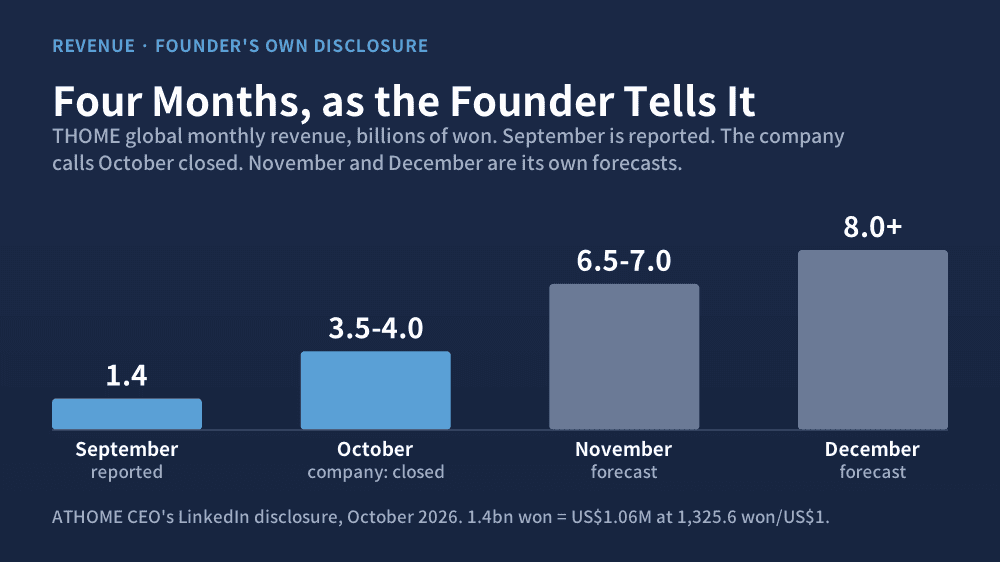
Yang has published monthly global revenue, which is unusual for a private Korean company and should be read for what it is: the founder’s own disclosure, posted alongside a recruiting appeal. September came in at 1.4 billion won, or US$1.06 million. October he puts at 3.5 to 4.0 billion won and calls closed. November at 6.5 to 7.0 billion and December above 8.0 billion are his forecasts, not results.
Amazon shows the same shape on a smaller base. Revenue there went from 190 million won in September to past 600 million won by the third week of October, with 1.5 billion won forecast for November on that channel alone. For 2027 the company expects at least 200 billion won in global revenue and says it has at least 5,000 offline doors committed.
Set the forecast against the starting point. THOME turned over about 35 billion won in total in 2025. A 200 billion won overseas year in 2027 is close to six times that, two years out. It is a large number stated plainly by the person responsible for hitting it, which is a more useful thing to have on the record than a range from a consultancy.
What does a 5,000-door year actually require?
Hardware on a beauty shelf is a different retail object from a cream, and the work scales with doors rather than with revenue. Every door needs a unit customers can pick up and switch on, because nobody buys a $300 appliance they have not held. Every door needs staff who can explain two frequencies without making a claim that moves the product into a different regulatory regime. Every market needs a returns policy written for electronics and a repair path that outlives the warranty.
The economics also depend on what happens after the box is opened. Devices have a long replacement cycle; the margin lives in the ampoules used with them, which is why the boost range went from two types to five. On ATHOME’s own Korean mall about one in five device buyers also bought skincare and about one in four skincare buyers came back. Carrying that ratio into a Sephora aisle, where the retailer owns the customer relationship, is the next build.
What is actually transferable here?
Not the rankings. Those are the output, and reading them as the lesson is how the rest of the industry gets this case wrong.
What transfers is the sequence. An appliance manufacturer already runs electrical safety testing, electromagnetic compatibility testing, returns handling and after-sales service, and those are the capabilities a cosmetics company cannot buy quickly. ATHOME spent a year converting that discipline into export infrastructure before it tried to sell anything, after a year of trying to sell without it. The order of those two years is the whole argument.
And it is worth naming what the TikTok Shop result means for the category. For a decade the American story about K-beauty has been value — good formulation at a price that undercuts the incumbent. A Korean brand holding the top of a US social commerce category at $300, against products at a tenth of that, is a different proposition entirely.
Three people did that part. The year before it, nobody saw.