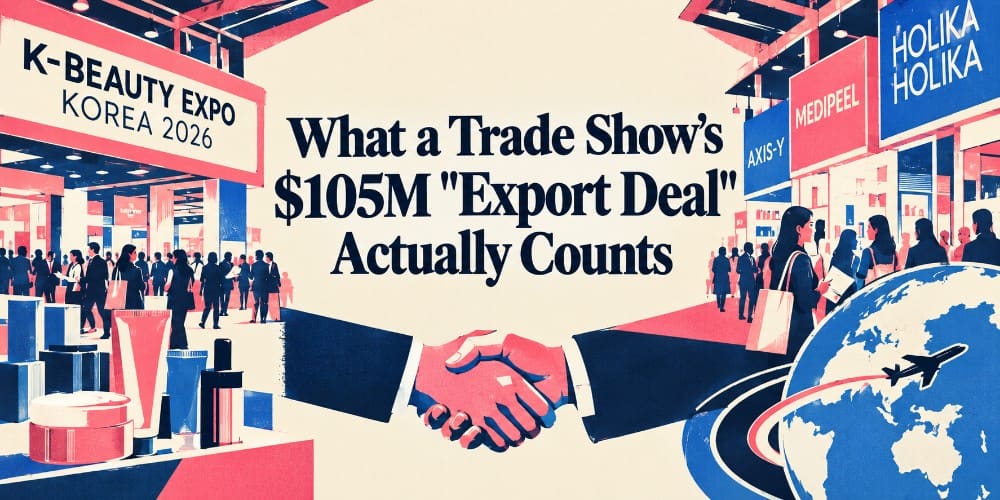
K-Beauty Expo Korea 2026 closed at KINTEX on October 17, and the organizer announced US$105 million in export deals, about 2.5 times the previous year. The announcement's own term for that figure is a contract-in-progress value, a category that sits between a meeting and a signature. The same announcement reports one confirmed on-site contract, worth more than US$100,000, with a US buyer. Both numbers are accurate. Only one of them is a sale.
What did the floor look like before the numbers arrived?
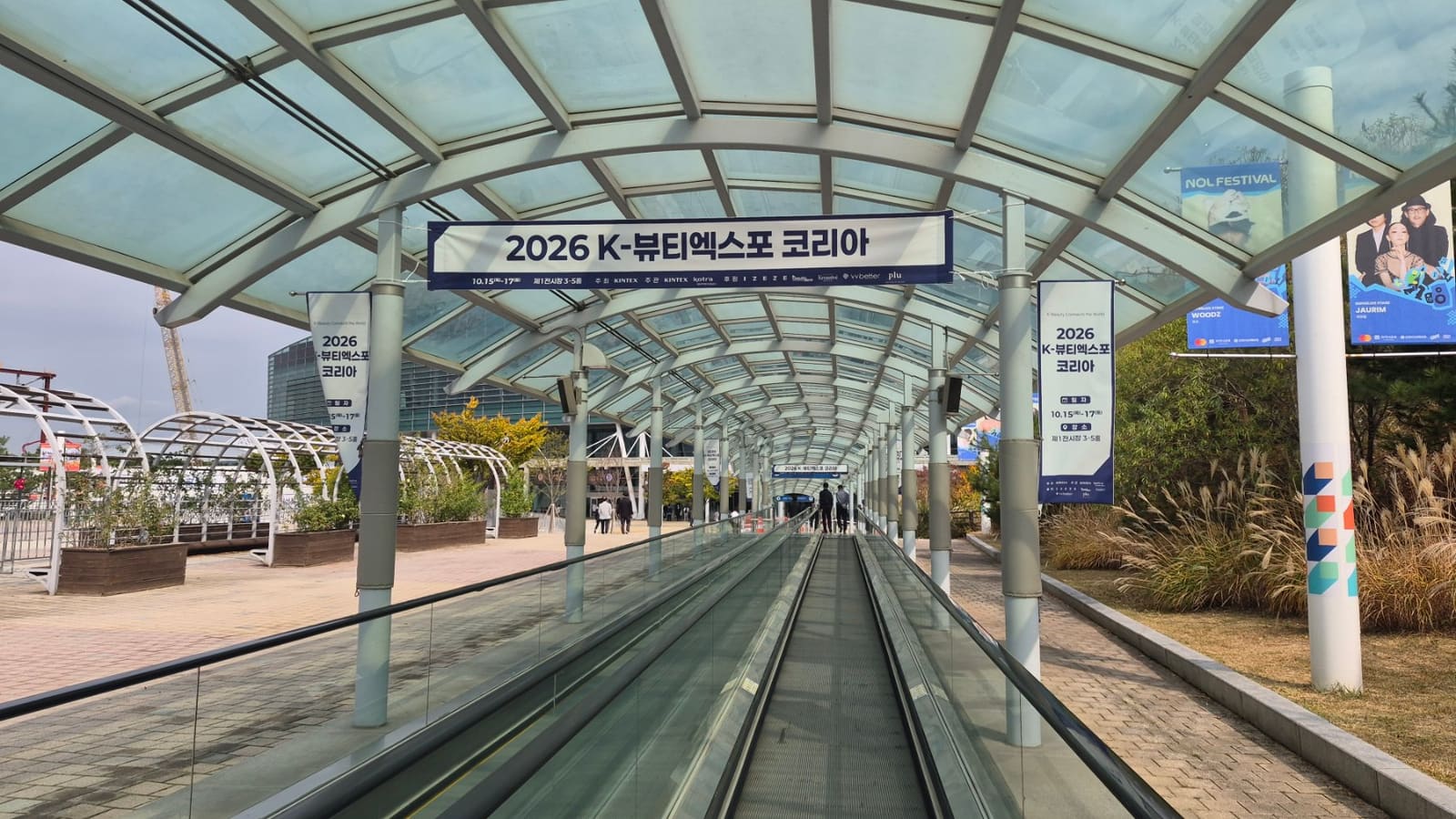
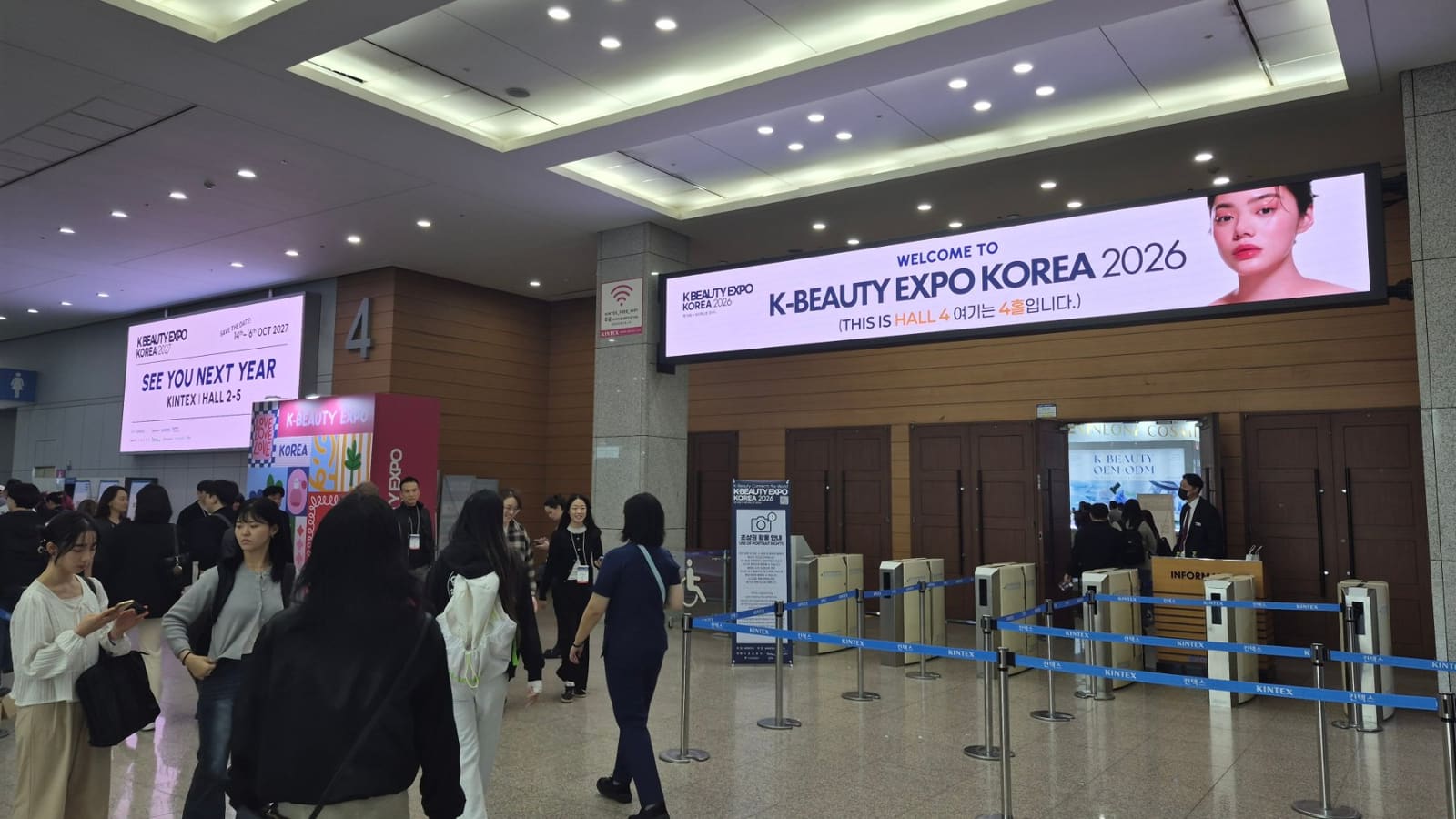
The author attended the show on October 15 and 16. On the first morning the line at the entrance ran long. Visitors who had registered online in advance moved through in minutes, which made pre-registration the practical difference between walking in and waiting at the gate.
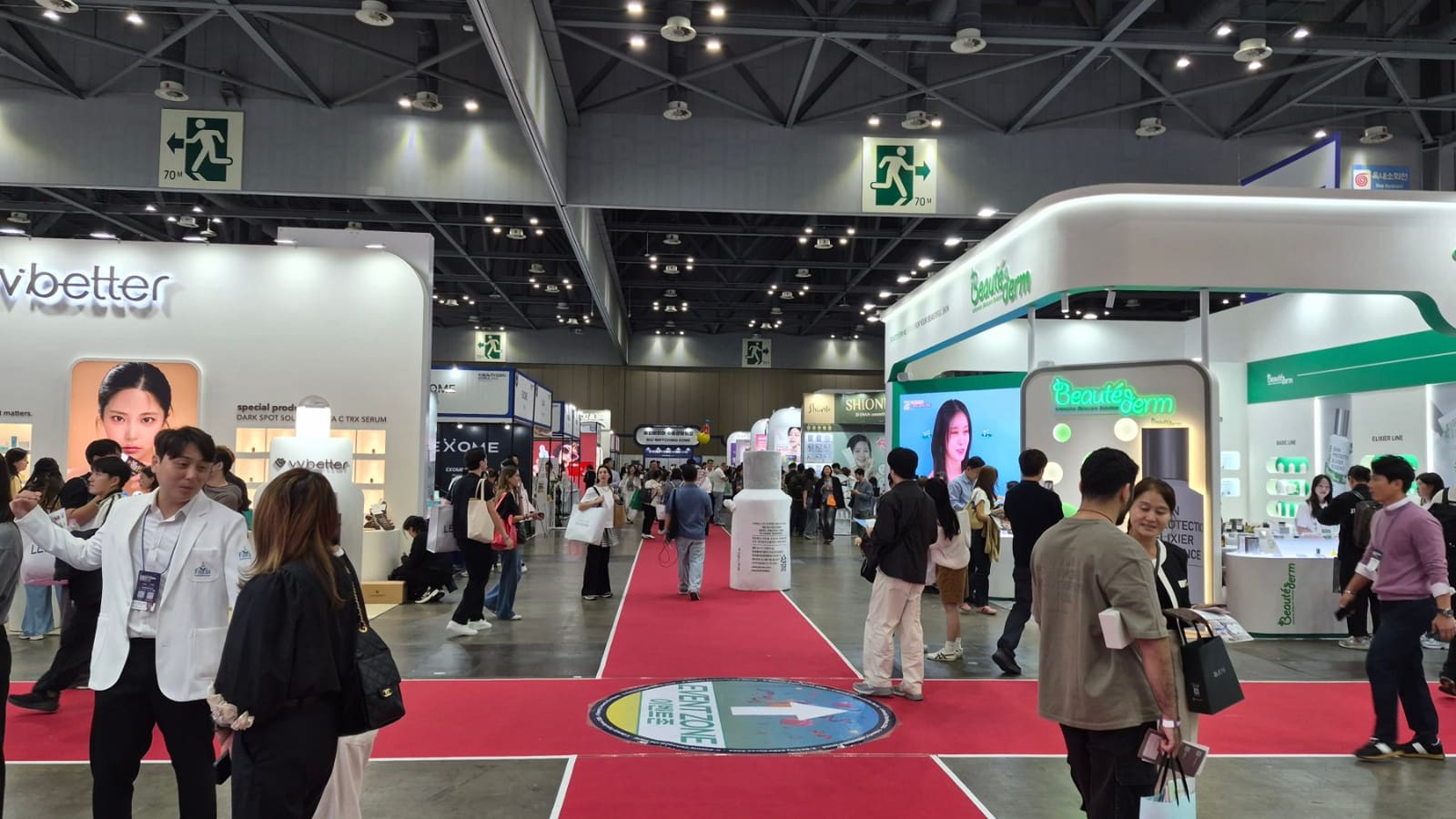
The business matchmaking area held more than a hundred consultation tables by the author's count, and it sat apart from the exhibition halls rather than inside them. The separation gave each space a single job: the halls for display, the tables for negotiation.
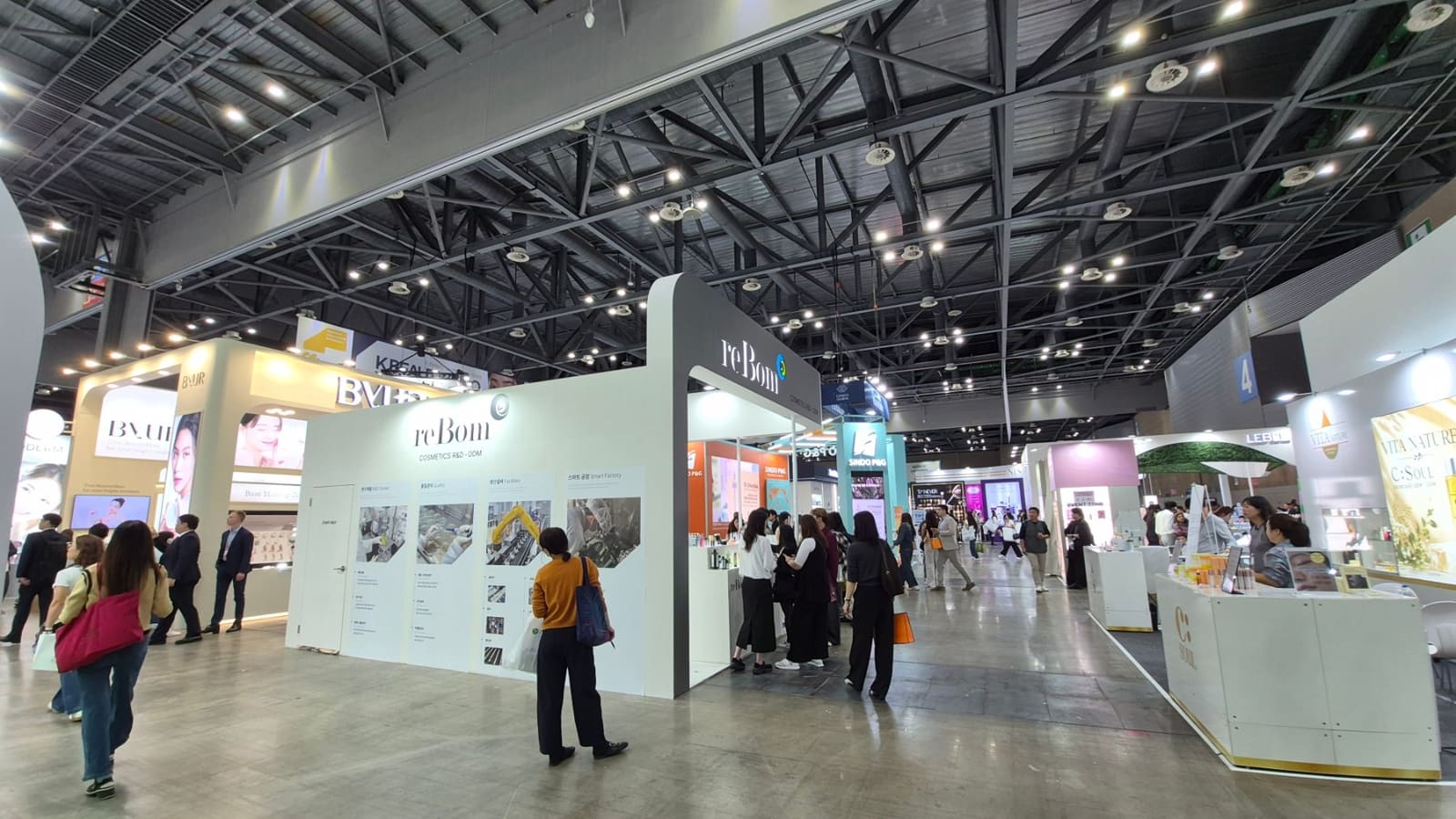
The crowd was visibly international, with Chinese, European and American visitors on the floor, and booths were staffed by English speakers almost without exception. The question those staff asked is the detail that explains the rest of this article. Rather than asking a visitor where they were from, booth staff asked where the visitor distributes.
Food service did not keep pace with the crowd. The restaurants filled and menus ran out early in the day.
What did the organizer announce?
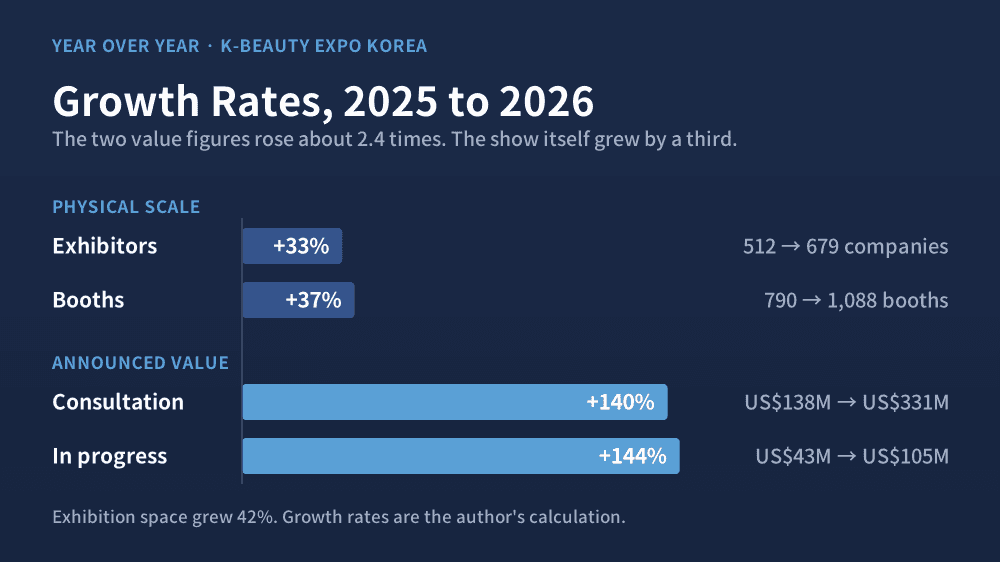
KINTEX released the results on October 19, two days after the show closed. The announcement reports 679 exhibiting companies from 15 countries, 597 of them Korean and 82 from abroad, across 1,088 booths. Total attendance was about 55,000, including more than 16,000 overseas buyers from more than 140 countries. Exhibiting companies rose 33 percent against 2025, booths 37 percent and exhibition space 42 percent.
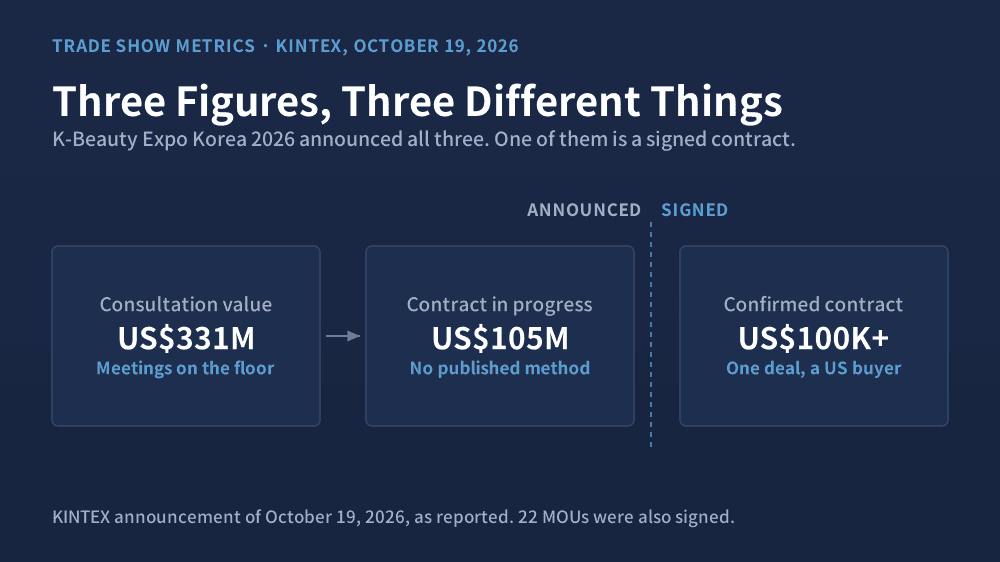
Three money figures accompany those counts. Export consultation value came to US$331 million. Contract-in-progress value came to US$105 million, about 2.5 times the previous year. Twenty-two memorandums of understanding were signed at a new signing area with buyers from the United States, China and Iraq. One on-site contract above US$100,000, with a US buyer, is reported as confirmed.
The English-language report of the announcement converted US$105 million to about 140 billion won, which implies a rate near 1,333.0 won to the dollar on October 19, 2026, the basis used for won equivalents here. The one-on-one export consultation program, run with the Korea Trade-Investment Promotion Agency's Northern Gyeonggi office, brought in about 220 buyer companies from 50 countries.
What is a contract-in-progress value?
The term belongs to the announcement. It describes deals being pursued after a meeting on the floor, short of a signature. It is not a customs category or an accounting one, and it has no equivalent in any reporting standard a buyer would recognize.
No published method accompanies it. None of the reports carrying the figure states whether it rests on exhibitor self-reporting after the show, a written indication of intent from the buyer, a letter of intent, or a quotation issued at the table. The number is a total without a stated definition of what is being totaled.
It also sits inside the larger figure rather than beside it. US$105 million is about 32 percent of the US$331 million in consultation value. The largest single case in the announcement is a Korean exhibitor's US$6.4 million consultation with a Romanian buyer, of which US$2.13 million is described as being pursued. Even the showcase example is pursuit, not purchase.
How much was actually signed?
One contract above US$100,000 is reported as confirmed on site. Against US$105 million, that is about 0.1 percent.
The 22 memorandums carry no amounts in the announcement and no statement about binding force. A memorandum of understanding records that two parties intend to do business. It creates no purchase order and no delivery date.
The distance between the two figures is a measurement gap before it is a performance gap. Exhibitors have no obligation to report a private contract to the organizer, and a deal opened at a trade show closes weeks or months later through the exhibitor's own channel, where the organizer never sees it. The single confirmed contract is what KINTEX could verify by October 19, not a count of everything the show produced.
Did the ratio change when the show got bigger?
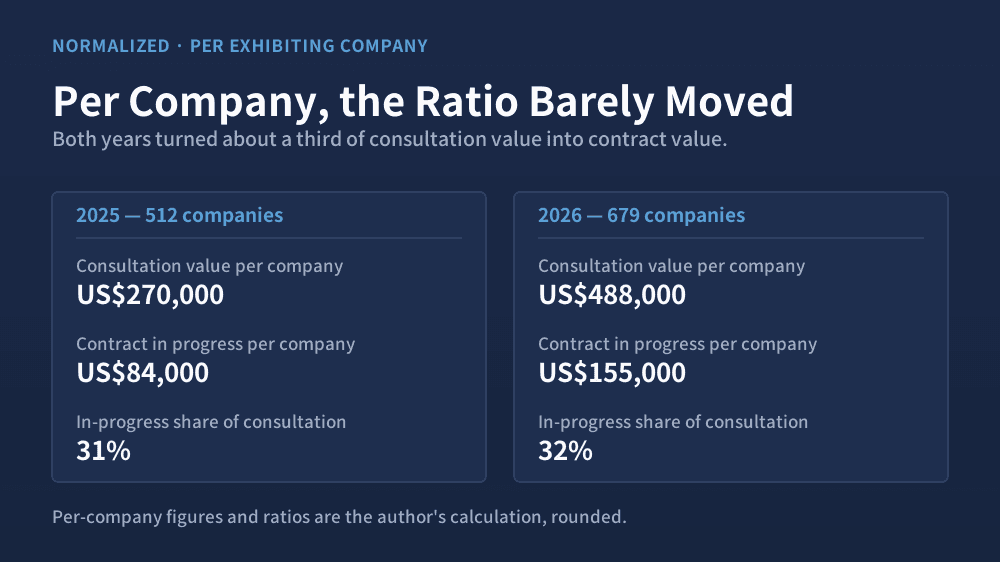
The 2025 edition, held September 11 to 13, reported 1,780 consultations worth US$138 million and US$43 million in contract-in-progress value. That is a ratio of about 31 percent. The 2026 ratio is about 32 percent.
Two years at the same ratio is consistent with a stable conversion assumption applied to a consultation total. It is not evidence of one, because no method has been published for either year. A ratio that holds steady while the show grows by a third is a fact about the arithmetic, not yet a fact about the market.
The underlying growth is uneven in an informative way. Exhibitors rose 33 percent and booths 37 percent, while consultation value rose about 140 percent and contract-in-progress value about 144 percent. The money figures grew roughly four times faster than the floor that generated them.
Per exhibiting company, contract-in-progress value went from about US$84,000 to about US$155,000, and consultation value from about US$270,000 to about US$488,000. Those per-company figures are calculated here from the announced totals, and they carry the same uncertainty as the totals they come from.
Who are the 16,000 overseas buyers?
Three audience numbers appear in the same announcement: about 55,000 total visitors, more than 16,000 overseas buyers from more than 140 countries, and about 220 buyer companies from 50 countries in the screened one-on-one program. The last group is about 1.4 percent of the second.
The wording has shifted as well. Reporting on the 2025 edition described the equivalent group as overseas visitors, 10,000 of them from 143 countries, while the same report's subheading called them buyers. Whether the counting rule changed between the two years is stated nowhere. A visitor who registers at the gate with a company name is counted; whether that visitor buys is a separate question, and registration does not answer it.
For a company deciding whether to take a booth next year, the useful denominator is the screened program rather than the gate count. Access to 220 vetted buyer companies is a concrete offer that can be priced against the cost of a stand. Sixteen thousand overseas badges is a description of foot traffic.
What did the booths already know?
The question heard repeatedly at the stands — where do you distribute, rather than where are you from — shows the exhibitors had read the room correctly. The floor was a sourcing room, staffed in English by default, and the brands treated every visitor as a channel rather than a consumer.
That behavior points to the metric that matches the activity. A trade show produces meetings. The 2025 announcement counted them: 1,780 consultations, which works out to an average of about US$77,500 each. The 2026 announcement reports consultation value without a consultation count, so the same average cannot be calculated for this year.
A count is harder to inflate than a value. Dropping the count while keeping the value moves the series in the wrong direction for anyone trying to compare one year with the next.
Where does a bigger show move the bottleneck?
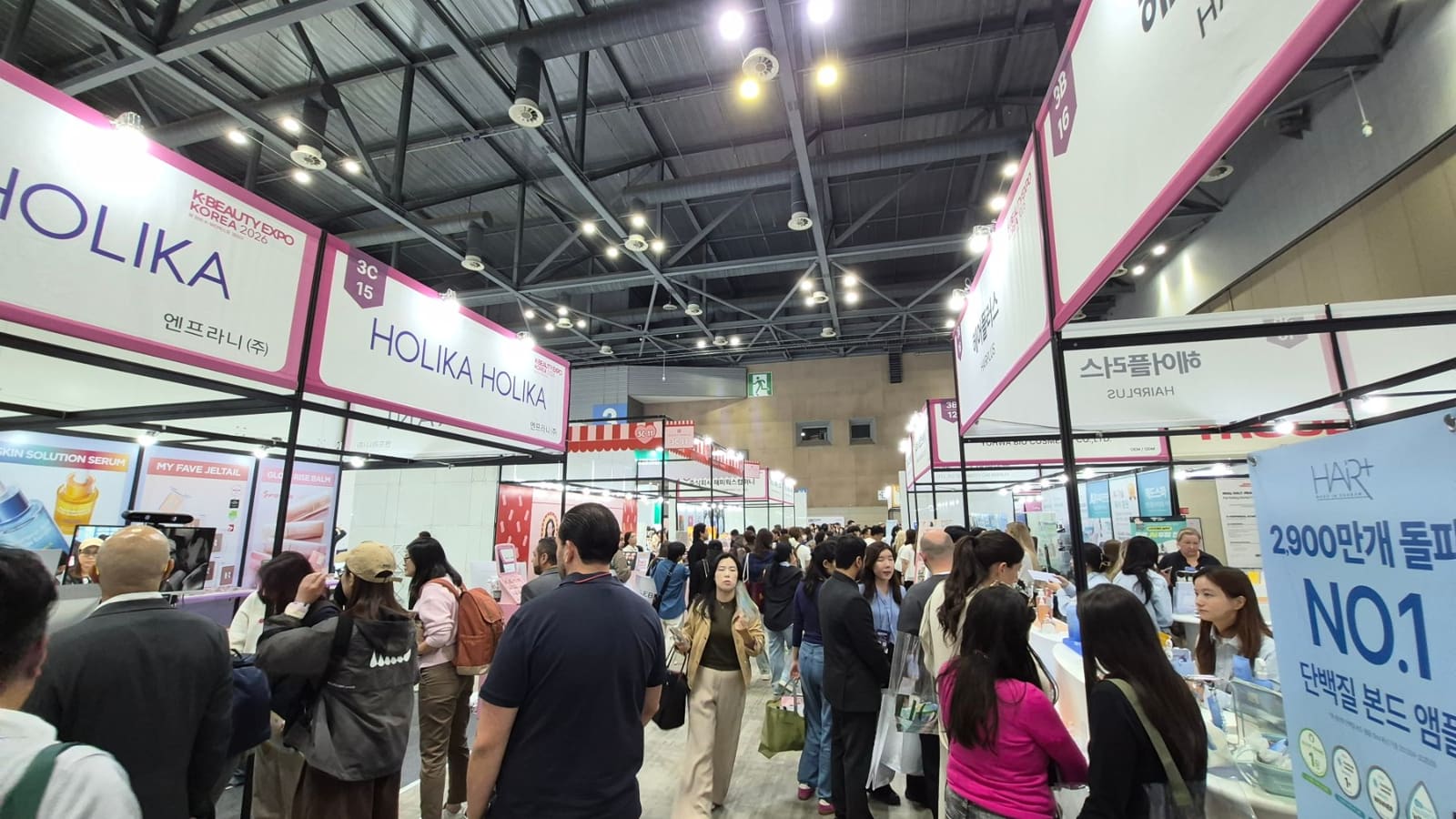
Exhibition space grew 42 percent and attendance rose from about 40,000 to about 55,000. Neither bottleneck observed on October 15 was on the exhibition floor. They were at the entrance and in the food halls, and the first of the two was solved for anyone who had registered online beforehand.
The organizer reports satisfaction above 96 percent among exhibitors and visitors. That is the organizer's own survey, published without a method, a sample size or the wording of the question, which puts it in the same class as the contract-in-progress figure: a number that cannot be checked from outside.
The 2027 edition is set for October 14 to 16 at KINTEX Hall 1, expanded to four halls, with exhibitor recruitment opening in January 2027. A fourth hall adds floor space. It does not add gates or restaurant seats.
How should a trade show result be read?
For an exhibiting manufacturer, the only figure that belongs in an internal report is its own: meetings held, samples shipped, quotations issued, orders dated. An aggregate consultation value measures the event, not the company standing inside it.
For a buyer or a brand weighing the cost of a stand, the screened matchmaking program is the part of the show with a countable outcome. The gate number describes the crowd that the stand stands in.
For an investor, a policy reader or the organizer itself, a value figure without a published method cannot be compared across years or against another show. Publishing the basis would cost nothing and would turn two years of figures into a series. The show grew on every measure that can be counted. The number that grew fastest is the one nobody has defined.