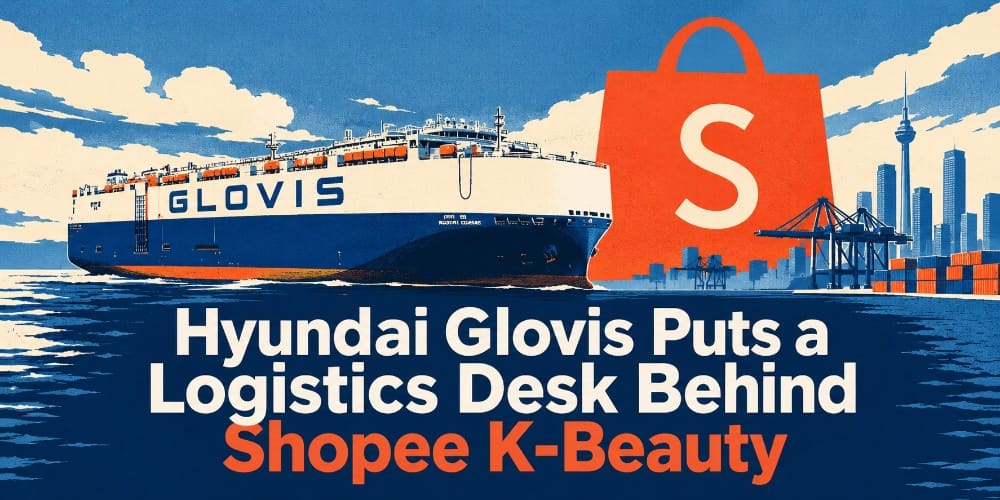
On October 26, 2026, Hyundai Glovis, a logistics company in Hyundai Motor Group, announced a one-stop service for Korean cosmetics sellers on Shopee Korea. It bundles domestic pickup, air or sea freight, customs clearance, local approvals, and fulfillment, and operations began in October. The company wants non-affiliated customers at 40% of revenue by 2030. The announcement names no price, no delivery time, and no party that holds the permit a foreign regulator issues.
What did Hyundai Glovis announce?
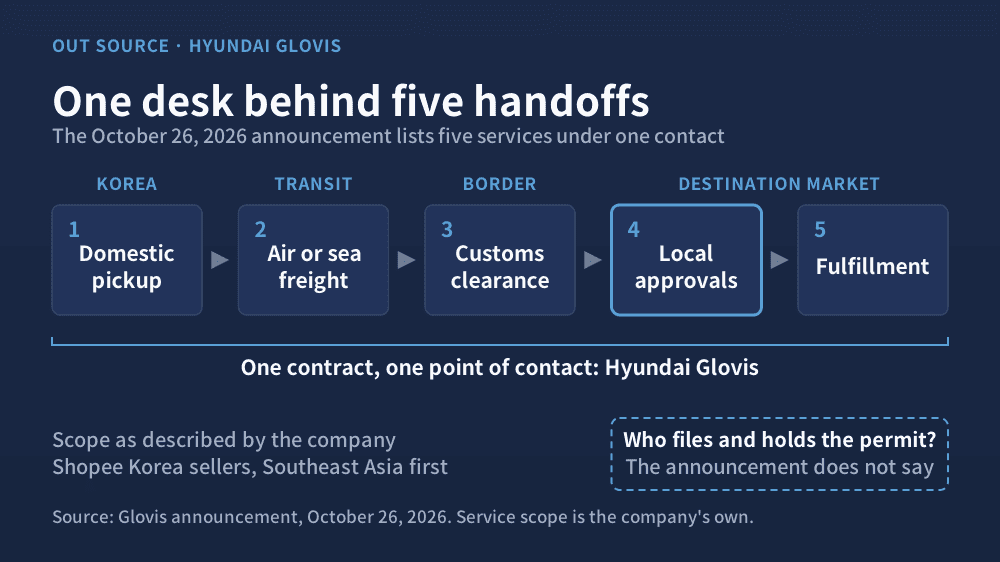
Glovis said on October 26, 2026 that it signed an end-to-end logistics partnership with Shopee Korea and that the service started operating in October. End-to-end means one point of contact covers every handoff between a Korean seller's warehouse and a buyer's door.
The company lists five services: domestic cargo pickup, air and sea freight, import and export customs clearance, local regulatory approvals, and fulfillment, meaning storage, order processing, and delivery in the destination market. Southeast Asia comes first. Latin America, where Shopee sells in Brazil, and other markets follow, with no date attached.
The figures in the announcement are the company's own. The coverage reviewed quotes only a Glovis official, who says logistics should become a competitive advantage for Korean brands rather than a cost line. Glovis puts Shopee's user base at about 700 million and gives no source for the number. Sea Limited, Shopee's parent, reported Shopee gross merchandise value, the total value of goods sold on the platform, of US$38.3 billion and 4.2 billion gross orders for the second quarter of 2026. Its results deck reports active buyers only as growth, 18% year over year, and gives no user count.
Why is a car logistics company selling to cosmetics brands?
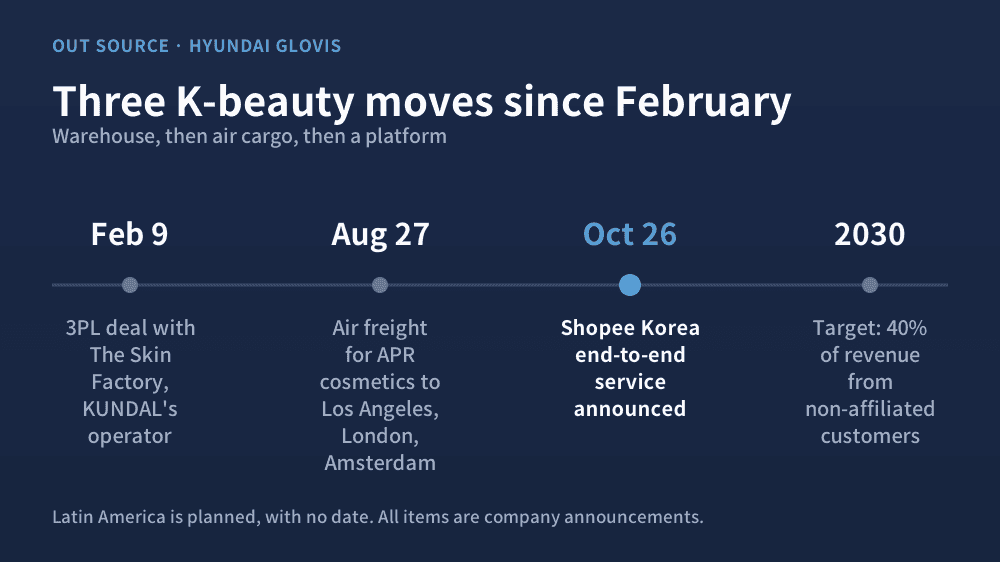
Glovis wants customers outside its own group. The company states a target of non-affiliated business at 40% of total revenue by 2030. Non-affiliated means customers outside Hyundai Motor Group. That target is Glovis's own goal, not a result.
Cosmetics fit the target for a mechanical reason. Car shipments move large identical units in bulk. A Shopee order is one lip tint in a padded envelope. Glovis describes its automated fulfillment center in the Seoul metropolitan area as built for high volumes of small, varied e-commerce orders, run with automated guided vehicles.
Selling that capability to many small beauty brands instead of one automaker group is the diversification the 2030 target describes. The shipper changes. The customer count rises. Each customer's volume falls.
Is this a new business, or an extension?
An extension. On February 9, 2026, Glovis announced a third-party logistics contract, known as 3PL, under which a provider runs a client's storage, packing, and shipping. The client was The Skin Factory, the operator of the KUNDAL hair and body care brand. Glovis described plans to add cross-border logistics, overseas customs clearance, and air and sea exports for the same client.
On August 27, 2026, Glovis announced contracts to fly cosmetics from APR to Los Angeles, London, and Amsterdam. The company said that as a freight forwarder it is responsible for the entire transportation process.
The October service adds the platform. Three announcements since February cover a domestic warehouse, intercontinental air freight, and a marketplace-linked cross-border service. The Shopee service expands an existing K-beauty business. It does not start one.
What does Shopee bring to the arrangement?
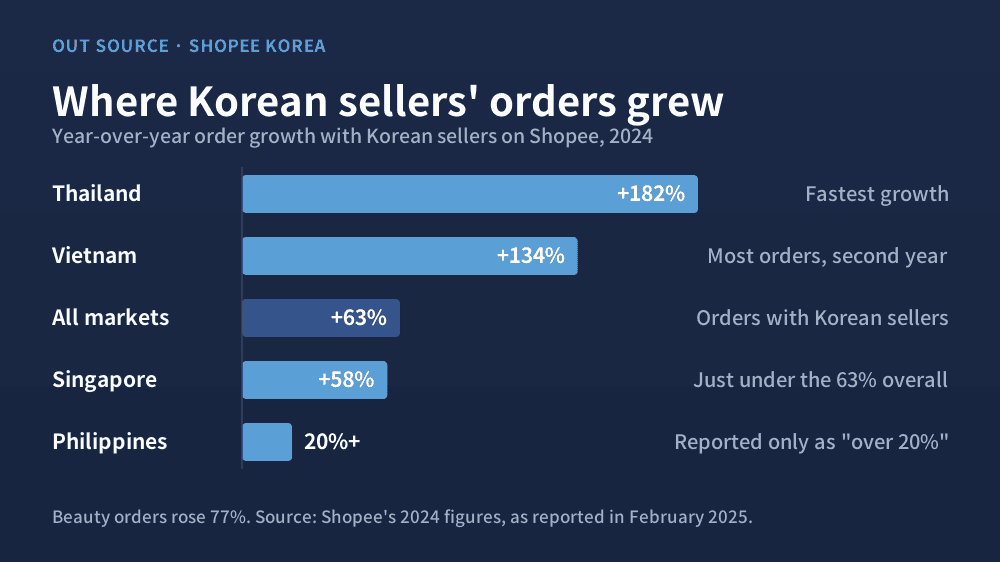
Demand data and a seller funnel. Shopee reported that orders placed with Korean sellers rose 63% in 2024, and orders in the beauty category rose 77%. Thailand grew 182%, Vietnam 134%, Singapore 58%, and the Philippines more than 20%. Vietnam produced the most orders for the second straight year. Those are Shopee's own figures for 2024.
Shopee also runs warehousing of its own. Its Fulfilled by Shopee program, known as FBS, handled about 31% of Korean product shipments in Malaysia, 26% in the Philippines and Thailand, and 23% in Singapore, by Shopee's count. Shopee also launched a domestic fulfillment service for Korean sellers in 2024. The Glovis service therefore sits next to platform fulfillment. Whether it feeds that program or competes with it, the announcement does not say.
Where do cross-border cosmetics shipments stall?
Glovis's answer is the handoffs. In the company's account, brands used a different provider at each stage, which broke work apart or slowed deliveries. The five-step chain makes that concrete: pickup, freight, customs, permits, and delivery in the destination market, each with a different counterparty under the old model.
One contact reduces the number of contracts. It does not reduce the number of steps. Customs clearance still happens at a border, and a permit still comes from a regulator. What changes is who answers the phone when a pallet is held. For a small brand, that is a saved cost in coordination. For a buyer, it moves the question from which forwarder to which party answers for the product.
Who holds the local approval?
The reporting does not settle it. One English-language report of the announcement states that Glovis handles local regulatory permits as part of the service. The announcement text distributed to Korean outlets says permit and customs work runs through a local subsidiary and the logistics network, and does not say whether that entity belongs to Glovis. Other reports list approvals as included and stop there.
The distinction decides who answers to the regulator. In cosmetics regulation, the party named on a product notification answers to the regulator for the product's safety and labeling. A logistics company can prepare the filing for a brand, file it in the brand's name, or file it in its own. Those are three different liability structures, and the announcement does not say which one applies.
What does the announcement leave out?
The press release asserts ambitious goals—specifically shorter shipping times and reduced logistical burdens for sellers—yet completely omits the foundational financial and operational metrics. Crucial details such as shipping rates, service fees, and the exact reduction in delivery lead times remain undisclosed.
Furthermore, the announcement provides no concrete data regarding order volumes, participating seller counts, or flagship brand partners utilizing the service. Beyond these operational gaps, the cited 700 million user base lacks a verifiable source, the Latin American expansion timeline has no target date, and Shopee's Korean entity has issued no supporting statement of its own. Consequently, every claimed merchant benefit relies solely on assertions made by Hyundai Glovis.
What does the structure mean for the industry?
For the broader industry, this partnership packages what was once a complex export bottleneck into a unified, off-the-shelf logistics product connecting merchants directly to the platform. For contract manufacturers (ODMs), product formulations and production batch records remain entirely unchanged. However, the final landed costs and delivery lead times borne by their brand clients are now governed by an external logistics layer over which the manufacturer has zero operational control.
For brands and international buyers, the primary shift is consolidation. Dealing with five separate logistics intermediaries is replaced by managing a single desk, significantly raising reliance on one sole counterparty. While administrative efficiency increases, critical regulatory questions—such as legal liability for product permits—remain unresolved until explicitly defined by individual commercial contracts.
From a regulatory and investment perspective, centralizing logistics through an intermediary-linked channel creates a single point of oversight. Regulators and investors gain a unified entity to evaluate rather than tracking fragmented supply chain nodes. Ultimately, while five operational handoffs have been consolidated into one desk, the legal liability and underlying risks have not transferred along with them.