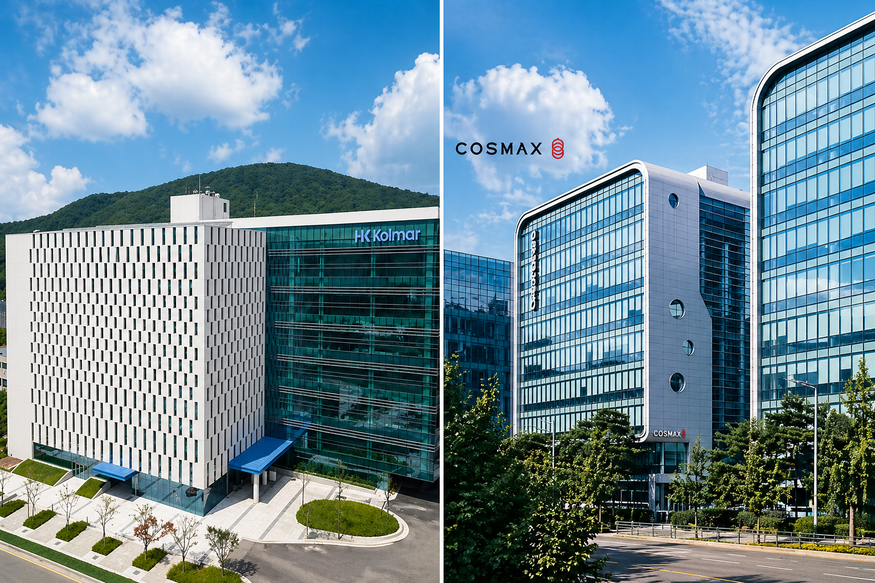
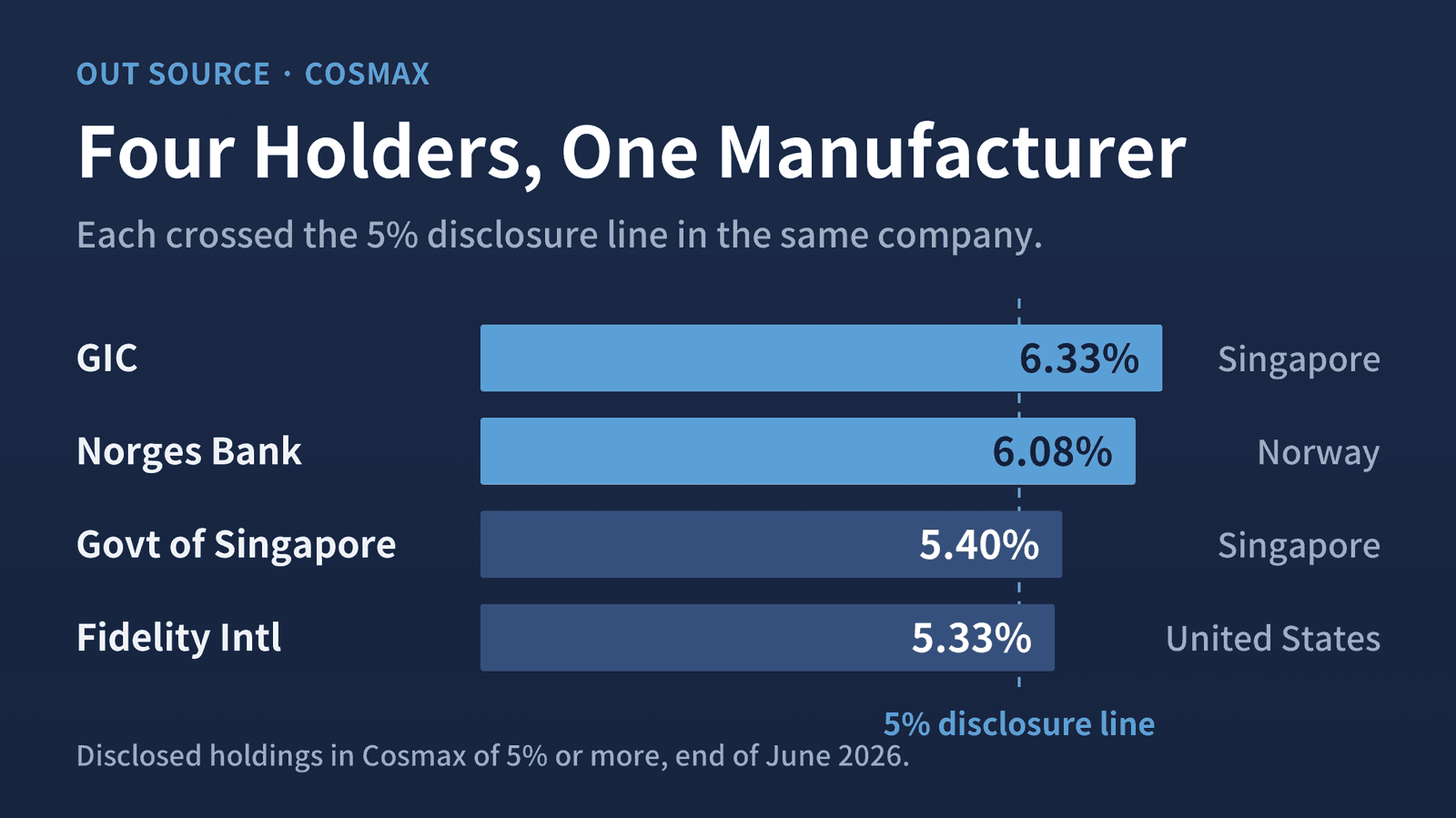
At the end of June 2026, four separate foreign institutions each held more than 5% of Cosmax: Fidelity International at 5.33%, Singapore’s GIC at 6.33%, Norges Bank at 6.08% and the Government of Singapore at 5.40%. Across Korea’s 500 largest listed companies, cosmetics went from two such holdings to nine in twelve months, the sharpest rise of any sector. The money is not landing where the brand headlines are. It is landing on the factory.
What did the June disclosures actually show?
The survey behind those numbers counts foreign corporations and funds holding 5% or more of Korea’s 500 largest listed companies by market capitalisation, as reported in shareholding disclosures, with the end of June 2026 as the reference date. It counts stakes rather than companies: one company with four qualifying holders registers four times. On that basis there were 123 disclosed stakes, against 95 at the same point a year earlier, an increase of 29.5%.
US-based asset managers and funds accounted for 69 of the 123, or 56.1%. European holders accounted for 25, or 20.3%. Japanese holders accounted for ten and Chinese holders eight. Preferred shares and special-purpose vehicles were excluded, as were companies listed too recently for a year-on-year comparison. Stakes held through a foreign company’s Korean subsidiary were counted; stakes held through the overseas subsidiaries of Korean companies were not.
Within that total, cosmetics moved from two qualifying stakes to nine, an increase of seven and the largest of any sector in the survey. Four companies account for eight of the nine. Cosmax carries four of them. d’Alba Global carries two, M&G Investments at 7.58% and Fidelity International at 5.06%. APR carries one, Fidelity Investments at 5.01%. LG H&H carries one, Schroders at 7.33%. The survey does not identify the ninth.
The figure circulating as a 350% increase is arithmetic on those two counts rather than a number the survey reports. Two to nine is the whole of it.
Why would sovereign funds reach a contract manufacturer before a brand?
Cosmax is an ODM — an original design manufacturer, a company that formulates and produces cosmetics for other companies to sell under their own labels. It has no consumer brand of its own in the markets where its output is sold.
A stake in a brand is a position on one label’s shelf. A stake in the manufacturer behind several labels is a position on the category’s volume, whichever label takes it. The distinction matters most in a category turning over quickly. Cosmax reported hair care revenue up about 65% in the first half of 2026 and 37 patent applications in hair care over the past three years; those are the company’s own figures. Its hair care exports grew at triple-digit rates in each of the three years from 2023 to 2025. Kolmar Korea expanded its hair care research headcount by 40% last year.
None of that requires an outside investor to pick which brand wins the shelf. That is the structural reason a manufacturer clears a sovereign fund’s threshold first.
Is foreign buying tracking share prices, or moving against them?
Foreign ownership ratios for seven listed K-beauty companies, measured on 1 October 2025 and again on 1 October 2026, rose in six of the seven. Two of those six fell in share price over the same twelve months. LG H&H dropped 4.7% while foreign ownership went from 26.86% to 31.46%. Silicon2 dropped 19.1% while foreign ownership went from 6.75% to 11.90%.
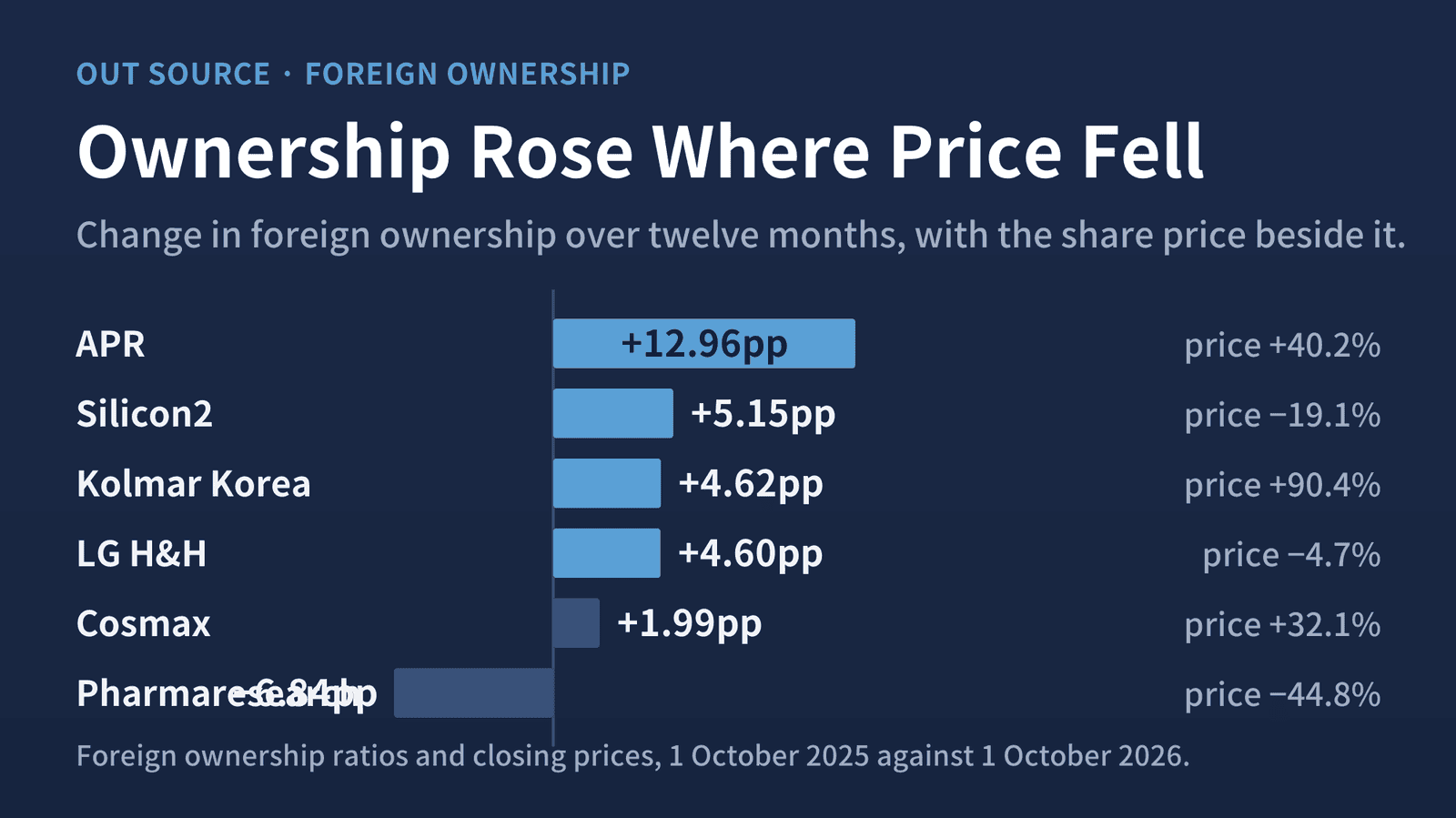
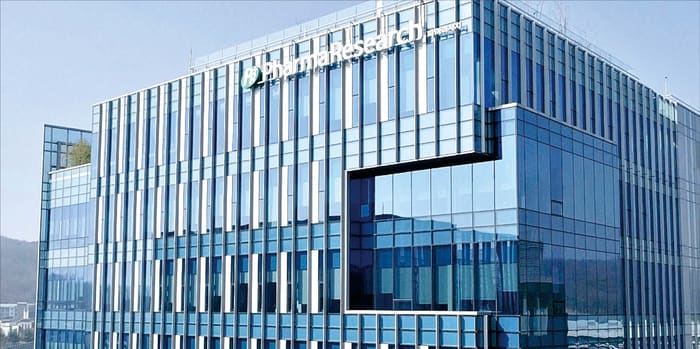
The four that rose on both counts were Amorepacific, from 123,200 to 136,500 won and from 22.57% to 26.11%; Cosmax, from 209,000 to 276,000 won and from 33.40% to 35.39%; Kolmar Korea, from 76,700 to 146,000 won and from 36.56% to 41.18%; and APR, from 261,000 to 366,000 won and from 25.40% to 38.36%. One of the seven fell on both: Pharmaresearch, down 44.8% in price with foreign ownership down from 20.48% to 13.64%.
Buying that continues through a 19% price decline is not momentum. It is accumulation against price, which is what distinguishes a change of classification from a trade.
What does the ETF filing establish, and what does it not?
Guinness Atkinson, a US manager of thematic funds, has filed to list a dedicated K-beauty ETF on the New York Stock Exchange. The filing divides the theme into four segments: brand owners; contract manufacturers and suppliers; distributors and retailers; and makers of aesthetic and dermatological products.
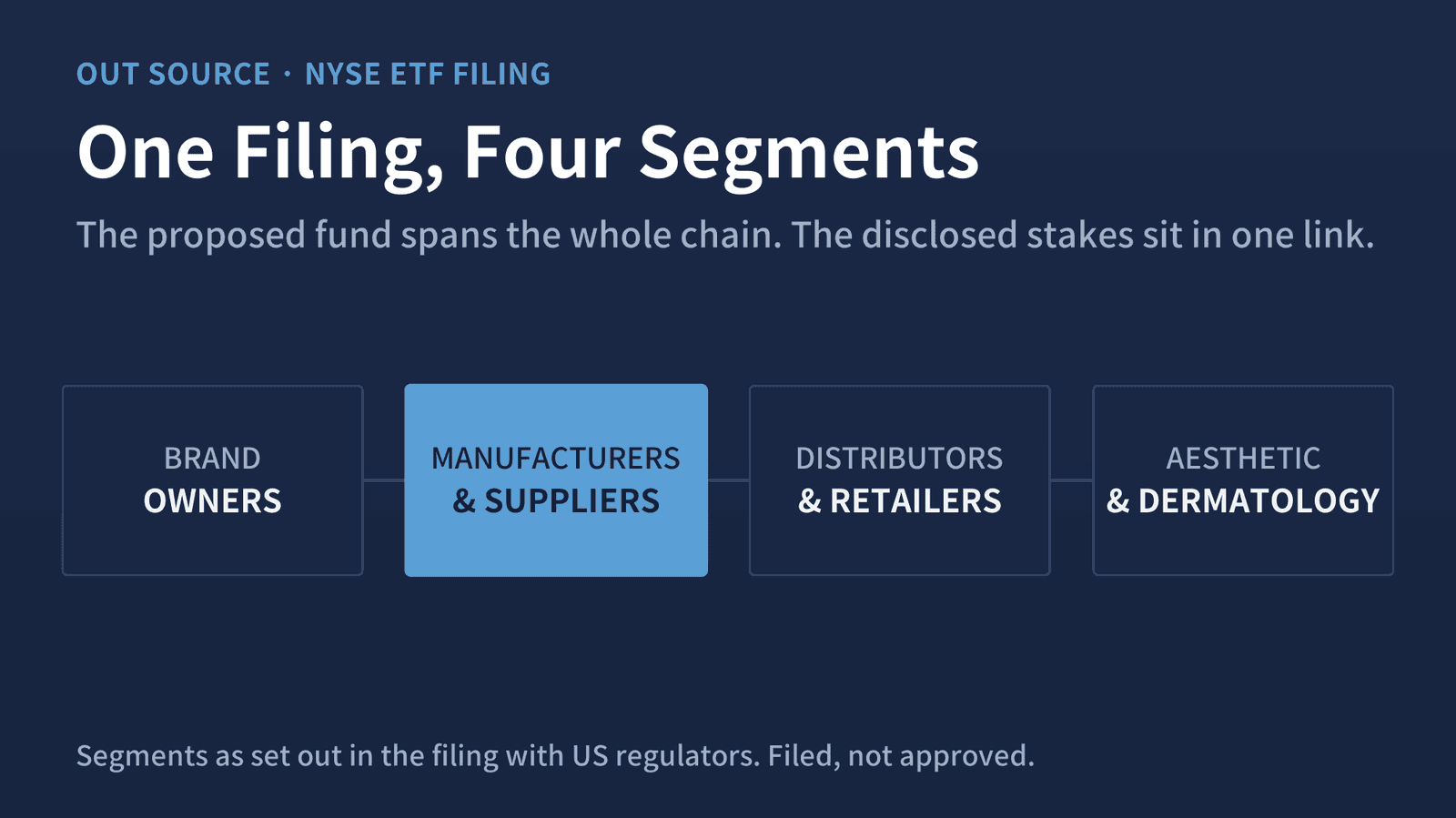
It has been filed. It has not been approved, and the two should not be run together. What a filing of this shape establishes is narrower than approval and not trivial: a US sponsor has concluded there are enough listed Korean names, with enough liquidity, to populate four distinct segments rather than a handful of brands. That is a statement about the depth of the universe rather than about any company in it. If it lists, it would be the first dedicated K-beauty theme on a US exchange.
Why did five brokerages cut targets on a company foreign funds were buying?
On 12 October, Korea Investment & Securities kept a buy rating on APR with a target of 520,000 won, about $387 at the rate of 1,345.1 won to the dollar at which the won closed on 13 October 2026 — the rate used for every conversion in this article. The analyst’s case rested on uncertainty easing rather than on new demand. APR adopted IFRS 18 early in the first quarter, which moved costs that had previously sat below the operating line into operating profit, and currency movement had made gain-and-loss estimates harder to pin down.
The next day, five houses cut their targets while keeping buy ratings. Meritz Securities went from 550,000 to 520,000 won. Shinhan Investment went from 540,000 to 510,000. Hyundai Motor Securities went from 550,000 to 510,000. Daol Investment & Securities went from 560,000 to 500,000. SK Securities went from 560,000 to 480,000.
The third-quarter estimate underneath those cuts puts revenue at 777.0 billion won, about $578 million, up 101%, and operating profit at 167.8 billion won, about $125 million, up 78%, for a margin of 21.6%. Revenue matches consensus. Operating profit sits about 15% below the consensus figure of 197.3 billion won. Revenue doubling and the price target coming down belong to the same quarter.
How much of the brands’ problem is the currency?
The United States and Europe together are close to 70% of APR’s revenue, so won strength works directly against the translated result. Hyundai Motor Securities put the drag from currency gains and losses at about two percentage points of operating margin on its own. Daol added a higher cost ratio, with air freight and inland transport rising as European sales grow. Shinhan pointed to sales commissions as the company expands offline in Germany and France.
SK Securities cut its target multiple from 28 times earnings to 25 to reflect multiple compression across peer brand companies, and noted that APR’s operating margin was 17% in 2024 and 24% in 2025, the earlier dip having followed its push into US online selling. None of those are demand problems. They are the cost of selling abroad under a currency that moved, in a market paying less for brand earnings than it did a year ago.
What does the one company foreign investors sold reveal?
Silicon2 and Pharmaresearch both fell in price over the twelve months. Foreign ownership rose by more than five points in one and fell by nearly seven in the other. The split is not between companies that performed and companies that did not.
That is the detail that argues against reading any of this as a block trade on ‘Korean cosmetics’. A sector label that moves together is a rotation. A sector label whose members are bought and sold in opposite directions in the same twelve months is being taken apart and priced piece by piece.
Which definition of the theme is the money actually buying?
Market capitalisations at the time of that comparison put APR at 13.70 trillion won, about $10.2 billion, and Amorepacific at 7.73 trillion won, about $5.7 billion. LG H&H stood at 4.04 trillion won, Kolmar Korea at 3.23 trillion, Pharmaresearch at 3.18 trillion, Cosmax at 3.07 trillion and Silicon2 at 2.44 trillion.
A fund weighted by market capitalisation would therefore be mostly brand. The disclosed stakes above 5% are mostly manufacturer. APR, the largest of the seven, is the one five brokerages marked down in a single day. Cosmax, which carries four of the nine disclosed stakes, is the second smallest. The index version of the theme and the disclosed-stake version of the theme are not the same portfolio, and both are being assembled at once.
Where does this leave manufacturing, brands and capital?
For manufacturers, the change is on the share register before it is in the order book. A contract manufacturer with a sovereign fund above 5% is answering a different set of questions at the margin: capacity disclosure, governance, the quality of its reporting. That is a cost before it is a benefit.
For brands and the buyers who stock them, the sell-side has separated revenue from earnings. Doubling the top line did not hold a target price. What decides the next re-rating is margin under a currency that moved, not growth.
For capital, the universe is now being priced as four segments rather than one story. The filing says so in its own structure, and the disclosures show the money reaching one segment first.
Nine disclosed stakes is not an asset class. It is the point at which the holders stop agreeing with each other. That is what reclassification looks like while it is happening.