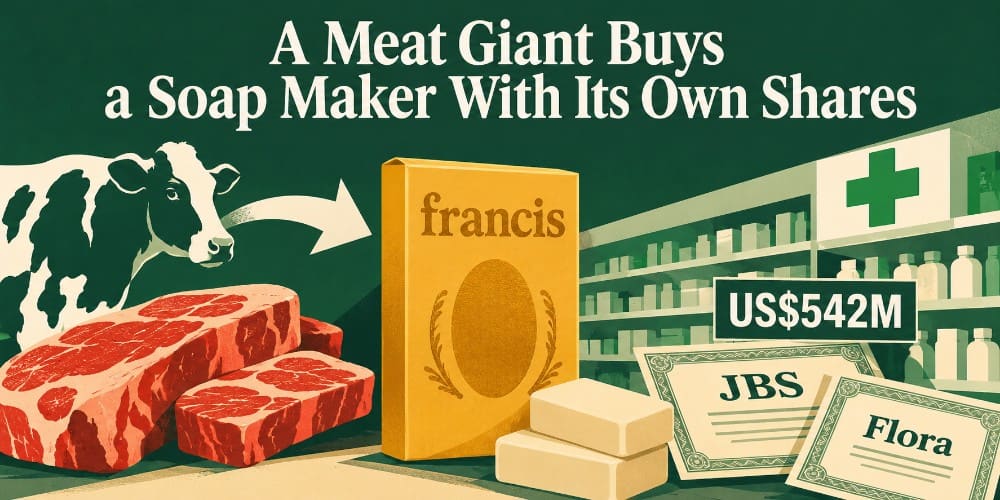
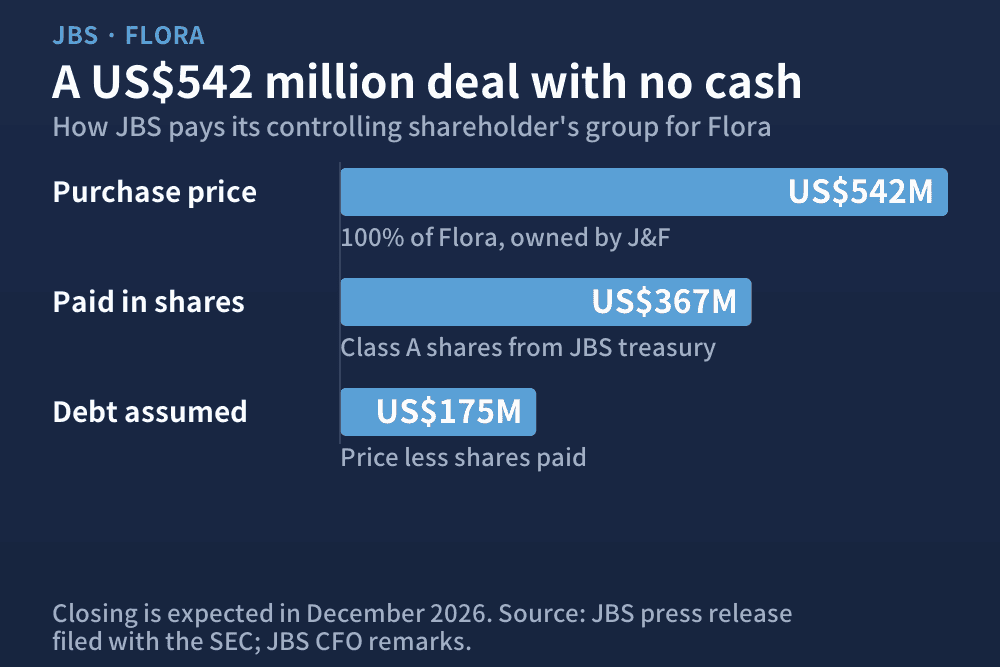
In November 2026, JBS, the Brazilian beef giant, agreed to buy Flora, the maker of the Minuano, Francis and Neutrox brands, from J&F, the Batista family holding company that controls JBS itself. The price is US$542 million, and JBS pays none of it in cash: US$367 million goes out in its own treasury shares and the rest is Flora's debt. A meat company is entering the pharmacy aisle by acquisition, with its own stock, from its own owner.
What is JBS buying from J&F?
JBS is acquiring 100% of Flora, a Brazilian consumer products company with more than 45 years of history that ranks among the country's five largest in bath products and laundry care. Its brands are Minuano, Francis, Neutrox and OX. It runs five manufacturing facilities, seven distribution centers and an R&D center, and employs more than 4,200 people. Net revenue for the twelve months ended September 2026 was R$2.9 billion.
J&F is the Batista family's holding company and the controlling shareholder of JBS. The seller is therefore also the buyer's largest owner, which makes this a related-party transaction: a deal between a company and the shareholder that controls it. Alongside Flora, JBS is buying Canal Rural, an agribusiness media company, from J&F for US$11 million on a cash-free, debt-free basis.
How does a US$542 million deal involve no cash?
JBS pays US$367 million of the price in Class A shares held in its own treasury and assumes Flora's debt. The debt component is the remainder, about US$175 million, so the price splits into roughly two-thirds stock and one-third debt.
Treasury shares are shares a company has issued and later bought back. Using them as currency spends stock that JBS already holds, not cash from its balance sheet. JBS expects the deal to leave its net leverage ratio unchanged, because Flora's earnings offset the debt it takes on.
Payment in stock also ties the parties together. The seller receives a claim on JBS instead of a cash exit, and it stays invested in the group that now owns Flora.
How did the board handle the conflict of interest?
JBS's audit committee, made up of independent directors, and its board approved the deals, and board members tied to the controlling shareholders abstained from the vote.
That process is the standard answer to a related-party deal: the people who decide are the people with nothing on the other side of the table. It does not remove the structural fact that the seller defines the asset's perimeter and the buyer's own stock is the currency. Each side had its own adviser, BTG Pactual for JBS and BR Partners for J&F, and EY helped JBS assess the synergies. JBS describes the terms of the Canal Rural purchase as substantially similar to Flora's, so one approval path covers both transfers from the same seller.
What does Flora's shelf presence give a beef company?
Flora gives JBS logistics it does not have today and access to dry, non-refrigerated points of sale. JBS is a business built on refrigerated protein, which moves through the cold chain, the temperature-controlled network that carries fresh and frozen food. Soap, laundry products and personal care move through a different network of dry warehouses, pharmacies, supermarkets and wholesalers.
The commercial prize is the pharmacy chain. JBS's outgoing chief executive, Gilberto Tomazoni, said Flora's portfolio strengthens JBS's position with pharmacy chains and that entering that market takes critical mass. Flora supplies the critical mass in one transaction instead of one product launch at a time.
How does beef tallow connect to soap?
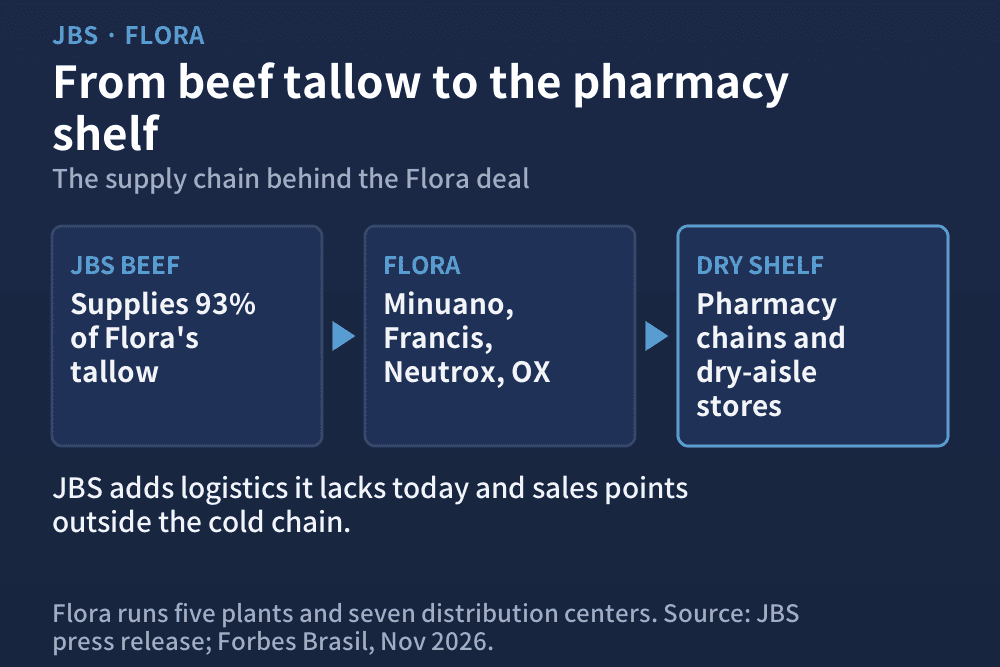
Tallow is rendered beef fat, a co-product of slaughter and a traditional raw material for soap. JBS already supplies the tallow Flora uses, and 93% of the tallow Flora buys comes from JBS.
After closing, that supply contract becomes an internal transfer. A co-product that once sold into a commodity chain now feeds a branded consumer product that JBS owns, and each step up the chain from fat to bar of soap to pharmacy shelf adds margin that previously sat on the other side of the contract.
JBS also names Genu-in, which makes bovine collagen applications, as a business the deal complements, which points the same by-product logic toward beauty and health ingredients.
Is US$542 million a high price?
Flora's EBITDA is about US$77 million, so the headline price is 7 times EBITDA, a measure of operating earnings before interest, taxes, depreciation and amortization. Counting the expected synergies, the multiple falls below 5 times.
JBS's chief financial officer, Guilherme Cavalcanti, put the present value of synergies over the next decade at US$400 million, nearly three-quarters of the purchase price. The synergies are fiscal and commercial: tax benefits from JBS's ICMS credits and commercial gains with pharmacy chains. A price that looks full on earnings looks modest once the buyer's own tax position and distribution are added to the target.
What are ICMS credits, and why do they sit inside the price?
ICMS is Brazil's state-level value-added tax on goods. A company that pays ICMS on its inputs earns credits to offset the ICMS due on its sales, and when credits pile up faster than liabilities they sit unused.
The deal places Flora's sales under a group that holds credits it can monetize. Flora did not capture that benefit under J&F, and JBS does. The value is real and specific to the buyer, which is why it appears in JBS's synergy figure and a buyer without those credits cannot claim it.
Why does the CEO transition matter to the timing?
Wesley Batista Filho succeeds Gilberto Tomazoni as JBS's global chief executive on January 1, 2027. Batista Filho said the deal gives JBS a platform to expand aggressively in wellness and described wellness as one of the areas with the greatest potential for value creation.
The deal is expected to close in December 2026, weeks before he takes the role. The incoming chief executive inherits the platform on his first day.
How do food groups reach beauty, and what does this route change?
A food group has two routes into personal care. It can develop a product and then fight for a shelf, or it can buy a business that already holds the shelf and fill it. JBS took the second. Its stated aim is expansion into consumer nutrition, health and beauty, which positions Flora as a platform inside a wider consumer plan rather than a one-off purchase.
The second route is faster and more expensive, and it carries inherited brands, plants and customers rather than a blank slate. It also changes the competitive map: a company with a captive supply of tallow, in-house collagen and a dry distribution network now competes in aisles where its rivals buy inputs from suppliers.
What does the JBS deal signal for beauty and personal care?
Adjacent industries price shelf access above product novelty. A buyer with raw materials, tax credits and a stock currency can pay for a platform that a pure beauty company cannot assemble on those terms.
For investors, the deal is a case study in how a controlling shareholder moves assets into a listed company without spending the listed company's cash. For distributors and retailers, it adds a counterparty that arrives with scale and a different cost structure.
The supply chain already ran from fat to soap. The deal adds the shelf.