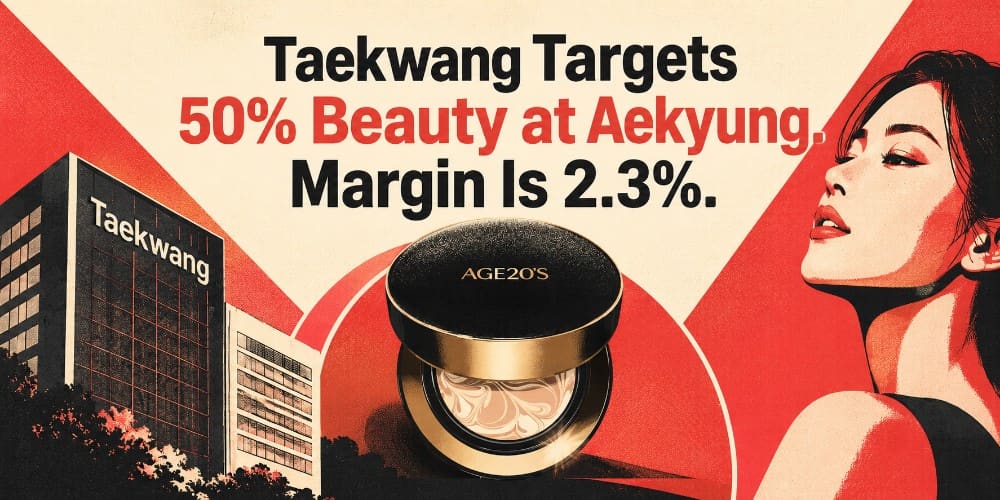
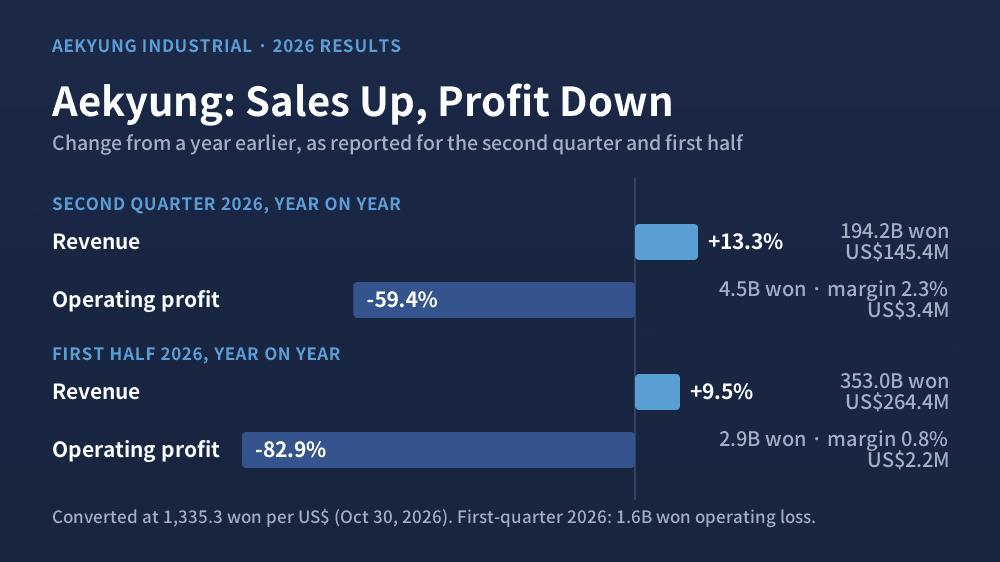
Taekwang Industrial, a petrochemical and fiber maker, has consolidated Aekyung Industrial since July 1, 2026. Aekyung's second-quarter revenue rose 13.3% to 194.2 billion won (US$145.4 million), while operating profit fell 59.4% to 4.5 billion won (US$3.4 million), a 2.3% margin. The owner's stated goal is a beauty share above 50% of revenue by 2028, up from 32.8%. The price came in at 444.2 billion won (US$332.7 million), below the 470.0 billion won (US$352.0 million) signed.
What did Taekwang buy, and what did it pay?
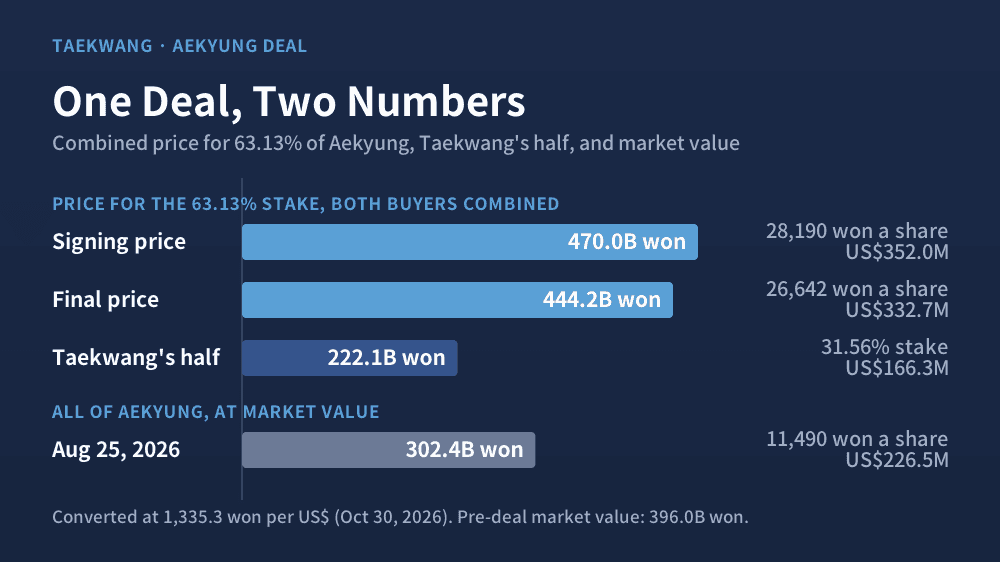
Two numbers circulate for this deal, 222.1 billion won (US$166.3 million) and 444.2 billion won (US$332.7 million), and both are correct. They describe different slices of the same transaction. The sellers, AK Holdings and Aekyung Asset Management, agreed in October 2025 to sell 63.13% of Aekyung Industrial. Two buyers split it evenly, 31.56% each: Taekwang Industrial and Beauty Life One, a private equity vehicle.
The signing price was 470.0 billion won (US$352.0 million), or 28,190 won a share. The final price for the full 63.13%, 16,672,578 shares, was 444.2 billion won (US$332.7 million), or 26,642 won a share. Taekwang's half comes to 222.1 billion won (US$166.3 million). Multiply 8,336,289 shares by 26,642 won and the figure lands on 222.1 billion won (US$166.3 million). The 444.2 billion won (US$332.7 million) is the two buyers' combined bill.
All dollar figures in this article use 1,335.3 won per dollar, the October 30, 2026 cross rate from Banque de France reference rates. Taekwang's 31.56% equals 33.09% of voting rights once Aekyung's treasury shares are excluded.
Why did the price fall from 470.0 to 444.2 billion won?
The per-share price dropped 5.5%, from 28,190 to 26,642 won, between signing and closing. The reduction is reported as an adjustment tied to toothpaste recall matters at Aekyung. The reporting reviewed does not itemize the adjustment.
A second liability was kept out of the deal. At closing on March 26, 2026, the humidifier-sterilizer liability was reported to stay with the seller, the Aekyung Group. The buyers paid for Aekyung with that exposure left behind and with the price cut tied to recall matters.
Who controls Aekyung when two owners hold equal stakes?
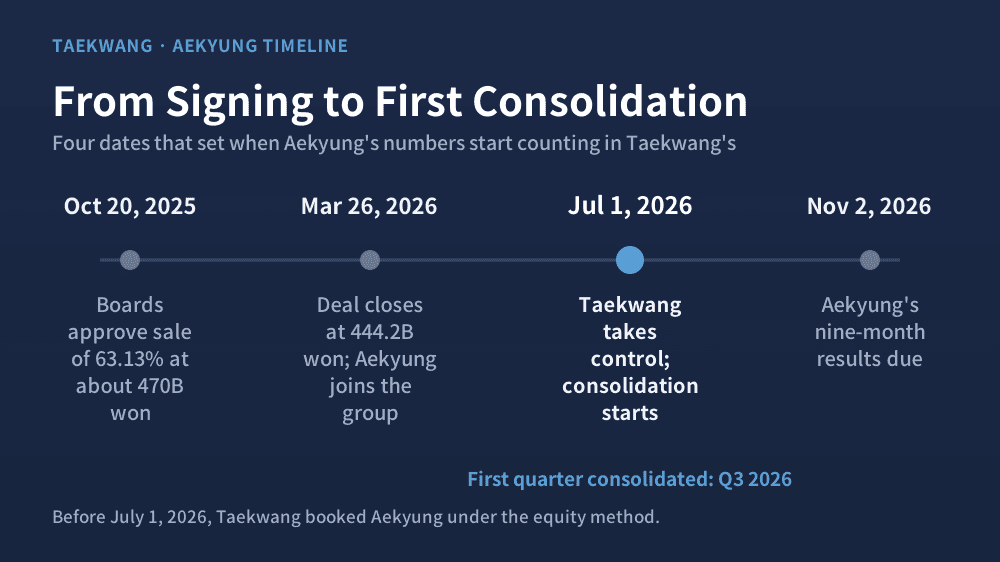
Control here rests on an agreement, not on a majority. Taekwang holds 31.56%, the same as Beauty Life One. At the end of March, Taekwang signed a joint investment agreement with Beauty Life One. A July 1 agreement followed, and from that date Taekwang holds de facto control over Aekyung's major operating and financial activities. De facto control means the power to direct the company without owning most of its shares, and it is what allows Taekwang to consolidate Aekyung.
Consolidation is the accounting step that adds a subsidiary's revenue and costs into the parent's statements line by line. Before July 1, Aekyung was an associate under the equity method, under which the investor books its share of the associate's profit as a single line. In the first half of 2026 that line was about 1.5 billion won (US$1.1 million), and dividends received were about 1.7 billion won (US$1.3 million).
Reports at signing named T2 Private Equity and Yuanta Investment as Taekwang's consortium partners. The terms of the joint investment agreement beyond its existence are not disclosed in the reporting reviewed. Two equal holders, one of them a private equity vehicle, is the structure in place today.
What was Aekyung before the deal?
Aekyung ended 2025 as a household-goods company with a cosmetics unit that was shrinking. Revenue was 654.5 billion won (US$490.2 million), down 3.6%. Operating profit was 21.1 billion won (US$15.8 million), down 54.9%, and the operating margin slid from 6.9% to 3.2%.
Cosmetics revenue was 214.9 billion won (US$160.9 million), down 17.8%. Its share of total revenue fell from 39% to 32%. Reports round that share to 32% or state it as 32.8%; both describe the same 2025 figure, 214.9 divided by 654.5. Cosmetics exports were 125.0 billion won (US$93.6 million), down 28%, and overseas sales made up 58% of cosmetics revenue. The China unit's sales fell from 83.2 billion won (US$62.3 million) in 2024 to 56.8 billion won (US$42.5 million) in 2025.
Domestic sales did not offset the export drop. Cosmetics sales at home were 89.9 billion won (US$67.3 million), up slightly. Aekyung's share of Korean face makeup was 4.5% in 2023 and 4.3% in both 2024 and 2025, and its share of household goods such as detergent and shampoo slipped from 7.4% to 6.2% over the same span, as reported at closing.
What do the 2026 numbers show?
Revenue and profit moved in opposite directions in both periods reported so far. In the second quarter, revenue rose 13.3% to 194.2 billion won (US$145.4 million) and operating profit fell 59.4% to 4.5 billion won (US$3.4 million). A first-quarter operating loss of 1.6 billion won (US$1.2 million) sits underneath that. For the first half, revenue was 353.0 billion won (US$264.4 million), up 9.5%, and operating profit was 2.9 billion won (US$2.2 million), down 82.9%. The half-year operating margin fell from 5.3% to 0.8%.
Cosmetics did gain weight. First-half cosmetics revenue was 127.2 billion won (US$95.3 million), 36% of the total, against 32.8% for 2025. Global sales were 42% of company sales in the second quarter, as reported.
Aekyung told the Korea Exchange that it would disclose cumulative nine-month results on November 2, 2026. Those figures were not available when this analysis was written, so every Aekyung number here runs through the first half.
What does a 50% beauty share require?
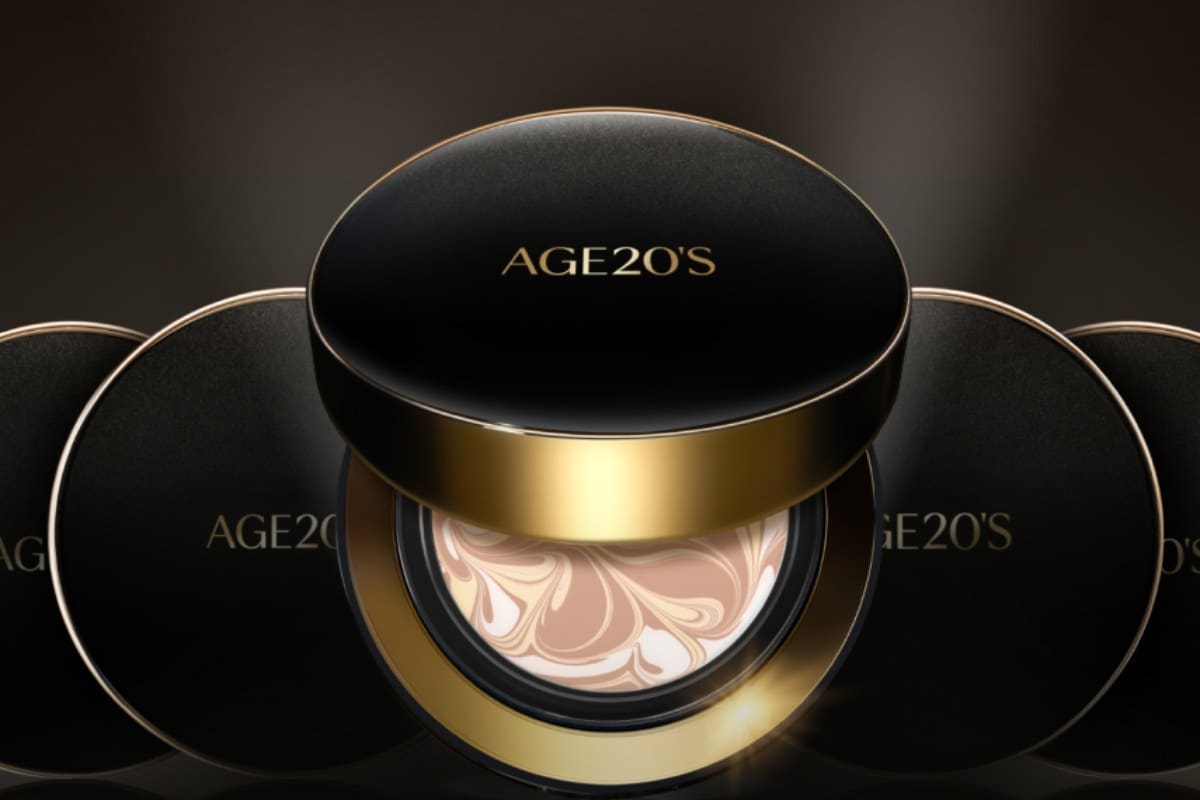
The target is the owner's own, stated when the deal closed: lift cosmetics above 50% of Aekyung's revenue by 2028, from 32% in 2025. A share has two inputs, and the arithmetic shows both routes.
On 2025 revenue of 654.5 billion won (US$490.2 million), a 50% share means 327.3 billion won (US$245.1 million) of cosmetics, 52% more than the 214.9 billion won (US$160.9 million) booked. The other route shrinks the denominator. With cosmetics flat at 214.9 billion won (US$160.9 million), the share reaches 50% only when total revenue falls to 429.8 billion won (US$321.9 million), which means household goods, now 439.6 billion won (US$329.2 million), would have to be cut by about half. The first half already shows the mix moving: cosmetics at 36% of revenue.
The reported plan splits Aekyung into four business units, makeup, skincare, personal beauty and home and dental care, each under independent responsibility management. Signiq and One Thing are named as the core skincare brands, with the United States, Europe and Southeast Asia named as the markets that replace China.
When do Aekyung's numbers start counting in Taekwang's?
The third quarter of 2026 is the first quarter in which Aekyung's revenue and costs sit inside Taekwang's statements. Taekwang's own first half is the baseline. Consolidated revenue was 1,091.0 billion won (US$817.1 million), up 12.2%, with an operating loss of about 12.5 billion won (US$9.4 million). The manufacturing and leasing segment lost about 15.8 billion won (US$11.8 million).
That is the parent taking over a subsidiary whose own half-year margin is 0.8%. Reporting on Taekwang's finances says cash flow goes first to large investments in cosmetics, energy and real estate development. Beauty is one of three claims on the same cash.
Aekyung is also not Taekwang's only beauty move. Taekwang set up a cosmetics subsidiary, SIL, in August 2025, launched its own skincare brand, Sapin, in June 2026, and became the largest shareholder of Dongsung Pharmaceutical in July 2026, as reported.
What does the market say about the price paid?
The share price answers part of it. Before the deal, Aekyung traded around 15,000 won and carried a market value of about 396.0 billion won (US$296.6 million). The buyers paid 26,642 won a share, 1.8 times that price. On August 25, 2026, the stock closed at 11,490 won, a market value of about 302.4 billion won (US$226.5 million). That close sits 57% below what the two buyers paid per share.
The gap between those prices is the price of control. The two buyers paid it for 63.13% and a say in how Aekyung is run. Minority holders own the same shares at the market price, currently well below the entry price.
What does a non-beauty owner change for the industry?
When a non-beauty corporate parent acquires a beauty company, it changes how the business is funded, how strategic risks are absorbed, and how capital is allocated. In the Taekwang case, ownership, daily management, and financial backing are split among three distinct entities: a traditional industrial conglomerate, a private equity partner holding an equal stake, and internal unit management. Because the parent conglomerate's legacy manufacturing division suffered losses (~15.8 billion won) while the newly acquired beauty business operates on slim margins (0.8%), the beauty unit no longer operates in isolation. Instead, it must compete directly against the parent company's other asset classes, such as energy and real estate, for core growth capital.
Operationally, the transition does not immediately alter product formulas, SKUs, or retail presentation on day one. However, non-beauty ownership often triggers a fast-tracked shift in market strategy. Faced with steep export declines in traditional regions like China, the new corporate parent refocuses expansion toward Western and Southeast Asian markets. For suppliers, retail channels, and international partners, the change in corporate ownership is felt long before any visible changes appear on store shelves.
From a regulatory and investment standpoint, non-beauty ownership restructures how risk and liability are handled. By dividing control through explicit shareholder agreements, adjusting transaction prices around product recall events, and keeping legacy liabilities with the seller, the buyer isolates the brand from past exposure. Ultimately, the true test of non-beauty ownership is whether corporate scale and fresh capital can expand operating margins once financial reporting is consolidated.