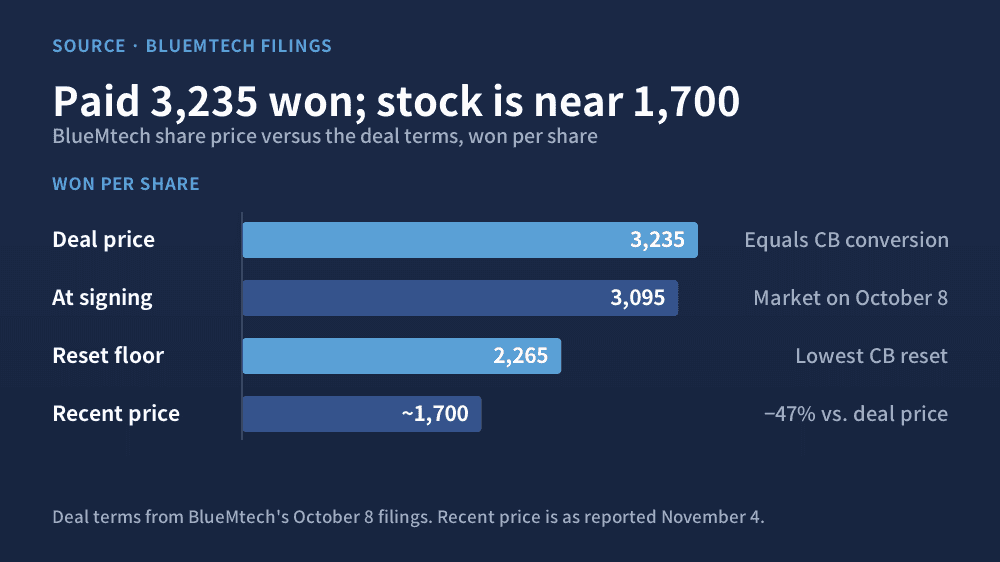
BlueMtech's buyers committed 59.1 billion won (US$44.0 million) on October 8, with the share purchase priced at 3,235 won. The stock now trades near 1,700 won, 47% below that price. The financing is a 36.0 billion won (US$26.8 million) zero-coupon convertible bond with a reset floor of 2,265 won, still 33% above the market. Its protection is a put option that opens May 6, 2029. The filings name a KDB Investment vehicle as buyer. Kolmar's role is reported, not filed.
Who is actually buying BlueMtech?
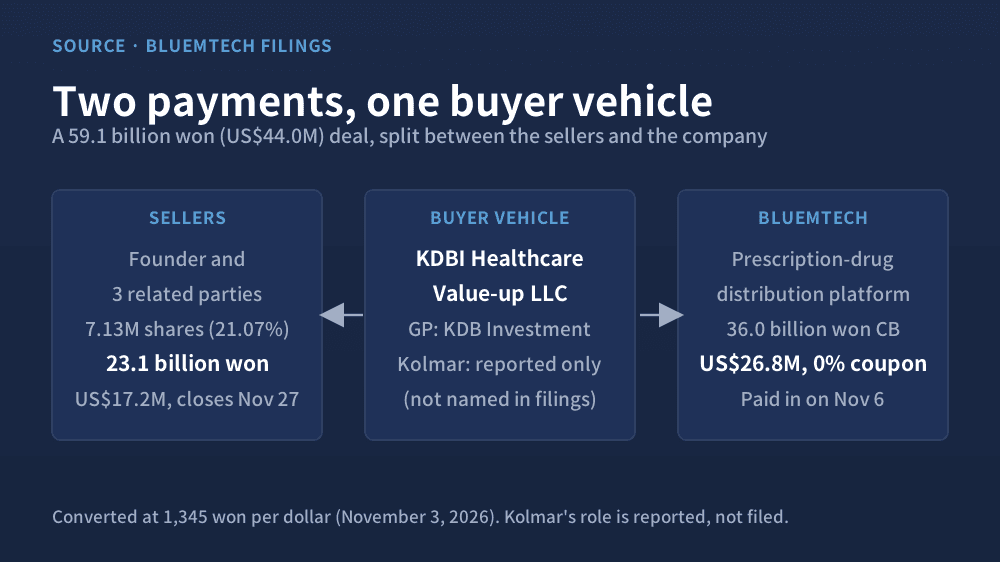
The filings name KDB Investment, the private equity arm wholly owned by the Korea Development Bank, as the counterparty on both the share purchase and the convertible bond. On October 30, KDB Investment moved its bond subscription into a special-purpose company, KDBI Healthcare Value-up LLC, and BlueMtech corrected its filing to match. The conversion price did not change.
Kolmar does not appear in that structure. Press reports describe Kolmar Holdings as the strategic investor behind the fund. Kolmar Holdings is the parent of the Kolmar group, whose cosmetics ODM arm Korea Kolmar is a separate listed company. (An ODM, original development manufacturer, formulates and produces products that other companies sell under their own brands.) Kolmar Holdings told reporters it had nothing to confirm beyond what was disclosed, and the filings do not name it.
What does the buyer get for 59.1 billion won?
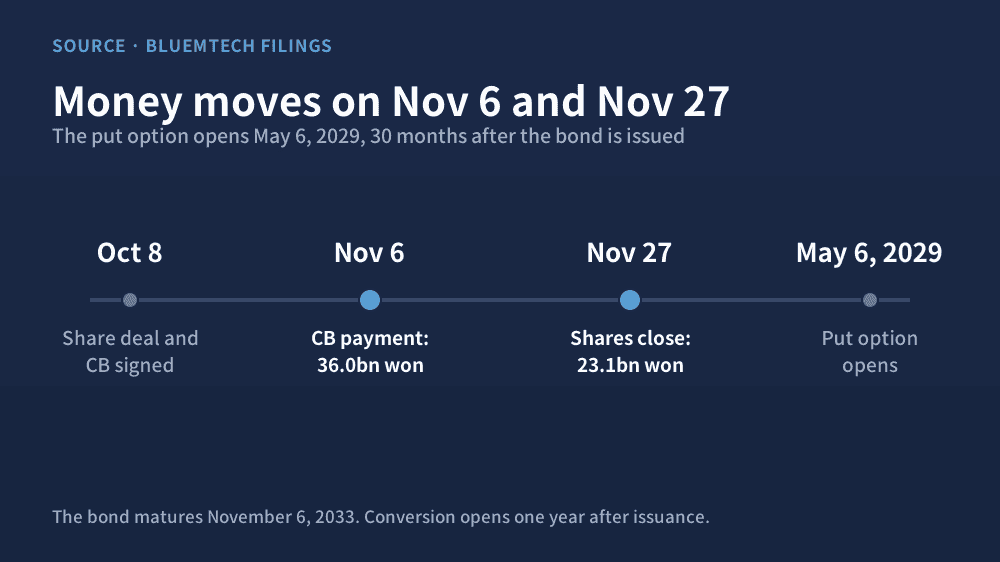
Two payments. The first is a 36.0 billion won (US$26.8 million) convertible bond (a bond the holder can swap for shares), which pays in to BlueMtech itself on November 6. The second is 23.07 billion won (US$17.2 million) for 7,131,777 existing shares, 21.07% of the company, bought from the founder and three related parties at 3,235 won a share. That payment is a single lump sum with no deposit, expected at closing on November 27. Together they total 59.1 billion won (US$44.0 million). Won figures in this article convert at 1,345 won per US dollar, the November 3, 2026 close, which makes the deal US$44.0 million.
Closing carries conditions. The bond must close, and a director nominated by the buyer must be appointed. The change in largest shareholder is not final until then. Reports in September put the sale price near 70 billion won (US$52 million). The signed deal is 59.1 billion won (US$44.0 million).
How large a stake does the buyer end up with?
BlueMtech has 33,846,547 shares outstanding. At the initial conversion price of 3,235 won, the bond converts into 11,128,284 new shares, equal to 32.88% of the current count. Add the purchased shares and the buyer holds 40.6% of the enlarged company.
The conversion price resets, and that moves the number. At the floor of 2,265 won, the bond converts into about 15.9 million shares and the buyer holds 46.3%. The lower the stock sits, the more of the company the same 36.0 billion won (US$26.8 million) buys.
Where is the paper loss?
The seller contract prices BlueMtech at 3,235 won a share. Reports on November 4 put the stock in the 1,700 won range, 47% lower. A paper loss is an unrealized one, a gap on the books with no sale behind it. On the 7,131,777 shares the buyer is still to purchase, the gap is about 10.9 billion won (US$8.1 million): 23.07 billion won (US$17.2 million) to be paid against shares worth about 12.1 billion won (US$9.0 million) at 1,700 won.
The comparison with the whole company is starker. At 1,700 won, BlueMtech's 33,846,547 shares carry a market value of about 57.5 billion won (US$42.8 million), less than the 59.1 billion won (US$44.0 million) the buyers committed. Part of that commitment is new money going into the company, so the two numbers are not a like-for-like price. They show the size of the discount.
Why does a conversion price matter when the stock sits below it?
A conversion price sets the exchange rate between the bond and the shares. At 3,235 won, a 36.0 billion won (US$26.8 million) bond swaps into 11.1 million shares. At today's 1,700 won, those shares are worth about 18.9 billion won (US$14.1 million), 52% of the bond's face value. No holder converts at that rate.
The bond resets for exactly this case. The conversion price can adjust downward seven months after issuance, and every seven months after that, but never below 2,265 won. At the floor the shares are worth about 27.0 billion won (US$20.1 million) at today's price, 75% of face value. The floor itself sits 33% above the market. Conversion is not where the protection lives.
What protects the bondholder?
The put option. Starting May 6, 2029, 30 months after issuance, the holder can demand repayment of the full principal, and can repeat the demand every three months afterward. The bond pays a 0% coupon and matures November 6, 2033. Until the put opens, the holder earns nothing in cash and holds an option that is out of the money.
A put at par turns the instrument into a claim on BlueMtech's balance sheet. The company has to be able to repay 36.0 billion won (US$26.8 million) in 2029. Its filing allocates 31.0 billion won (US$23.1 million) of the proceeds to operations, 26.0 billion won (US$19.3 million) of it for strategic investment planned in 2027, and 5.0 billion won (US$3.7 million) to debt repayment.

What is BlueMtech?
BlueMtech was founded in 2015 and listed on the KOSDAQ market in December 2023. Its main business, Bluepharm Korea, is an online platform where pharmaceutical companies sell prescription drugs to hospitals and clinics. Company figures reported in September count about 36,200 members, 68.4% of clinic-level care institutions nationwide.
The financials are a distributor's. In 2025, consolidated revenue was 185.9 billion won (US$138.2 million), up about 39% year over year, against an operating loss of 2.0 billion won (US$1.5 million). In the first half of 2026, revenue was 99 billion won (US$73.6 million) and the operating loss 0.6 billion won (US$0.4 million).
What does a cosmetics group want with a drug distributor?
The filings do not say. Reports connect the deal to HK inno.N, the Kolmar group's pharmaceutical affiliate, and describe the distribution network as the synergy. That is a reported rationale, not a disclosed one, and Kolmar has confirmed none of it.
The structure is worth reading on its own terms. An ODM earns on capacity and on customers, and a prescription-drug distribution network is a different asset class with different margins. The contract fixes the share price at a level the market has since cut nearly in half, and the bond carries a put that sets its floor at par.
What does the deal settle for the industry?
For manufacturers, the exposure is now outside beauty. A group that built its position on cosmetics capacity is reported to have a stake in a pharmaceutical distribution platform that is losing money at the operating line.
For brands and buyers, the relevant question is narrow: whether the clinic network the filings describe is open to products other than prescription drugs. Nothing in the filings says it is.
For investors and regulators, the structure is the lesson. An equity price that has fallen 47% and a bond that repays at par are two different bets inside one deal. The first is already marked. The second is marked on May 6, 2029.