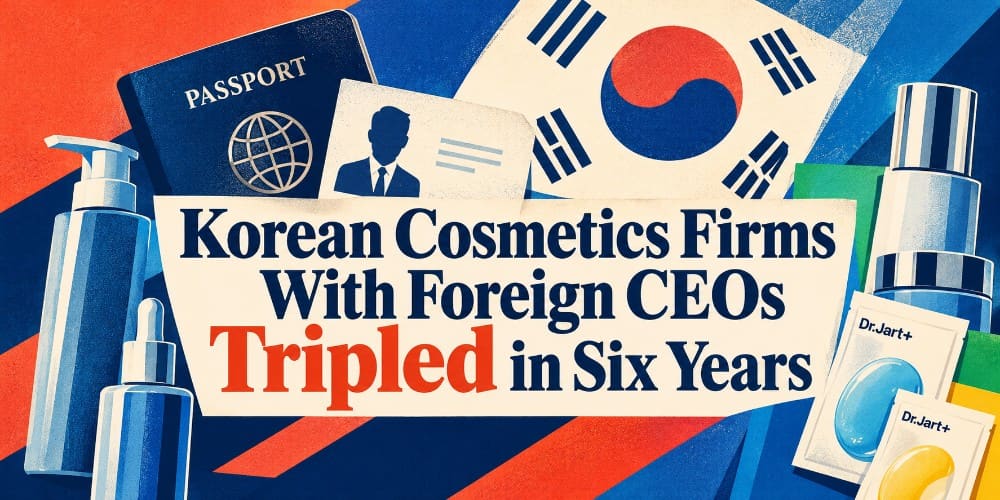
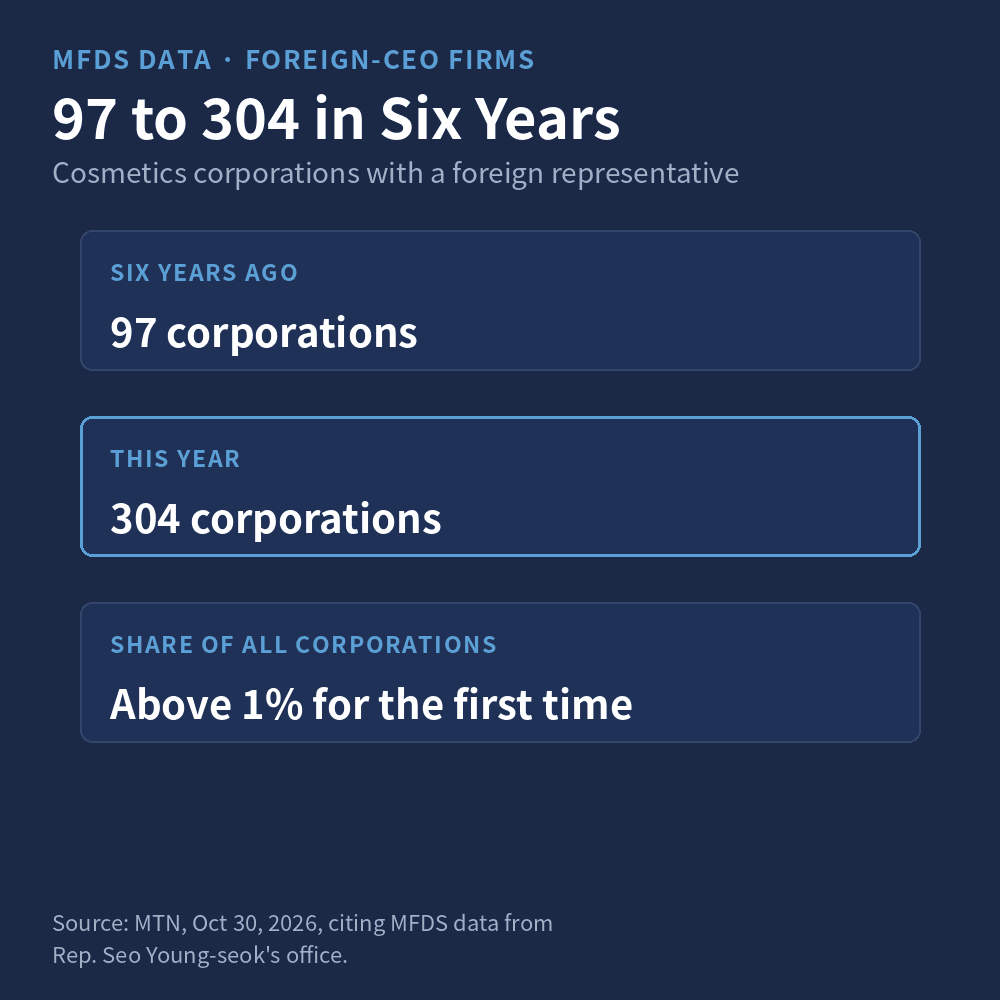
Korean cosmetics corporations headed by a foreign national numbered 304 this year, up from 97 six years ago, and passed 1% of the total for the first time. MTN reported the figures on October 30, 2026, citing Ministry of Food and Drug Safety (MFDS) data given to lawmaker Seo Young-seok's office. The count measures one fact, the nationality of the person at the top. A buyer reading "Korean brand" may take it as origin, factory or owner.
What exactly was counted?
MTN describes the group as corporations that sell cosmetics they make themselves or commission from others, where the representative is a foreigner. The article gives two data points, 97 and 304, and no figures for the years between. It does not publish the base for the 1% line, the split by nationality, or whether the firms hold manufacturing or responsible-sales registrations.
A little arithmetic helps. If 304 is just over 1%, the base is below about 30,400 corporations. The Korean Cosmetic Association reported 28,412 responsible-sales businesses at the end of 2025, per Cosmorning, and 304 would be about 1.1% of that. The units differ, a business versus a corporation, so this is a sense of scale and not a match.
What does the government-support case show?
MTN's example is a "dermo K-beauty" brand that began as a cosmetics distributor and then launched its own label. Both co-CEOs hold Chinese nationality. The Ministry of SMEs and Startups selected it as a K-export strategic item, which brings overseas entry and marketing support linked to Olive Young. The article does not name the brand.
MTN reports no rule was broken. Eligibility is set by the Framework Act on Small and Medium Enterprises, with no nationality condition, and the ministry says it does not check the representative's nationality. Professor Kim Joo-deok of Seoul Cyber University questioned whether domestic tax money should support firms with foreign CEOs. The reporter's conclusion is that it is time to discuss how far the K-beauty category should extend.
Do origin, factory and owner line up?
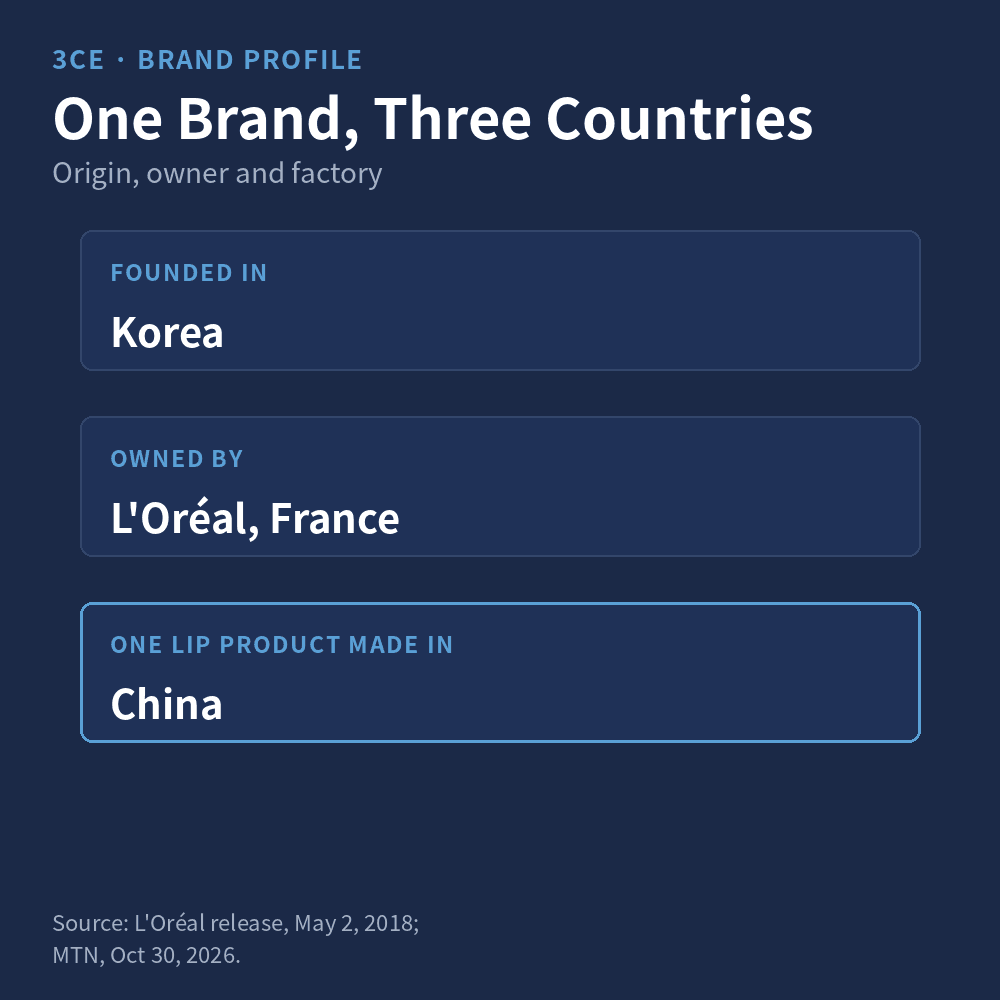
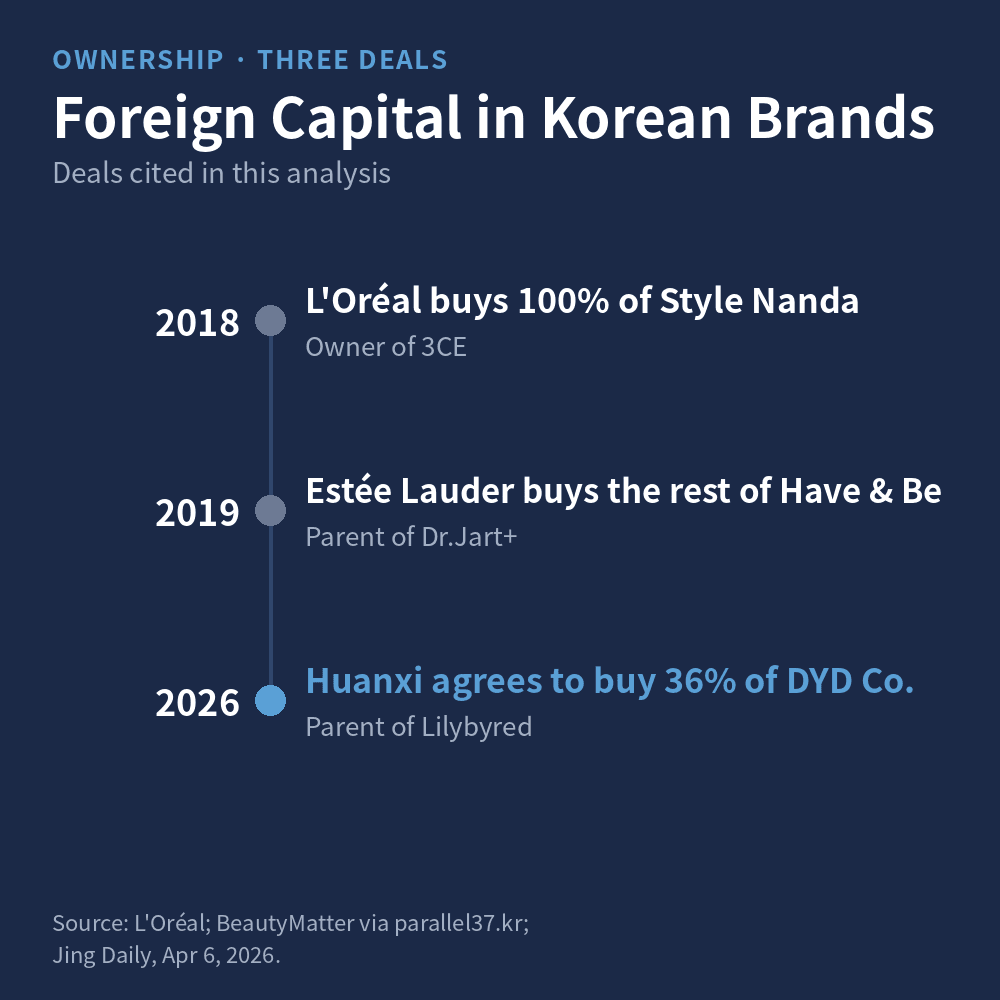
MTN's own counter-examples say no. 3CE belongs to L'Oréal, which announced on May 2, 2018 that it was buying 100% of Style Nanda, 3CE's owner. Korean media reported a price of about 400 billion won (roughly US$370 million at 2018 exchange rates). MTN adds that one 3CE lip product is made in China.
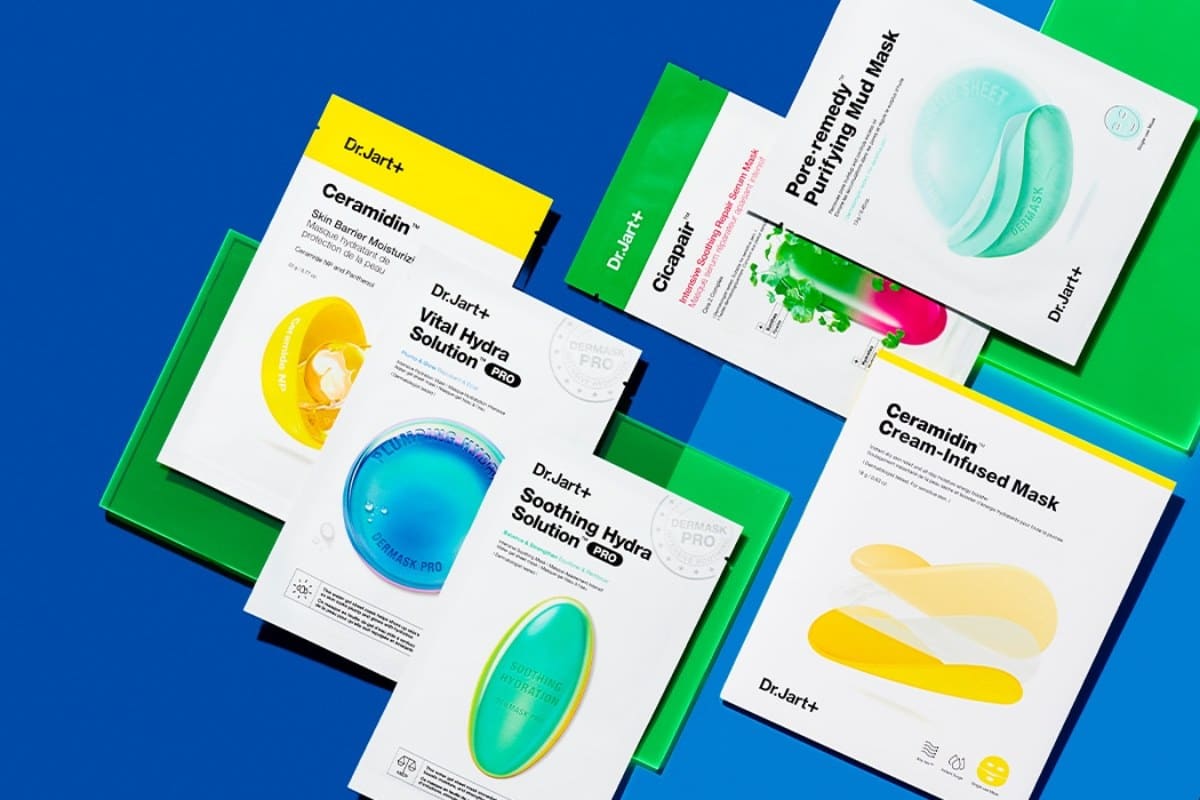
Dr.Jart+ belongs to Estée Lauder, which agreed in November 2019 to buy the two-thirds of Have & Be it did not own. It later recorded $375 million in impairments in fiscal 2025, explored a sale, and said in July 2026 that it would keep the brand, per BeautyMatter. Lilybyred is the more nuanced case. MTN says Chinese capital acquired it. Jing Daily reported on April 6, 2026 that Hangzhou Huanxi Group agreed to buy 36% of DYD Co., the brand's parent, for 120 million yuan (about $17.4 million), which would make it the largest shareholder, with closing expected by the end of May. We could not confirm the closing.
What should a buyer ask?
Four questions sort the claims. Where was the brand founded, and by whom? Who signs as the legal representative? Where is each product made and filled? Who holds the shares? The MFDS count answers only the second.
For an overseas buyer, "Korean brand" in a pitch is a claim that needs a definition. Ask which company holds the responsible-sales registration, which site manufactures the item, and who owns the company. None of the answers is bad in itself. They are different facts, and a supplier can be Korean on one and not on another.
What does this say about the K-beauty label?
The 97-to-304 jump shows that more people from abroad are running Korean cosmetics companies. It does not show who owns them, where they make their products, or who benefits from support programs. A foreign CEO may run a Korean-owned firm, and a Korean CEO may run a foreign-owned one.
As support programs grow, the question moves from "who counts as Korean" to "what is the support for": factories, brands, jobs or exports. MTN's data does not answer that. It shows that the passport count is the easiest thing to measure, and the easiest to misread.
The statistic counts passports. The market also trades origin, factory and ownership.