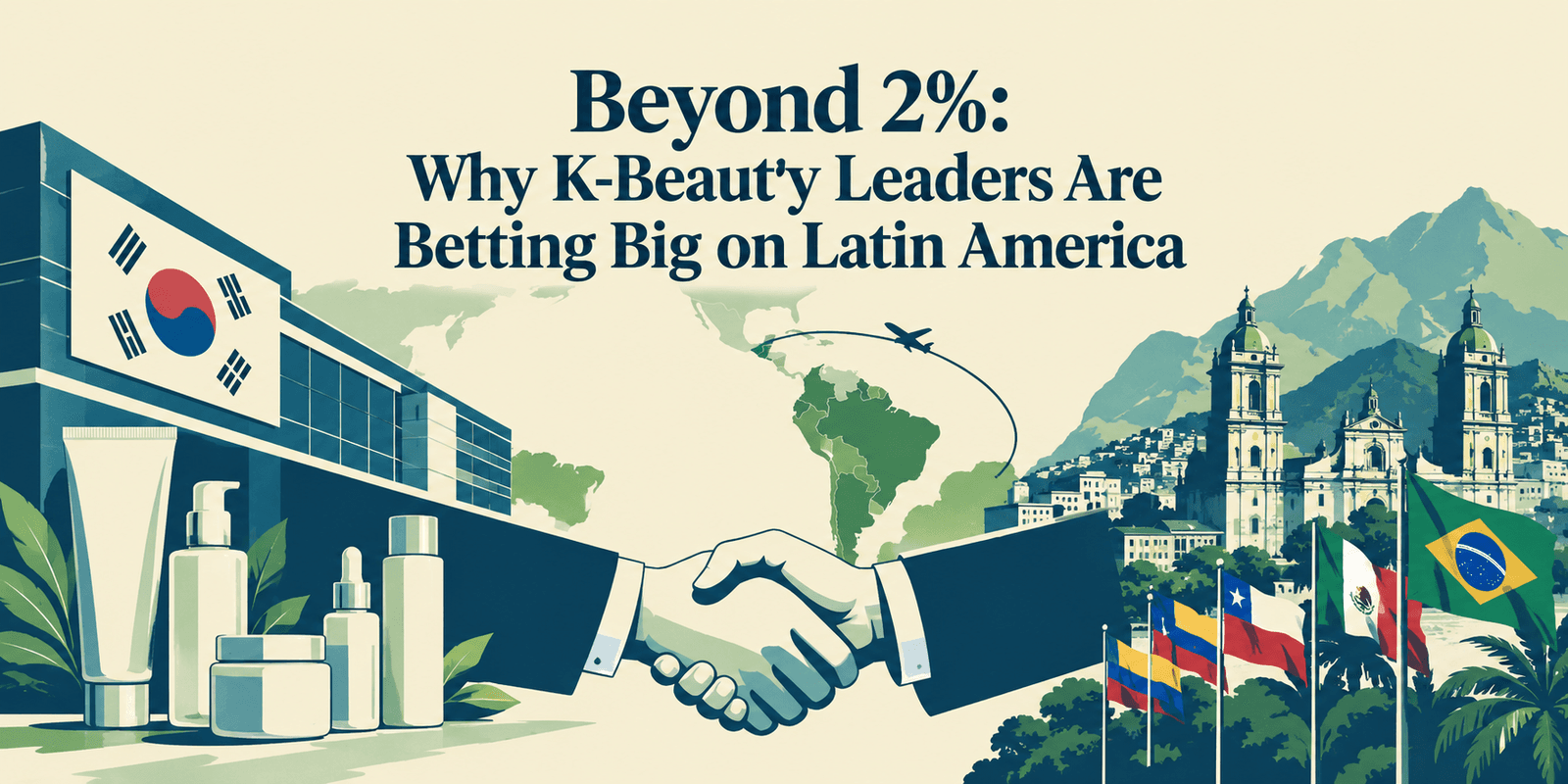
On November 17, Brazil published Decree 13.169, the first of eight signatories to enact the ALADI cosmetics agreement. The agreement ends the Certificate of Free Sale, the home-market document exporters need to register a cosmetic abroad, and replaces prior registration with notification. Brazil exported US$1.06 billion of cosmetics and related products in 2025, 76.3% to ALADI markets. Tariffs stay put. The barrier moves from paperwork filed before launch to accountability carried after it.
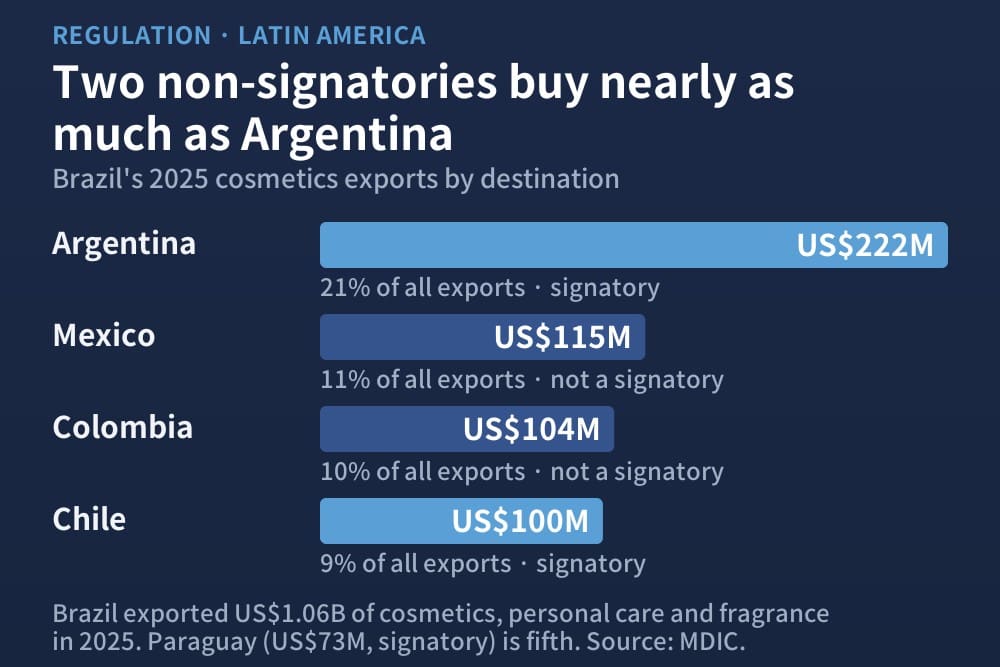
▲ Argentina took US$222 million of Brazil's 2025 cosmetics exports; Mexico and Colombia, outside the pact, took US$219 million together.
What did Brazil put into law?
Decree 13.169, dated November 16 and published in the Diário Oficial da União on November 17, 2026, executes Partial Scope Agreement No. 20 on the elimination of technical barriers to trade in cosmetic products. A partial scope agreement is a deal under the 1980 Montevideo Treaty that binds only the members that sign it. ALADI, the Latin American Integration Association, is the Montevideo-based body that hosts it.
The signatories are Argentina, Bolivia, Brazil, Chile, Ecuador, Paraguay, Peru and Uruguay. Brazil is the first to complete its domestic procedures. The decree took effect on publication, but the agreement's application waits on a second signatory.
Mexico and Colombia took part in the negotiations and are not among the signatories. The agreement is open to other ALADI members.
The agreement's stated aims are to reduce costs and increase predictability for companies, to promote regulatory cooperation and convergence among the signatories, and to expand Brazilian exports of cosmetics, personal hygiene and perfumery products into a regional market valued at more than US$55 billion.
What does the Certificate of Free Sale do, and why does removing it matter?
A Certificate of Free Sale, or CFS, is a document issued by the exporting country's authority stating that a product is sold freely in its home market. Exporters often need it before a cosmetic can be registered or sold abroad. The agreement eliminates it as a marketing requirement.
The burden falls hardest on small and medium-sized manufacturers, which chase the same documents as large groups with a fraction of the regulatory staff. Mercosur dropped the notarized CFS requirement in 2019, so the direction is not new. The pact widens it beyond Mercosur and removes the certificate itself.
How does notification replace registration?
Under the agreement, countries commit to replace prior authorizations or registrations with notification procedures. A notification informs the authority that a product is entering the market; it does not wait for a permit. Each country sets the risk criteria that decide which products qualify, and surveillance models differ by country.
Where registration remains, the agreement requires it to be objective, transparent and impartial, and to finish within a brief and reasonable period. Invima, Colombia's regulator, summarized the consensus as a simplified model that checks minimum safety conditions, with market surveillance as the core of sanitary control.
Where does the control move?
Surveillance of products on the market gets stronger. Companies carry responsibility for the safety and quality of their cosmetics and must keep information available to the authorities. Consumers get mechanisms to report undesirable effects and quality problems.
That is the structural change. A prior registration asks a brand to prove itself once, to a regulator, before it sells. Surveillance asks the brand to hold the proof for as long as the product is on the shelf. The document burden shrinks and the accountability burden grows, and it grows on the party that holds the safety file: the brand owner.
Invima's account of the consensus adds expedited mechanisms to prohibit or restrict ingredients when needed. A regime that watches products after launch needs a fast way to act on what it sees.
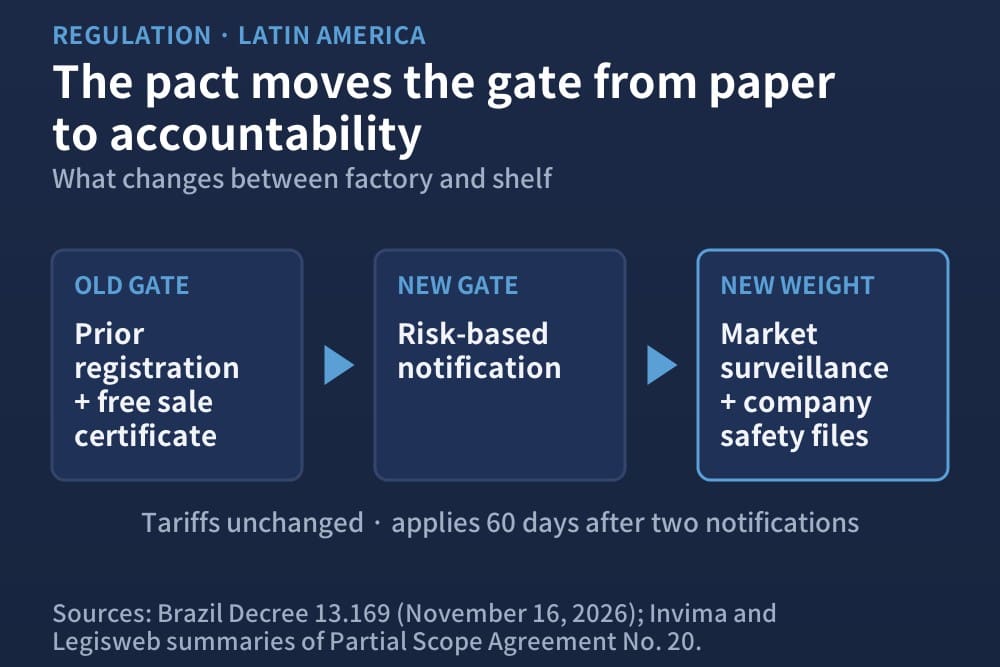
▲ Prior registration and the free sale certificate give way to risk-based notification, with the weight moving to market surveillance and company-held safety files.
What gets harmonized so that labels and plants travel?
The agreement moves labeling requirements, good manufacturing practices (GMP, the rules for how a plant produces and documents a product) and ingredient review closer together, based on international references. Invima lists minimum labeling requirements, GMP based on ISO 22716:2007 and its updates, and the incorporation of international cosmetic ingredient lists into national reviews.
The practical effect is fewer market-specific adaptations. A label or a plant dossier built to the common minimum does not need rebuilding for each signatory, which lowers the cost of adding a second and third country.
The text has a precedent. Brazil and Chile ran an earlier bilateral initiative with similar goals, and the new agreement generalizes the approach to eight countries.
When does it start?
Application begins 60 days after at least two parties notify the ALADI General Secretariat that their internal procedures are complete. For each remaining signatory, the 60-day period runs from its own notification. Brazil's decree took effect on publication, but the agreement as a whole waits for a second country.
Import tariffs are unchanged. The agreement works on technical requirements, not duties, and once in force it applies only between signatories for which it has entered into force.
How big is the market this moves?
ALADI values the regional cosmetics market at more than US$55 billion. Brazil, the world's third-largest market for these products behind the United States and China, exported US$1.06 billion of cosmetics, personal care and fragrance in 2025, up 20.1% from 2024, to about 190 markets. ALADI countries took about 76.3% of it, roughly US$791 million.
Brazil's Ministry of Development, Industry, Trade and Services lists Argentina at US$222 million, Mexico at US$115 million, Colombia at US$104 million, Chile at US$100 million and Paraguay at US$73 million as the top destinations. Brazil's sector counts more than 3,000 companies and over 130,000 direct industrial jobs, so the savings in paperwork spread across a long list of companies.
Who stays outside the pact?
Mexico and Colombia are Brazil's second and fourth destinations, at US$115 million and US$104 million. Together that is US$219 million, almost as much as Argentina's US$222 million, and none of it moves under the pact's rules until those countries join. The line between inside and outside now runs through a single exporter's order book.
Both countries took part in the negotiation. Invima reaffirmed Colombia's commitment to regulatory modernization and said streamlined requirements must protect public health without harming competitiveness or transnational trade. The door is open, and the signatures are not there yet.
What do suppliers from outside the region see?
Korean beauty exports to South America grew from US$15.3 million in 2020 to US$70.2 million in 2024, more than fourfold. Brazil took 45.0% of that, Chile 23.2%, Colombia 9.4% and Peru 8.0%. Three of those four destinations are signatories of the pact, and together they account for 76.2% of the total.
Cosmetics made up more than 90% of Korean exports to the region and hair care about 6.5%. Korea moved from 17th to 13th among suppliers to South America's beauty import market, with its share rising from 0.7% to 1.6%. At a 1.6% share, Korean suppliers adapt to a regional standard rather than shape it.
A supplier outside the region faces a regulatory bloc converging on common labeling, GMP and ingredient lists. Regulators gain surveillance at the cost of the paperwork they used to collect, and manufacturers gain speed at the cost of carrying their files for as long as the product sells. The pact does not remove the work. It moves the work to the party whose name is on the label.