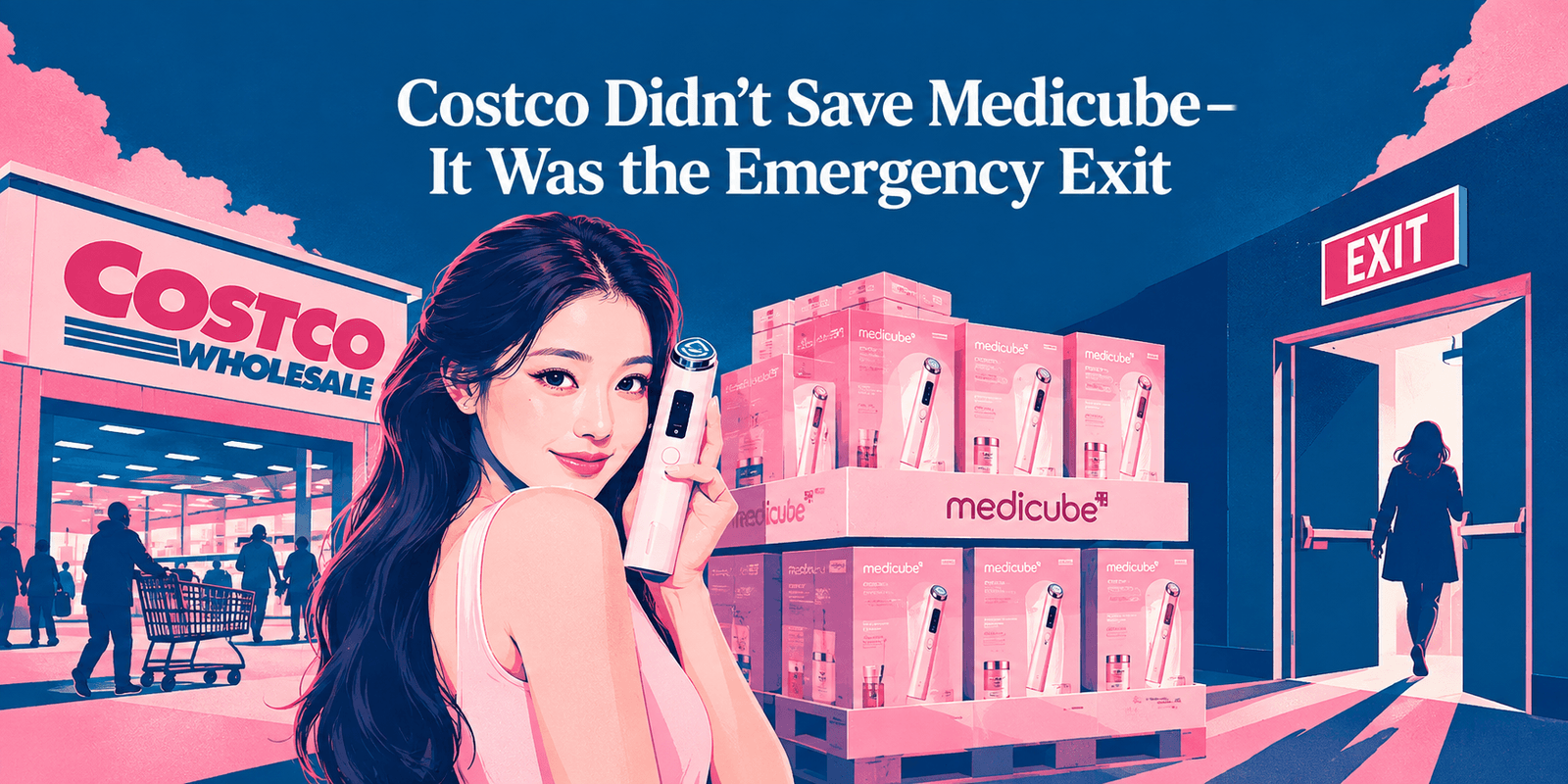
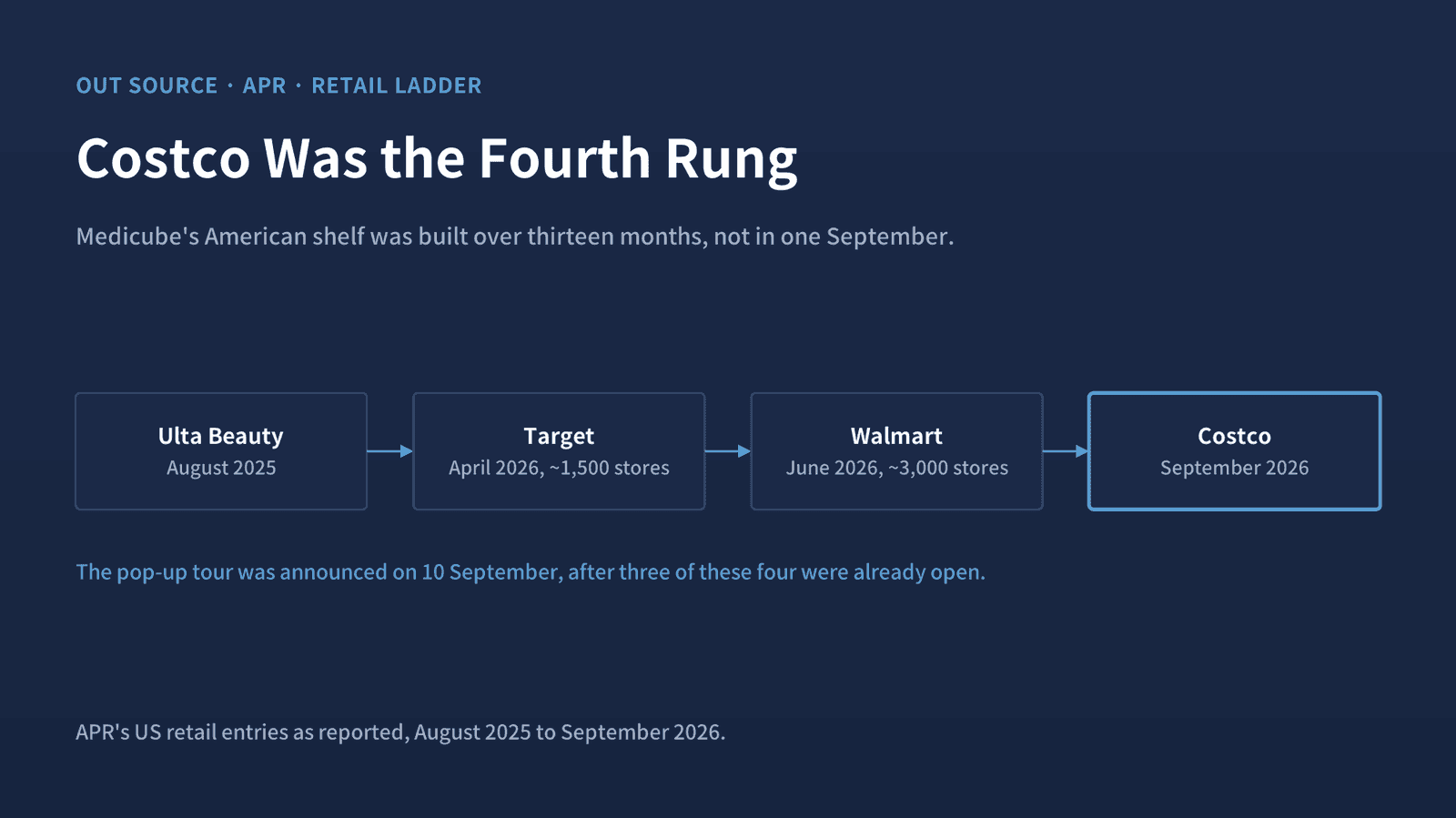
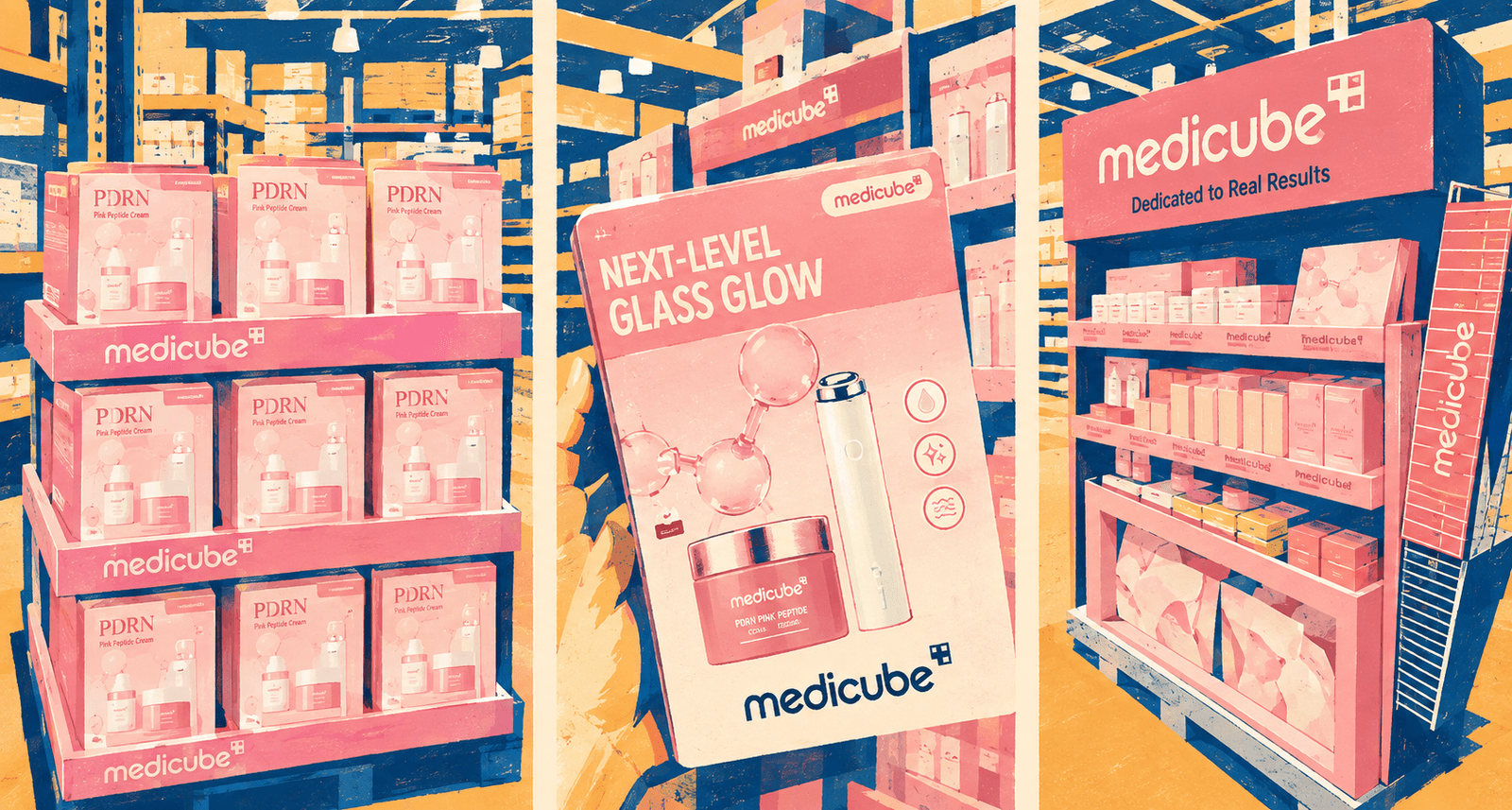
Medicube put its Zero Pore Pad 2.0 into every Costco in the United States in September 2026 and ran a celebrity meet-and-greet at a Los Angeles pop-up in the same month. Read together they look designed — online profit proven first, physical retail layered on after. The ledger says something duller and more useful. Medicube entered Ulta in August 2025, Target in April 2026 and Walmart in June. Costco was the fourth rung.
What actually happened in September?
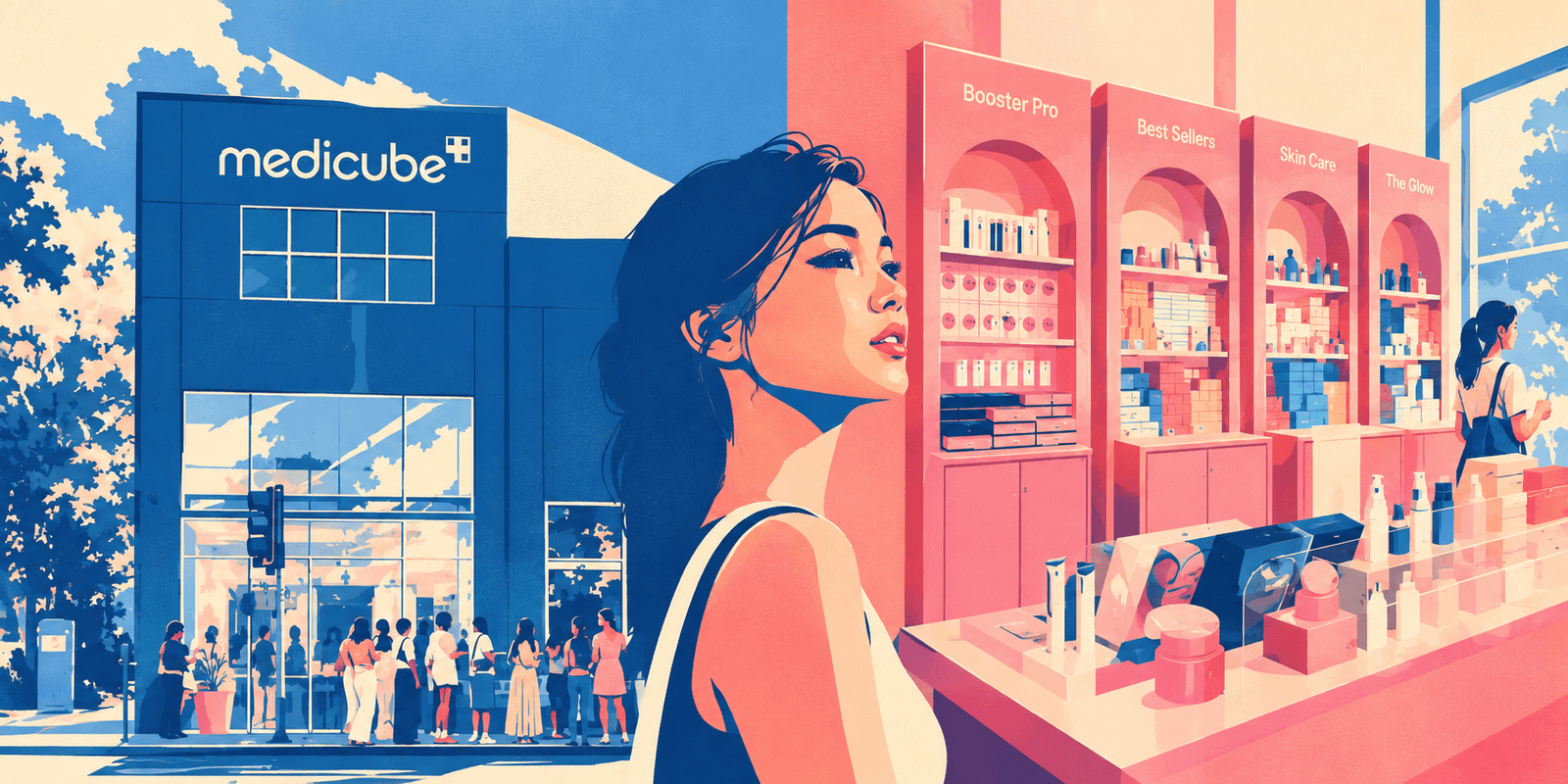
Two things, close together. The Zero Pore Pad 2.0 went into Costco locations across the United States. And APR announced a four-city pop-up tour on 10 September — New York on the 10th to 12th, Los Angeles on the 25th to 27th, London on 9 to 11 October, Paris on 23 to 25 October — under the name Medicube Wellness Club X2.
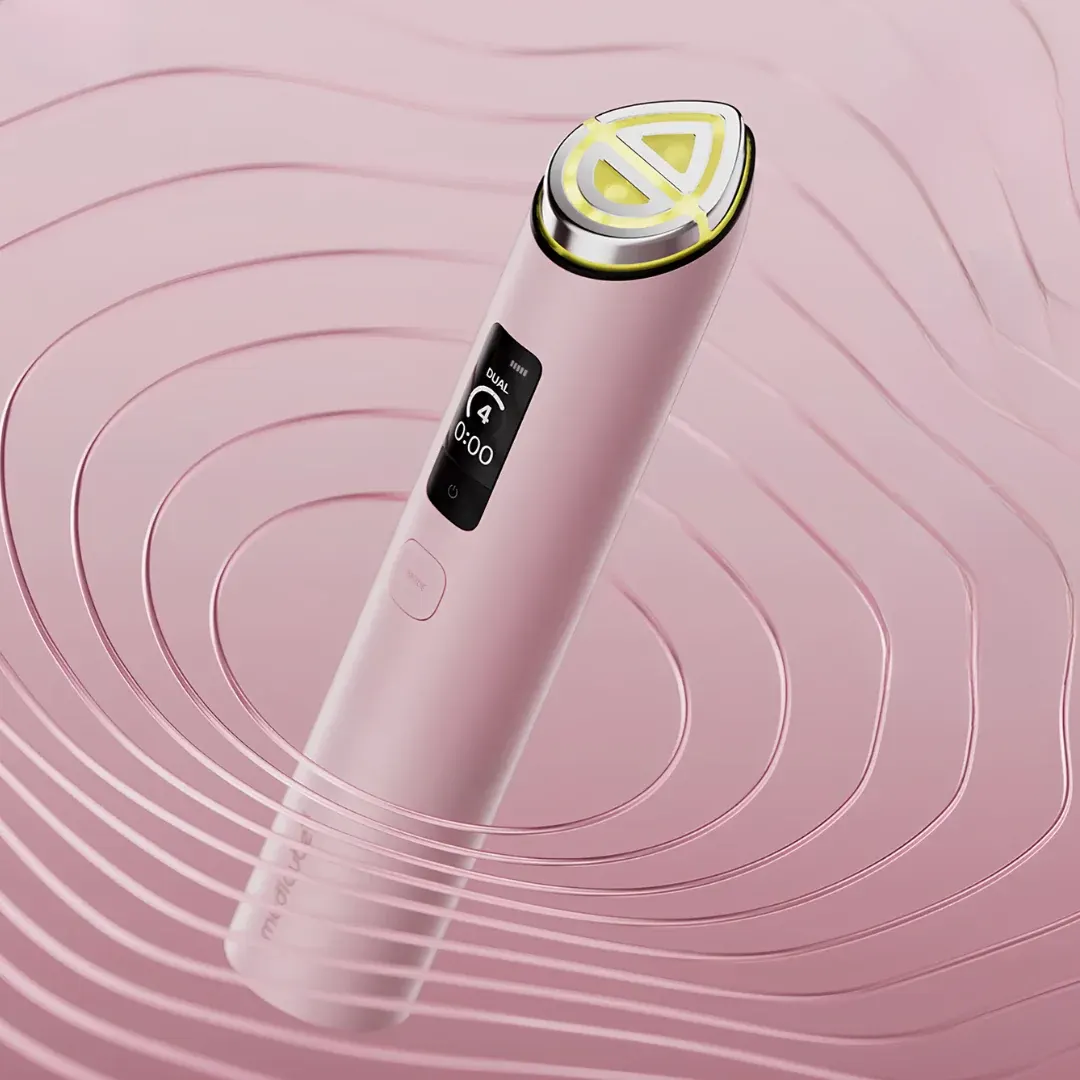
The pop-ups are built around the AGE-R Booster Pro X2, a home beauty device, with consultation zones, hands-on demos, on-site purchase and a trade-in programme for owners of older units. At the Los Angeles stop, Olandria Carthen — a Love Island USA season seven alumna now working as a fashion and social personality — held a meet-and-greet, and the strongest circulation came from small fan accounts posting about it rather than from paid amplification.
APR's stated reason for the tour was "unprecedented international demand." The figures behind that phrase: first-half 2026 revenue of 647.8 billion won in North America, up 264 percent, and 228.9 billion won in Europe, up 380 percent.
When did Medicube actually go offline?
August 2025, at Ulta Beauty. Then Target in April 2026, roughly 1,500 stores. Then Walmart in June, roughly 3,000. Then Costco in September.
Thirteen months, four retailers, in ascending order of door count and descending order of price positioning. The Walmart and Costco entries had been publicly flagged as a plan back in May 2026, four months before the Costco shelves actually filled.
So the September cluster was not a design decision about when to begin physical retail. Physical retail had been running for over a year. What September represented was the top of a ladder somebody started climbing in the summer of 2025.
What has that done to the revenue mix?
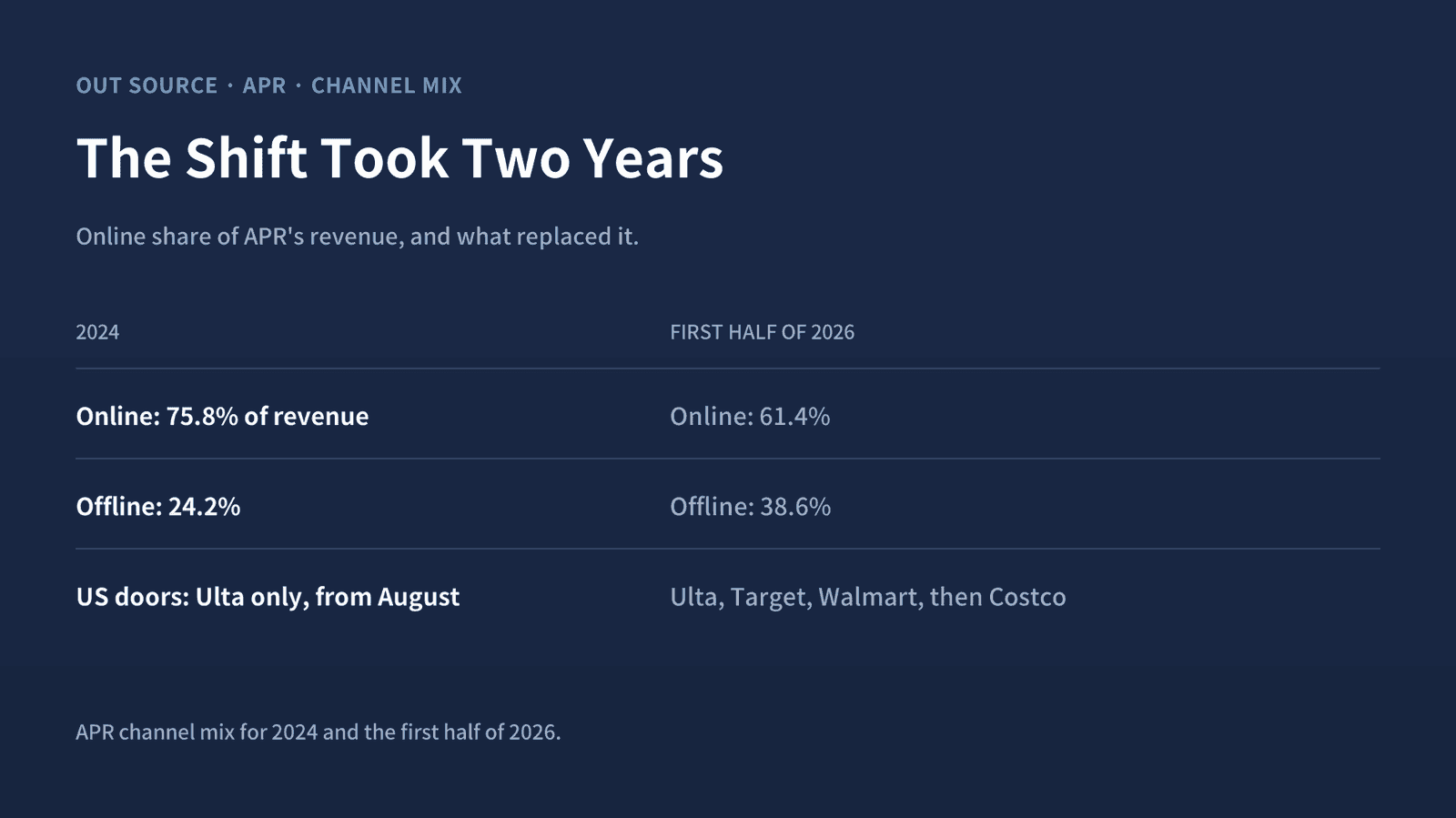
Online was 75.8 percent of APR's revenue in 2024. In the first half of 2026 it was 61.4 percent, with offline at 38.6.
Fourteen points of mix moved in eighteen months, and the direction is the whole story. This is a company that was effectively an e-commerce business becoming a company where two fifths of revenue comes off a physical shelf. That transition is slow by construction — you cannot accelerate a retail reset calendar — and it is why the entries land as a staircase rather than an event.
What was happening online in the same month?
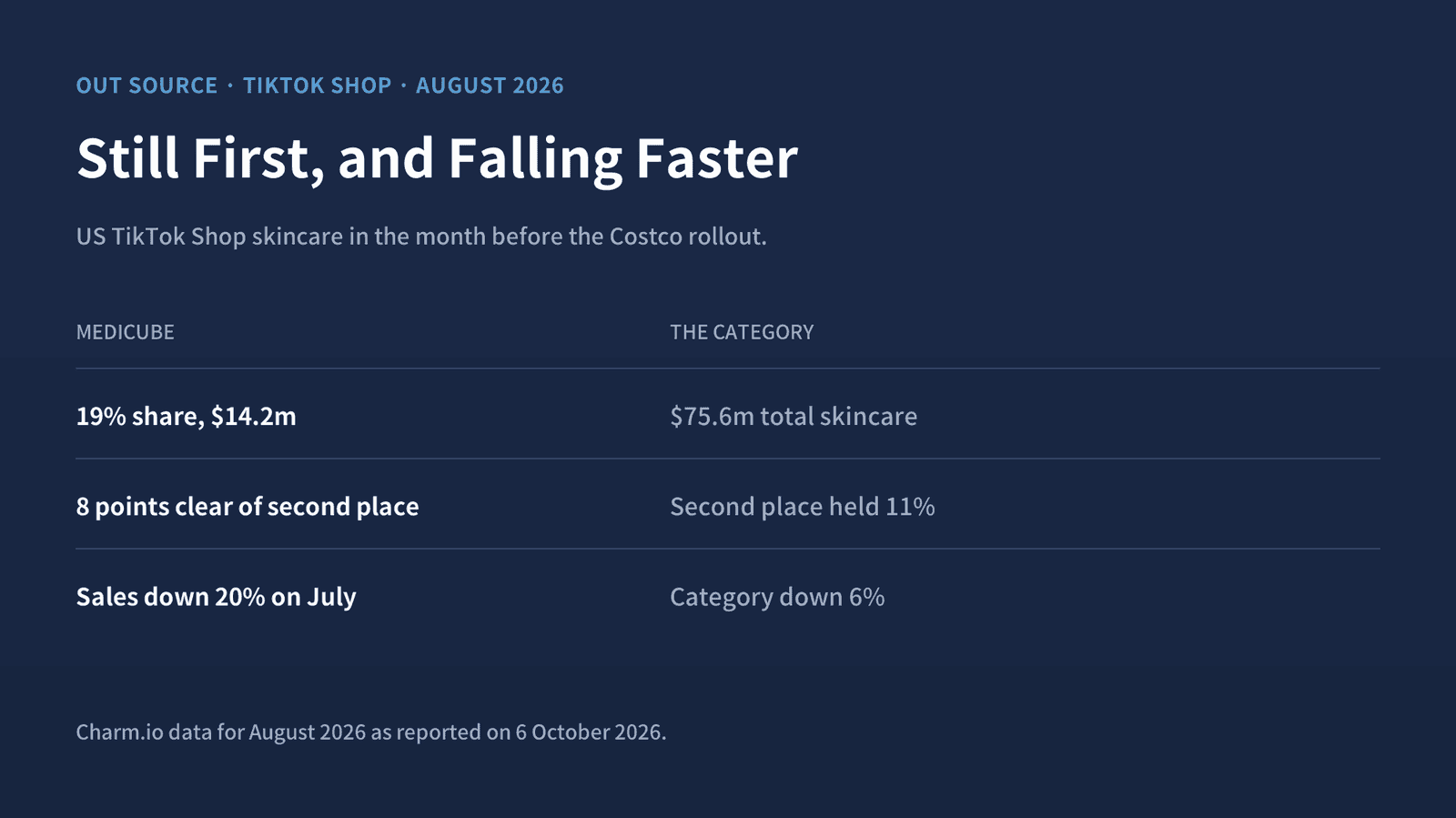
Here is the part the September narrative leaves out. In August 2026, the month before the Costco rollout, Medicube held 19 percent of the US TikTok Shop skincare category — $14.2 million of a $75.6 million category, first place, eight points clear of Dr. Melaxin in second at 11 percent. Eight of the top ten brands in that category were Korean, and the ten together held 45 percent of it.
Dominant, in other words. And in the same month Medicube's TikTok Shop sales fell 20 percent against July, while the category as a whole fell 6 percent.
One month is one month, and a single decline in a single channel proves nothing on its own. But it does reframe the sequencing question. The offline push did not arrive because online had been proven. It arrived at the point where the best online channel had stopped compounding and the company needed the next leg to carry the number.
Is a pop-up a sales channel or a proof?
Neither, mostly. A three-day pop-up in Los Angeles sells a rounding error against 1.3 trillion won of expected North American revenue, and it proves nothing a company already doing those numbers needs proving.
What it does is put a device in somebody's hands. The AGE-R line is the hardest part of Medicube's range to sell online, because a home beauty device at that price is a considered purchase that people want to touch. The trade-in programme is the tell: it is aimed at existing owners upgrading, which is a retention mechanic, not an acquisition one.
The celebrity layer does something narrower still. Olandria Carthen's fan accounts are small and unpaid, and that is precisely their value — organic posts from accounts with four-figure followings read as real in a way a sponsored post does not. It is cheap, it is credible, and it does not scale. Which is fine, because the Costco shelf is what scales.
What did the share price actually react to?
APR's stock was up close to 100 percent across 2026 as of 31 August — reported ahead of the Costco launch, not after it. The ordering matters, because the easy version of this story has the Costco news driving the re-rating, and the dates do not support it.
What was in the market by then was the second quarter: revenue of 767.5 billion won, up 134.2 percent, operating profit of 190.6 billion won, up 134.5 percent, and overseas sales at 91.8 percent of the total. The company raised annual guidance from 2.1 trillion won to 3 trillion. A vice president, Shin Jae-ha, put expected North American revenue at around 1.3 trillion won, with North America at roughly 49 percent of second-quarter revenue.
The Costco entry was a confirmation of a thesis the market had already bought, not the news that created it.
Does the Fenty comparison hold?
Partly, and the part that fails is the instructive one. Fenty Beauty launched on 8 September 2017 with 40 foundation shades, through Sephora in the US and Harvey Nichols in the UK, and generated $72 million in earned media value in its first month. That was genuinely a single-day detonation — the shade range, the celebrity and the distribution all arrived together, on a brand nobody had bought from before.
Medicube's September is the opposite shape. Four retailers over thirteen months, a device line already selling, a category position already first, and a pop-up tour announced after three of the four retail entries were open. Nothing detonated. A staircase got to its top step.
Both can work. They are different instruments, and confusing them is how a brand with no distribution spends a launch budget on a single day and wakes up with nowhere to sell.
What transfers to a brand without 3 trillion won of guidance?
The order, and only the order. Prove the product in a channel where failure is cheap and data is immediate. Use that proof to open the easiest physical door, which for a Korean brand in America has been Ulta or a marketplace listing. Then climb — specialty, then mass, then club — in ascending door count, because each rung needs the previous one's sell-through numbers to justify the buy.
What does not transfer is the compression. APR climbed four rungs in thirteen months because it had the inventory, the working capital and the second-quarter numbers to make every buyer's decision easy. A brand without those climbs the same ladder on a longer clock, and trying to skip rungs is how the opening order becomes the only order.
Where does this leave the three parties?
Manufacturers and ODM suppliers. A client moving from 24 percent offline to 39 percent in eighteen months changes its order profile completely — larger runs, longer lead times, packaging specs that survive a club-store pallet. The suppliers who can follow that shift keep the account.
Brands and the buyers who stock them. The sequence is the asset, not the September cluster. A pop-up at the top of a built ladder works. The same pop-up with nothing underneath it is an expense.
Investors. The channel mix line is the one to track. Online falling as a share while revenue doubles is a company successfully changing shape; online falling while revenue flattens is something else entirely, and the TikTok Shop number in August is the first place that distinction will show.
September did not start anything. It finished something that started in August 2025.