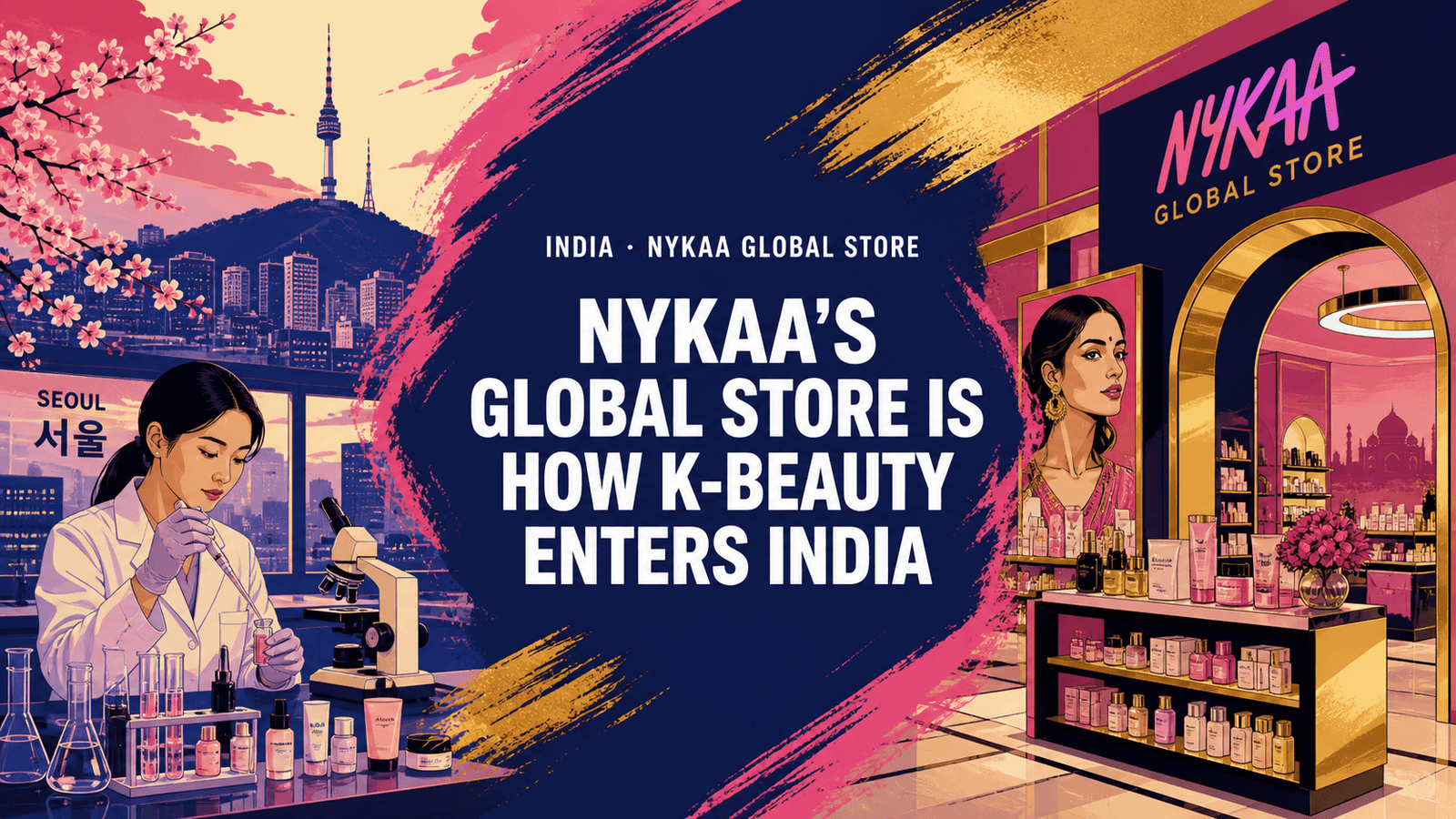
Nykaa sells K-beauty in India as a marketplace and as the importer. In the quarter ended September 30, 2026, brands that came through its Global Store import arm grew more than 60 percent year on year, against 30 percent for platform gross merchandise value (GMV, the total value of goods sold). They now generate 34 percent of Nykaa's Korean beauty business, up from 23 percent. Nykaa imports the Korean brand, registers it, prices it, stores it, and sells it.
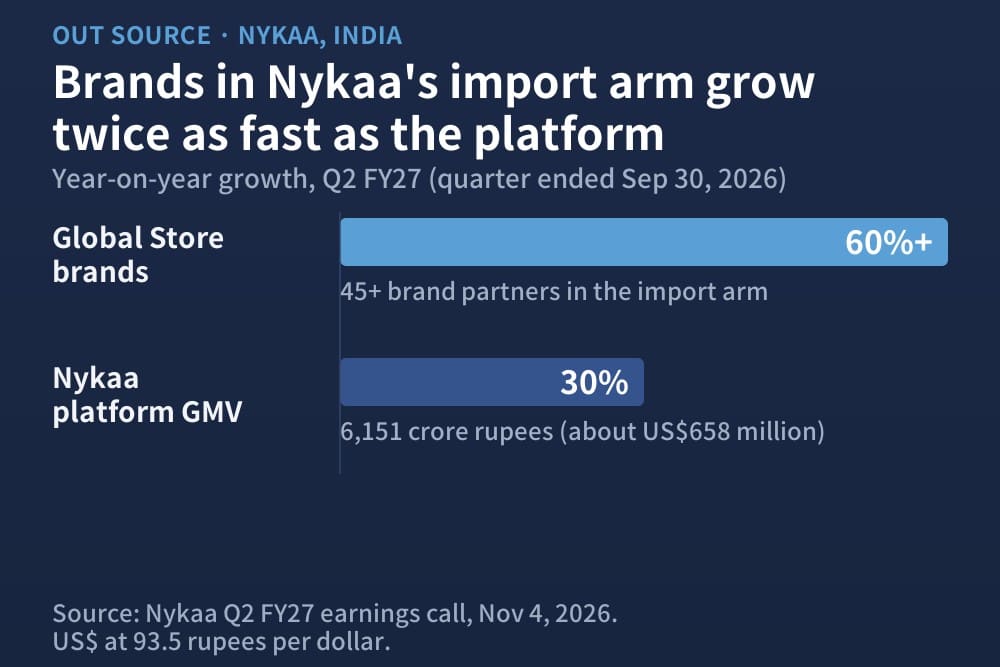
▲ Global Store brands grew more than 60 percent in the quarter ended September 30, 2026, twice the 30 percent growth of Nykaa's platform GMV.
What did Nykaa report about Global Store for the quarter ended September 30, 2026?
On its November 4, 2026 earnings call for the second quarter of fiscal 2027 (the year ending March 2027), Nykaa said more than 45 brands now partner with it through Global Store. Anchit Nayar, CEO of beauty e-commerce, said those brands are growing at over 60 percent year on year, more than double the growth rate of the overall platform.
The platform itself had a strong quarter. GMV grew 30 percent to 6,151 crore rupees (a crore is 10 million; about US$658 million at 93.5 rupees to the dollar in November 2026). Revenue rose 28 percent to 3,006 crore rupees, and net profit reached 101.2 crore rupees, about US$10.8 million. Beauty GMV grew 25 percent to 4,454 crore rupees, and Nykaa added 14 stores to reach 338 across 111 cities.
Nykaa launched Global Store in 2021 to sell international beauty brands in India. Five years on, the program is no longer a corner of the catalog. The company's investor presentation gives it its own slide of outcomes, and the call treated it as a growth engine in its own right.
What does Global Store actually do for a brand?
Nayar described a service that lets a brand import, register, price, and handle supply chain and warehousing in India. Each of those steps normally belongs to a different party: an importer, a distributor, a warehouse, a marketplace. Global Store puts them under one contract.
The marketing layer sits on top. Nykaa offers full-stack marketing across content creators, events, and performance and digital campaigns. It runs direct-to-consumer websites on behalf of brand partners, operates freestanding stores, and distributes through multi-brand specialty stores and general trade, the traditional neighborhood retail channel.
Kiehl's shows the full version. Nykaa runs the L'Oréal brand end to end, including its direct-to-consumer website and freestanding stores. Nykaa operates 16 brand boutiques, 14 of them for Kiehl's and 2 for Charlotte Tilbury. The investor presentation adds 3,600 brand activations and more than 2 million customers acquired in the last 12 months, and counts 17 luxury brands distributed online and through more than 250 stores.
Why does a 34 percent share of Korean beauty matter?
Korean brands that come through Global Store now account for 34 percent of Nykaa's Korean beauty business, up from 23 percent. They grow GMV at 2.5 times the rate of other Korean brands on the platform. The remaining 66 percent of Korean beauty business comes from brands that grow slower.
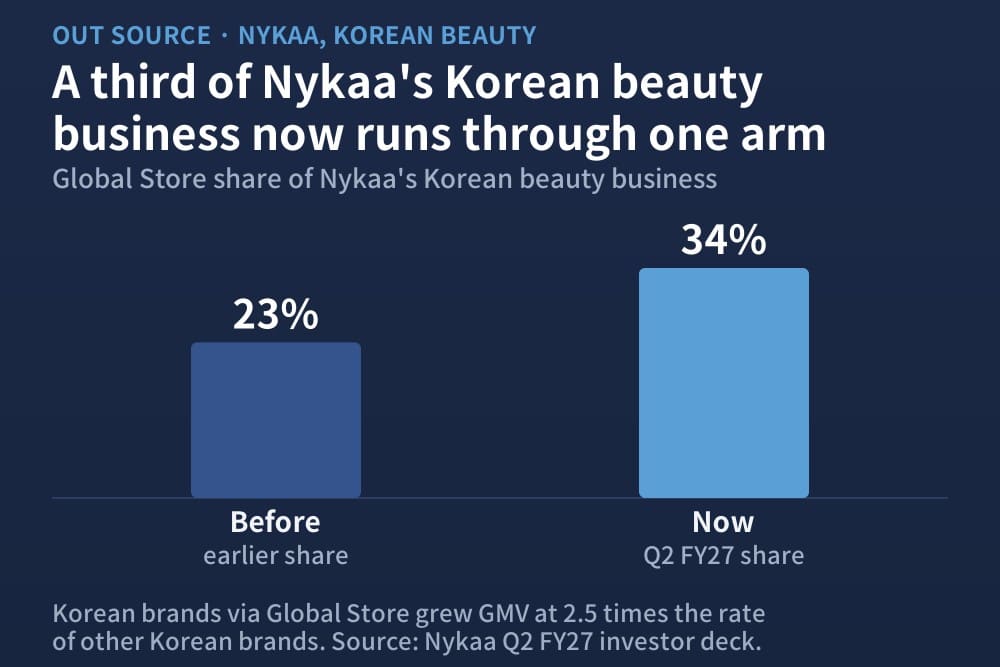
▲ Global Store's share of Nykaa's Korean beauty business rose from 23 percent to 34 percent, and its Korean brands grew GMV at 2.5 times the rate of other Korean brands.
The shift is 11 percentage points of share inside a single category. The fastest-growing Korean brands on India's largest beauty platform are the ones Nykaa imports. Growth and operator control arrive together.
That pairing is the insight in the numbers. A platform that controls import timing, pricing, stock position, and marketing can set all four around a launch. A brand supplying a distributor and a marketplace separately has to coordinate them across separate parties.
How is an importer-operator different from a distributor?
A distributor buys stock and sells it on to retailers. A marketplace lists products and takes a commission. Nykaa's Global Store does both and adds the rest: registration, pricing, warehousing, the brand's own website and stores in India. Nayar called it the distribution and imports arm.
For a brand, the chain compresses. The usual sequence runs brand to importer to distributor to retailer to shopper. Under Global Store, it runs brand to Nykaa to shopper, with one counterparty holding the import file, the price list, the stock, and the customer data.
Fewer handoffs shorten the path from the Korean warehouse to the Indian shelf, and launches follow one platform's calendar instead of several.
What did the Mamonde launch show?
Mamonde, the Amorepacific brand, launched in India in August 2026 exclusively on Nykaa. The release dated August 18, 2026 lists 10 products centered on the Rose HA and Peony BHA lines, aimed at Indian Gen Z and millennials. It positions the brand as high-performance skincare at accessible price points in a K-beauty market in India that premium brands largely dominate, and it frames the formulas around dryness, excess sebum, and enlarged pores tied to local climate.
On the earnings call, Nayar said Mamonde was one of three launches in the quarter and came exclusively through Global Store, which he described as Nykaa's distribution and imports arm. The release speaks of an exclusive Nykaa launch, and the call identifies the structure behind it.
The pairing is the point. A group of Amorepacific's size entered India through a platform-run, exclusive channel. The entry model, not the brand, is what Nykaa reported to investors.
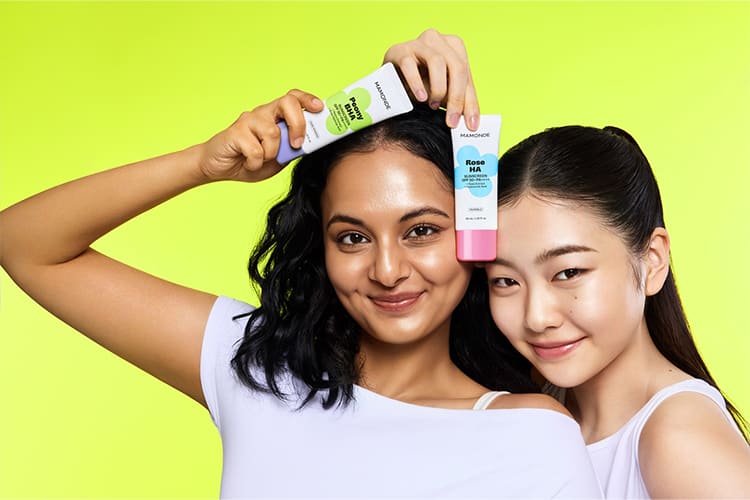
▲ Mamonde launches on Nykaa in India. Photo: Amorepacific
What does a brand give up under this model?
Exclusivity comes first. Mamonde launched exclusively on Nykaa. Anua, La Roche-Posay, Aestura, and SK-II all launched exclusively with Nykaa earlier. Exclusive launches tie a brand's India debut to one counterparty.
Control comes second. When one party holds the import registration, sets the price, and keeps the stock, the brand's India business becomes a service relationship with that party. The brand's own decisions narrow to product, positioning, and the choice of partner.
The brand gains what it cannot build quickly alone: 338 stores in 111 cities, more than 2 million customers acquired in 12 months, and a team that handles registration and warehousing. The trade is control for reach, and the quarter's numbers show brands accepting it.
How does the model reshape the Korean export channel?
Korea's export chain commonly runs through distributors that buy from the brand and resell by country. Global Store replaces that layer in India with a platform that owns the retail end as well.
Other platforms with logistics and stores hold the same ingredients: a customer base, a warehouse network, a store footprint, and the willingness to take import risk. Nykaa has all four in India.
For Korean manufacturers, the counterparty changes. A single platform importing for more than 45 brands becomes a buyer whose launch calendar sets the ordering rhythm.
What does the platform-as-importer model change for the industry?
Distribution now runs on two models. One sells stock to a local partner and steps back. The other keeps operational control in the market. Nykaa reports that the brands on its second model grow more than twice as fast as the platform.
Manufacturers see larger, more regular orders from fewer buyers. Brands and buyers see faster launches and a single point of accountability, and in exchange accept exclusivity and a thinner role in the market. Investors see a platform that earns on import, retail, and marketing at once.
The importer of record is now the platform.