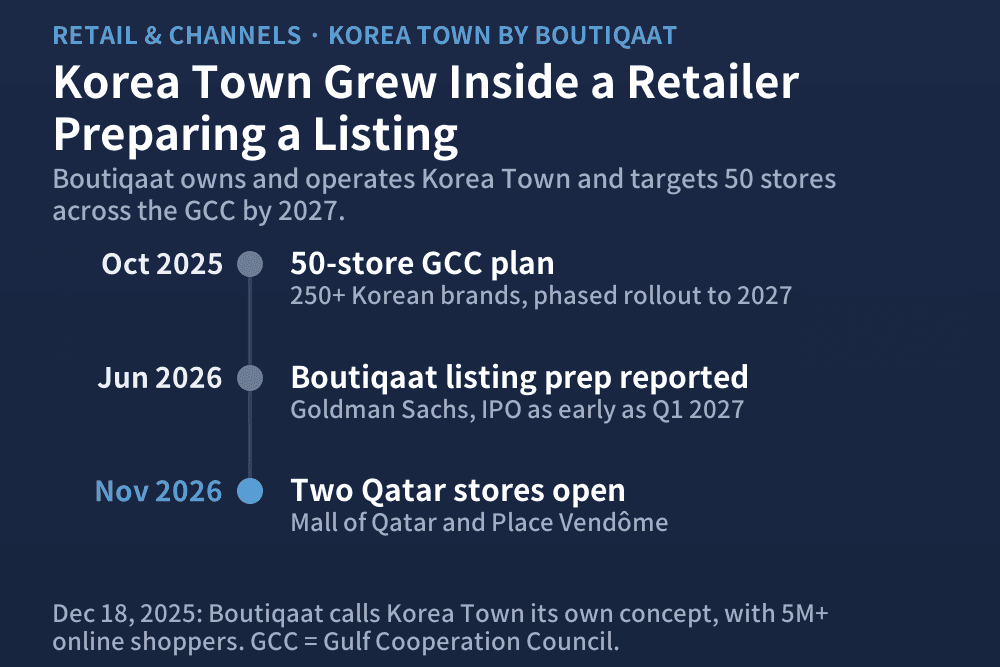
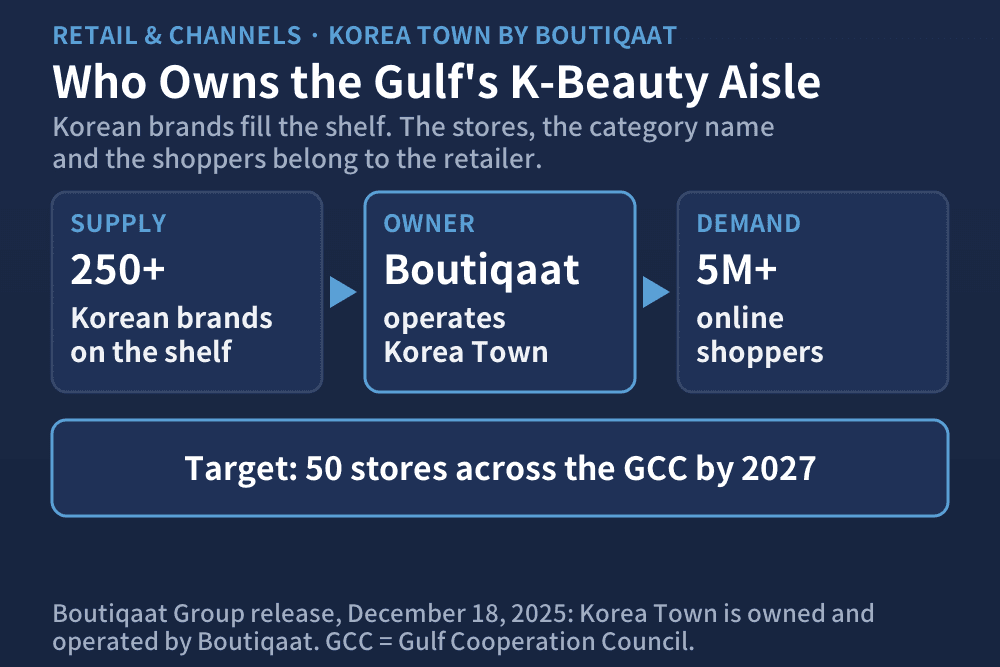
Korea Town, a K-beauty retail chain in the Gulf, is not a Korean company's export. A December 18, 2025 release describes it as a concept owned and operated by Boutiqaat, a Kuwait-based beauty platform with more than 5 million online shoppers. The plan is 50 Korea Town stores across the Gulf by 2027, and a June 2, 2026 Bloomberg report put Goldman Sachs behind a Boutiqaat listing as early as the first quarter of 2027. In the Gulf, the K-beauty aisle has an owner, and the owner is a retailer.
What is Korea Town, and who owns it?
Korea Town was founded in Kuwait and sells Korean skincare, makeup, haircare, body care and lifestyle products through Boutiqaat's online platform and its own stores. The December 18, 2025 release states that it is a retail concept owned and operated by Boutiqaat. Boutiqaat sells beauty, fragrance, fashion and lifestyle products across the Middle East and partners with brands in Europe, North America and Asia.
The ownership fact changes how the model reads. Korea Town is no Korean distributor's retail arm and no leased aisle inside someone else's store. The stores, the app, the shopper data and the name belong to a Gulf retailer that chose Korean beauty as a category and branded it as a destination.
The same structure appeared earlier. A March 2025 report had Korea Town signing an exclusive partnership with the Korean skincare brand One Thing and selling it across Kuwait branches, including The Promenade, The Warehouse, Al Kout Mall, Marina Mall and Otaib Tower in Jahra, plus online through the Boutiqaat platform.
What does "Powered by Boutiqaat" mean in practice?
An October 2025 announcement formalized the partnership between Korea Town and Boutiqaat Group for Perfumes and Cosmetics under a "Powered by Boutiqaat" model. Boutiqaat supplies online retail infrastructure, logistics, a data-driven digital ecosystem, an influencer network and AI-enhanced consumer engagement tools.
Those five items decide whether a product sells after it lands in a market: who holds the inventory, who sees the shopper's data, who commands the influencers and who answers the customer. A brand on the shelf controls its formula and its packaging. The retailer controls the rest.
Brand and manufacturer contact runs through the same house. The contact line on the November 2, 2026 release is [kt.distribution@boutiqaat.com][7], a distribution address at Boutiqaat rather than an office in Seoul.
What did the 50-store plan promise?
The October 2025 announcement set a target of 50 Korea Town stores across the GCC by 2027, rolled out in phases from 2025. The GCC, the Gulf Cooperation Council, is the six-state bloc of Bahrain, Kuwait, Oman, Qatar, Saudi Arabia and the United Arab Emirates, and the plan named all six as markets. It also cited a roster of more than 250 Korean beauty brands across skincare, haircare, cosmetics, accessories and lifestyle products.
A redesigned flagship at The Gate Mall in Kuwait was named as the template for new branches. A template matters in a retailer-owned concept: 50 stores share one layout, one assortment logic and one supply system, all set by the owner.
The December 18, 2025 release restated the target as 50 Korea Town stores across the Middle East. A May 24, 2026 report added that Boutiqaat's backing is meant to carry the chain to customers across the Gulf, Iraq and Jordan.
Which Korean brands fill the shelf?
The December 2025 release listed COSRX, AXIS-Y, SKIN1004, Celimax, Isntree and Some By Mi among the portfolio additions, along with Hince, Milk Touch and Dr. Althea. A May 2026 report said 22 new Korean brands joined in the first quarter of 2026, including Beauty of Joseon, Banila Co. and Espoir, and that the chain carries more than 250 brands.
The numbers describe a retailer curating a category the way a department store curates a floor. A brand enters because the retailer chooses it, and the exclusive launches the chain advertises are the retailer's to grant. All of the brands sit under one label, and the label belongs to Boutiqaat.
What did Qatar add in November 2026?
A November 2, 2026 release announced two Korea Town stores in Qatar, at Mall of Qatar and Place Vendôme. It lists stores in Kuwait, Qatar and Bahrain plus an online channel on the Boutiqaat App, and it says more GCC openings are planned without giving dates or locations. Souha Hasan, general manager of Korea Town by Boutiqaat, called the expansion into Bahrain and Qatar a milestone.
Three of the six markets named in the 2025 plan appear in the release as store markets. The UAE, Saudi Arabia and Oman remain on the plan. The two Qatar doors turn the announcement into execution outside Kuwait. The target is still 50.
Why does a retailer preparing a listing want a country-named aisle?
The June 2, 2026 Bloomberg report put Goldman Sachs behind a Boutiqaat listing as early as the first quarter of 2027, at a valuation above US$1 billion. Boutiqaat's June 8 release called Korea Town a cornerstone of its expansion strategy and named the platform as its route to collaborations with Korean brands and manufacturers.
A listing story needs a growth line that investors can count. Korea Town supplies one: a store target with a date, a brand roster with a number and a category with a nation's name on it. The chain turns a platform that sells many things into a platform that owns one destination. Each opening moves the store count toward 50, the figure the plan itself puts forward.
How do brand launches work inside the model?
The December 2025 release described integrated 360-degree campaigns: brand launches, influencer activations, expert-led masterclasses, and online and offline activations. It cited a SKIN1004 masterclass at Al Assima Mall that drew more than 300 celebrities and influencers.
The retailer runs the event, hosts the audience and owns the influencer network that fills the room. The brand supplies product and its name. Launch performance depends on the retailer's guest list as much as on the brand's reputation, a different dependency from selling through a distributor that holds stock and waits.
Korean officials attend these events as well. Representatives of the Embassy of the Republic of Korea in Kuwait were at a Korea Town store opening in May 2026, alongside celebrities and beauty enthusiasts. A retailer-owned aisle doubles as the visible face of Korean beauty in the market.
What does the Boutiqaat model offer a brand that a distributor does not?
A distributor buys stock and resells it to retailers. In the Korea Town model the owner of the stores also holds the logistics, the shopper data and the influencer network. A brand deals with one counterparty for storage, sales, data and promotion, and the counterparty already has more than 5 million online shoppers.
The same concentration sets the terms. Exclusivity, as in the One Thing partnership and the exclusive launches the chain advertises, is a retailer's tool. So is the roster: the retailer chooses which brands enter. A brand gains reach across the markets in the plan and gives up the position of the party that holds the customer.
Who owns the category when the retailer names it?
The brand view sees one relationship that opens the markets in the plan, a base of more than 5 million online shoppers and a launch machine that comes with the shelf. The retailer view sees a category it owns outright: the name, the stores, the data and the supplier list. Both views describe the same arrangement and weigh the same facts differently.
The facts do not change between the two. Boutiqaat owns and operates Korea Town. Brands supply it. The aisle has an owner, and the owner is a retailer preparing to list.