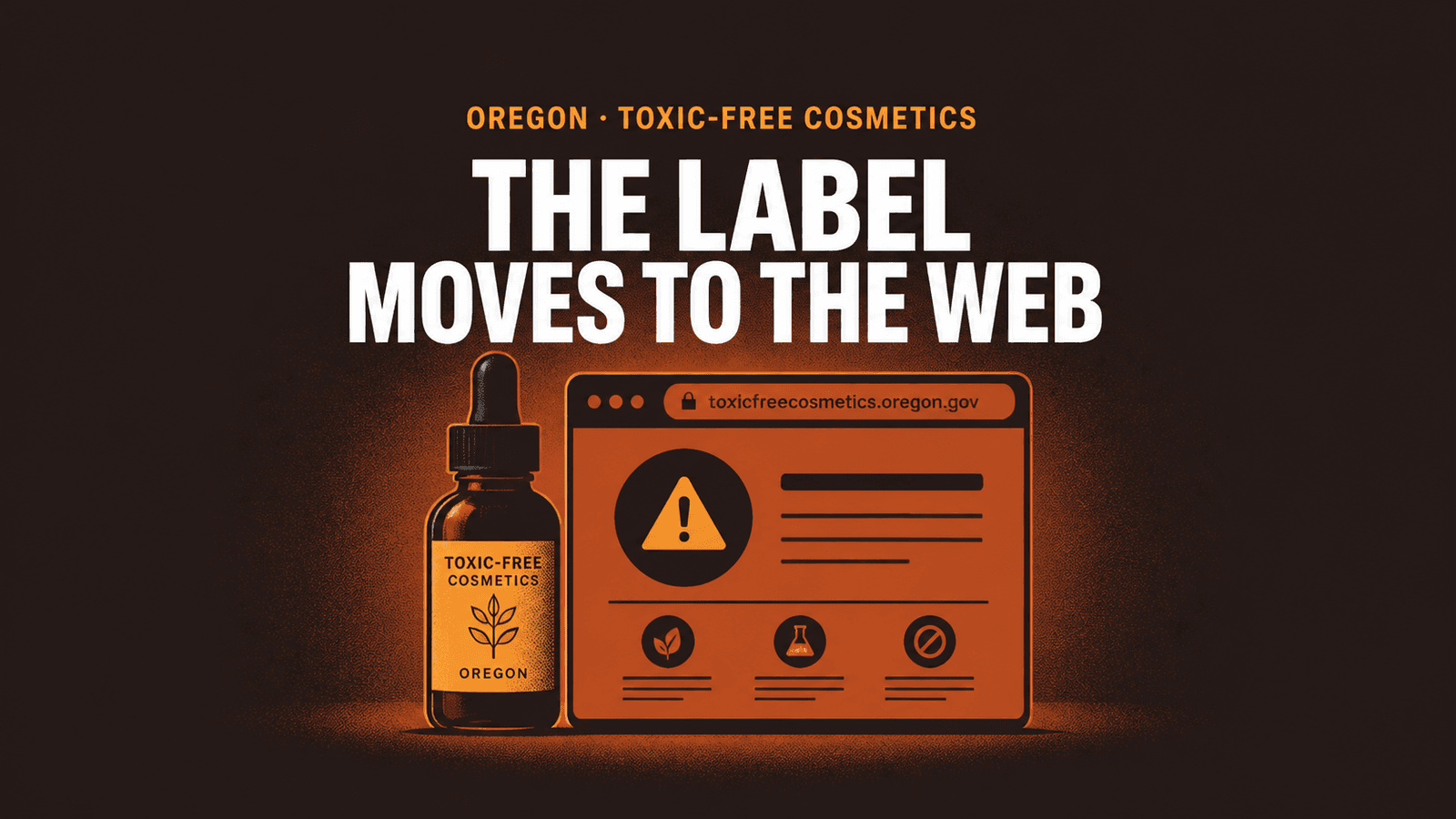
Oregon is not banning 17 cosmetic chemicals. It is attaching a hyperlink to them. The Oregon Health Authority filed its rules on October 30, 2026, and the law takes effect on January 1, 2027. A product containing any of the 17 above its limit must carry the phrase "Oregon Toxic-Free Cosmetics Act - Warning" on its product page. The duty falls on whoever produces, imports or distributes the product, and a violation is counted across a whole product line. The label is now a web page.
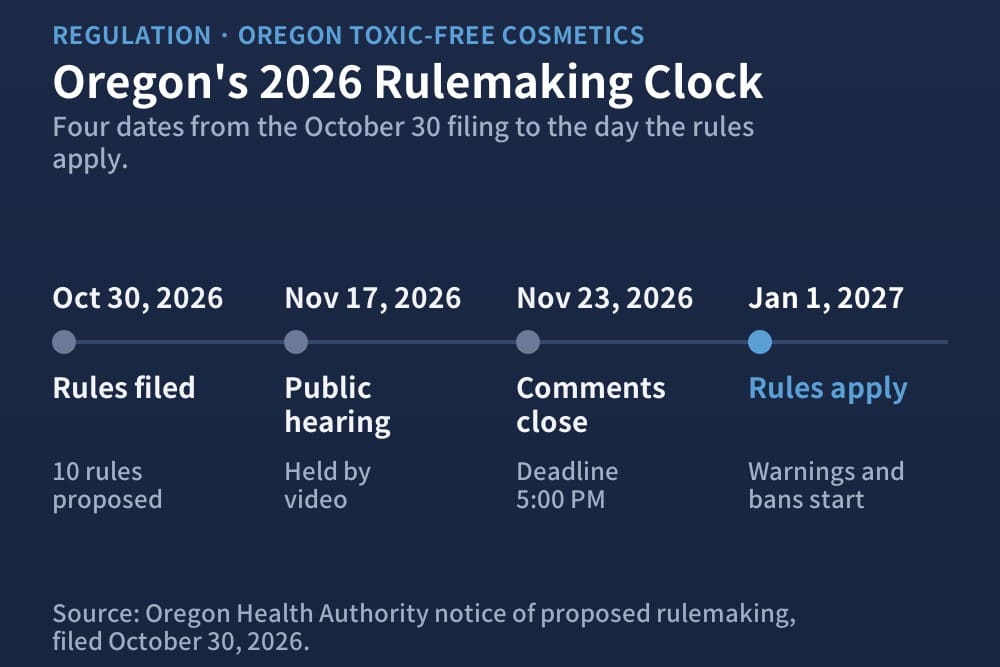
▲ OHA filed ten rules on October 30, 2026, took comments through November 23, and the rules apply on January 1, 2027.
What did Oregon file on October 30, 2026?
The Oregon Health Authority (OHA) filed ten administrative rules at 12:16 PM on October 30, 2026. They implement Senate Bill 546, the Toxic-Free Cosmetics Act that the Oregon legislature passed in 2023. The rules define terms, name the high priority chemicals of concern, set limits for them, require website warnings, list prohibited chemicals and set penalties.
The hearing was held by video on November 17, and the comment period closed on November 23 at 5:00 PM. The rules apply to cosmetic products sold or offered for sale in Oregon on or after January 1, 2027. The United States notified the World Trade Organization on November 18, 2026, which is the channel governments use to announce product rules that affect trade.
The date is not the rules' own. The statute's website-notice and prohibition sections become operative on January 1, 2027 under the 2023 law. The rulemaking settles how the law works on that day, not whether it starts.
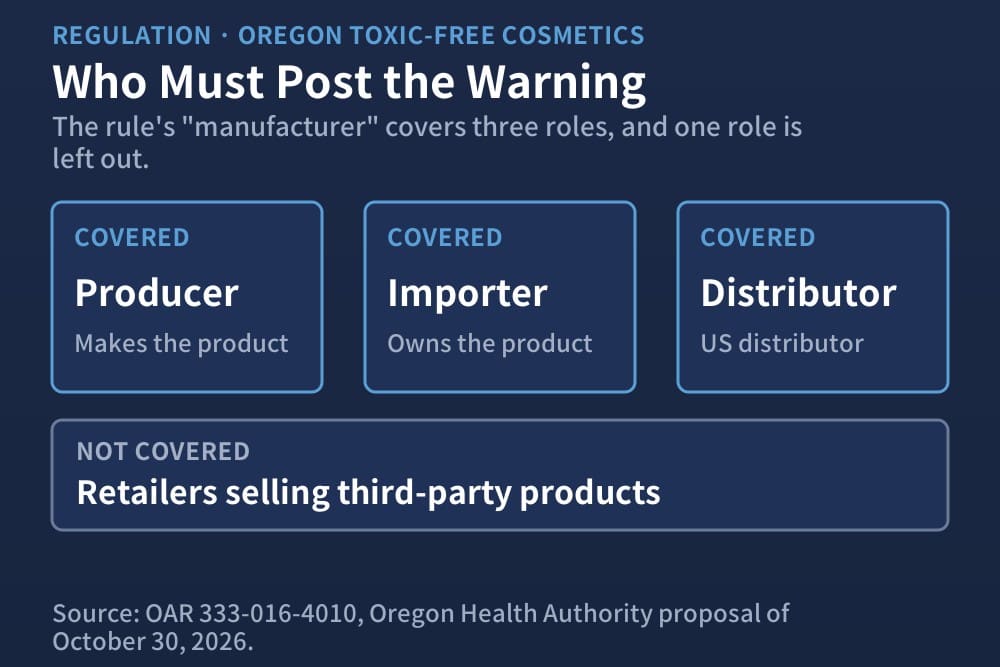
▲ Oregon's rule covers producers, importers and distributors as manufacturers and leaves out retailers of third-party products.
Who counts as the manufacturer?
The rule defines a manufacturer as any person who produces a cosmetic product, or an importer or domestic distributor of one. An importer is the owner of the product. Retailers selling third-party products are not manufacturers, and neither are grocery wholesalers or retailers that contract a third party to make cosmetics under their own brand.
Professional-only cosmetics are included. Soap, dietary supplements and FDA-regulated food and drugs fall outside the definition of a cosmetic product, although the ban on eight chemical groups still reaches cosmetics that contain drug ingredients.
The duty therefore attaches to whoever owns or makes the product, not to the shelf it sits on. A brand that produces its product and sells it into Oregon is a manufacturer under the definition, and so is the US importer that owns a product made elsewhere. A retailer that only resells is outside it.
What are the 17 chemicals?
The list in OAR 333-016-4020 names benzene, acetaldehyde, anthraquinone, butyl paraben, 4-hydroxybenzoic acid, styrene, acrylonitrile, vinyl acetate, triphenyl phosphate, 1,4-dioxane, tricresyl phosphate, estragole, C.I. Disperse Blue 1, trisodium nitrilotriacetate, 2-ethylhexyl-4-methoxycinnamate (octinoxate), octamethylcyclotetrasiloxane (D4) and musk xylene.
A draft the rules advisory committee reviewed in August carried 41 candidate chemicals. The October 30 filing names 17, and each has a limit in Exhibit A of the rule. The list mixes the familiar, such as butyl paraben, 1,4-dioxane, D4 and octinoxate, with chemicals most formulators never handle, such as C.I. Disperse Blue 1 and tricresyl phosphate.
These 17 sit in the warning tier, not the ban tier. A product at or above a chemical's limit must disclose it. Nothing in the list forces the product off the shelf.
Why do two thresholds govern one list?
Each chemical has a de minimis level, the concentration below which no warning is required. For an intentionally added chemical it is the practical quantification limit (PQL), the lowest concentration a laboratory can measure reliably under routine conditions. For a contaminant, meaning a trace amount incidental to manufacturing with no intended function, it is 100 parts per million (ppm) for every chemical on the list.
The PQLs in Exhibit A run from 1 to 100 ppm. Benzene, acetaldehyde, styrene and acrylonitrile sit at 1 ppm. Octinoxate sits at 5 ppm, D4 at 10 ppm, 1,4-dioxane at 20 ppm and triphenyl phosphate at 50 ppm.
The split decides outcomes. A formula carrying 1,4-dioxane as a trace byproduct at 90 ppm triggers nothing. The same chemical added on purpose at 25 ppm triggers the warning. Whether an ingredient is classified as added or incidental is a fact about the supply chain, and the manufacturer proves it with third-party laboratory results.
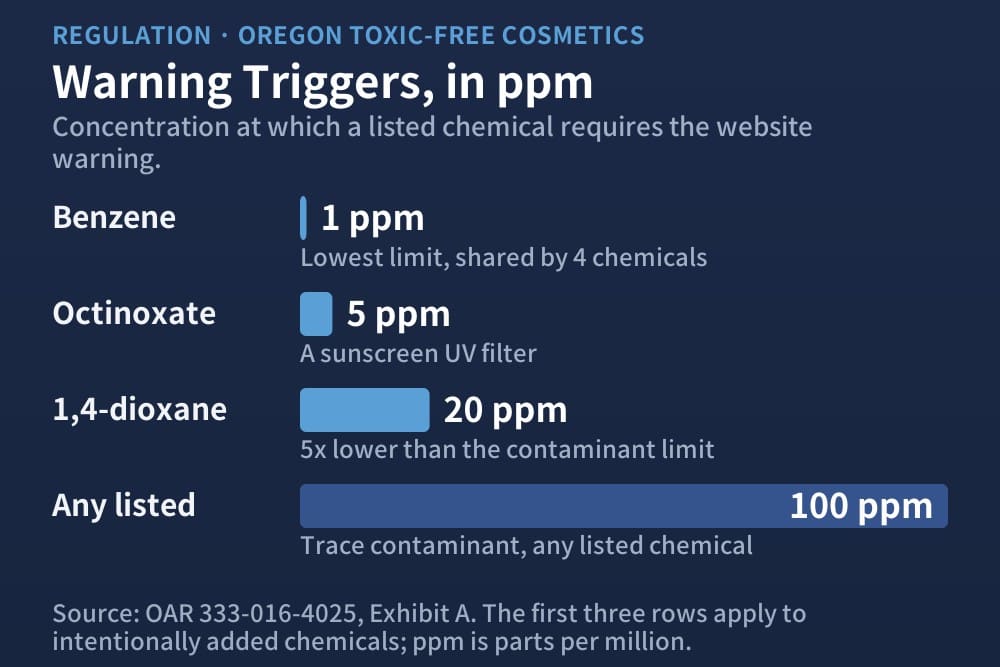
▲ Benzene triggers the warning at 1 ppm and 1,4-dioxane at 20 ppm when added on purpose; a trace contaminant triggers it at 100 ppm.
What does the website warning require?
The warning goes on the manufacturer's own website, on the product's detail page. It is a hyperlinked phrase, "Oregon Toxic-Free Cosmetics Act - Warning," displayed prominently, which the rule defines as immediately visible, adjacent to the product image or listing, and in type at least 75% of the size of the adjacent text. A buyer must not have to search for it.
The link leads to a text block that lists the high priority chemicals in the product, states health effects such as cancer, endocrine disruption and reproductive toxicity, and points to the state's page at healthoregon.org/toxicfreecosmetics. Packaging meant to be discarded before use is exempt. Applicators, containers and cases are exempt unless a listed chemical transfers into the product as a contaminant at or above the de minimis level and testing detects it.
The notice does not go on the pack, and it does not go on a retailer's page. The compliance work moves from the packaging line to the team that runs the brand's own product pages.
What does enforcement look like?
OHA can impose a penalty of up to $5,000 for a first violation and up to $10,000 for a second and each later one. A violation is a single course of conduct covering the entire cosmetic product line sold in Oregon, so one finding attaches to a line and does not multiply by item.
The process starts with a written notice. For a missing website notice, the manufacturer has 90 days to cure before a penalty applies. For a prohibited chemical, it must submit a statement of compliance within 10 calendar days of OHA's request and has 90 days to cure. Compliance is shown with third-party laboratory results or proof that the notice is in place.
The Legislature funded the program with $270,392 per biennium. OHA's fiscal statement counts 24 to 30 cosmetics manufacturers headquartered in or operating in Oregon and more than 4,500 hair, nail and skin care service businesses. A program of that budget enforces through document requests. The document that answers one is a laboratory report.
How does the warning tier sit beside the ban tier?
The rule's prohibited list repeats the statute: ortho-phthalates, PFAS, formaldehyde and formaldehyde-releasing agents, methylene glycol, mercury, triclosan, m-phenylenediamine and o-phenylenediamine above their limits, and lead or lead compounds at 10 ppm or above. Those products cannot be sold in Oregon. The 17 can, with a notice.
The list of 17 changes only through rulemaking, and OHA reviews it every three years. OHA must also post the list online with each chemical's known health impacts. The warning tier has a schedule for change built into the law.
What does the rule change for the global supply chain?
For a manufacturer, the unit of compliance becomes the formula sheet and the supplier data that separate added chemicals from incidental ones. For a brand or a buyer, it becomes the product page and the import contract, which together decide who owns the product at Oregon's door and who owns the page that carries the notice.
The label is now a web page. The formula sheet is now its evidence.