Two new K-beauty stores open in the Bay Area this quarter — Stonestown Galleria in San Francisco in November, Serramonte Center in Daly City in December, the second one beside a Korean supermarket. They belong to Moida, which belongs to Silicon2, which is the company that supplies more than 600 K-beauty brands to 175 countries through StyleKorean.com. The distributor that gets Korean brands onto other people's shelves is now building its own, and it wants more than 100 of them by 2027.
What is actually opening?
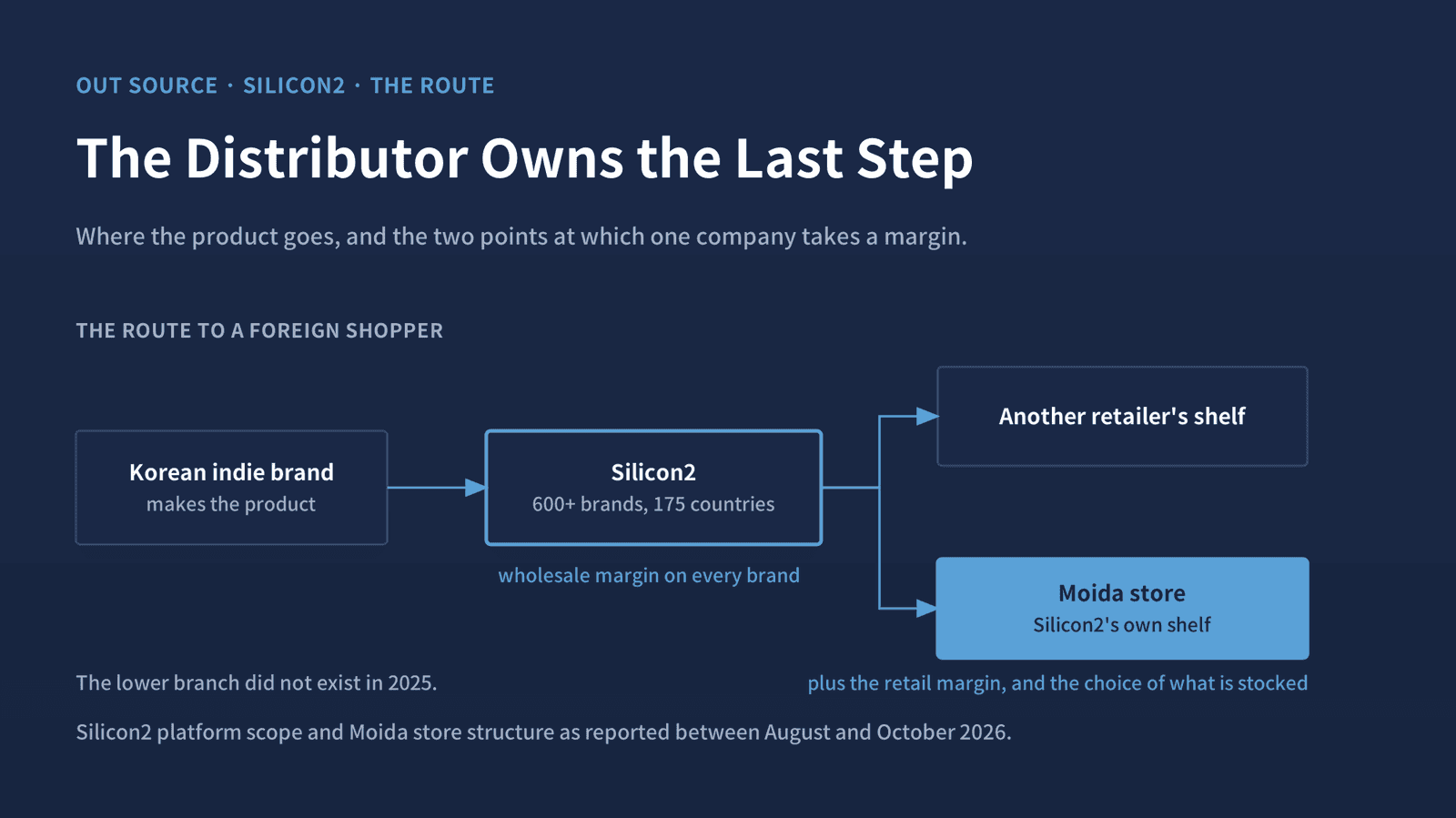
Stonestown Galleria first, on the mall's ground floor, in a unit left by an accessory brand, with construction already underway. Serramonte Center follows in December, in a former children's indoor play area near Old Navy and a Korean supermarket and restaurant.
Moida's existing footprint, as reported in early October: Orange and Ontario in California, Altamonte Springs in Florida, a Champs-Élysées flagship in Paris, and two stores in Portugal. The pipeline named alongside them runs to two more in the Seattle area, three more in Florida and one in San Diego.
Counts vary by source, which is itself worth noting. Silicon2's own site lists stores in London and Jakarta that the Korean trade reporting does not, and company statements in August put the network at around 20 across five countries. Nobody's list is wrong; the chain is opening faster than any single list tracks.
Who is Silicon2, and why does the name matter here?
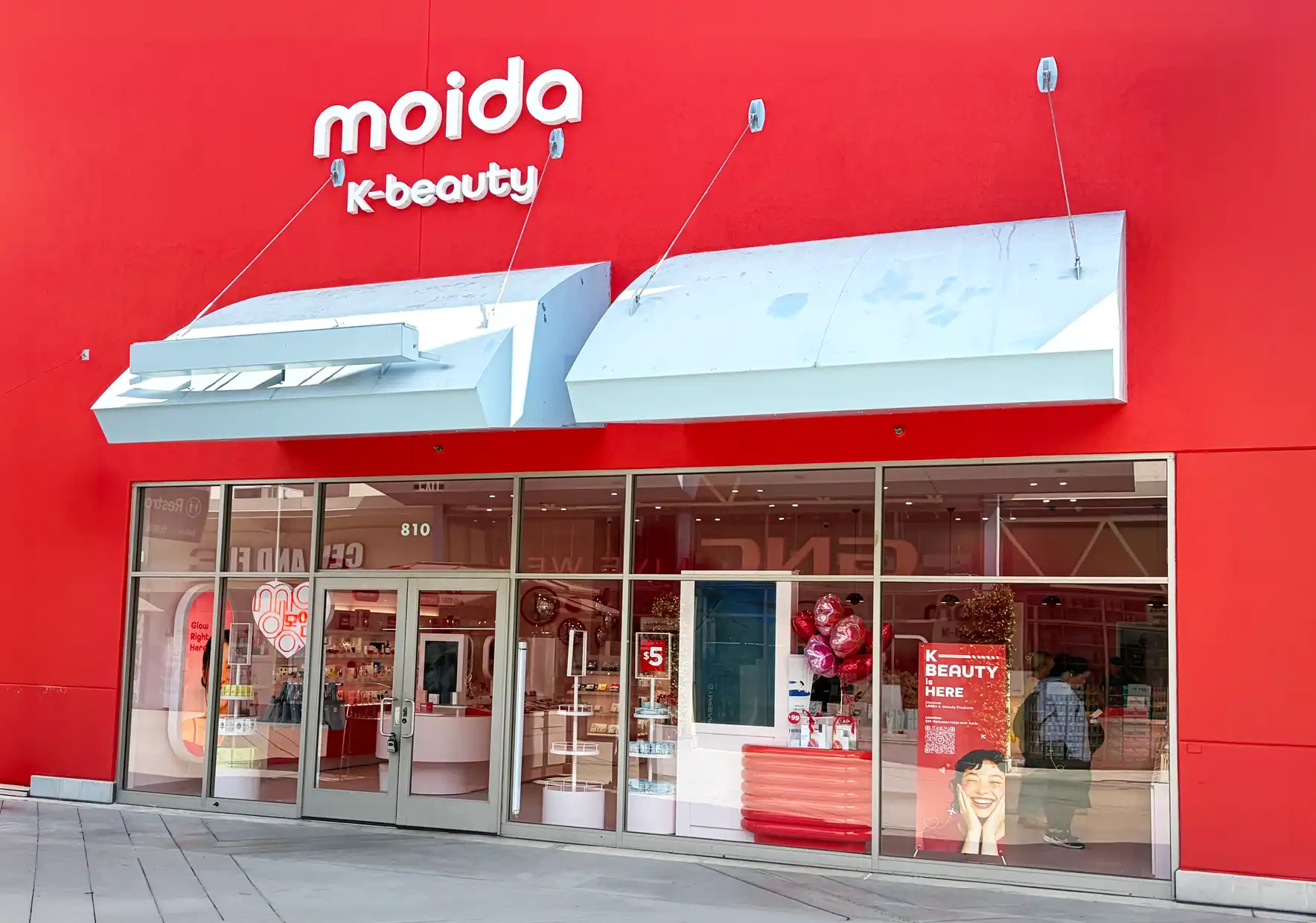
It is the plumbing. StyleKorean.com, its platform, carries more than 600 K-beauty brands into 175 countries, and for a large number of Korean indie brands it has been the single mechanism by which their product reaches a foreign buyer at all.
The scale is not incidental. Revenue went from 131.0 billion won in 2021 — about $97 million at 1,343.60 won to the dollar, the close on 6 October 2026, the rate used throughout this piece — to 1.1196 trillion won ($833 million) in 2025, a 61.9 percent jump on the prior year's 691.5 billion won ($515 million). Operating profit was 205.5 billion won ($153 million) at an 18.4 percent margin. In August 2026 the private equity firm CVC put 300 billion won ($223 million) into the business, which the company framed as a strategic partnership to become a global K-beauty distribution platform.
Europe is already its largest revenue region. Poland is its European logistics hub. It has named the UAE, Mexico, Vietnam and Indonesia as the next markets.
Why is a distributor opening its own shops?
Because the margin sits downstream and the data sits downstream, and a wholesaler has neither.
Silicon2 sells to retailers. It sees order volumes, not shoppers. It learns what a buyer reordered three months late, which is a poor substitute for watching somebody pick up a jar, read the back and put it down. A store gives it the retail margin it currently hands to its customers, and a continuous feed of what actually converts, by location, which it can then sell back to the brands as a service.
The Paris opening shows what that data looks like in practice. The store ran a KOREA BEST zone stocked with products Korean consumers themselves had vetted, and one brand in it sold roughly five times the daily average of another Paris store on opening day. A wholesaler cannot run that experiment. A retailer can run it every week.
What does it cost to be on both sides?
The structural problem has a name, and Korean brands should say it out loud: the company deciding whether your product reaches a foreign market is now also the company deciding whether it gets a facing in a shop it owns, with different economics on each side of that decision.
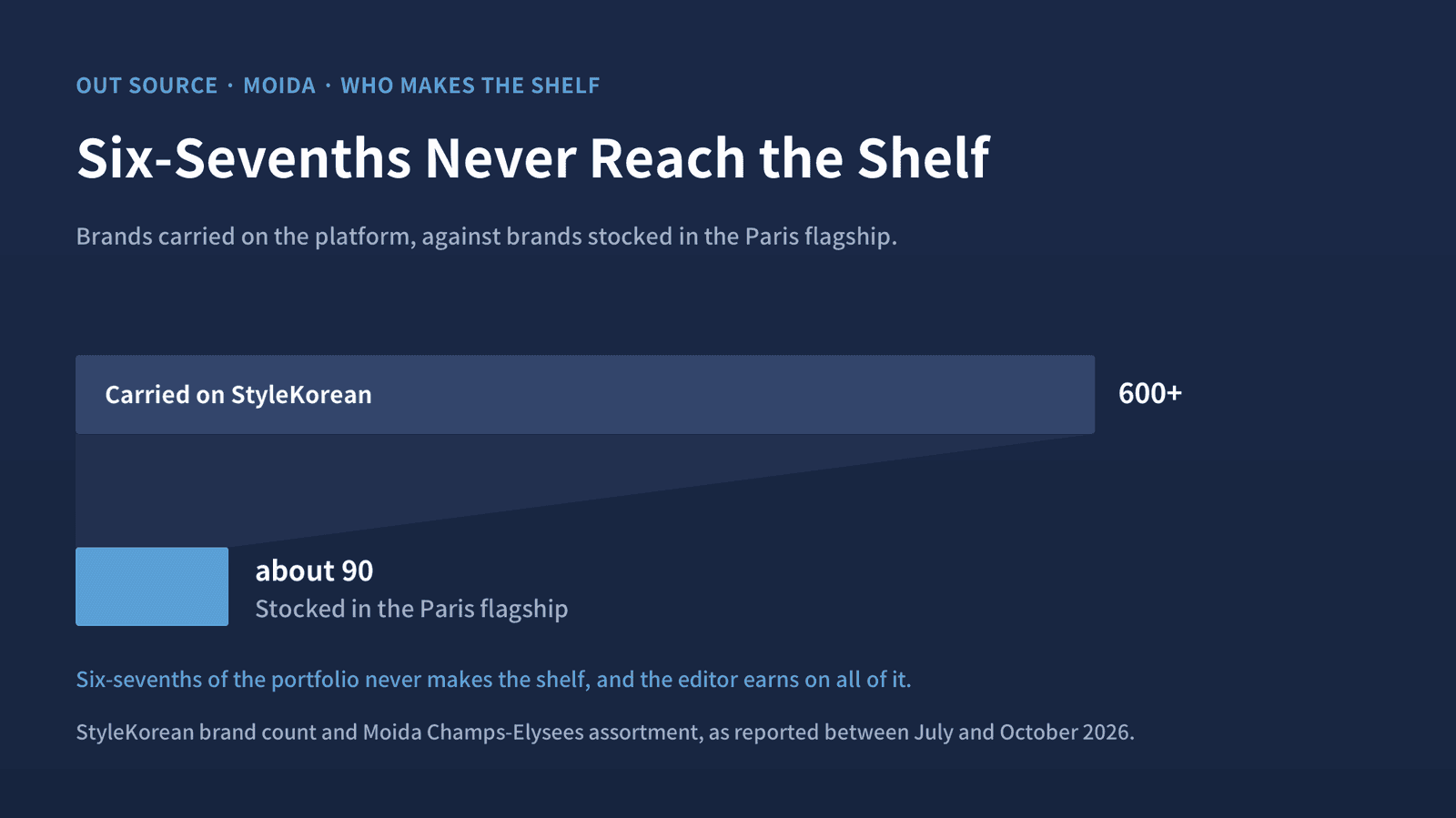
Moida's Paris store carries about 90 brands. StyleKorean carries more than 600. Roughly six-sevenths of the portfolio does not make the shelf, and the party choosing is the same party taking a wholesale margin from everyone in the portfolio either way.
None of which is improper. Retailers have always edited, and private label has been doing a harsher version of this for a century. It is simply a conflict that did not exist in the relationship a year ago, and brands negotiating 2027 terms should price it.
Can the economics carry it?
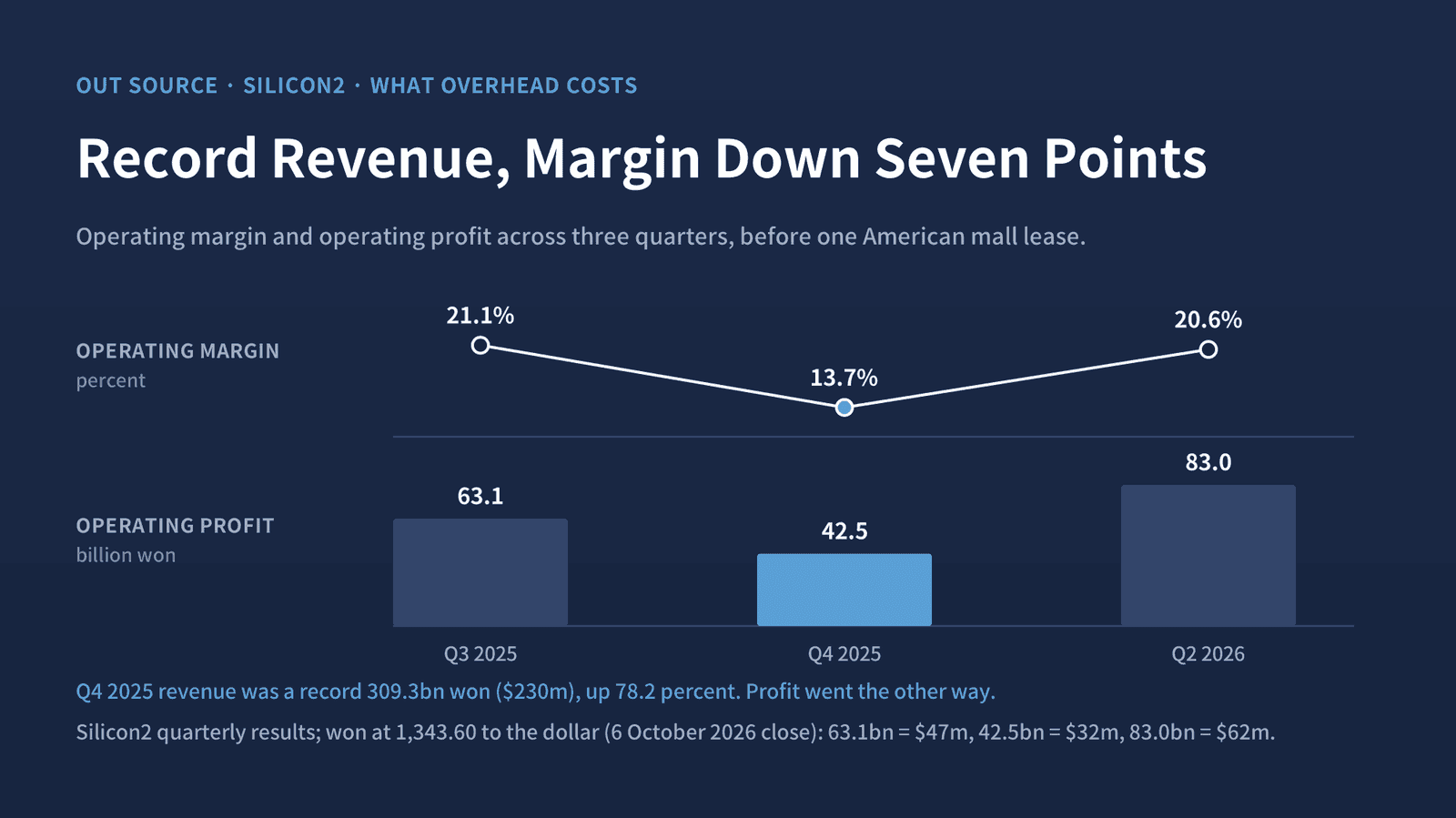
The warning is already in the accounts. In the fourth quarter of 2025 Silicon2 posted record revenue of 309.3 billion won ($230 million), up 78.2 percent year on year — and operating profit of 42.5 billion won ($32 million), down 32.6 percent from the third quarter's 63.1 billion won ($47 million). Operating margin fell from 21.1 percent to 13.7, a drop of 7.4 points in three months.
The causes were start-up costs for new subsidiaries in Dubai, Italy and Mexico, air freight on customs-test shipments, rising container costs on European volume and heavier marketing spend. Note what is absent from that list: store leases. Inventory had already climbed to 246.6 billion won ($184 million), up 35.9 percent in a single quarter.
Margin recovered — the second quarter of 2026 came in at 402.6 billion won ($300 million) of revenue and 83.0 billion won ($62 million) of operating profit, a 20.6 percent margin. But the Q4 episode is the useful one, because it shows how little overhead it takes to move this margin structure seven points, and physical retail is overhead that does not go away when a quarter ends. That is what the CVC money is for.
Why Daly City and not Union Square?
This is the part that gets misread, and it is the most interesting decision in the whole announcement.
Stonestown and Serramonte are suburban malls in catchments with large Asian-American populations, and the Daly City unit sits beside a Korean supermarket. That is not K-beauty breaking into mainstream America. It is a retailer putting a till where its customer already shops, at suburban rent, with no acquisition cost attached.
Set it against Paris. The Champs-Élysées store runs to 466 square metres with about 90 brands and more than 1,300 products, it posted the highest opening-day sales of any Silicon2 store, and 60.4 percent of first-time buyers signed up as members on the spot. One of those two formats is a credential on a famous street. The other is a cash register. A chain aiming at 100 stores needs far more of the second kind than the first.
How does this sit against how everyone else is expanding?
Awkwardly, and in Silicon2's favour on the evidence so far. Shinsegae is running a three-month pop-up at Hudson Yards with about 30 brands and nothing permanent announced. Korean brands have generally reached American consumers by renting space inside somebody else's chain — Ulta, Target, Costco — on that retailer's terms and planogram.
Silicon2 signed leases. The format is less glamorous than a flagship and far less reversible than a pop-up, and it is the only one of the three that produces a customer list the Korean side owns.
Where does this leave the three parties?
Manufacturers and ODM suppliers. A distributor with its own stores eventually wants its own margin on its own product, and private label is the obvious next step for anyone holding 100 stores and daily sell-through data. Whoever gets that brief gets volume and no brand.
Brands and the buyers who stock them. Your distributor is becoming your competitor, slowly and legitimately. Read the 2027 contract with that in mind: shelf commitments, data rights on your own sell-through, and whether exclusivity still means what it did when it was signed.
Investors. The line to watch is operating margin against store count. Wholesale at 18 percent and retail at 100 doors are not the same business, and the fourth quarter of 2025 already showed what a little overhead does to this P&L.
For twenty years the Korean question abroad was how to get on a shelf. Somebody finally decided to buy the shelf.
Selling Korean beauty abroad? Parallel37 finds overseas buyers for Korean beauty brands. See how our export representation works.