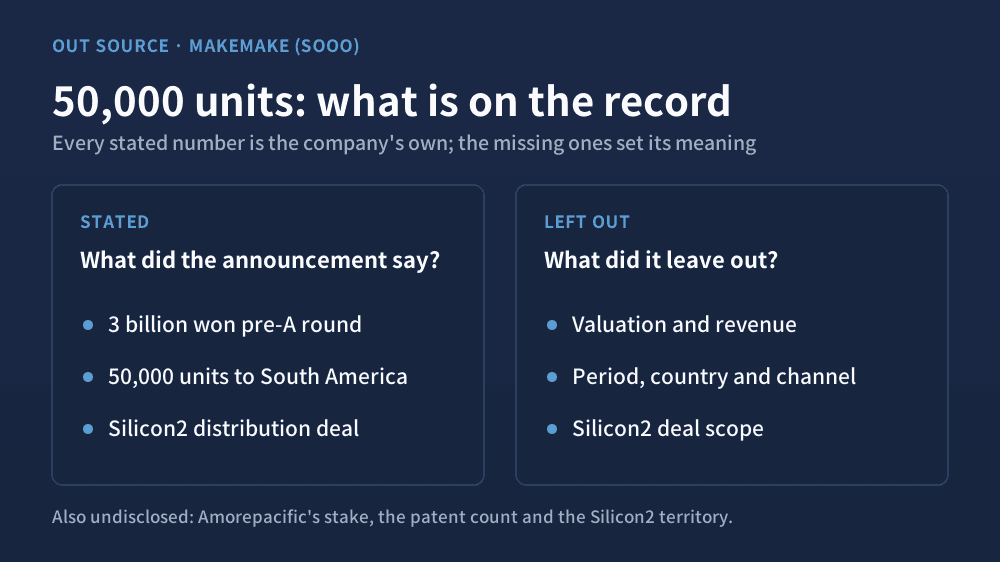
Makemake announced a 3 billion won (about US$2.23 million) pre-A round on September 23, 2026, and said it had shipped 50,000 SOOO units to South America, a market it entered in 2026. Those are the only hard numbers: no valuation, revenue, shipment period, destination country or sales channel. SOOO began as a swim shampoo for pool chlorine, yet the story told to investors is about water itself: hard water, metal ions, scalp care, devices. The unit count proves less than the headline implies.
What did the funding announcement actually put on the record?
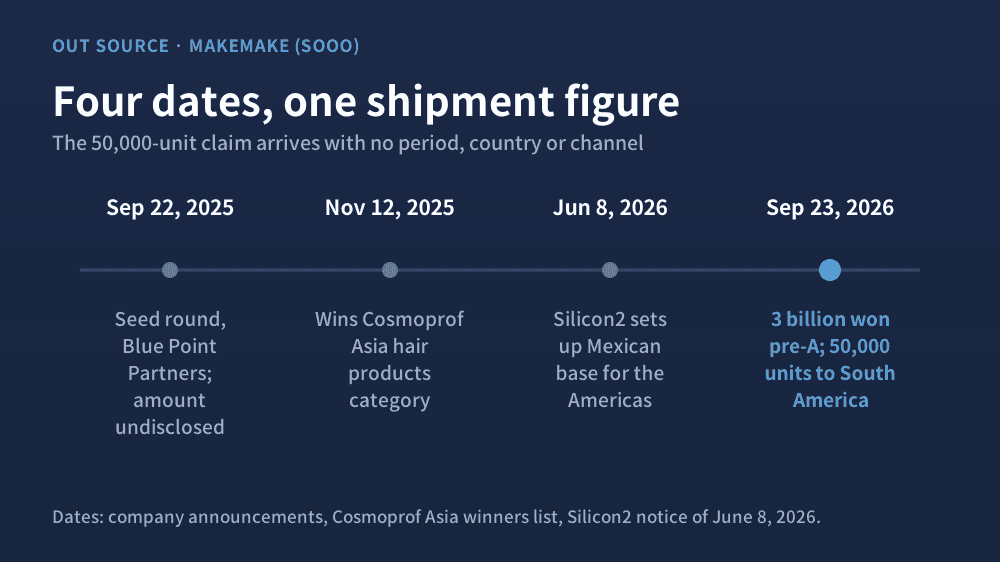
Makemake runs SOOO, a brand it describes as a water stress solution. Its September 23, 2026 announcement lists a 3 billion won pre-A round, a funding round that sits between a seed round and a Series A. At 1,346.18 won per dollar, the November 2, 2026 close, that is about US$2.23 million. Signite, Amorepacific and Ignite XL joined as new investors. Blue Point Partners, the deep-tech accelerator that backed the company at seed, followed on.
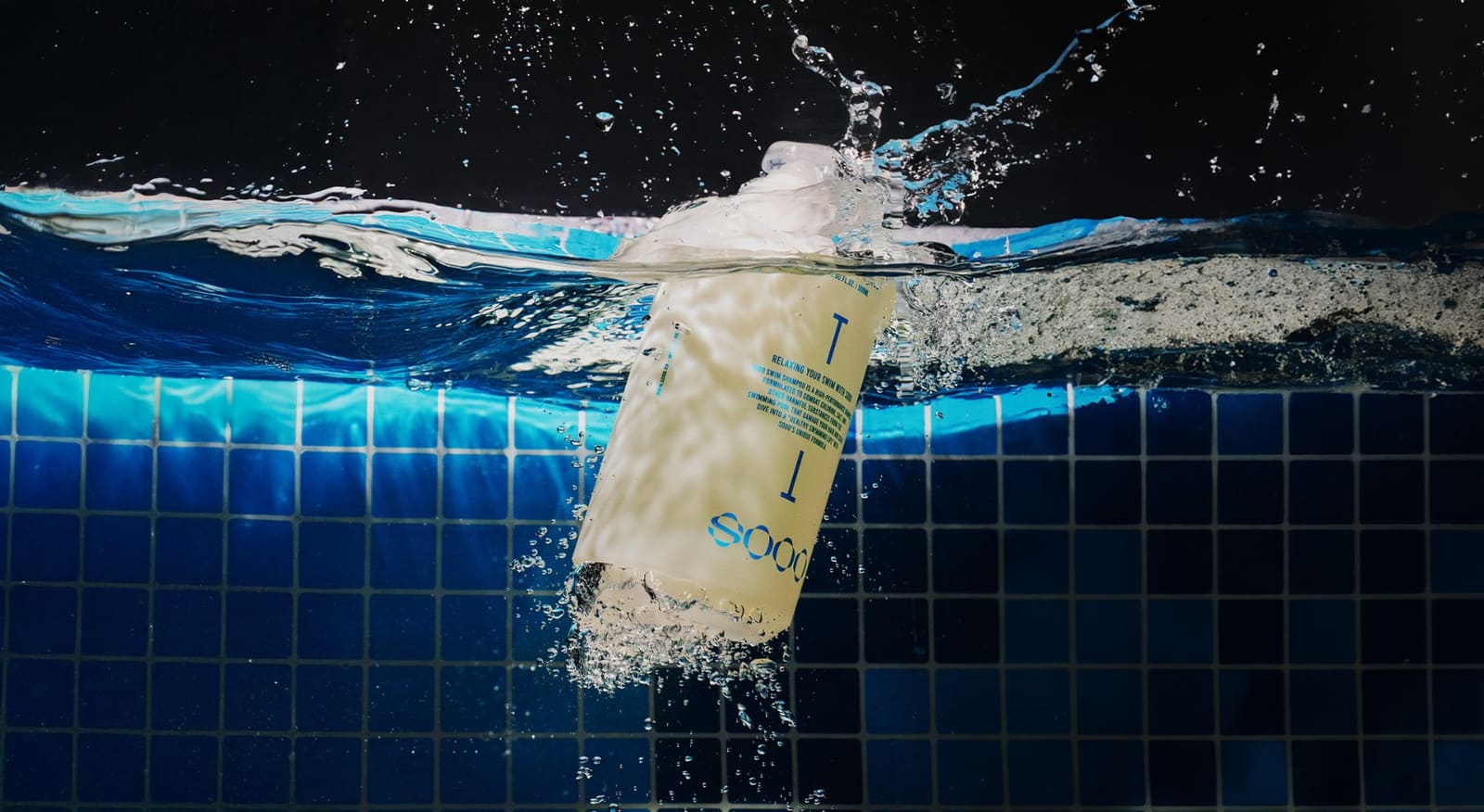
The announcement also states that Makemake exported 50,000 units to South America, a market the company says it entered for the first time in 2026, and that it signed a distribution contract with Silicon2, a Korean K-beauty distributor. It does not state a valuation, revenue, the period the 50,000 units cover, the countries, or whether Silicon2 handled the shipment. Every operating figure in it is the company's own.
How big is Makemake, and what does a pre-A round say about it?
No article gives a founding date. Coverage in November 2025 called Makemake a second-year company, and a third-party company database lists 2024 as its founding year, with Yongin as its base. Revenue is absent from the round announcement. Coverage in November 2025 relayed a company projection of sales rising from 300 million won in 2024 (about US$223,000 at the same exchange rate) to about 5 billion won in 2025 (about US$3.71 million). That is a projection, and the coverage does not make clear whether it covers the whole company or one product line.
At about US$2.23 million, the round pays for the three uses the company names: core material and product technology, entry into North America, and expansion into scalp care, hair care and beauty-tech devices. It is a development round, not an expansion round. The scale of the business is set by what the company ships, and the company has not said what it shipped in money terms.
Why is a pool-water brand now talking about hard water and metal ions?
Hard water is water carrying high levels of dissolved minerals such as calcium and magnesium. Metal ions are dissolved metals in tap or pool water. Makemake says its in-house water-quality technology and patent-based materials now extend to both, beyond chlorine, and it calls SOOO a water stress brand, not a swim brand. The change alters what the product is defined by. A conventional shampoo is defined by a hair type or a concern. A SOOO product is defined by the water it is used in.
That definition carries a commercial consequence that needs no efficacy claim to see. A product defined by a water condition follows the water. Chlorinated pools exist in every market. Hard water and metal content vary by city and by pipe. Extending the technology to those conditions turns one product into a set of local problems, each with its own formulation question. The announcement does not say which of those formulations exist today.
The announcement counts a patent-based material among the company's assets and gives neither a patent count nor patent numbers. The scope of that protection is the open item. The positioning does not depend on it.
What does the 50,000-unit figure cover, and what does it leave out?
Fifty thousand units is a count of products, not revenue. The announcement attaches no price, no period and no country to it. It says South America as a region. The coverage does not say whether the figure is one shipment or a running total, and it adds only that initial sales have begun in overseas markets.
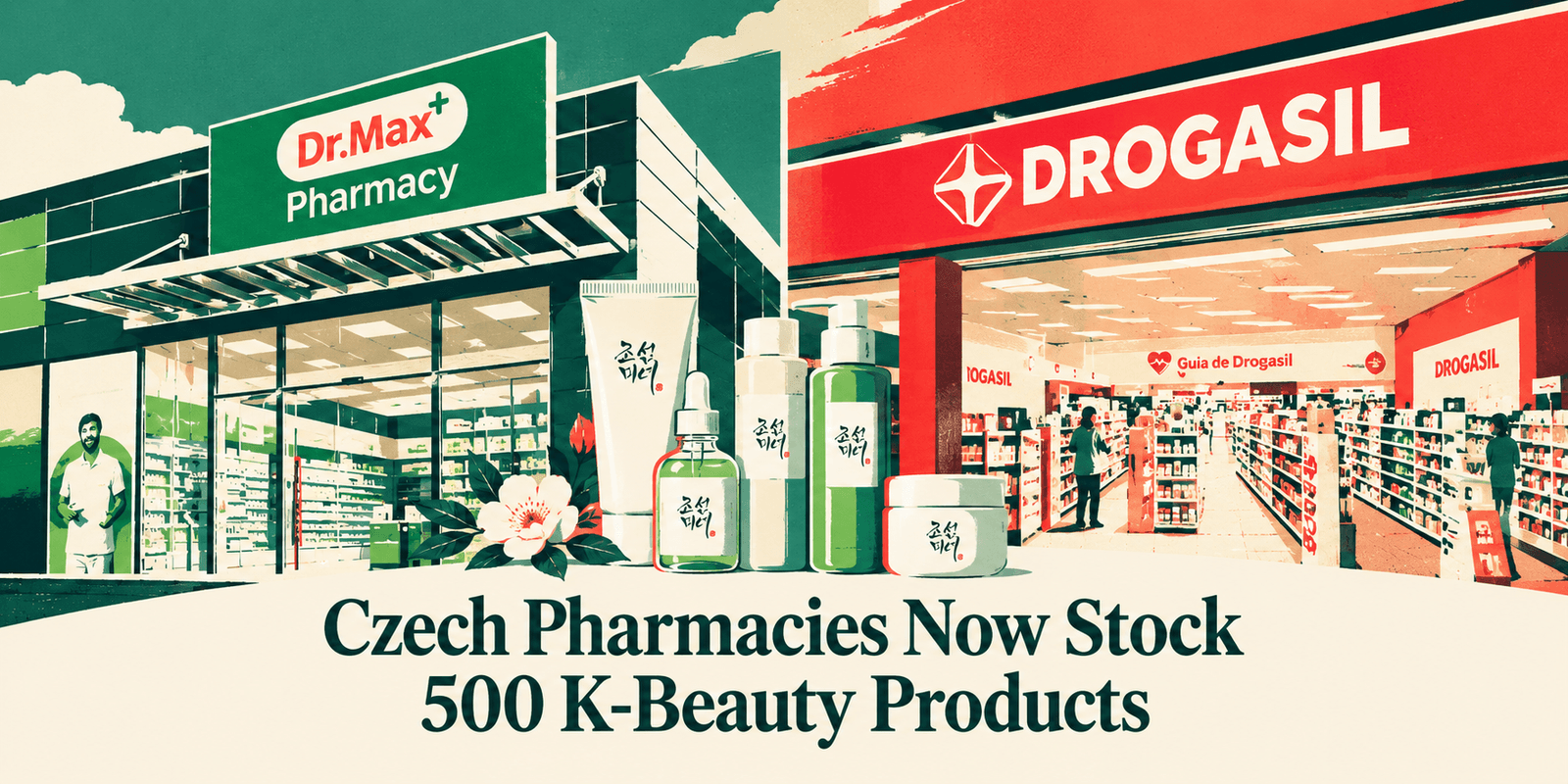
A Raia Drogasil product page lists a SOOO Swim Shampoo, 500 ml, under the brand name Sooo, sold and delivered by Drogasil, a Brazilian pharmacy chain operator. The page carries no date, names no importer and shows no usable price. It confirms that a Brazilian retailer lists the product. It does not confirm that those units are part of the 50,000.
Shipped units and consumer sales are different numbers, and the announcement reports only the first.
Why South America, and what does the market data say?
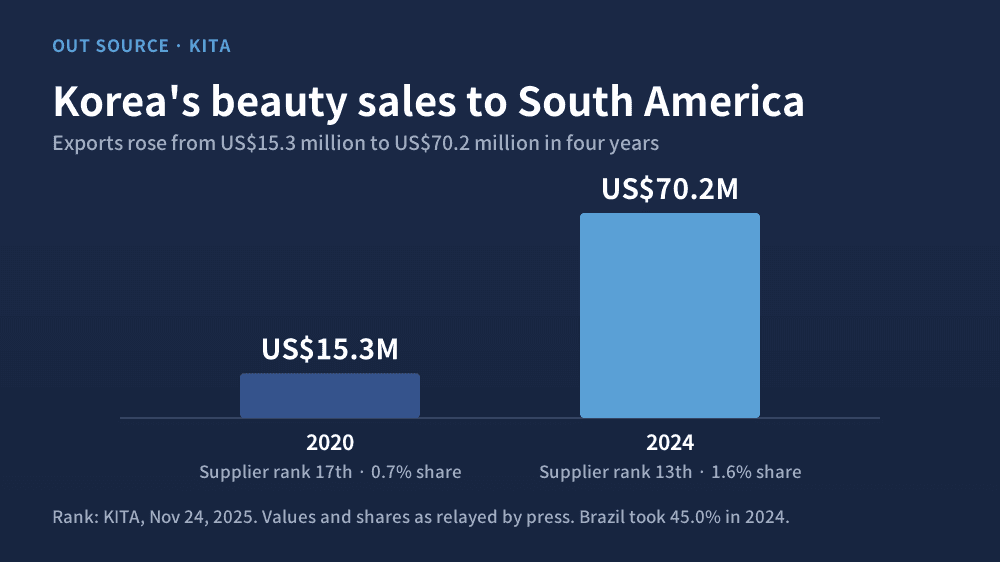
The Korea International Trade Association's November 24, 2025 report puts South American beauty imports at US$4.13 billion in 2024 and Korea's rank among suppliers at 13th, up from 17th in 2020.
Press coverage of the same report gives Korea's beauty exports to the region as US$70.2 million in 2024, against US$15.3 million in 2020, and Korea's share of the import market as 1.6%, up from 0.7%. Brazil took 45.0% of those exports, ahead of Chile at 23.2%, Colombia at 9.4% and Peru at 8.0%. Hair care such as shampoo and conditioner was about 6.5% of Korean exports.
The numbers describe a market where Korean exports are small and rising, and where hair care is a thin slice. They do not identify SOOO's destination, which the company has not named. Nothing in the data links a swim product to any one country.
Where does Silicon2 fit, and where does it not?
Silicon2 announced a Mexican subsidiary on June 8, 2026. It positions the unit as a base connecting North and South America and a forward post for expansion into Central and South America, and it said it plans a Brazilian subsidiary within 2026. Those are the distributor's own statements.
The Makemake announcement says only that it signed a distribution contract with Silicon2 while expanding its overseas sales network. It gives neither the scope nor the territory of the contract, and it does not say that Silicon2 handled the South American shipment. Two facts sit side by side: a distributor building a Latin American base and a brand shipping to the region. The documents do not connect them.
For a brand this size the distinction matters. A distributor contract can mean inventory bought outright by the distributor or goods listed on its platform. The announcement says neither.
What does Amorepacific's seat in the round establish?
Amorepacific joined as a new investor. No stake, amount or valuation was disclosed. Makemake's chief executive, Kwak Hyo-seop, said the round mattered less for the capital than for securing strategic partners to build SOOO's global growth.
A beauty group on the cap table is a statement about ownership, not about distribution. The announcement does not say that Amorepacific will distribute, manufacture or co-develop anything. It describes an investment round, not an acquisition, and SOOO remains an independent brand.
What do the awards prove?
Cosmoprof Asia's official 2025 winners list names Makemake Inc. of South Korea for SOOO Swim Shampoo 500ml in its hair products category. Press coverage places the ceremony on November 12, 2025, in Hong Kong.
In October 2026 Makemake also reported that a kids all-in-one product won personal care product of the year at the 2026 Beautyworld Dubai awards, that the swim shampoo was a finalist for hair product of the year there, and that SOOO took a grand prize at Shanghai K-Beauty Glow Week. Those are company-reported results.
An award rates a product against a field of entrants on one day. It carries no sales data, and it answers none of the questions left open on the shipment.
What does SOOO say about niche-first brands in export markets?
The record supports one structural point. SOOO defined itself by a condition of use, water, not by a skin or hair type, and that definition is the basis of the roadmap Makemake presented to investors: hard water, metal ions, scalp care, devices.
Manufacturers read that roadmap as a formulation workload: each water condition is a separate technical problem and a separate validation file. Brands and buyers read it as a category claim that has to survive retail shelves and distributor catalogs, where a swim shampoo competes for space with general hair care. Regulators and investors read it through the claims: a product positioned on water chemistry puts the label's wording about what it removes or neutralizes under review in every market it enters.
The decisive numbers are still missing: price, period, country, channel, revenue. Until they appear, 50,000 units is a headline and the roadmap is a plan. A niche that travels by water is still sold one shelf at a time.