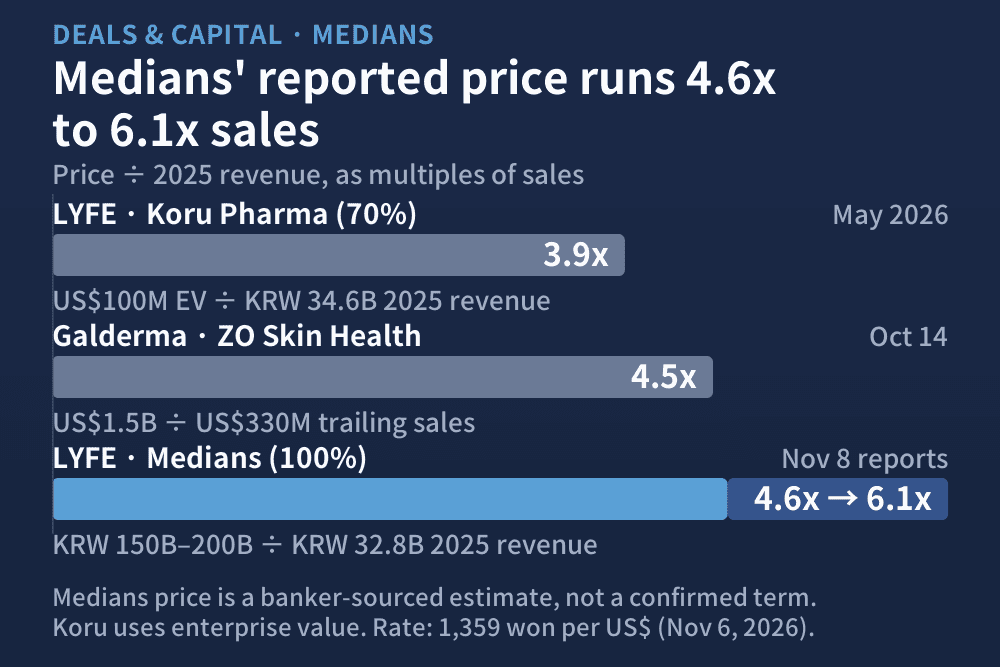
Two reports on November 8, 2026 say LYFE Capital, a Singapore healthcare private equity firm with US$2 billion under management, will buy Medians, the Korean maker of the Histolab and Aowa skincare brands. The reported price is 150 billion to 200 billion won (US$110 million to US$147 million) on 32.8 billion won (US$24.1 million) of 2025 revenue, or 4.6 to 6.1 times sales. Its customers are about 12,000 clinics. A medical aesthetics fund is paying for a channel, not a cosmetic.
What did the November 8 reports actually say?
Two outlets reported on November 8 that LYFE Capital will acquire 100% of Medians. Both cite investment banking sources. Neither quotes a named person, and neither reproduces a statement from either company.
One report says a share purchase agreement (SPA), the contract that fixes price and conditions before shares change hands, was signed recently and that the shares move to LYFE in stages. It puts the price at 150 billion to 200 billion won, with 200 billion won (US$147 million) in the headline. The other report puts it at up to US$147 million. At 1,359 won per dollar, the November 6, 2026 reference rate, 150 billion won is US$110 million and 200 billion won is US$147 million, so the two reports describe the same ceiling. Every won figure below converts at that rate.
Neither report gives a closing date or a list of regulatory approvals. The sellers are reported as the founder and other shareholders, advised by EY Hanyoung. Medians is not listed, so there is no exchange filing to check the figure against. The range is a trade estimate, not a deal term.
Who is LYFE Capital, and why does a healthcare fund want a cosmetics maker?
LYFE describes its strategy as investing in healthcare supply chain assets, specialized product platforms, and next-generation research services. Its Asia headquarters is in Singapore, it lists an office in Seoul, and its website puts assets under management at US$2 billion.
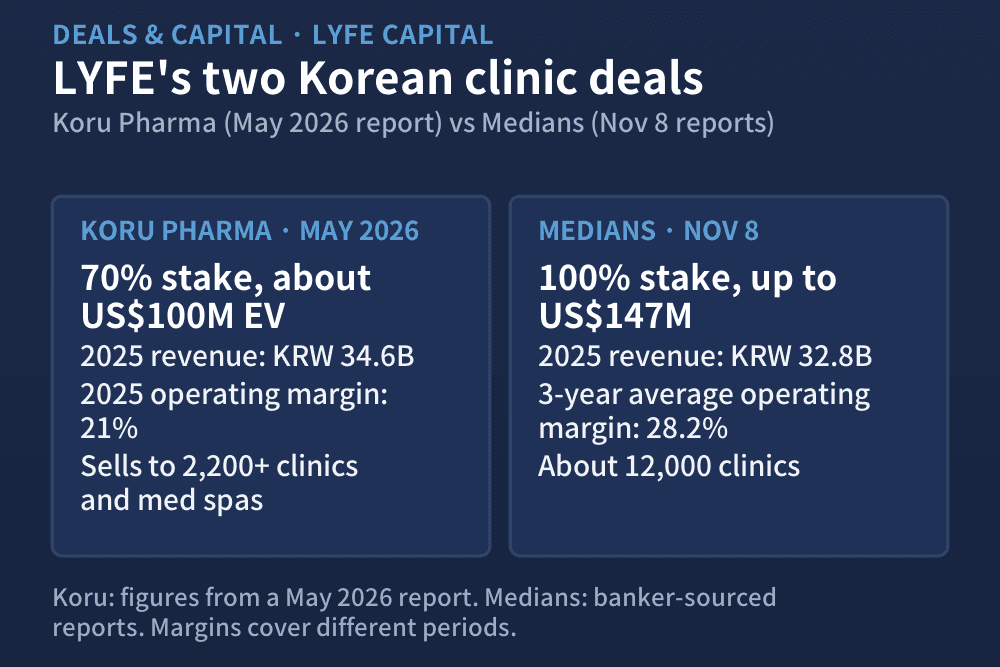
Its Korean record is short and specific. In 2023 it took a minority stake in Jeisys, a maker of energy-based aesthetic devices, and exited within 12 months when ArchiMed led a take-private, a buyout that removes a company from the stock market. It holds convertible bonds in ST Pharm, a listed contract development and manufacturing organization (CDMO), a company that develops and makes drugs for other firms. In May 2026 its first solo control deal in Korea was reported: 70% of Koru Pharma, a medical aesthetics company, at an enterprise value of about US$100 million. Enterprise value is the price of the whole business, equity plus net debt.
At that time a LYFE partner put Korea's share of the global medical aesthetics market at an estimated 20% to 30%. Medians would follow Koru in the same field.
What does Medians actually sell, and who buys it?
The report lists toners, creams, ampoules, serums, and aesthetic devices, supplied directly to about 12,000 dermatology and aesthetic clinics rather than through retailers such as Olive Young. Histolab's own site calls the brand a dermatology-focused professional brand, points visitors to official sales hospitals, and runs a separate channel for professional members.
Aowa is the more open of the two. Its site describes an aesthetic professional brand, with a separate professional shop, and it also runs an official online shop with a cart, reviews, and coupons. In late 2020 and early 2021, an Aowa anti-aging cream sold out on Lotte Home Shopping. The accurate description is a clinic-led business with a consumer outlet. Clinic-only is a claim the sources do not support.
How big is the business behind the price?
The report gives Medians revenue of 28.0 billion won in 2024 (US$20.6 million) and 32.8 billion won in 2025 (US$24.1 million), up 17.1%. It gives an average operating margin of 28.2% over the past three years. Operating margin is operating profit as a share of sales. At 28.2%, the business keeps more than a quarter of each sale after running costs, before interest and tax.
The base is small: US$24.1 million of revenue. The report attributes the margin to the business model: direct B2B supply creates lock-in, it says, and steadier growth than retail brands that depend on trends. Those figures come from the same banker-sourced reporting as the price. The reports cite no audited statement.
What multiple does the reported range imply?
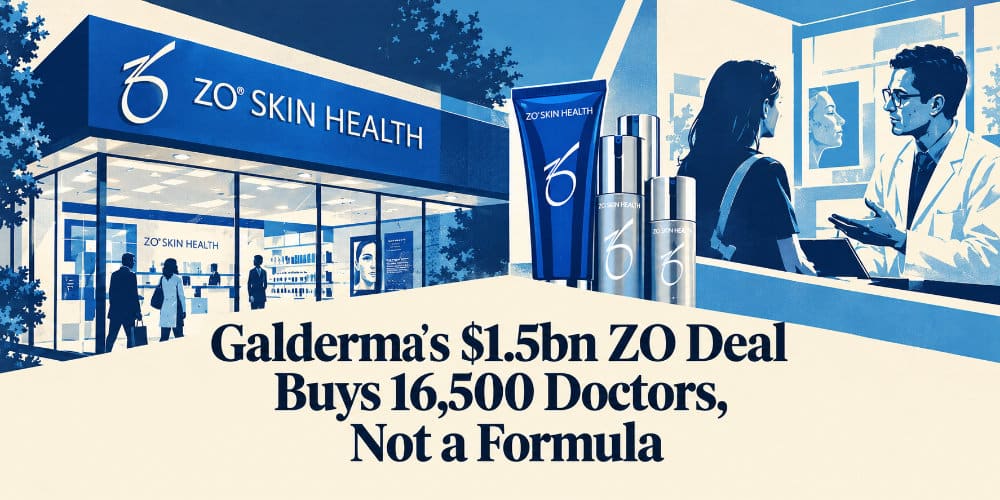
Divide the reported range by 2025 revenue and the result is 4.6 to 6.1 times sales. The two comparisons closest to this deal sit below the top of that range. In October, Galderma agreed to pay US$1.5 billion for ZO Skin Health, on about US$330 million of trailing sales, or 4.5 times, for more than 16,500 physician, medical spa, and online accounts. LYFE's own Koru deal works out to about 3.9 times 2025 revenue of 34.6 billion won (US$25.5 million), on the enterprise value above.
The low end of the Medians range sits at the ZO multiple. The top is 1.6 turns above it. One caution applies to every number in this section: neither report says whether the figure is the price for the shares or the value of the whole business, and the multiples here divide it by revenue regardless. The range is a bracket, not a valuation.
What would a financial buyer do with a channel it cannot cross-sell into?
A strategic buyer such as Galderma can push its own products through the accounts it buys. A fund holds no product line. It has to deepen the accounts it has or add companies on top of them.
Neither report states LYFE's plan for Medians. The Koru deal shows the template the fund announced for its last Korean control investment: bolt-on acquisitions and global expansion, using in-house manufacturing, licensing, and acquisitions. Koru sells injectables, skin boosters, and regenerative products exclusively to more than 2,200 clinics and med spas. Both companies are suppliers to clinic accounts. Whether LYFE applies the same template to Medians is not stated.
Why is a clinic channel worth more than its account count suggests?
A clinic account is counted in accounts, not stores. Medians' 2025 revenue of 32.8 billion won (US$24.1 million), spread over about 12,000 clinics, averages about 2.7 million won (roughly US$2,000) per clinic per year. That is a rough figure, because the revenue includes everything Medians sells, devices and the consumer shop among it. ZO's trailing sales of about US$330 million over 16,500 accounts average about US$20,000.
The gap sits in revenue per account, not in the number of accounts. A supplier with 12,000 relationships and US$2,000 of average annual sales per clinic owns the access and sells a thin slice of it. That slice is what a buyer with a growth plan underwrites.
What do the reports leave unconfirmed?
The price and its basis are the first gap. The reports give a range, attribute it to unnamed bankers, and do not say whether it covers equity or the whole business. The staging of the share transfer is the second. The reports say the shares move to LYFE in stages and give no schedule, so the date LYFE holds control is not known.
Three more items are missing: which LYFE fund pays, whether the founder stays in management, and whether Medians' consumer-facing lines continue under the same terms. A company announcement or a closing notice settles each one. Until then, every figure here carries the same label: reported.
What does the same deal say to three different readers?
For makers and contract suppliers, the range sets a reference for professional-channel portfolios. A clinic-supplied product line now has a buyer pool beyond the medical aesthetics strategics. For brands and buyers, a clinic channel runs outside retail. A brand that wants both, as Aowa's online shop shows, runs two storefronts with two sets of customers.
For regulators and investors, a cosmetic sold through a medical channel is judged on its label claims in both worlds. A new owner inherits every claim on every label. The fund is the news. The channel is the asset.