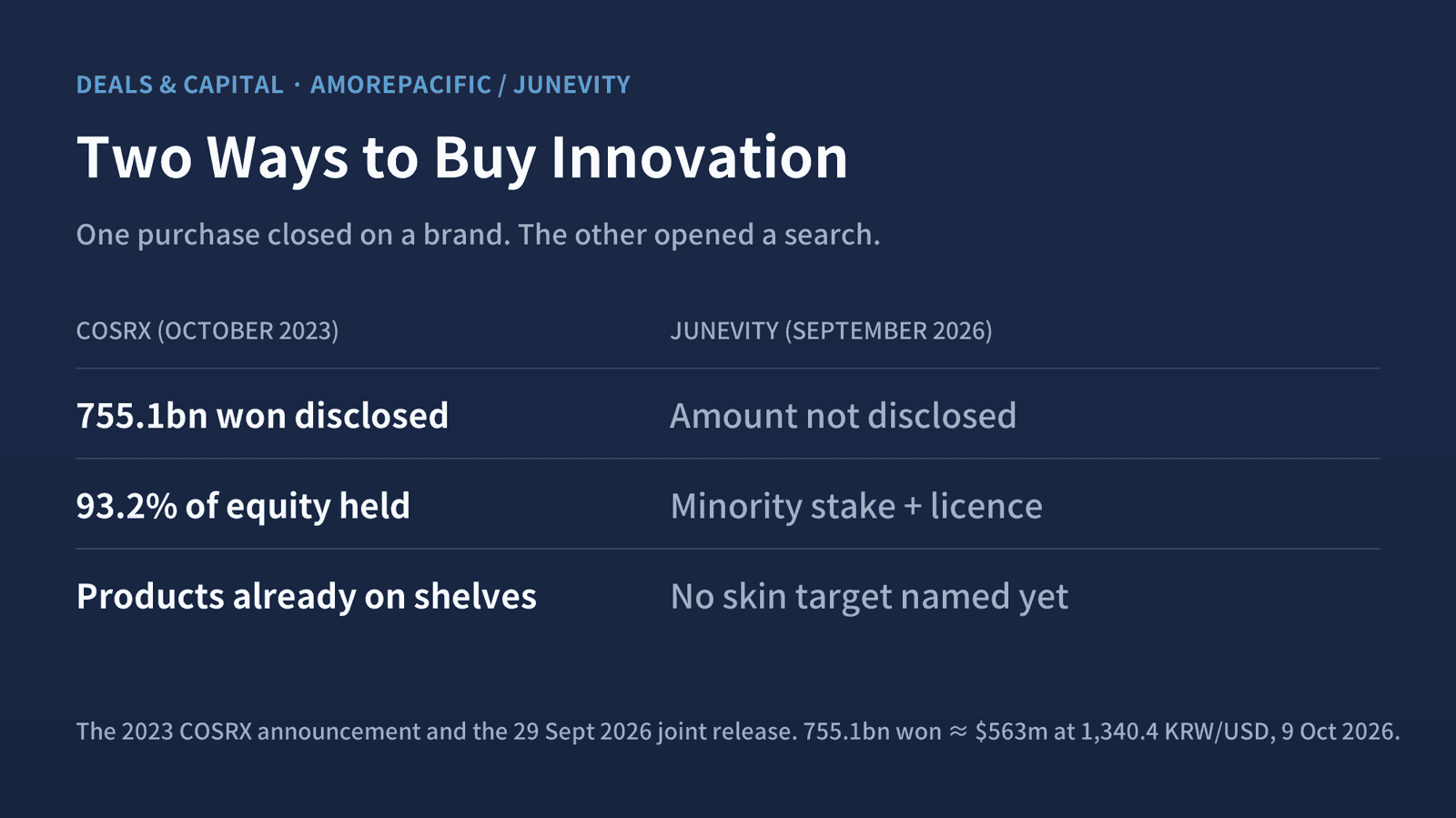
Amorepacific paid 755.1 billion won (~$563 Million USD) for the remaining shares of COSRX in October 2023, taking its holding to 93.2%. Its venture arm's own materials put its cheques at $2 million to $5 million per company per round. On 29 September 2026 that arm invested in Junevity, a San Francisco biotech founded in 2023, and signed a separate licence covering cosmetic applications of a platform that has not yet named a skin target. The amount is undisclosed. The distance between those two numbers is the deal.
What did the two companies actually sign?
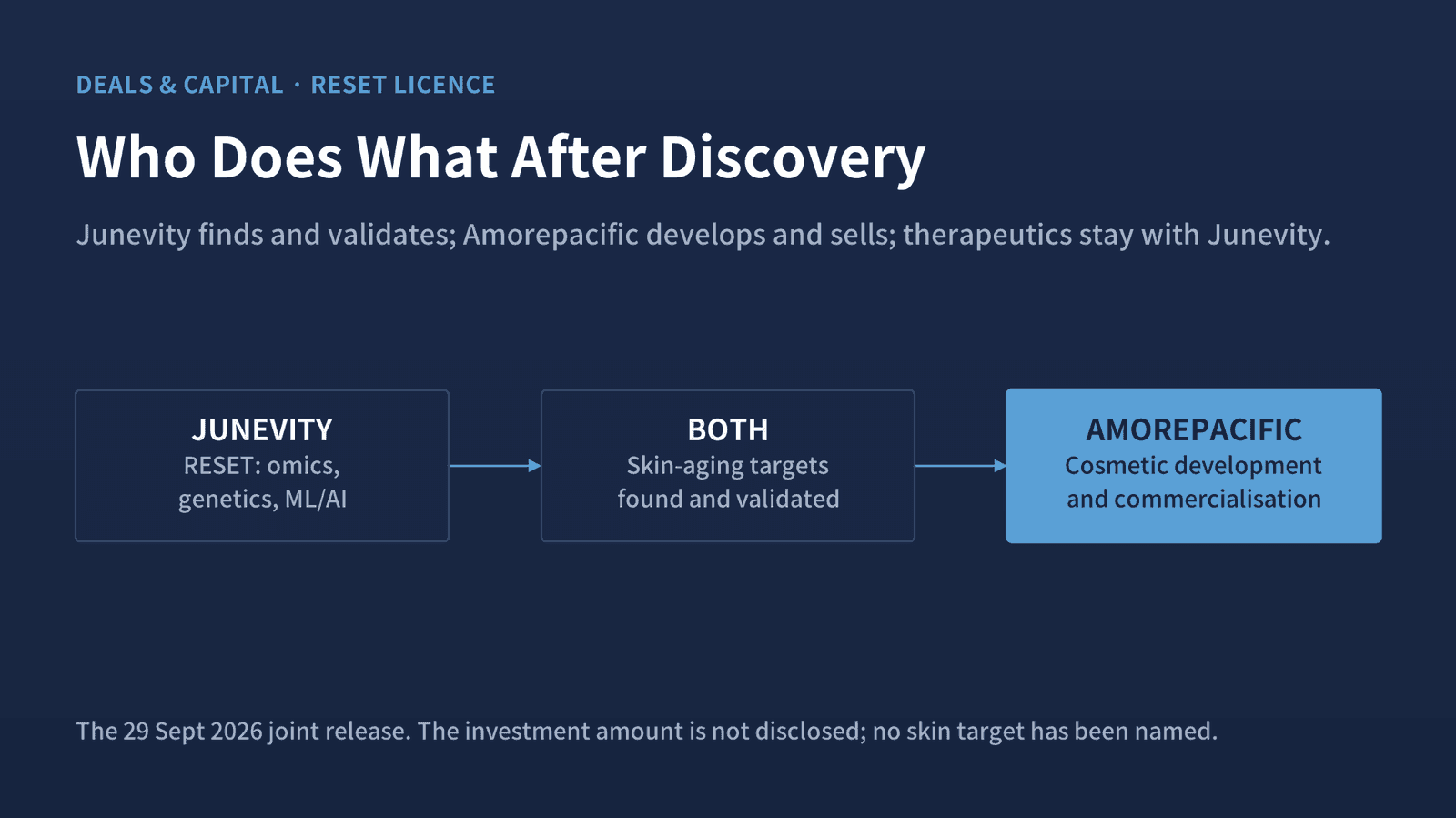
The joint release describes three things at once. Amorepacific Ventures, the group's corporate venture capital arm — an investment vehicle owned by an operating company, investing for strategic as well as financial return — made a strategic investment in Junevity. The two companies signed a separate licensing agreement covering cosmetic-field applications. And they entered a collaboration under which Junevity applies its RESET platform to identify skin-aging pathways suited to cosmetics.
The division of labour is explicit. After targets are discovered and validated, Amorepacific leads development and commercialisation of the resulting cosmetic products. Junevity continues advancing the therapeutic applications of the same platform, where its lead siRNA candidate for obesity is heading into human clinical trials. The investment amount is not disclosed.
Won figures here are converted at 1,340.4 won to the dollar, the rate of 9 October 2026.
How large is a cheque Amorepacific does not disclose?
Amorepacific Ventures publishes its own parameters. Its materials describe investments of $2 million to $5 million per company per round, from seed through later rounds, with follow-on capital reserved for milestone achievement, and name its focus areas as aesthetics, hair, obesity, dermatological drugs, beauty food, platform technology, services and devices. It invests as lead or inside a syndicate and offers portfolio companies help commercialising in Asian markets.
Junevity states it has raised more than $20 million in seed financing led by Goldcrest Capital and Godfrey Capital. That figure is the company's own. Against a base of that size, a cheque inside the published band buys a minority position, not control, and the licence rather than the equity is where the commercial substance sits.
What does the RESET platform claim to do?
A transcription factor is a protein that switches whole sets of genes on or off, so moving one can shift an entire network rather than a single pathway. RESET combines human disease omics — large-scale measurement of molecules in diseased human tissue — with human genetic linkages and machine learning to pick transcription factor targets whose repression moves a gene network toward a healthier state.
The claim is methodological rather than chemical. The platform does not propose an ingredient. It proposes which switch to press, and leaves the question of what presses it to whoever holds the relevant field licence.
What has the platform actually shown?
Junevity published peer-reviewed work in the Proceedings of the National Academy of Sciences in January 2026, arising from its chief scientific officer's research at UCSF. The company reports that four transcription factors were each individually capable of reversing age-associated gene expression in human fibroblasts, and that in aged mice liver gene expression profiles were reversed, steatosis and fibrosis reduced and glucose tolerance improved. The work combined transcriptomics, computational modelling and CRISPR-based Perturb-seq, and the company states the effects occurred without inducing dedifferentiation or oncogenic programs.
Two gaps are worth stating plainly. The transcription factors in that work are not named in the partnership announcement, and the company's lead candidate engages a target it keeps confidential. And human fibroblasts in culture and mouse liver are not human skin in use. No skin-aging target has been named under this collaboration at all, because finding one is what the collaboration is for.
How does this compare with the way Amorepacific has bought innovation before?
Amorepacific acquired Tata Harper in 2022. In October 2023 it announced the purchase of the remaining COSRX shares for 755.1 billion won, about $563 million, taking its holding to 93.2% after an initial 38.4% stake in September 2021. Those transactions bought finished products, existing revenue and shelf presence.
The Junevity deal buys none of those. It buys first access to targets that do not yet exist, in a field where the partner retains the larger therapeutic application. The two approaches are not alternatives and the second does not replace the first. Amorepacific is running brand acquisition at nine figures and target discovery at seven, and the second does not reduce the need for the first.
Why would a cosmetics company want a therapeutics platform at all?
The binding constraint in prestige skincare is the claim, not the formulation. A cosmetic has to change appearance rather than treat disease, and that line determines what can be said on a carton. A target-discovery platform does not move that line. What it changes is what the formulator aims at: a named biological mechanism instead of an ingredient with an observed effect.
Amorepacific is buying from strength rather than difficulty. Group revenue in the second quarter of 2026 was 1.2543 trillion won (about $936 million), up 14.6%, with operating profit of 122.8 billion won (~$91.6 Million USD), up 53.3%. At the leading subsidiary, overseas revenue of 551.6 billion won grew 28% against domestic growth of 10%, and overseas operating profit nearly doubled. The company's second-quarter materials list biotechnology-based anti-aging innovation and AI-driven business transformation among five strategic priorities, with no investment figures attached to either.
Who sits on both sides of this deal?
The release identifies the chief technology officer of the Amorepacific R&I Center as Brian Byung-Fhy Suh. Amorepacific Ventures' own team listing carries the same name among its investment principals, alongside managing director Paul Byung-Young Kang. The research function and the investing function are not at arm's length here, which is ordinary for corporate venture capital and worth noting when reading the strategic rationale.
The venture arm's published focus list already included obesity, which is Junevity's lead therapeutic programme, and platform technology. The investment fits the stated mandate on both the cosmetic and the therapeutic axis before a single skin target has been identified.
What has to be true before a product exists?
A sequence of conditions, each one unresolved. A skin-aging transcription factor has to be found and validated. It has to be modulable by something that can lawfully and physically go into a cosmetic, which siRNA itself is not — siRNA, or small interfering RNA, is delivered as a therapeutic, under drug regulation, not as a cream. Whatever does the modulating has to survive formulation and remain stable on a shelf. And the effect has to be large enough to support a claim a cosmetics regulator permits.
Junevity is preclinical. No timeline has been published for the skincare programme. Independent commentary on the deal makes a further point that the release does not: aging clocks and shifts in gene expression are biomarkers, and a change in a biomarker is not by itself a demonstrated reversal of aging. Rejuvenation has been a loose word in cosmetics for decades, and turning it into a biological claim raises the standard of proof rather than lowering it.
Where does this leave formulators, brand owners and investors?
For research organisations and ODM manufacturers, target discovery is becoming a purchased input rather than an in-house capability. What then differentiates is not finding the mechanism but converting a named target into a stable, compliant, manufacturable formulation. That work does not move to a platform company.
For brand owners, nothing on a shelf changes because of this agreement. It buys optionality on a claim, years ahead of any claim, and a competitor who signs a similar licence tomorrow is at the same starting line.
For investors, the disclosure asymmetry is the signal. A 755.1 billion won (~$563 Million USD) acquisition arrives with a number attached because the rules require it. A strategic investment paired with a field licence arrives without one. The cheque is small by design, because what is being bought is the right to look first.
Amorepacific did not buy a molecule. It bought a place in the queue.