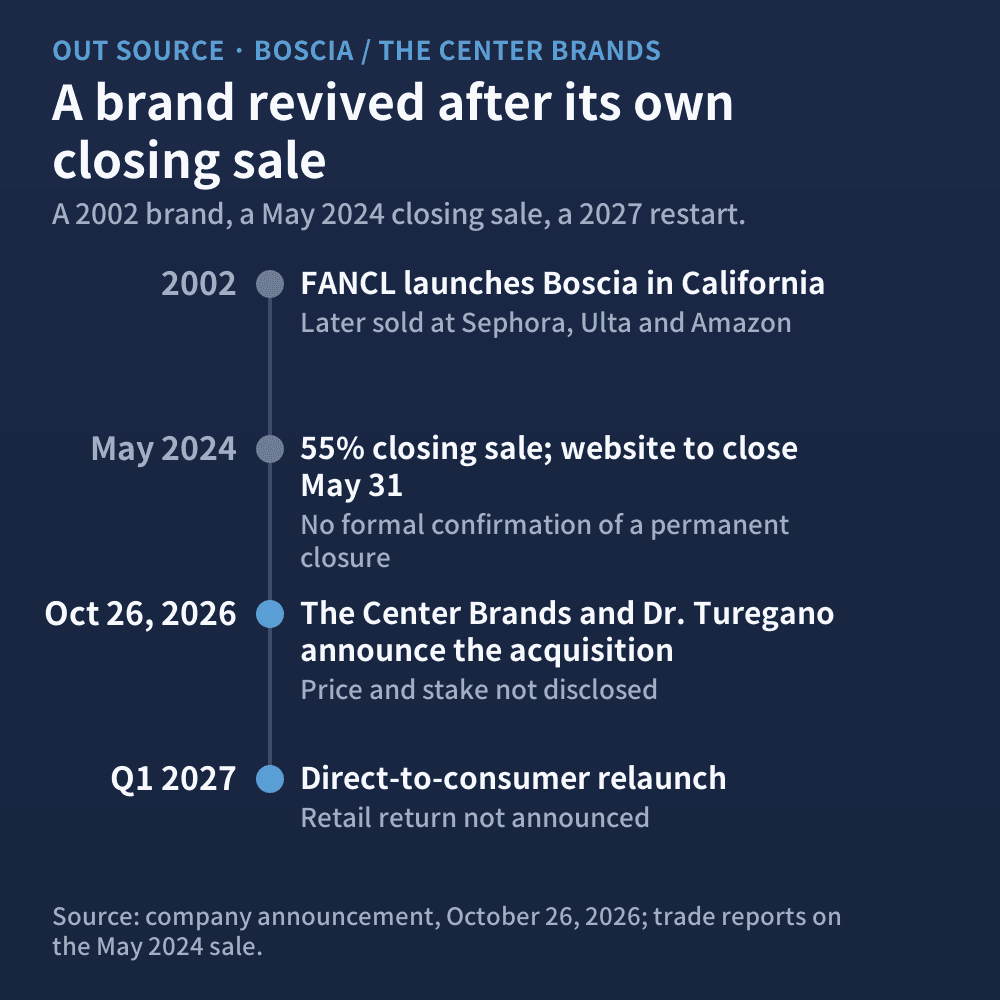
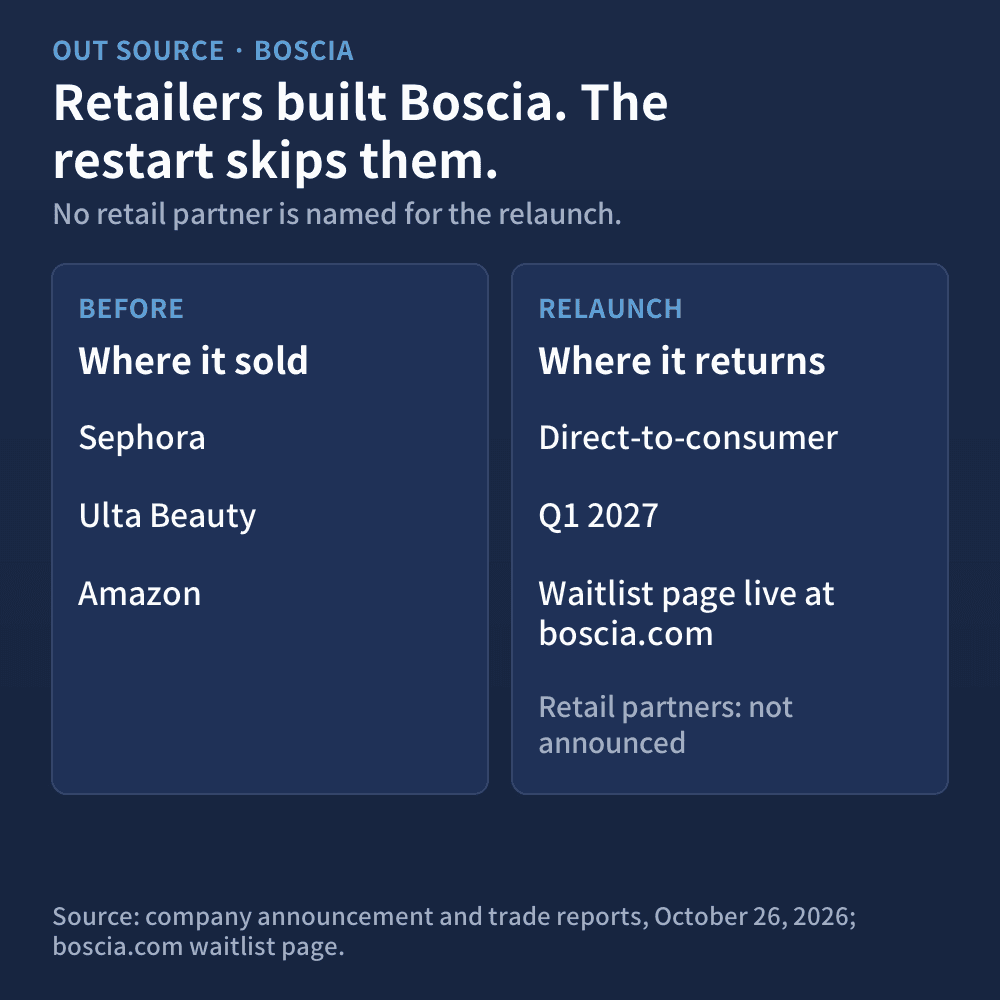
Boscia held a 55%-off closing sale in May 2024 and said its website would close on May 31. On October 26, 2026, the beauty accelerator The Center Brands and a dermatologist announced they had bought the brand from its Japanese parent, FANCL, for a direct-to-consumer relaunch in the first quarter of 2027. The price is undisclosed and no retailer is named. Sephora, Ulta Beauty and Amazon carried the brand before. It returns without them. What changed hands was not a shelf position. It was a name.
What exactly was announced on October 26, 2026?
The Center Brands, a U.S. beauty accelerator founded by Ben Bennett, acquired Boscia from FANCL, the Yokohama-based cosmetics group that launched the brand in California in 2002. The Center Brands made the purchase in partnership with Dr. Mamina Turegano, a triple board-certified dermatologist, internist and dermatopathologist based in New Orleans. Financial terms were not disclosed.
The announcement fixed one date and left most of the rest open. The relaunch is direct to consumer, set for the first quarter of 2027. Which products return, whether new products launch, and whether the brand re-enters physical retail have not been announced. Right now, [boscia.com][11] carries a waitlist page that invites visitors to be the first to know when the brand launches.
Direct to consumer, or DTC, means the brand sells from its own website and keeps the customer relationship, the price and the margin that a retailer would otherwise take. Every other choice in the Boscia plan follows from that one.
How did Boscia end up needing a restart?
FANCL launched Boscia in 2002. The name joins “botanical” and “science,” and the brand was built on gentle, clean-positioned formulas with Japanese skincare roots. Trade reports name its black charcoal products as signature items, including a peel-off charcoal mask from 2010 that circulated again on TikTok. Distribution started as a Sephora exclusive and then widened to Ulta Beauty and Amazon.
In May 2024, Boscia announced a closing sale of 55% off everything on its site and said the site would close on May 31. The notice told customers to enjoy a final discount. The brand never formally confirmed a permanent closure and announced no buyer. The trade press reported it as a shutdown and treated Boscia as finished for two and a half years.
Why does a brand with no active store still have a price?
A closing sale ends sales. It does not end recognition. Boscia said its website would close on May 31, 2024, and by October 2026 it had a buyer anyway. The asset is a name with 24 years of recognition, an ingredient story, a formula library, and a long archive of reviews, photos and press. None of that sits on a retailer’s shelf.
FANCL has not explained the sale. The structure shows what moved: a trademark and a story passed from a conglomerate that had stopped operating the brand to an owner that intends to operate it. For a parent company, a dormant brand is a cost with a book value. For an acquirer that builds brands for a living, it is a head start on awareness that costs nothing to rebuild. The price decides who won that trade, and the price is private.
There is a second shift inside the first. Sephora, Ulta Beauty and Amazon carried Boscia in front of shoppers for years, and the awareness that work produced did not leave with the retailers. It stayed attached to the name. The new owners inherit the result of that retail spending without carrying the retail relationships that produced it. That is the most valuable thing a closing sale can leave behind, and the least visible on a balance sheet.
Who is The Center Brands, and what does it buy?
An accelerator, in the way The Center describes itself, builds brands alongside talent and operators rather than only writing checks. Bennett founded the company in 2020, and a spokesperson has said it prefers “accelerator” to “incubator.”
Its portfolio list includes Prequel, Cyklar, Make Beauty, Proper, Phlur, Saltair and Naturium. Three of those have been sold on: Naturium to e.l.f. Beauty in 2023, Phlur to TSG Consumer in 2025, and Saltair to TSG Consumer in 2026. A buyer with that record treats brands as assets built to be passed on. Boscia enters the portfolio as a revival rather than a build, a different starting point from a brand created inside the accelerator.
What does a dermatologist add where the retailer used to be?
At Sephora, Ulta Beauty and Amazon, the retailer did part of Boscia’s selling: placement, in-store education, and a trust signal that came from the retailer’s own name. A DTC site has none of that. Turegano fills the slot with credentials. She has more than 16 years in dermatology, trained at Georgetown, completed a fellowship at UCLA, and has research in JAMA Dermatology and the Journal of the American Academy of Dermatology. She is of Japanese heritage and has said the brand feels personal to her because of its Japanese roots.
The announcement describes her as a partner in the acquisition whose perspective will guide the brand’s evolution. Her title and her stake were not disclosed. The signal to shoppers does not depend on either: a clinician’s name replaces a retailer’s name as the guarantee. Trust gets earned on a product page instead of in an aisle.
Why relaunch direct to consumer only?
DTC lets the new owners set the price, own the customer record, and test products without a retailer’s planogram, the shelf plan that fixes which products sit where. It also removes wholesale, the model in which retailers buy the product and resell it. The cost is reach. A brand that sold through three large retailers now has to generate its own traffic, and the waitlist is the first tool for that.
The sequence is the point. A waitlist converts an old name into a customer list before a single product ships. If retail partners come back, they will be negotiating against measured demand instead of nostalgia. If they do not, the brand has already built the channel it chose.
What stays unknown?
Five things remain undisclosed: the price, the split of ownership between The Center Brands and Turegano, the product list, Turegano’s formal role, and the retail plan. Each one is a test. The product list shows whether the revival sells the old charcoal heritage or a new formula. The retail plan shows whether DTC is a strategy or a staging ground. The price shows what a dormant name is worth.
The answers arrive on a schedule the owners control. The first quarter of 2027 is the first point at which any of them becomes visible, and the waitlist page is the only public signal before then.
What does Boscia’s return mean for the rest of the industry?
The three sides of the industry read this deal differently.
Manufacturers see a new order book, not a continuing one. A brand returning after a closing sale has no recent volume history to forecast from, so supplier relationships restart cold. Brands and retailers see a name that left their shelves coming back on someone else’s website, with no guarantee that shelf space returns on the old terms. Investors see a closing sale that never became a formal closure. The name stayed in circulation, and the buyer started from it.
A closing sale is not an ending. It is a transfer of the brand from the people who ran the shelves to the people who own the name.