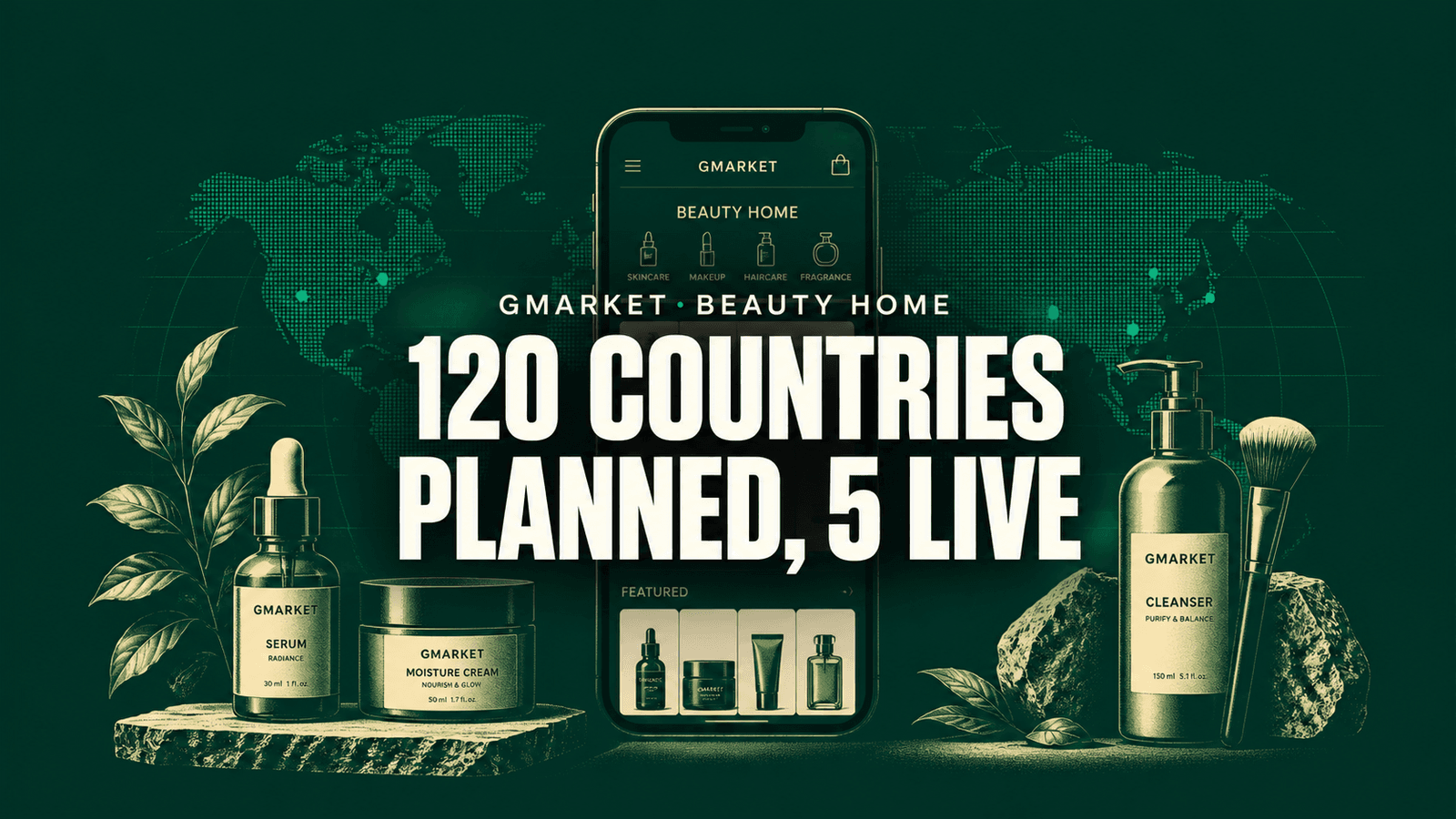
Gmarket opens a beauty-only section inside its app in the first quarter of 2027, and it sells the section on two promises: a discovery layer at home and about 120 countries abroad. The abroad half is a channel list, not a sales record. Through Lazada, Gmarket currently serves five countries, and beauty is about 20% of the roughly 630,000 pieces it exported from October 2025 through September 2026. A general marketplace is borrowing a specialist's format and a partner's overseas network.
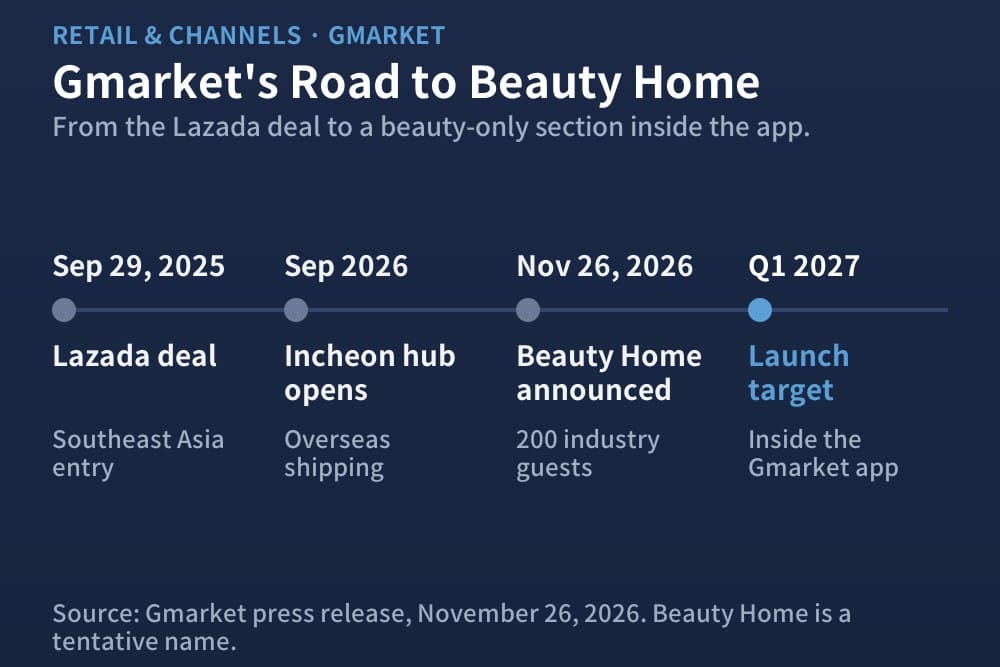
▲ Gmarket signed with Lazada on September 29, 2025 and targets a beauty-only section for the first quarter of 2027.
What is Gmarket actually building?
Gmarket announced the section at its 2026 Beauty Conference, held at its Seongsu-dong headquarters in Seoul on November 26, 2026. The tentative name is Beauty Home, and the target is the first quarter of 2027. In retail terms it is a vertical, a section of a general app that organizes one category with its own search, content and merchandising.
Four features define it: product search built around skin concerns, seasonal trends and purchase routines; dedicated brand sections; live broadcasts and short-form video; and AI recommendations personalized for each shopper. All four address the same problem. In beauty, thousands of look-alike items compete for one shopper's attention, and the platform that organizes the search wins the first click.
A Gmarket official framed it the same way: beauty is a category where the environment in which shoppers discover and experience products matters as much as brand strength and product quality.
Why does a general marketplace need a beauty aisle?
Gmarket is not a beauty specialist. In October 2025 it ranked fifth in Korea by monthly active users, behind Coupang, 11Street, AliExpress and Temu. Its strength is breadth: 660,000 sellers on the platform in the first half of 2026, up 5% from a year earlier. Breadth supplies price and variety, but it gives a shopper no reason to begin a skincare search there.
A vertical supplies the reason. It makes the shopper's concern the entry point, not the seller's name, and it adds the formats that beauty discovery now runs on. Gmarket moved into a new Seongsu headquarters on October 12, 2026 with a live-commerce open studio on the seventh floor. The live and short-form features of Beauty Home needed that studio first.
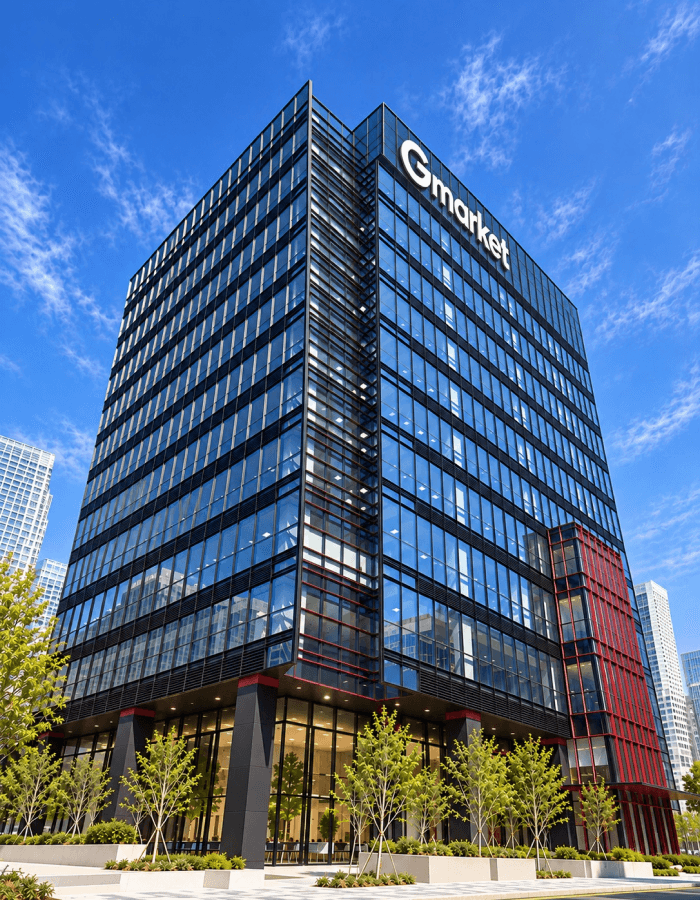
▲ Gmarket moved into its Seongsu-dong headquarters in October 2026, where it hosted the Beauty Conference on November 26. Image: Gmarket / Shinsegae Group
Which brands is the build aimed at?
Gmarket ran two events two and a half months apart. On September 7, 2026 it hosted a growth-strategy seminar with the beauty support company Woods Studio for about 50 domestic beauty brands, among them The Dermafactory, NDP, Barl and Aorra. The package offered growth support worth up to 50 million won (US$37,000), a three-month incubation program, and help with listing on Lazada.
The November 26 conference drew about 200 industry guests. The invited brands included LG H&H, Goodai Global, Aekyung, Torriden and Centellian24. The program covered the 2027 beauty strategy, Southeast Asian e-commerce, a session on selling beauty products to overseas buyers, and one-on-one consultations for brands that want to open stores or enter overseas markets.
The two events form two tiers. Small brands get subsidized onboarding, and large brands get a distribution conversation. A vertical needs both: the large names that shoppers already search for, and the newer names that give discovery something to show.
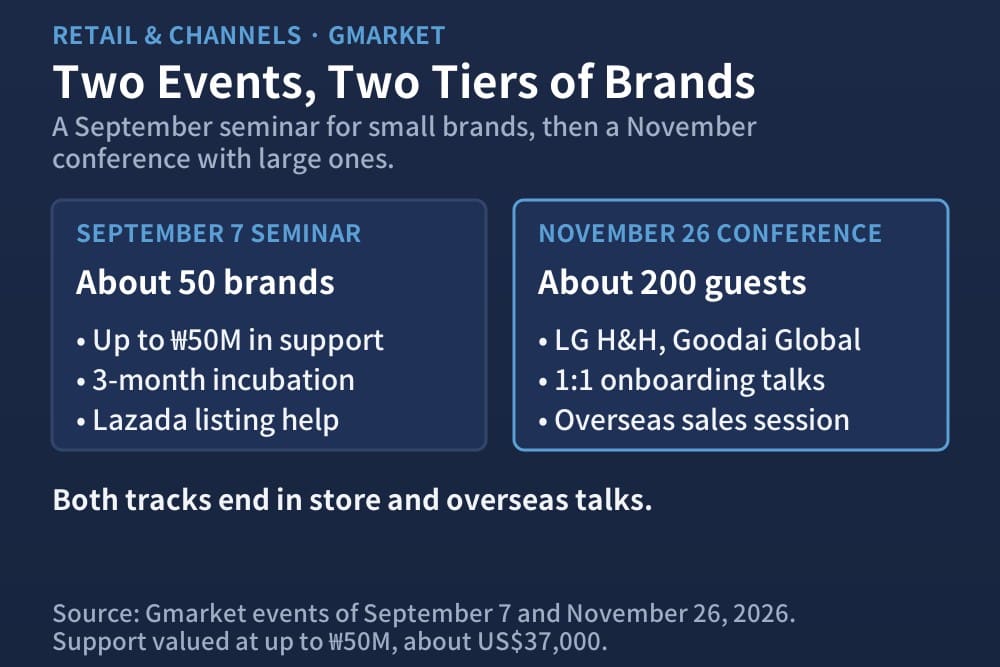
▲ Gmarket held a seminar for about 50 brands on September 7, 2026 and a conference for about 200 guests on November 26.
Where does the number 120 come from?
Gmarket plans to widen its overseas sales channels to about 120 countries through Lazada and Alibaba International, the Alibaba group's cross-border commerce arm. The access follows from ownership. Gmarket was folded into Grand Opus Holdings, the joint venture of Shinsegae and Alibaba that Korea's Fair Trade Commission cleared in September 2025.
Today the pipe is narrower. Lazada is Alibaba's Southeast Asian platform, with about 160 million members, and Gmarket signed its partnership with it on September 29, 2025. Through Lazada, Gmarket exports to five countries: Singapore, Malaysia, the Philippines, Thailand and Vietnam. An October 28, 2026 report put the link with Alibaba's global platform in the first half of 2027.
The figure of 120 counts the places where the channels operate. It describes reach, and revenue follows listings. The move from 5 to 120 changes the shelf a brand can list on and nothing else on its own.
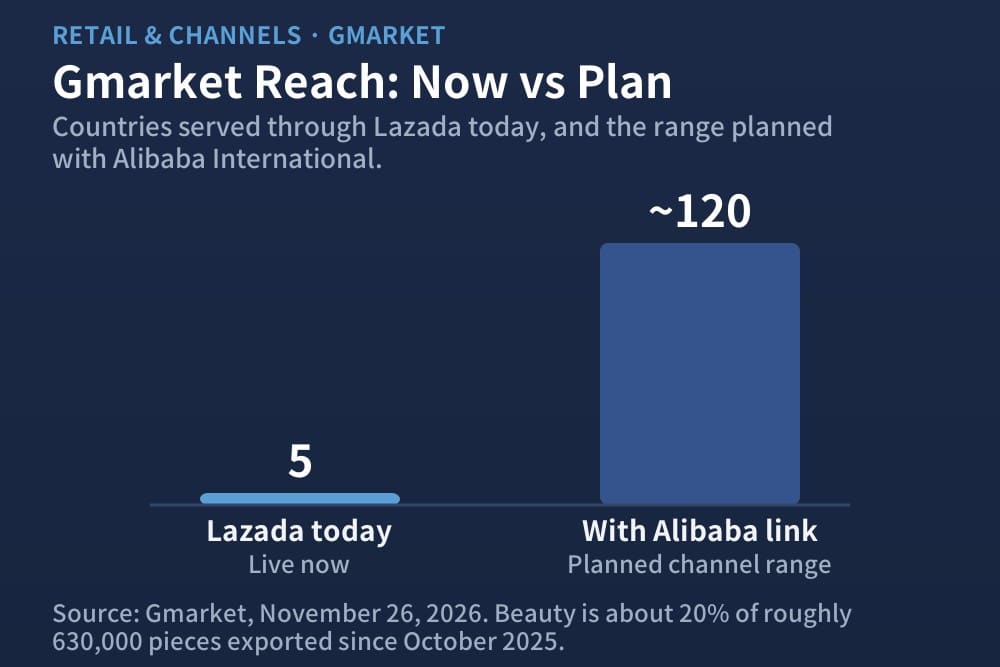
▲ Gmarket serves 5 countries through Lazada today and plans a channel range of about 120 countries with Alibaba International.
What has the export pipe carried so far?
Gmarket began exporting in October 2025. Through September 2026 its cumulative export volume was about 630,000 pieces, and beauty made up about 20% of it. That is roughly 126,000 beauty pieces in twelve months, or about 10,500 a month.
A flow of that size is a pilot-scale pipe. The Incheon overseas shipping center that opened in September 2026 exists to widen it, and Gmarket has named beauty a strategic export category. The order of work is visible in the dates: logistics in September 2026, the listing tools of Beauty Home in the first quarter of 2027, and the wider reach after that.
Why does the plan read like a Lazada playbook?
Gmarket's chief executive, James Chang, took the job on September 26, 2025. He co-founded Lazada Philippines in 2012 and later served Lazada Group as chief commercial officer, chief business officer and Indonesia chief executive. Gmarket signed with Lazada three days after he started.
The sequence is a chief executive bringing a network he knows to a domestic platform: partnership first, export pipe second, category vertical third. At his inauguration he committed to about 700 billion won (US$521 million) in annual spending to strengthen the domestic business and expand overseas. Beauty Home is the first product built on that wiring.
What does a brand buy when it opens a store in a marketplace aisle?
A specialty retailer's buyers decide what stands on the shelf. In a marketplace vertical, the brand opens its own storefront, and the platform's tools decide who is seen: search by concern, live broadcasts, short-form video, AI recommendations. The brand's work moves from winning a buyer to winning a feed.
What one onboarding opens is the marketplace's argument. A domestic store, a Lazada listing and, later, an Alibaba channel come through one consultation. Where the marketplace gives up ground is curation. A shopper who wants someone else to choose goes to a specialist.
What does the announcement settle?
For marketplace operators, it settles that a category can be rebuilt inside a general app and that overseas wiring can be sold as a product. For brands, it adds a door with a lower cost of entry than a retailer's buying process and a higher cost in attention.
Beauty Home is a format. The overseas network is the asset. The first quarter of 2027 shows which of the two shoppers use.