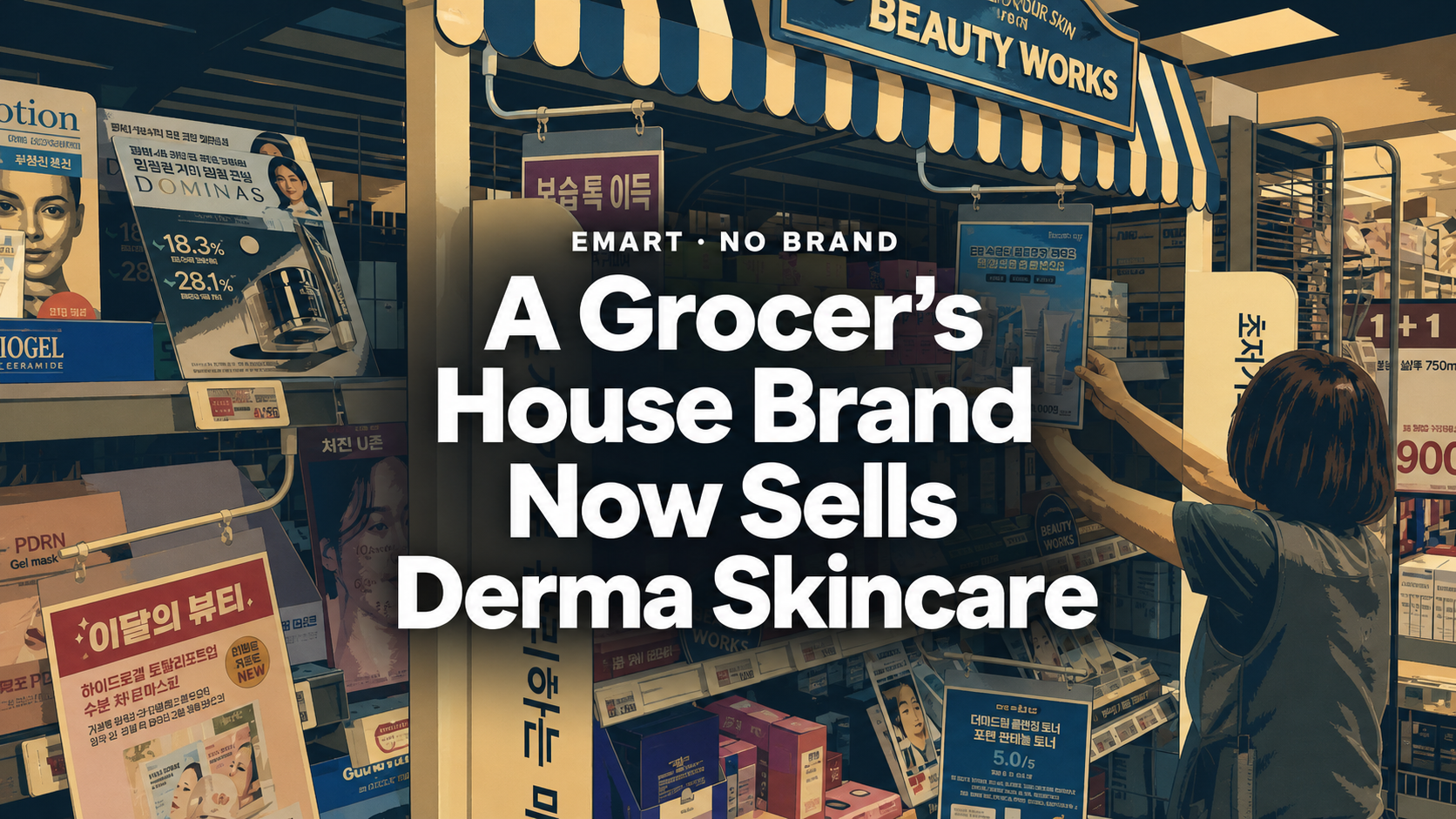
Emart's No Brand, the grocer's house label, put six dermatological skincare products on shelves in late October 2026, all at 9,980 won (about US$7.50). A PDRN line follows in November and 12 hair and body items in December. Derma is the category where trust is supposed to be earned by a name, and the label built on having none is entering it with a single price, a medical-device maker's lab and other brands' names on the roadmap.
What did No Brand actually put on the shelf?
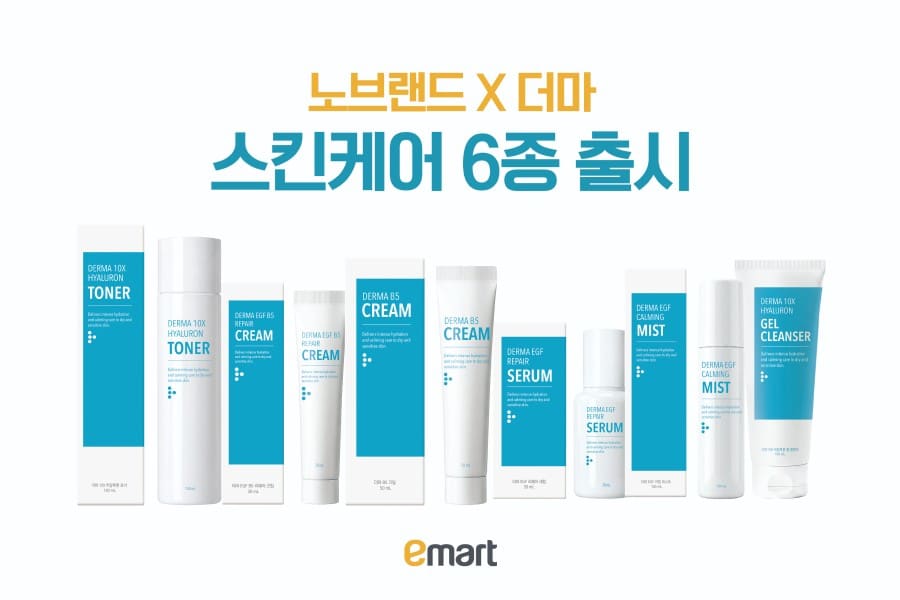
The launch is six products: a cleanser, a toner, a mist, a serum and two creams. They sell at No Brand specialty stores now, and Emart's November 17, 2026 release puts them in Emart stores in November. The line was developed with One Biogen, a manufacturer of medical devices and cosmetics.
The next two steps are already dated. November brings five PDRN skincare products. PDRN, short for polydeoxyribonucleotide, is a DNA-fragment ingredient that became a staple of Korean skin-booster and ampoule launches. December brings 12 hair and body products developed with Kundal, following more than 20 Kundal products in 2025.
The release also lists toner pads, mask packs, hydrogel masks, sun care, body odor care and protein haircare as later additions. The sequence reads as a category plan, not a product launch: one new territory per month.
Why does one price for six products matter?
Every item in the derma line sells at 9,980 won, which is about US$7.50 at 1,330 won per US dollar on November 19, 2026. A cleanser, a toner, a mist, a serum and two creams share one number, and it sits just under 10,000 won.
Brands price each item against its own cost and its own competitors. A retailer prices the shelf. One price lets store staff, shelf talkers and the app listing say the same sentence about all six items, and it removes the comparison between the cheap cleanser and the expensive cream that a brand would have to defend.
The line sold more than 1,000 units in test sales at No Brand specialty stores before the Emart rollout. A thousand units is a pilot-sized number. The Emart rollout is what turns a pilot into a shelf.
Why does a grocer need a partner from the medical-device side?
In private label, the manufacturer usually stays invisible. Here the release names it, and names it by trade: One Biogen makes medical devices and cosmetics. In derma, credibility travels with the laboratory. A retailer with no skincare heritage cannot borrow trust from its own name, so it borrows it from the maker's category.
The same direction of travel shows up elsewhere in Korea. Amorepacific Holdings signed an investment deal in July with Hiher Corporation, a skin-aesthetic device maker, and Classys, Hugel and Pharmaresearch are all moving from devices and injectables into cosmetics and aftercare. Device and cosmetics supply chains are converging, and a grocer with a purchasing desk can now draw on both.
What does a spec sheet do when there is no brand to trust?
The launch materials lead with formulation numbers. The B5 cream lists 50,000 ppm of dexpanthenol, which is 5 percent; ppm means parts per million. The cleanser is weakly acidic. All six products passed a primary skin irritation test.
A concentration is the one attribute a nameless label can print and a shopper can compare. Established derma brands compete on the name a dermatologist recognizes. A private label competes on the number on the back of the pack.
Why is the roadmap built from other brands' names?
The December hair and body line is a Kundal collaboration, and a Son & Park color cosmetics collaboration of 29 products is also on the plan. The label that has no brand is assembling its beauty range category by category from brands the shopper already knows: derma from a device maker's lab, hair and body from Kundal, color from Son & Park.
This is the same logic as the single price, applied to identity. The retailer fixes the price, the shelf and the specification, and rents the recognition. GS25 already carries Son & Park and Witch's Factory products, so the names on the No Brand roadmap are names that Korean convenience channels have been teaching shoppers to trust.
How does No Brand's position differ from Daiso and the convenience chains?
Daiso sells basic and makeup lines made with cosmetics companies. CU runs about 600 beauty-focused stores, and its beauty sales rose 31.1 percent from January to May 2026. GS25 stocks Son & Park and Witch's Factory. Daiso and the convenience chains concentrate on basics and makeup; large marts offer skincare next to hair and body.
No Brand's derma line moves further along that spectrum. Five steps of a routine at one price, from cleanser to cream, give a shopper a reason to come back for the next item. In a channel where every format now sells beauty, the contest has shifted from access to repurchase.
How big is the beauty shelf No Brand already runs?
No Brand Beauty started in 2016, and about 150 beauty products reached No Brand specialty stores this year across basic skincare, hair, body and makeup. Emart separately began widening its ultra-low-price range of items at 5,000 won or less in April 2025; it now carries 85 products across skincare, haircare and bodycare, up from 25 mask packs at launch in 2023.
Emart reported skincare sales up about 12 percent year over year from January through November 2026, and men's skincare up about 13 percent at Traders and Emart Everyday. The shelf is no longer a promotional corner. It has its own sales line and its own product roadmap.
What does the release say about where this is heading?
Kim Jin-hee, the buyer on Emart's No Brand lifestyle development team, said both No Brand and Emart are expanding beauty products shoppers can pick up in daily life at reasonable prices. Kim added that Emart will keep introducing products differentiated by ingredients, function and quality as well as price.
That second sentence moves the retailer's own definition of competitiveness. The 85-item ultra-low-price range was built on price. Ingredients, function and quality are what the derma line is built to carry, and the release says so in the same breath as price.
What does the launch change for brands and manufacturers?
The grocer now controls four layers that used to belong to a brand: price, formulation specification, manufacturing partner and shelf. What it still lacks is a name, and it fills that gap by renting one per category.
For a manufacturer, a named role on a private-label launch is a credential in itself. For a brand, a collaboration with a mart label is distribution, and it is also a rental that ends when the contract does. The brand is the one layer left in the stack that the retailer does not own.