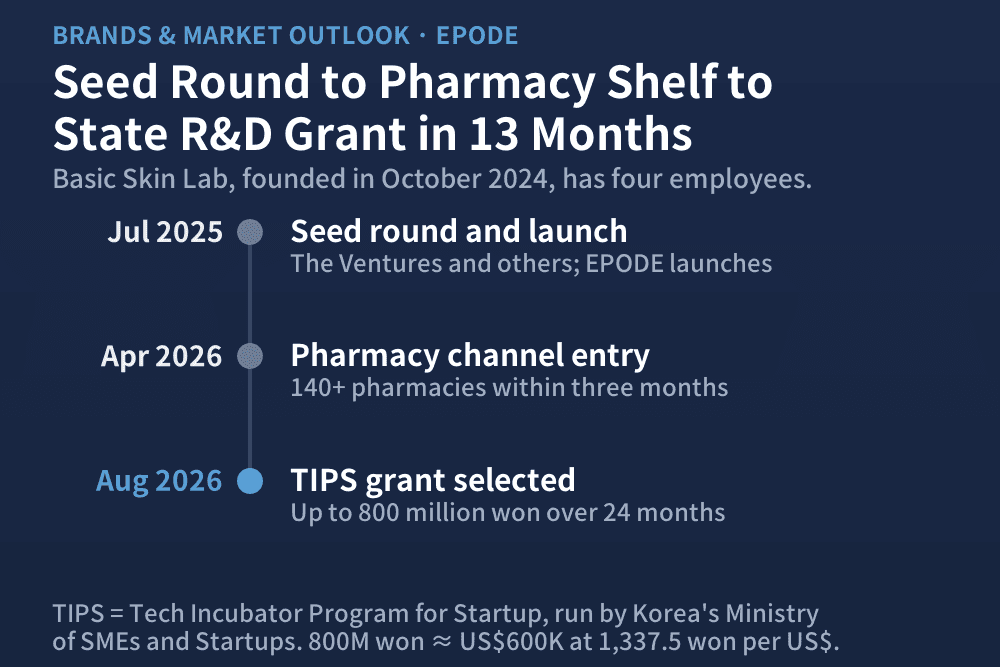
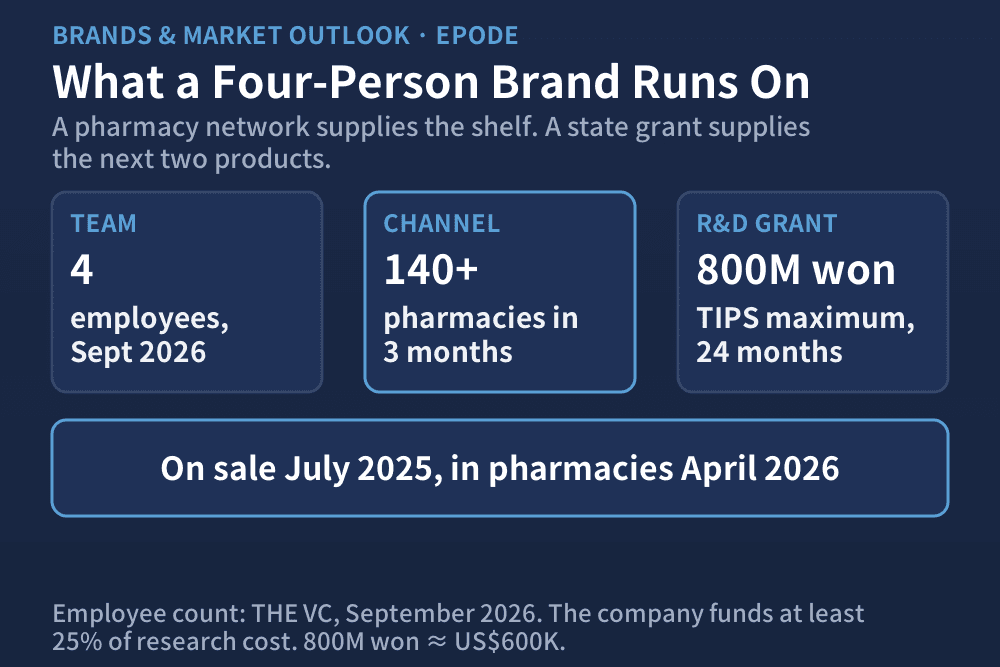
EPODE, a derma skincare brand run by Basic Skin Lab, went on sale in July 2025. Nine months later, in April 2026, it entered Korean pharmacies, and within three months it stood in more than 140 of them. THE VC, a startup database, lists four employees as of September 2026, or 35 pharmacy doors per person. On August 19, 2026 the TIPS program of the Ministry of SMEs and Startups selected it for a grant of up to 800 million won (about US$600,000) to build two new products.
Who is behind EPODE, and how large is the team?
EPODE is the premium derma skincare brand of Basic Skin Lab, a startup led by CEO Kim Seung-yeon, who comes from the biopharmaceutical industry. THE VC dates the company's founding to October 31, 2024 and counts four employees as of September 2026.
The company raised a seed round in July 2025 from The Ventures and other investors, and EPODE launched the same month. Founding to launch took about nine months. Launch to a nationwide pharmacy shelf took nine more.
What is on the shelf?
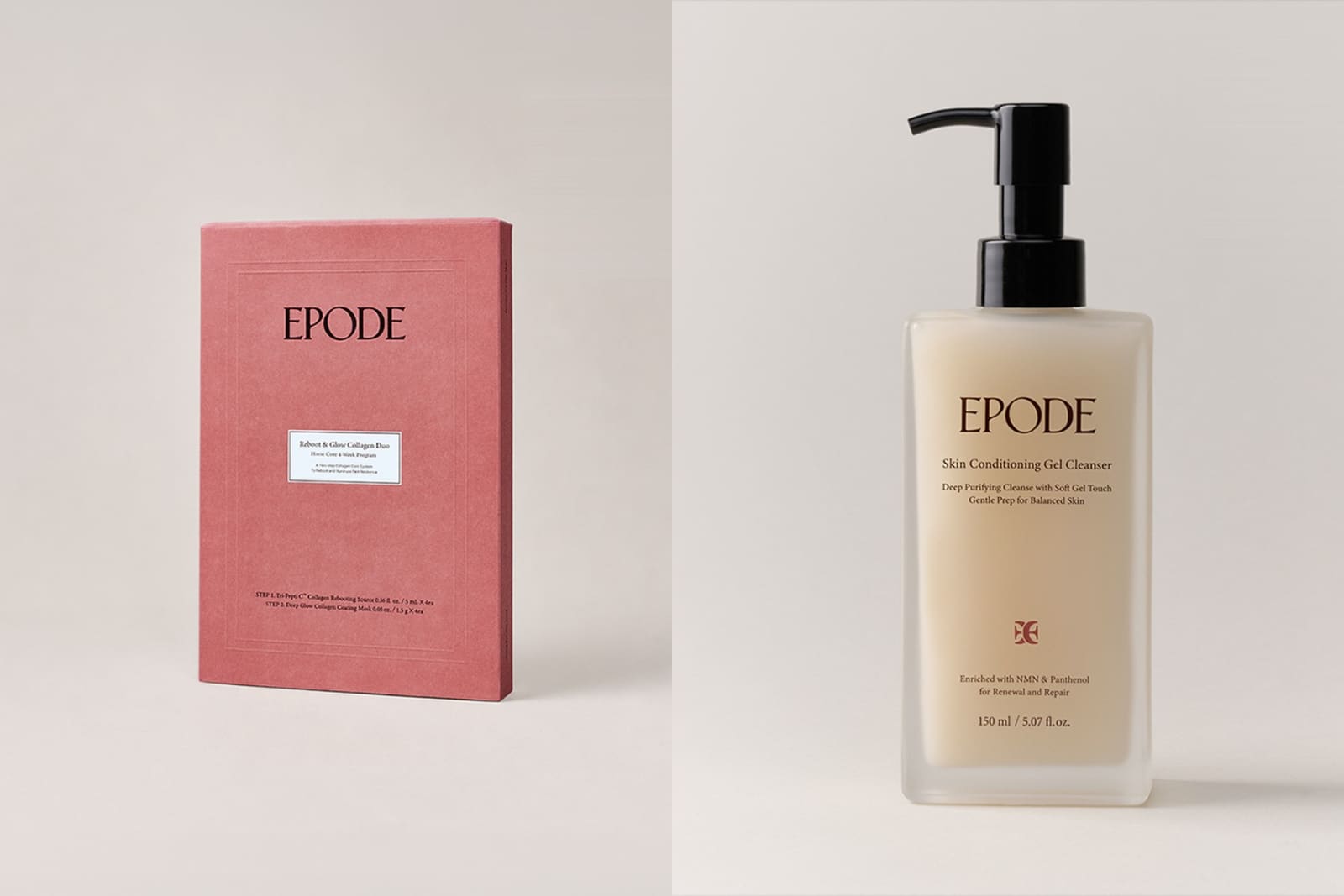
The August 2026 release names two products. The Reboot & Glow Collagen Duo is a dry mask pack used once a week and sold as a seven-day, one-pack format. The Skin Conditioning Gel Cleanser is a gel-type cleanser built on naturally derived surfactants and panthenol.
Both belong to derma skincare, the category that positions itself on skin science. Kim said the company will keep launching cosmetics of real substance rather than compete on trending ingredients or ingredient content, and will build a sustainable derma brand on biopharmaceutical technology and a deep understanding of consumers.
How did a four-person team reach 140 pharmacies?
EPODE entered offline pharmacies in April 2026 and reached more than 140 locations nationwide within three months. That is more than 1.5 new pharmacies a day, every day, for a company with four employees, or 35 doors per person. The named premium curation pharmacies include Optima Wellness Museum Pharmacy, Onnuri Pharmacy and Doremi Pharmacy.
The arithmetic says the work at each door is done by someone else. At a pharmacy counter the pharmacist and the staff handle the shopper, the recommendation and the reorder. The brand's four employees cannot stand in 140 stores, so the shelf sells through the people who already work behind it.
A pharmacy shelf also matches the brand's story: a founder from biopharma, a technology borrowed from drug delivery and a counter staffed by pharmacists.
The scale is a foothold, not a takeover. Set against a network of about 23,000 pharmacies, 140 doors are 0.6% of the channel. The figure shows how much of the shelf remains to win, and how much of the work at each new door falls on people outside the company.
How stable is the pharmacy channel a young brand is entering?
Pharmacies in Korea are not a fixed set. According to the Health Insurance Review and Assessment Service, 2,005 pharmacies opened and 1,555 closed in 2025, a net gain of about 450, in figures published on February 23, 2026.
A brand with 140 doors is exposed to that turnover. Doors that close take the shelf with them, and doors that open are new relationships to win. The channel as a whole changed through more than 3,500 openings and closures in a single year, and holding a roster of 140 means managing a list that keeps moving.
The ratio sharpens the point. For every ten pharmacies that opened in 2025, nearly eight closed. A shelf placement in this channel depends on a counter that stays open, and the brand has to keep replacing the doors it loses.
Who else is moving onto the pharmacy shelf?
A March 4, 2026 report said K-beauty listings on Barophama, a pharmacy-focused platform, were rising. The brands ranged from large beauty companies such as Pharmaresearch, Dr. Elcia, Celltrion Skincure and RXmi to pharmacist-run specialty brands, and the report put the platform's network at about 23,000 pharmacies, 90% of the national total. EPODE entered pharmacies one month after that report.
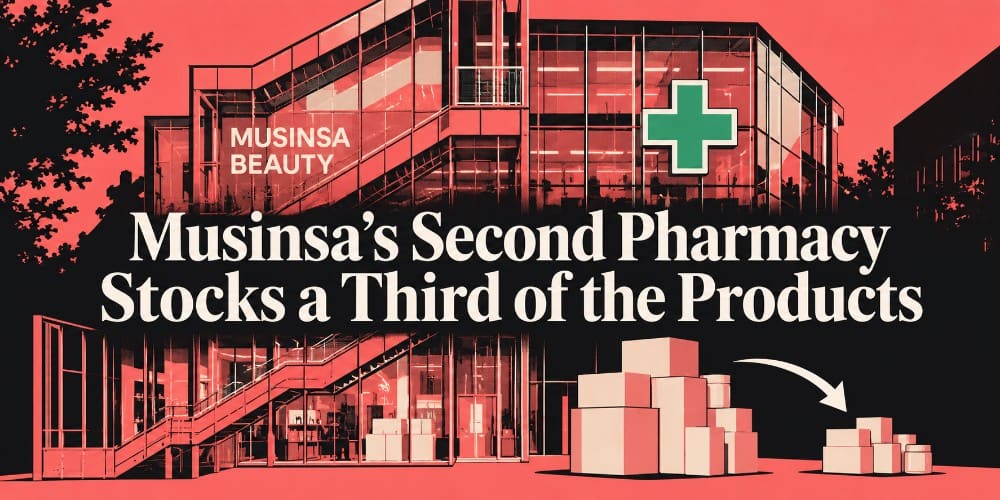
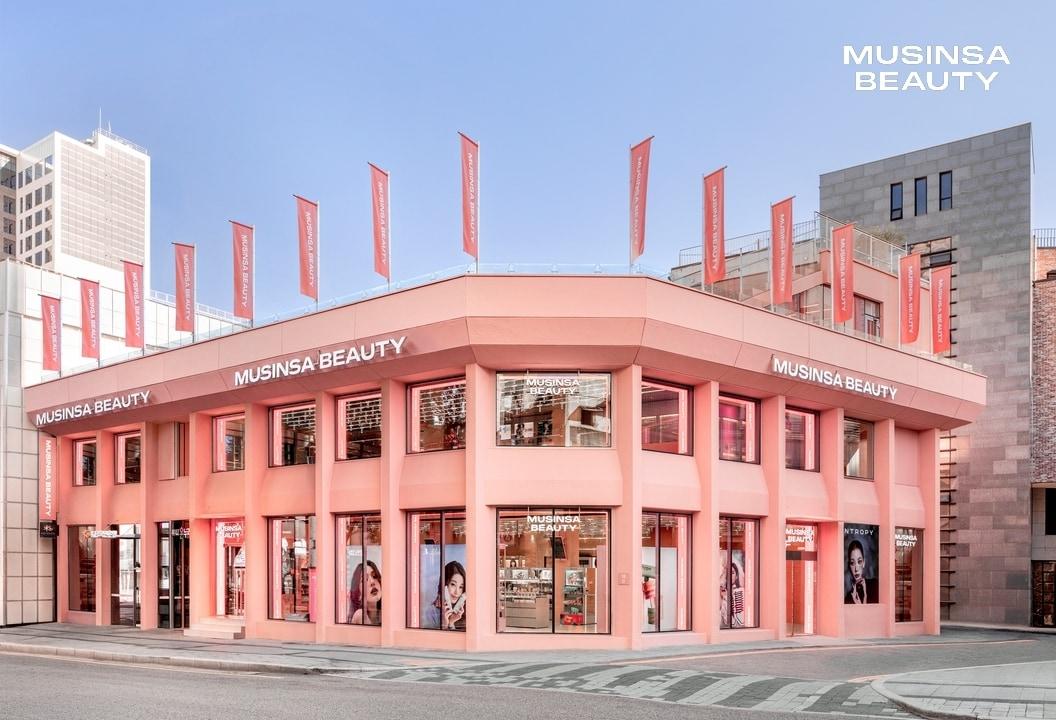
The format is also spreading beyond the pharmacy itself. Musinsa Beauty's second beauty-only store, in Seongsu, opened on November 11, 2026 with a pharmacy on its second floor carrying about 110 brands and more than 700 products, grouped by concerns such as acne, pigmentation, dryness and hair loss. A fashion platform now treats the pharmacy shelf as a store-in-store format.
The shelf EPODE entered in April already held listed groups, pharmacist-run labels and a fashion platform's pharmacy corner. A 140-door roster is the entry ticket to that crowd, and the crowd sets the pace for reorders and shelf space.
What does EPODEPTH borrow from drug development?
EPODEPTH is Basic Skin Lab's proprietary technology. It applies the concept of a drug delivery system, the pharmaceutical discipline that controls how an active ingredient is carried and released, to cosmetics. The company's CEO comes from biopharma, and the technology carries that vocabulary into skincare.
The TIPS project aims to advance EPODEPTH and to develop two new products, with goals of better delivery efficiency, formulation stability and functionality. Those are formulation-engineering targets, measured in a laboratory before they reach a label.
What did the TIPS selection add?
TIPS, the Tech Incubator Program for Startup, is run by Korea's Ministry of SMEs and Startups. Basic Skin Lab was selected for its 2026 R&D general track, reported on August 19, 2026. The grant runs up to 800 million won over 24 months, about US$598,000 at 1,337.5 won per US dollar, the November 10, 2026 close, and the company funds at least 25% of the total research cost.
The deliverables are the advanced EPODEPTH technology and two new products. The first products went on sale with seed money, and the next two arrive with a public program behind them. A partly funded two-year pipeline is a different kind of plan from one that waits on the next round.
What does the 13-month sequence show?
The company was founded on October 31, 2024. The seed round and the launch came in July 2025, pharmacy entry in April 2026, 140 doors by about July, and the TIPS selection on August 19, 2026. Four steps fit inside less than 22 months from founding.
Capital, channel and public R&D money arrive in that order, and each step stands on the one before it. The seed round paid for the launch, the launch gave the brand a product to place on shelves, and the shelf record now sits beside a technology plan with a grant attached.
What does the structure change for small brands and their buyers?
A seed-stage brand can hold a national channel with a team that fits around one table. Two items that usually sit on a startup's payroll, selling labor and formulation research, sit elsewhere here: the pharmacy counter supplies the first and a state program supplies part of the second.
For buyers, the signal is the shape of the company. Four employees, 140 doors and a funded technology roadmap describe a brand whose growth runs through outside networks. The structure is the story: a small team, a borrowed shelf and a public R&D budget.
Two readings of the 140 doors sit side by side. One counts them as distribution already secured. The other counts them as 140 relationships that four people keep supplied, reorder after reorder. Both readings use the same number, and the second is the one that decides the next 140.