Gukil Special Printing made 43.9 billion won (US$32.8 million) of revenue and 4.6 billion won (US$3.4 million) of operating profit in 2025, a margin near 10 percent on boxes. Bankers put its value at 100 billion to 150 billion won (US$75 million to US$112 million). The buyer is Changshin, a cosmetic container maker that Ark&Partners bought in December 2025. Korean cosmetic packaging is no longer a vendor line that brands squeeze on price. It is an asset private equity is assembling, and the unit being sold is the container-and-box set, not the box.
What is Changshin buying in Gukil Special Printing?
A November 11, 2026 report said Changshin signed a share purchase agreement, the contract that transfers ownership of a company's shares, with the largest shareholder of Gukil Special Printing. Gukil was founded in 1998 in Chungmuro, Seoul. It makes cases and boxes for cosmetics, food and pharmaceuticals, and runs the whole job in one line: sample making, printing and post-processing, the finishing work applied after printing. Its strength is special post-processing for high-end cosmetic cases.
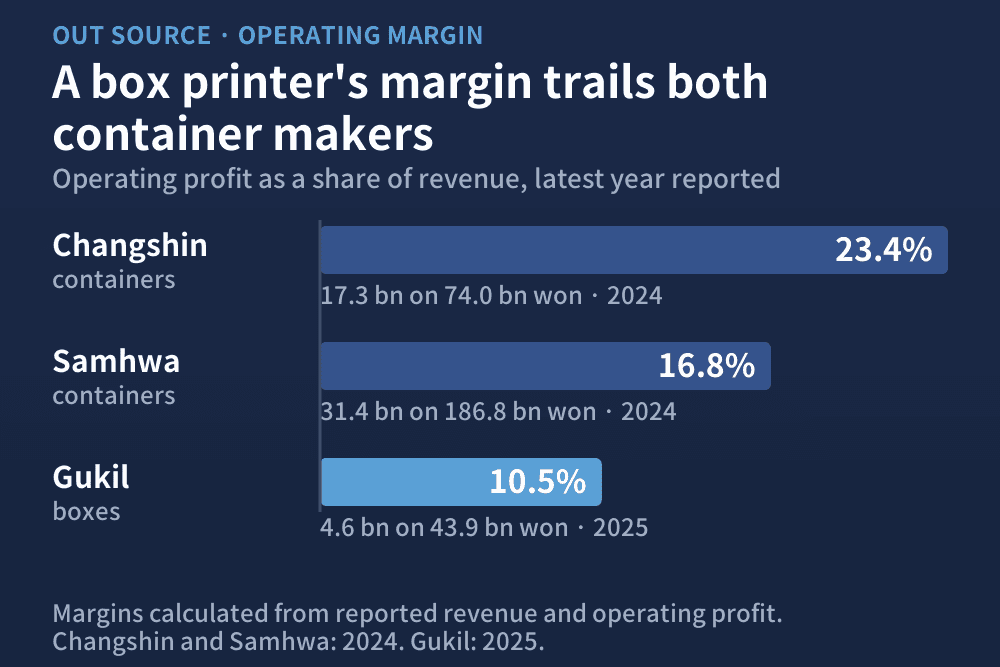
Gukil's 2025 revenue was 43.9 billion won (US$32.8 million), up more than 70 percent from 2022. Operating profit was 4.6 billion won (US$3.4 million), a margin near 10 percent. Over the past two years it spent about 5.8 billion won (US$4.3 million) replacing and expanding printing equipment. Conversions in this article use 1,336.85 won per US dollar, the November 11, 2026 rate.
Bankers put the value of 100 percent of the equity at 100 billion to 150 billion won (US$75 million to US$112 million). The founding family keeps part of its shares and stays in management.
Who owns Changshin, and what is a growth buyout?
Ark&Partners is a private equity firm founded in 2020 by two former VIG Partners executives. Its strategy is the growth buyout: take control of companies too large for venture capital and too small for the big buyout funds, then place operators from an in-house value creation group inside the portfolio company. Ark's CEO, Kim Seong-min, says the core of that strategy stays the same whether the target is a platform company or a manufacturer.
The record is concrete. Ark bought 47 percent of Remember in 2021 for 110 billion won (US$82 million) and sold it to EQT Partners in 2025 at a 540 billion won (US$404 million) valuation. Ark is now raising a second fund with a 400 billion won (US$299 million) target, has secured 40 billion won (US$30 million) from the IBK Growth M&A Fund, and aims it at growth companies valued at 200 billion won (US$150 million) or less. Gukil's valuation sits inside that band.
What did Ark buy in Changshin, and how fast is it growing?
Changshin was founded in 1988 and makes cosmetic containers. Its main customers are indie skincare brands, and it keeps adding overseas indie brands to a base of about 600 domestic and overseas clients. The plant is in Hwaseong, Gyeonggi: about 2,500 pyeong (roughly 8,260 square meters) with injection molding, post-processing and assembly under one roof, capacity of about 65 million units, and about 1,500 molds on hand.
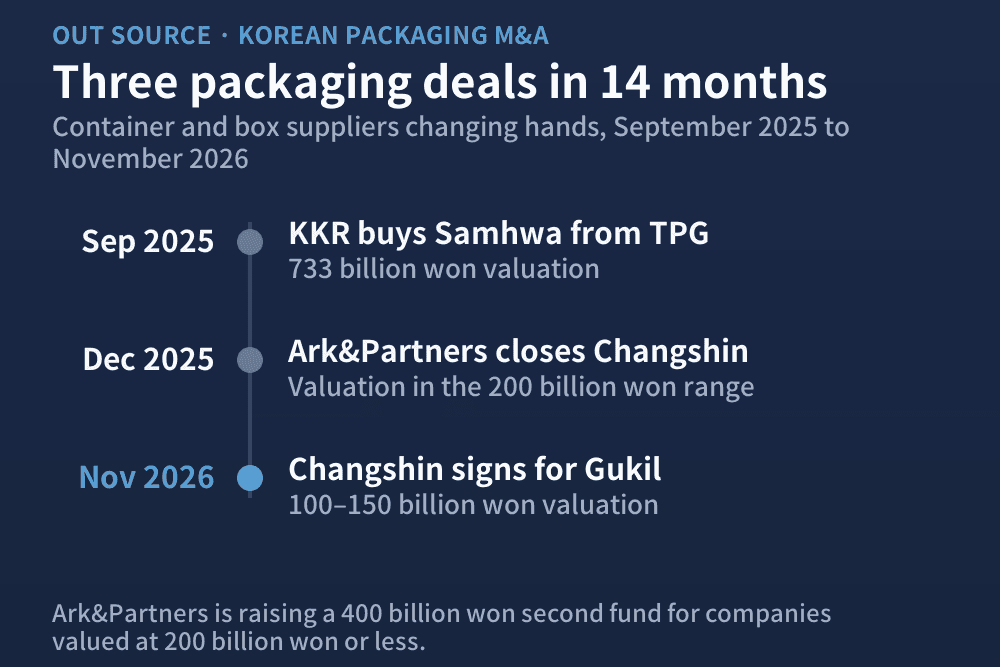
Revenue went from 48.1 billion won (US$36 million) in 2023 to 74 billion won (US$55.4 million) in 2024 and 75 billion won (US$56.1 million) in 2025. Operating profit was 17.3 billion won (US$13 million) in 2024 and 16.2 billion won (US$12 million) in 2025. Ark closed the purchase in December 2025 at a valuation in the 200 billion won range, roughly US$150 million. The year the owner changed was the year growth paused. In the first half of 2026, revenue rose more than 30 percent from a year earlier.
Why does a container maker buy a box maker?
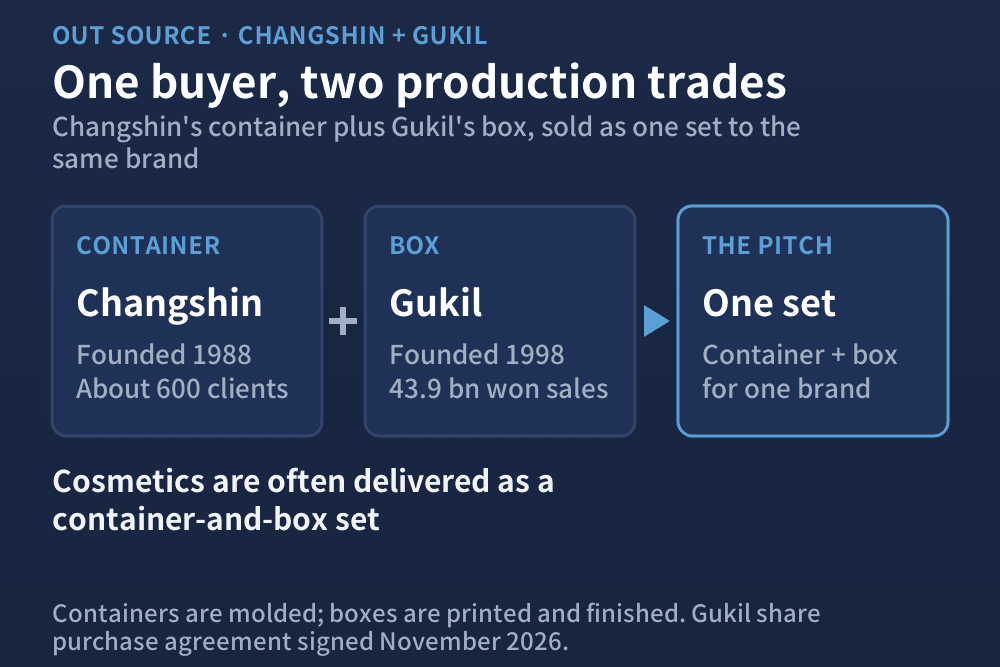
Cosmetics are often delivered as a container-and-box set, so a supplier that owns both can sell the pair to the same brand. Changshin's customers are indie brands. Gukil supplies the box side, with a sample-to-finishing line already built. The deal is a bolt-on acquisition: buying a company in the same industry to add capability to a platform already owned. The pattern also has a name in private equity, buy-and-build.
Two production trades sit behind one purchasing desk at the brand. A container is molded. A box is printed and finished. Different machines, different skills, one customer. Today the cross-selling is a sales thesis, not a result, and this article treats it as the structure of the deal.
What changes for a small brand that buys both from one supplier?
A small brand today sources the container from one factory and the box from another. That means two quotes, two production schedules, two quality checks, and a box that must fit a container made somewhere else. Under common ownership those become one counterpart.
The brand gains coordination. It gives up leverage. One supplier sets the price on both parts, and replacing one part means untangling the other. The brand's alternative to the set is another set supplier, not another box printer. For indie brands, the buyers Changshin names as its core, that is a structural change in how packaging is bought.
Is Gukil priced like a box printer or like a packaging leader?
In September 2025, KKR bought Samhwa from TPG at a valuation of 733 billion won (US$528 million at the time). Samhwa was founded in 1977, supplies more than 300 cosmetic brands, and earns about 60 percent of its sales from multinational clients. In 2024 it reported revenue of 186.8 billion won (US$140 million) and operating profit of 31.4 billion won (US$23 million).
Divide valuation by operating profit and the deals line up. Samhwa comes to about 23 times. Gukil, at 100 billion to 150 billion won (US$75 million to US$112 million) against 4.6 billion won (US$3.4 million), comes to roughly 22 to 33 times. A finisher with a 10 percent margin is priced in the same range as a packaging supplier with a 17 percent margin and a global client list.
What is Changshin trying to become?
In July 2026, Changshin described itself as the fifth-largest cosmetic packaging maker in Korea and a company moving toward a full-service platform: ODM (original design manufacturing, where a factory develops and produces a brand's product), branding, marketing and distribution. Growth comes through bolt-on stakes in same-sector companies. The CEO, Shin Geon-woo, spent 18 years at cosmetics ODM firms, starting at Kolmar Korea in 2007, and is the first professional manager appointed after the Ark purchase.
The targets are explicit. Changshin sets a 2030 revenue goal of 500 billion won (US$374 million), against 75 billion won (US$56 million) in 2025. Gukil's 43.9 billion won (US$32.8 million) of 2025 revenue equals about 58 percent of Changshin's. One bolt-on closes a large share of the distance between a container maker and a full-service platform.
Where does packaging consolidation leave each side of the table?
Manufacturers face a choice. Scale under a sponsor, as Samhwa did under KKR for multinational clients and Changshin is doing under Ark for indie brands, or stay independent and sell components to someone who did. Independent printers and mold shops now have a visible price reference. It is Gukil's.
Brands and buyers face a procurement change. The unit of purchase moves from component to set, and supplier diversification becomes a decision instead of a default. Investors face a rotation. Capital that chased brands in 2025 is buying the parts those brands cannot launch without.
Brands rotate. The container and the box do not. That is what private equity is buying.