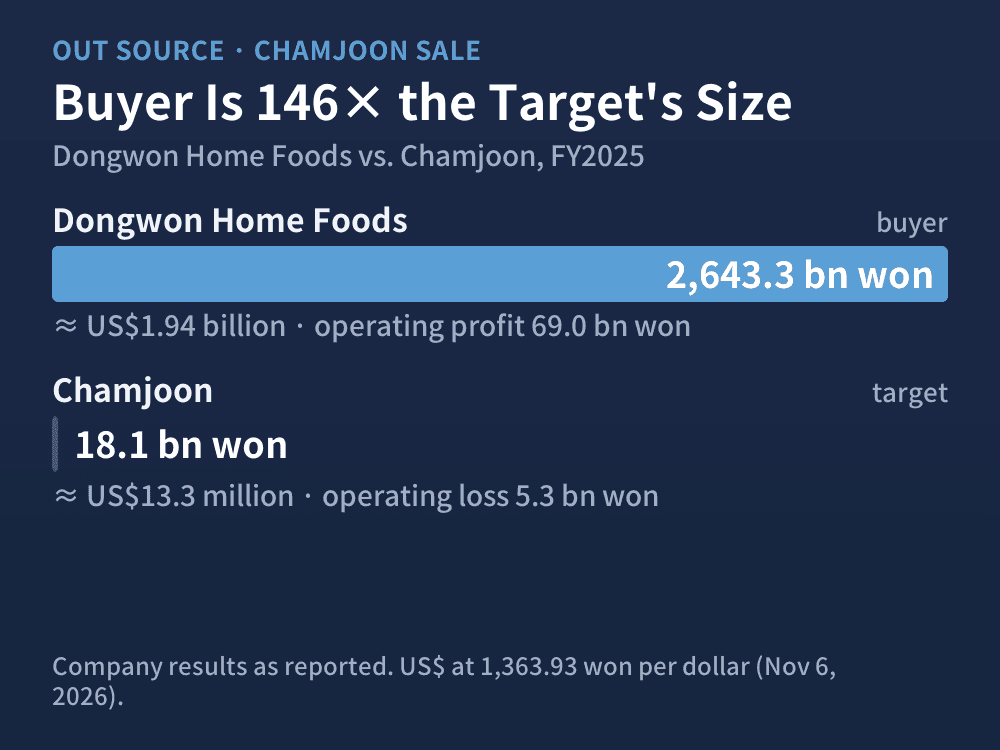
Chamjoon, a first-generation Korean cosmetics brand, filed for court-supervised rehabilitation on November 21, 2025. Its 2025 revenue was 18.1 billion won (US$13.3 million) against an operating loss of 5.3 billion won (US$3.9 million). Dongwon Home Foods, the preferred bidder, booked 2.64 trillion won (US$1.94 billion) in revenue and 69.0 billion won (US$50.6 million) in operating profit. The buyer is 146 times larger, so price is not the constraint. The gap is brand marketing, product planning and digital channels.
What has Dongwon actually won so far?
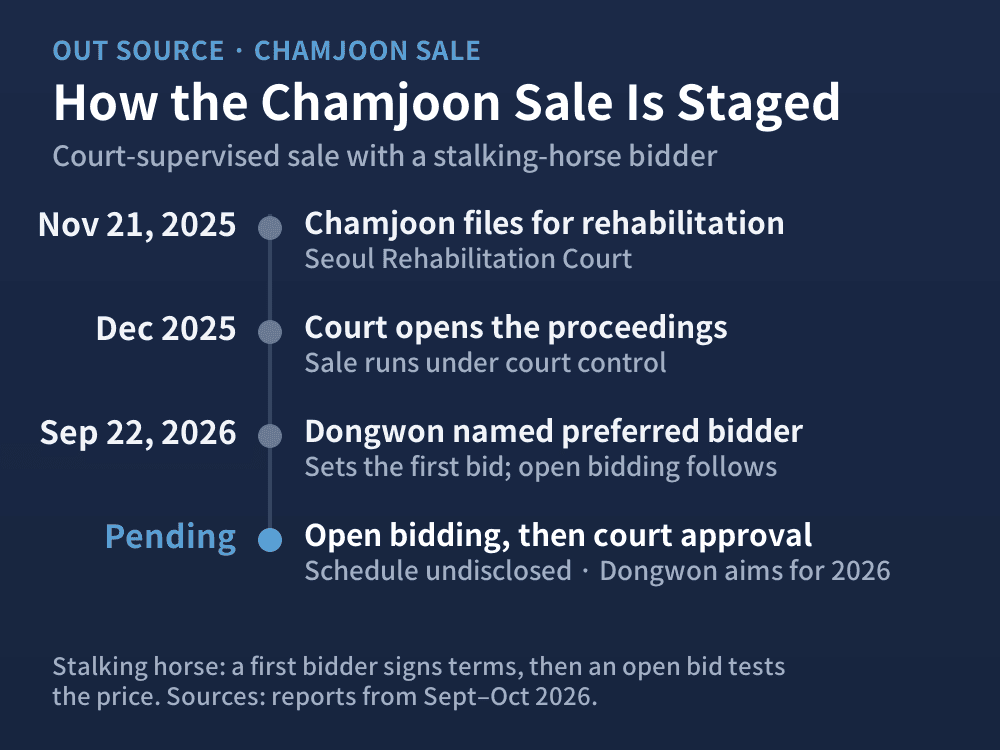
Dongwon Home Foods, the food-ingredient distribution affiliate of Dongwon Group, was named preferred bidder for Chamjoon on September 22, according to reports published at the end of that month. The structure is a stalking-horse sale: one bidder signs terms first, and an open public bid then tests whether anyone offers more. If no better offer arrives, the court approves the sale and the preferred bidder becomes the buyer.
None of that has happened yet. The public bidding schedule is undisclosed, and so is the purchase price. A Dongwon Group official confirmed that the group took part in the bidding but said nothing is finalized, and reports say Dongwon aims to complete the acquisition within 2026.
How did a top-three brand end up in court?
Chamjoon was founded in 1984 by the pharmacist Kim Kwang-seok and built its name on basic skincare and green-frog advertising. It launched a cleansing water in 1988, and reports at the time of its filing place it third in Korean cosmetics sales in the 1990s.
The decline ran through the 2010s. In 2015 Chamjoon failed to pay the balance on an Incheon Airport duty-free contract and forfeited a 10 billion won (US$7.3 million) deposit. It later sold Gangnam real estate to cover cash shortages, and operating losses ran for five consecutive years from 2020.
Chamjoon filed with the Seoul Rehabilitation Court on November 21, 2025, and the court opened proceedings in December 2025. Rehabilitation is a Korean court procedure in which a distressed company keeps operating while creditors vote on a repayment plan. Here the route out is a sale of the company.
What does the balance sheet say?
Chamjoon's revenue fell to 18.1 billion won (US$13.3 million) in 2025, roughly half its 2024 level. Its operating loss narrowed to 5.3 billion won (US$3.9 million) from nearly 15 billion won (US$11.0 million). Total assets stood at 22.3 billion won (US$16.4 million), and the equity deficit was about 35 billion won (US$25.7 million). That is full capital impairment: accumulated losses have erased all of the company's equity and the deficit is larger than its total assets. Dollar figures in this article use 1,363.93 won per dollar, the November 6, 2026 close.
The loss narrowed because costs fell faster than sales. Selling, general and administrative expenses (SG&A) dropped to 12.1 billion won (US$8.9 million), less than half the 2024 level, as revenue halved. The improvement comes from a shrinking business, not a growing one.
How big is the buyer next to the target?
Dongwon Home Foods reported 2.6433 trillion won (US$1.94 billion) in 2025 revenue and an operating profit of about 69 billion won (US$50.6 million). Chamjoon's revenue equals less than 1% of that. Chamjoon's operating loss equals about 8% of the buyer's operating profit. Affordability is not in question.
Dongwon Group started in fisheries and expanded into food, packaging and logistics. Its acquisition record sits in distribution: the livestock distributor Geumcheon in 2015, the logistics company Dongbu Express in 2017 and MKC in 2021, according to reports. Cosmetics would be added to fisheries, food, packaging and logistics as a new line.
What does a food group's infrastructure replace?
The reported synergies are in cost and logistics. Purchasing and manufacturing scale lower the cost of goods. Dongwon Systems has co-developed eco-friendly cosmetic packaging with Kolmar Korea, a cosmetics ODM, meaning an original design manufacturer that develops and produces products for other companies' brands. Dongwon F&B's direct-sales experience supports an online mall, and Dongwon Logis works with 96 partners in 27 countries, according to the reporting.
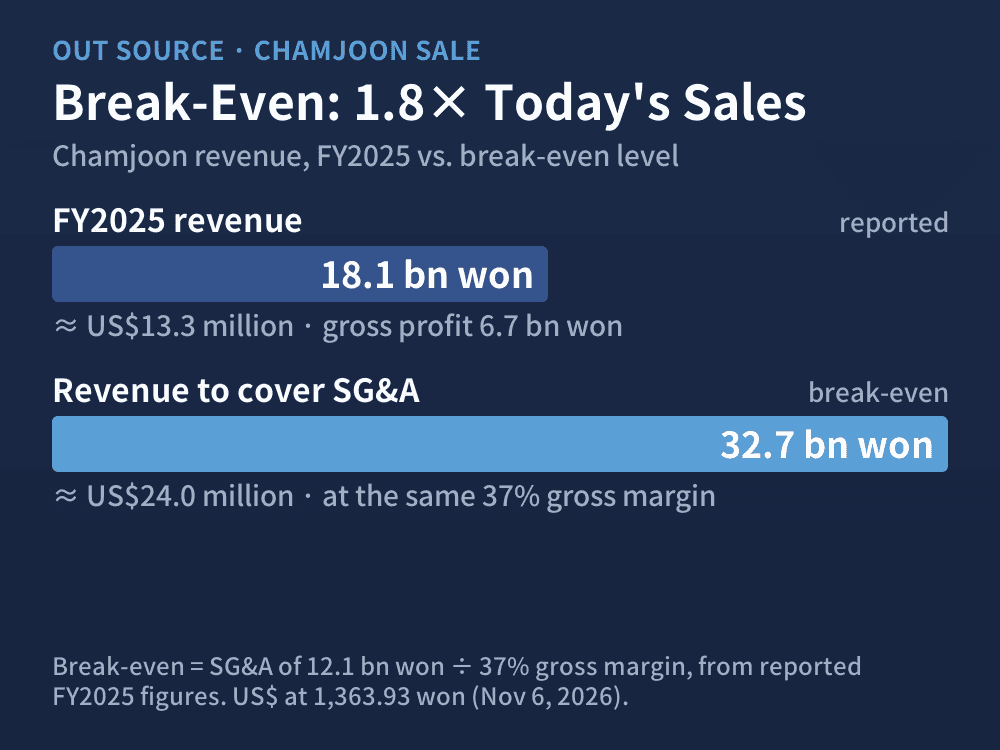
Those items address Chamjoon's 2025 cost structure. Cost of sales was 11.4 billion won (US$8.4 million) on 18.1 billion won (US$13.3 million) of revenue, which left a gross profit of 6.7 billion won (US$4.9 million), a 37% gross margin. The plants can also take outside work: analysts cited in the reports see the group extending Chamjoon's production lines into ODM, which requires sales and quality-control skills different from running an own-brand business.
What does it not replace?
Product planning, brand marketing, research and digital channels are the capabilities the reporting says Dongwon must add. Cosmetics trends turn faster than food and need heavier marketing spend. A first-generation brand needs product renewal and overseas marketing to benefit from export growth, and the core task is converting past recognition into current purchases. Korean cosmetics exports reached a record US$11.4 billion in 2025, up 11.8%, as cited in the reports.
The break-even arithmetic shows the size of that task. At the 2025 gross margin of 37%, covering SG&A of 12.1 billion won (US$8.9 million) takes about 32.7 billion won (US$24.0 million) of revenue (US$24.0 million), 1.8 times the 2025 figure. That is a calculation from reported figures, not a forecast of the buyer's plan.
Which routes are food groups taking into cosmetics?
Dongwon's purchase is one of four routes visible in the same reporting window.
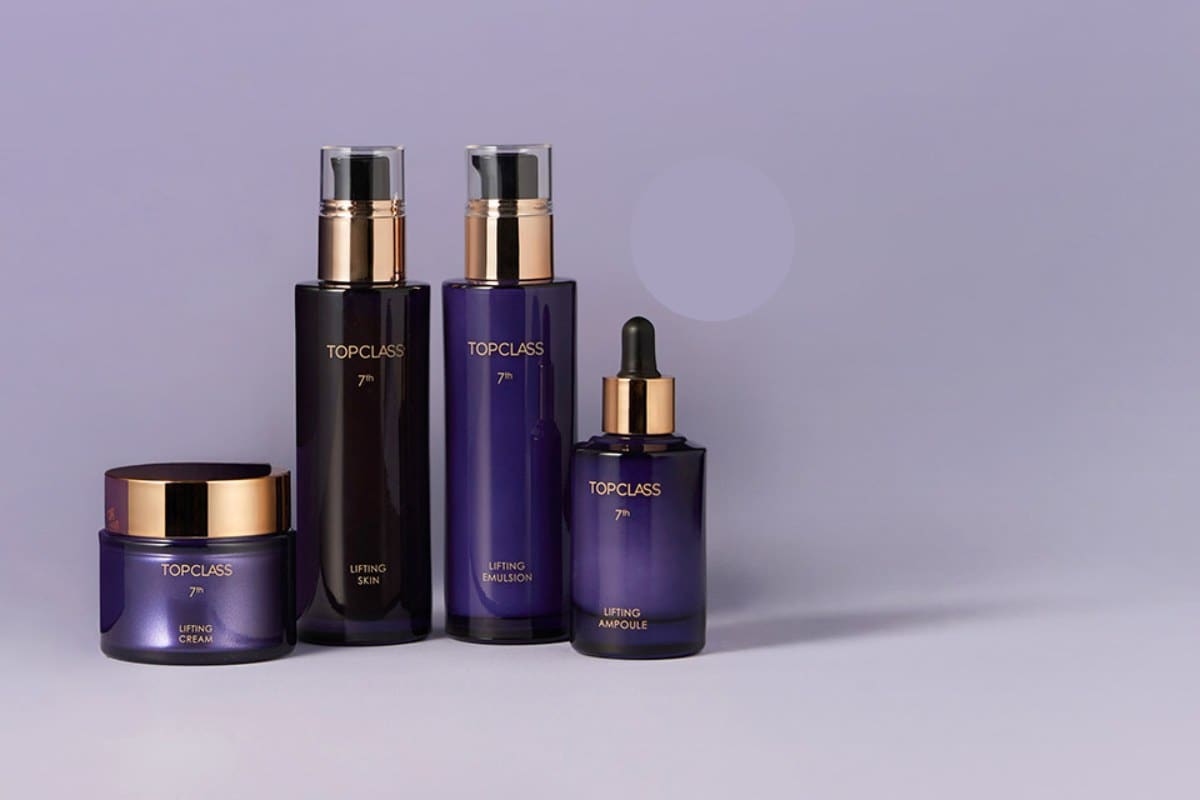
- Buy the plant and the name in court. Dongwon is bidding for Chamjoon, which reports credit with a production facility in Wonju and more than 40 years of basic skincare R&D.
- Build from your own ingredient. hy launched the IOCell brand with five skincare products built on HY7714, its in-house skin probiotic strain, which the Ministry of Food and Drug Safety has certified as an individually recognized functional ingredient. hy has sold HY7714-based ampoules and creams through its online mall since 2023.
- Take a stake or buy a manufacturer. Hite Jinro invested in Barum International, the operator of the vegan brand Dear Dahlia, through convertible bonds in April, in an amount not disclosed. A convertible bond is a loan that can convert into shares. Its affiliate Seoyoung E&T acquired the ODM B&B Korea in 2024.
- Add the license. Orion's affiliate Orion Jeju Volcanic Water added cosmetics manufacturing and sales to its business purpose in 2025.
Only Dongwon's route runs through a court sale, and the court sets the floor. A rehabilitation sale cannot pay creditors less than they would receive in liquidation, so the price starts from the value of the assets and not from the history of the brand.
What can still change the deal?
Three steps remain: open bidding, court approval and creditor approval of the rehabilitation plan. A better offer in the open bid replaces Dongwon. Secured creditors must approve the plan by at least three-quarters of the voting amount and unsecured creditors by at least two-thirds. Priority claims such as unpaid wages and severance remain unresolved.
The earlier record is thin. A June sale attempt drew three to four interested parties, including strategic investors, and none reached the final bid stage. Dongwon says it is the only bidder in the current round. Its earlier bids for larger targets, Hankook McDonald's, Boryung Bio Pharma and HMM, ended without a Dongwon win.
What does the deal say about who owns cosmetics capacity?
Three readings sit side by side.
- Manufacturing: plants and research teams are now bought by groups whose core business is food, packaging and logistics. A working production line is priced as a strategic asset, not as the leftover of a failed brand.
- Brands and buyers: a name built in the 1990s carried Chamjoon to a court sale but not past 18.1 billion won (US$13.3 million) in revenue. Recognition that is not converted into current purchases is priced at liquidation value.
- Regulation and capital: the court compresses the timeline. Filing came in November 2025 and a preferred bidder in September 2026. The open bid and the creditor vote decide the rest.
A food group can buy a plant in a courtroom. It cannot buy a customer there.