On September 1, 2026, Shiseido bought the 35% stake held by its joint venture partner in Shiseido Liyuan Cosmetics, the Chinese company behind the Aupres brand, and reached 100%. On November 17, 77 days later, it agreed to sell all of it to a group led by IDG Capital. The joint venture agreement expires in December, and the parties agreed not to renew it. The order of the steps is the point: a company with a partner attached is hard to sell, and a company with the partner removed is not.
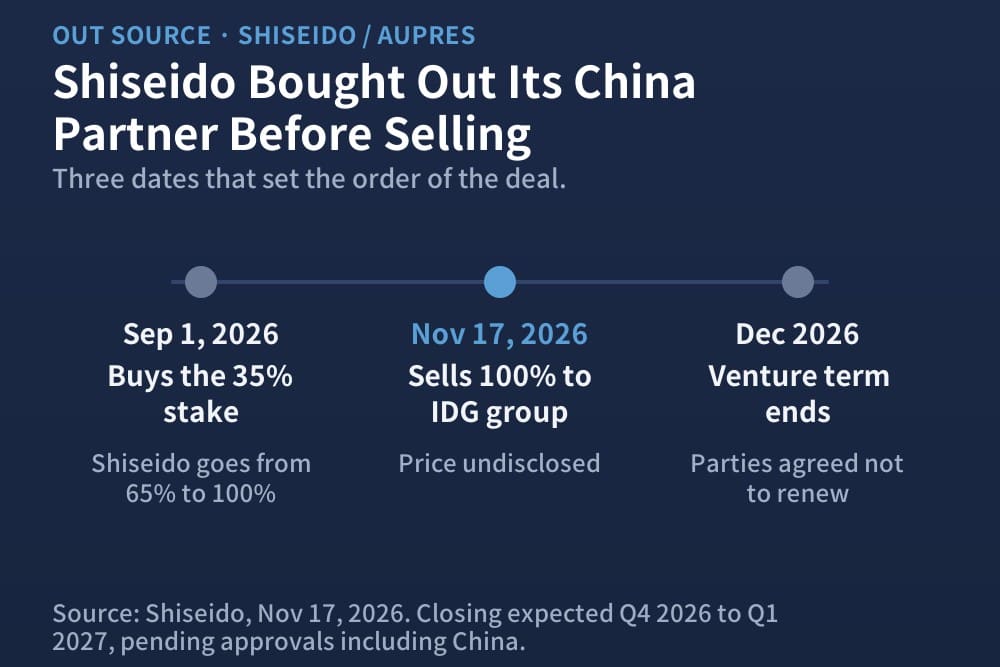
▲ Shiseido bought its partner's 35% on September 1, 2026, agreed to sell 100% on November 17, and the venture agreement ends in December.

▲ Shiseido developed and sold the China-exclusive AUPRES brand through Shiseido Liyuan Cosmetics. (Image: Shiseido)
What exactly did Shiseido sell?
Shiseido Liyuan Cosmetics, known as SLC, manufactures and markets Aupres, a skincare, sun care and makeup brand that Shiseido has sold only in China since 1994. The company was set up in 1991 as a joint venture with Beijing Liyuan. A joint venture is a company owned jointly by two parties. The release puts SLC's capital at RMB 94 million as of December 31, 2025.
Beijing Liyuan is a subsidiary of Yiqing Group, which is owned by the Beijing Municipal Government. The partner was a municipal state entity, and it sat next to Shiseido on the shareholder register for 35 years.
The sale covers SLC's Beijing factory and production equipment as well as the company itself. The buyers are funds managed by IDG Capital, which hold 95% through two special purpose vehicles, and a limited partnership formed mainly by SLC's new management team, which holds 5%. A special purpose vehicle is a company formed to hold a single investment.
Why did the buyout come before the sale?
Shiseido held 65% of SLC until September 1, 2026. On that day the group acquired the 35% held by Beijing Liyuan and took the company to 100%. Seventy-seven days later it announced the transfer of its entire stake.
A buyer of a majority stake in a joint venture buys a partner along with the company. The partner has board seats, a claim on profits and a voice on who owns the business next. A buyer of 100% buys the company and nothing else.
Buying out the partner first converted a shared company into a transferable one. The 35% purchase cost Shiseido money, and what it bought was a clean title. The title sat on Shiseido's books for 77 days before the sale was announced.
What does the December expiry decide?
The third joint venture agreement between the partners expires in December 2026. According to the release, the parties agreed not to renew it.
A fixed term puts a date on every decision around it. The buyout came three months before the expiry, and the sale announcement came about six weeks before it. Both steps line up with a venture that ends on a known day.
Closing is expected between the fourth quarter of 2026 and the first quarter of 2027, subject to regulatory approvals in the relevant countries and regions, including China.
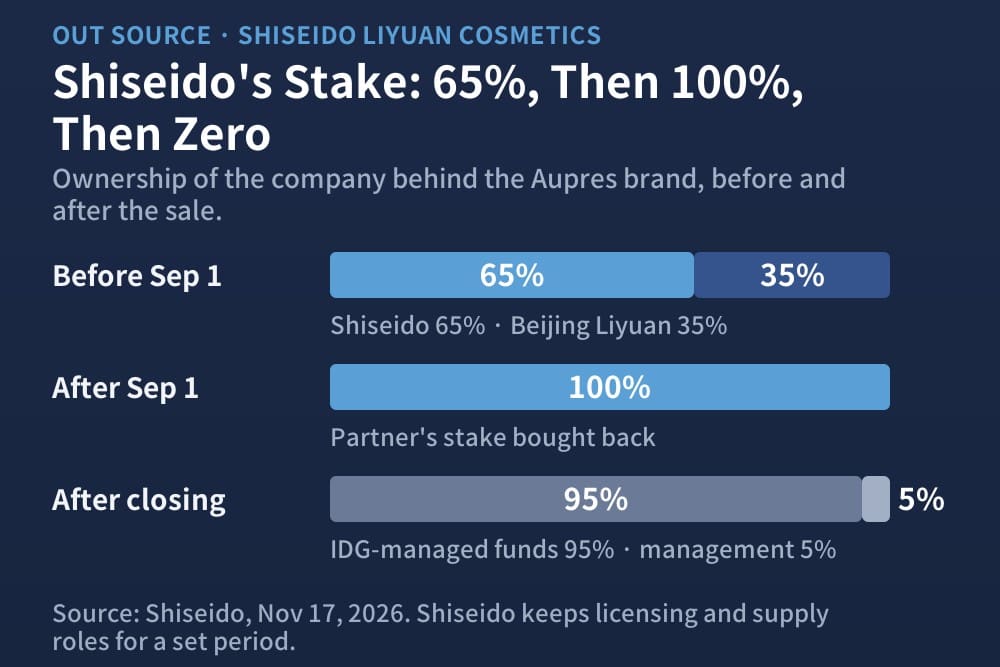
▲ Shiseido's stake in the Aupres company runs from 65% to 100% to zero, with IDG-managed funds taking 95% and management 5% at closing.
What does Shiseido keep after the sale?
Shiseido licenses the intellectual property rights that the business needs to operate. It supports new product development, provides technical assistance for the stable supply of existing products, and continues to supply raw materials and selected products. The support runs for a specified period after the transfer.
Shiseido leaves as owner and stays as licensor and supplier. Ownership of the company moves to IDG. The brand's intellectual property, raw materials and product development keep a Shiseido connection through the support period.
Aupres has been sold only in China, so a license with a single-market scope fits the asset. Shiseido describes China as a strategically important market, and the license keeps a route into it without the cost of ownership.
Who is on the other side of the table?
IDG Capital is a private equity firm, and funds it manages hold 95% of SLC after closing. The funds sit in two special purpose vehicles. With that majority, the brand's strategic decisions sit with the investor, while daily operations sit with the managers.
The other 5% sits in a limited partnership formed mainly by SLC's new management team. A management stake gives the operators of the business a share of the outcome from the first day under new ownership. The team that runs the brand also owns a piece of it.
Shiseido said the business is positioned to execute with agility as an independent brand under IDG's support and a management team with experience in beauty brand management. The buyer brings capital, and the managers bring operating continuity.
Why is Shiseido selling now?
Shiseido ties the sale to its 2030 medium-term strategy, which aims to improve profitability and capital efficiency. The company said it wants to concentrate management resources where its competitive advantage is greatest.
The business needs ongoing investment in product innovation and digital capabilities. Selling it moves that spending to an owner built to fund it, and it frees Shiseido's attention for its priority brands and higher-growth opportunities.
The company calls China strategically important and says the market is changing quickly. The sale narrows what Shiseido owns in China without removing Shiseido from the market. The licensing and supply ties keep the company present behind the brand while ownership sits elsewhere.
What happens between signing and closing?
The sale rests on a binding agreement, but ownership does not move until closing. Closing needs regulatory approvals in the relevant countries and regions, including China, and Shiseido expects it between the fourth quarter of 2026 and the first quarter of 2027.
Shiseido said the expected effect on its fiscal 2026 consolidated results is already included in the revised earnings forecast it announced on November 10, 2026. The revision came seven days before the sale announcement.
SLC stays a consolidated Shiseido subsidiary until closing, and the buyers hold no shares until then. The support commitments on licensing, development and supply run for a specified period after the transfer.
What does the sequence teach about ventures with an expiry date?
A venture with a fixed term runs on two clocks. The legal clock ends in December, when the agreement expires. The commercial clock decides who owns the brand after that date. The partners own the legal clock because the agreement binds both of them, and the buyer and the seller own the commercial clock because they set the terms of the transfer.
Shiseido used the months before expiry to move from partner to sole owner and then to seller. The partner's departure was the first event in the sequence, and the brand's departure was the second.
The structure also shows what an exiting owner can still hold: a license, a supply line and a development role. Those three ties outlast the equity.
What does the Aupres structure say about China exits?
Brand owners read the expiry date of a venture as the start of the sale process, not the end of the contract. The partner's stake is the first asset to clean up, and the buyer's price depends on how clean it is.
Buyers read the license and supply terms as the continuity plan. Capital arrives with a new management team, and the former owner's support keeps the product pipeline running during the handover.
Local partners read the same terms as a closing window. A partner with a stake and a fixed term holds its most valuable position before the term ends.
The partner left first. The brand left second. The license stays.