Church & Dwight is paying about US$225 million for 45% of BALI Treatment GmbH, the company behind the curl-care brands BALI CURLS and BALI GENTS. BALI was founded in 2022 and reported about US$100 million in net sales for the twelve months ended October 31, 2026. The other 55% is not in the purchase; Church & Dwight can buy it starting two years after closing. A minority stake reads as a buyer that stopped short. This one is a first installment, and the contract already names the second.
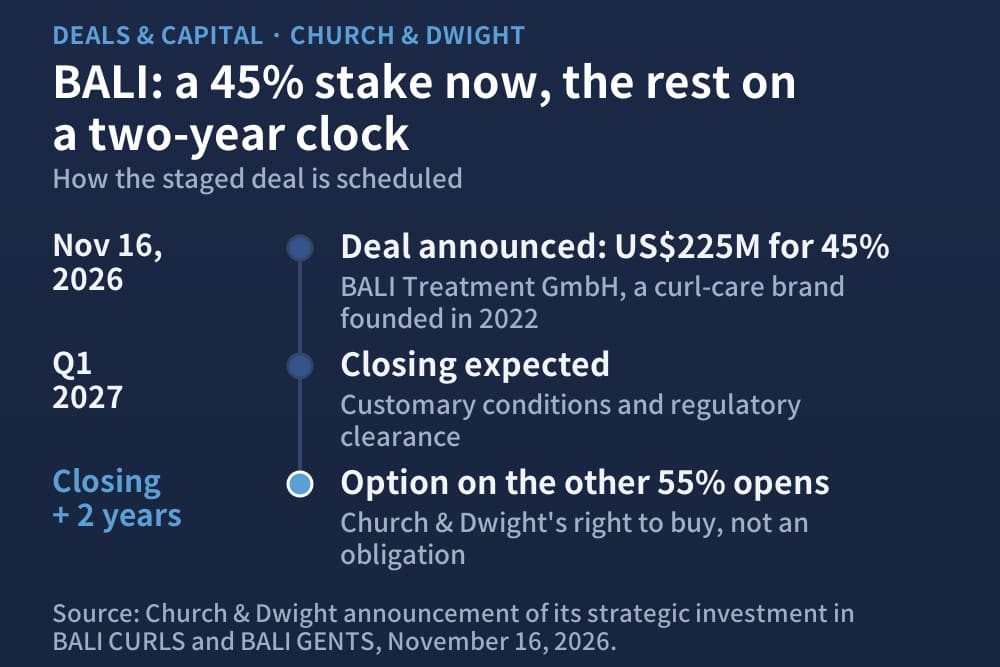
▲ Church & Dwight pays about US$225 million for 45% of BALI and can buy the remaining 55% starting two years after closing.
What exactly did Church & Dwight sign?
Church & Dwight signed a definitive agreement to acquire 45% of the shares of BALI Treatment GmbH for about US$225 million. Closing is expected in the first quarter of 2027, subject to customary closing conditions and regulatory clearance.
The second step sits in the same agreement. Church & Dwight can acquire the other 55% starting two years after closing, which puts the earliest second step in the first quarter of 2029 on the announced schedule. The company expects the investment to be accretive to cash earnings in 2027, after acquisition-related expenses and interest expense. The first 45% is built to add to earnings before the second decision arrives.
What did BALI build in four years?
Hendrik Genotte founded the business in 2022 to make hair care and styling products for curly and textured hair. For the twelve months ended October 31, 2026, net sales came to about US$100 million, a nine-figure business within five years of its founding.
Church & Dwight describes market-leading positions in Germany and Austria, with expansion across Europe underway. BALI's own online store lists drugstore and supermarket partners including dm, Rossmann, Müller, Edeka, Kaufland and Kruidvat, and the brand presents BALI CURLS as high-quality curl care at an accessible price. A brand sold on mass-retail shelves grows along the footprint of its retail partners.
Rick Dierker, Church & Dwight's CEO, put the limit plainly: distribution today is concentrated in a limited number of European markets. The US$100 million is a regional number, and the deal is built around the gap between that region and everywhere else.
Why does a curl-care brand carry that much weight?
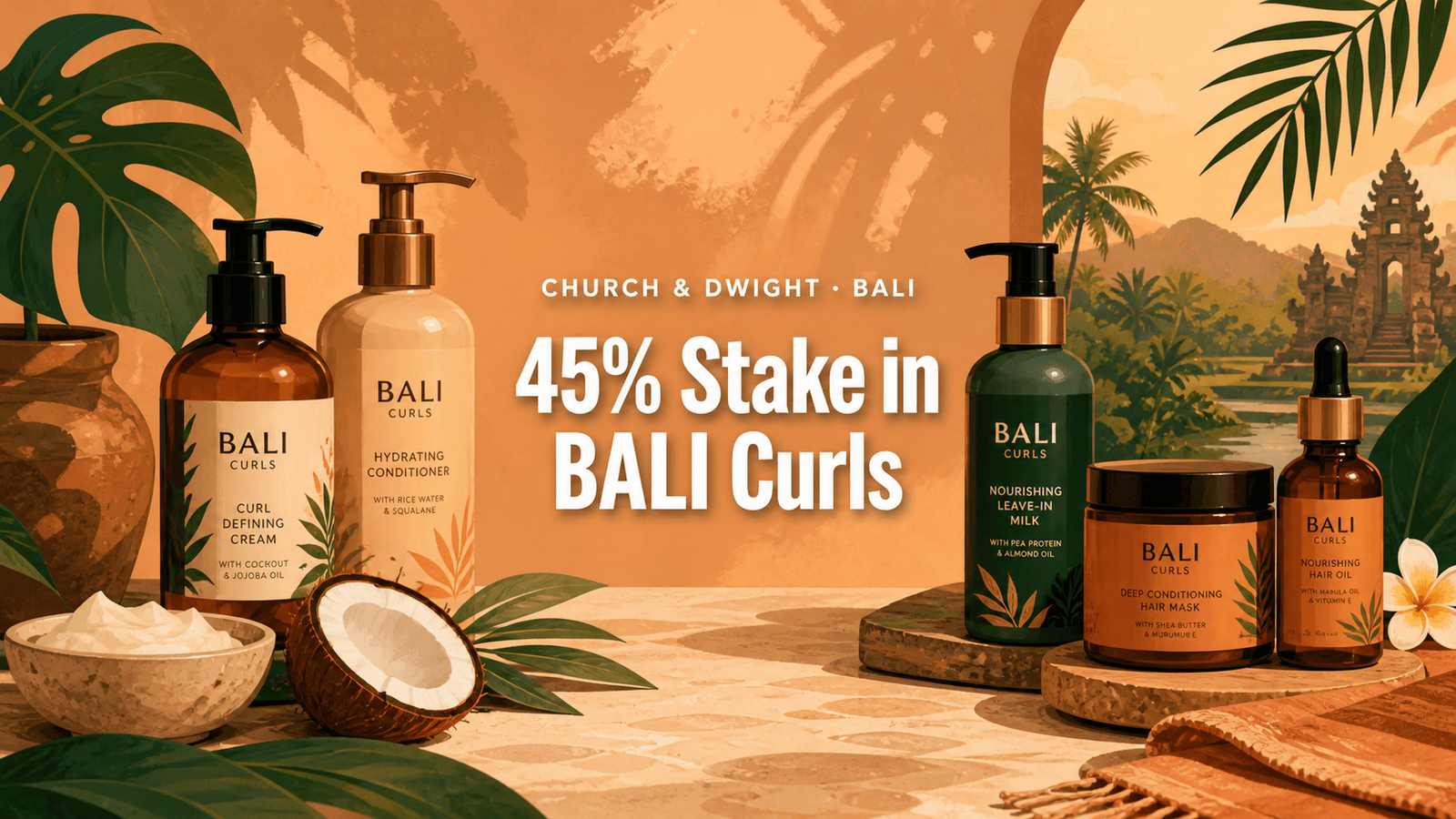
▲ BALI CURLS product lineup as Church & Dwight acquires a 45% strategic stake. Photo: Bali Care / Church & Dwight
Genotte said the business grew from his own experience with curly hair. The definition is narrow by design. BALI CURLS covers treatments, washes, creams and serums for curls, and BALI GENTS extends the company into men's grooming.
A narrow customer definition gives a brand a category it can lead. Church & Dwight's acquisition checklist asks for a number one or number two position in a category, and the fastest way to be first is to define the category around a customer nobody else serves with this much focus. In Germany and Austria, BALI has done that.
Why buy 45% first?
The two halves of the structure pay for different things. The first 45% buys a share of a brand that already sells about US$100 million a year. The option on the 55% buys the right to own the outcome of the next two years, the years in which BALI is supposed to leave its home footprint.
Dierker said Church & Dwight will use its global capabilities to extend the BALI brands beyond the European markets where they are concentrated, and described the investment as a step in the company's strategy to accelerate international growth. Genotte called the arrangement a partnership. The capital is the smaller contribution. The larger one is distribution that BALI does not have.
A buyer that expects distribution to create the value does not need to own the whole company to start delivering it. It needs a stake large enough to matter and a clause that lets it buy the rest once the delivery shows.
What does the two-year clock do for each side?
On the announced schedule, closing falls in the first quarter of 2027 and the option opens two years later. In between, BALI trades for two full years with Church & Dwight as a 45% shareholder, in whatever new markets that partnership opens.
A call option is the right, without the obligation, to buy at a later date. Church & Dwight holds that right and does not owe the second purchase. After two years of results in new markets, it chooses with data in hand. The owners of the other 55% have those same two years of results to set against whatever the second step is worth.
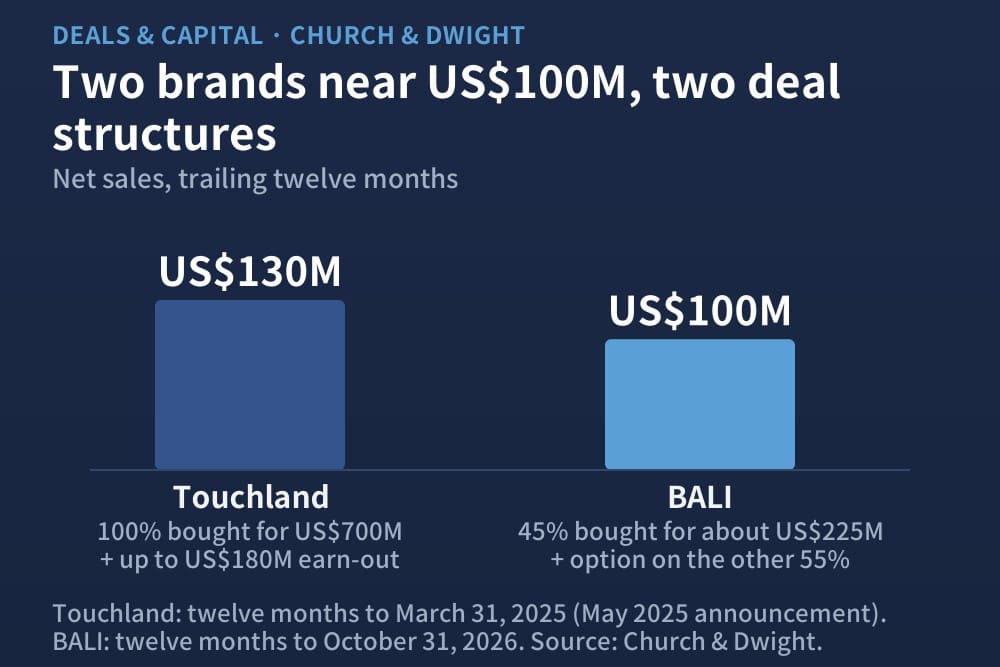
▲ BALI is bought in parts at about US$100 million in net sales; Touchland was bought whole at about US$130 million, with an earn-out of up to US$180 million.
How does BALI compare with Touchland?
In May 2025, Church & Dwight agreed to acquire the Touchland brand for US$700 million at closing, paid in cash and restricted stock, plus an earn-out of up to US$180 million tied to Touchland's 2025 net sales. Touchland's trailing twelve-month net sales were about US$130 million through March 31, 2025, and Dierker called it Church & Dwight's eighth power brand.
BALI sits in the same size class, at about US$100 million, and gets a different structure: 45% now, an option later. Touchland was bought whole, with part of the price held back against performance. BALI is bought in parts, with the later part held back against time. Both contracts convert uncertainty about a young brand's coming year into a term of the deal.
What is on Church & Dwight's checklist?
Church & Dwight's stated criteria for acquisitions are a brand that is first or second in its category, asset-light, and accretive to growth and gross margin. Asset-light describes a business that owns little heavy infrastructure, such as factories, and relies on partners for production.
Dierker described BALI as a high-performing, asset-light consumer brand with strong category leadership, and said the company's balance sheet leaves room for more acquisitions. In 2025 Church & Dwight sold its VitaFusion and L'il Critters vitamin brands to concentrate on its power brands. The portfolio rule runs in both directions: exit categories where the company is not a leader, and buy brands that are.
Why do drugstore-built brands attract staged deals?
A brand that sells through drugstore and supermarket chains expands one retailer at a time. Each new country means a new set of listings, and a listing is something a distribution partner either wins or does not. That makes the buyer's contribution measurable in a way that a formula or a social following is not.
A staged deal turns that measurement into a contract. The partner commits capital now and decides on the rest after the listings show up or do not. For the brand's owners, the structure shares the risk of the next two years with a partner that carries more weight with retailers than a single brand does. For the buyer, it replaces a forecast with a record.
What does the structure say to the rest of the market?
Forty-five percent for about US$225 million with an option attached is a template. Strategic buyers can enter a young brand at the point where revenue is proven and geography is not, and brands near US$100 million in sales can sell the first part of the company without selling the whole of the decision.
Church & Dwight pays for what BALI has already sold and keeps the right to pay for what it has yet to sell. The first payment is cash. The second is a decision, and it opens two years after closing.