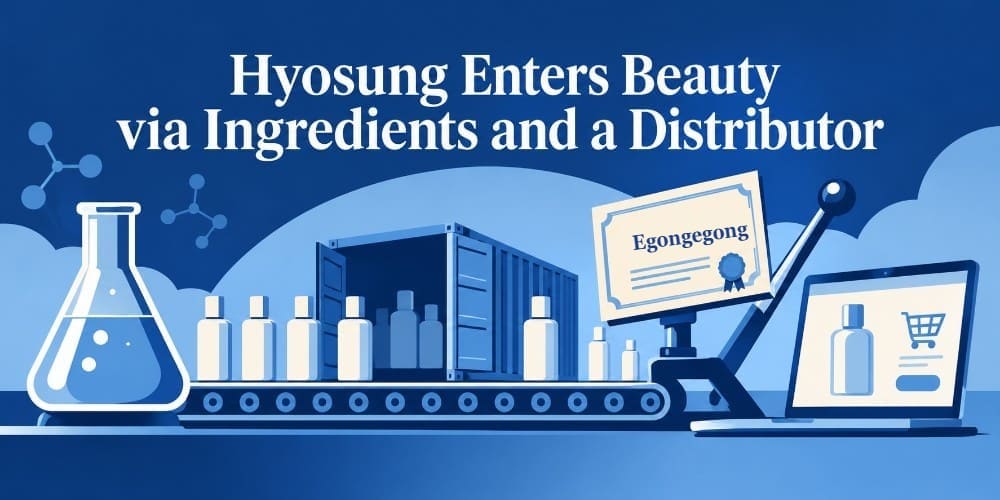
Hyosung Corp., the holding company of a Korean industrial group, committed 30 billion won (US$22.4 million) in convertible bonds to Egongegong, a distributor of Korean beauty brands on Amazon and other U.S. platforms. Its venture arm backed an ingredient maker and a skin-data company, and a 50 billion won (US$37.3 million) beauty fund is in preparation. None of those holdings is a brand. Hyosung's route into beauty runs through the pipes that carry other companies' labels, and the bond keeps every next step open.
What has Hyosung actually bought in beauty?
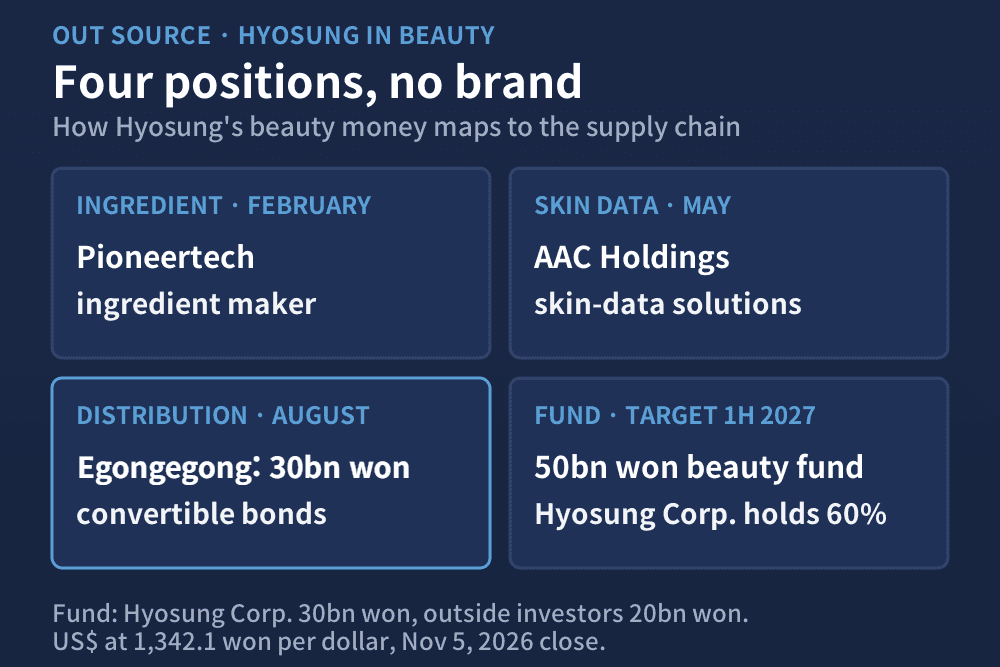
In August 2026, Hyosung Corp. committed 30 billion won (US$22.4 million) to the pre-IPO funding round of Egongegong, a Korean company that sells Korean beauty brands on Amazon and other U.S. e-commerce platforms. The money comes as convertible bonds, loans that the holder can later convert into shares.
Hyosung Ventures, the group's corporate venture capital arm (CVC), set up in 2022, holds the other positions. On May 12 it invested in AAC Holdings, a company that analyzes customer data such as skin condition and lifestyle habits to design personalized medical and beauty solutions. In February it invested in Pioneertech, a maker of functional cosmetic ingredients.
A beauty fund of 50 billion won (US$37.3 million) is in preparation. Hyosung Corp. would put in 60%, or 30 billion won (US$22.4 million), and outside investors the remaining 20 billion won (US$14.9 million). Formation is targeted for the first half of 2027, and recruitment of investors is under way. Dollar conversions here use 1,342.1 won per dollar, the Seoul closing rate on November 5, 2026.
Why does the list contain no brand?
Every item on it sits upstream of, or beside, many brands. An ingredient maker sells to whichever label wins. A skin-data company sells analysis to whichever label wants it. A distributor moves whichever label a U.S. platform will carry. Hyosung earns when any of them succeeds.
A brand purchase concentrates risk the other way. It buys one story, one product range and one founder's judgment, and the return depends on all three. The three holdings Hyosung chose are bets on the category's volume, not on a winner.
Pioneertech's reported customers are premium Korean brands, and the company is pursuing private-label business in China and Southeast Asia. The ingredient position earns from brands at home and from private-label work abroad, two sources of demand that do not depend on the same label.
What kind of company is Egongegong?
Egongegong was founded in 2019. It screens Korean beauty products in-house and distributes them to overseas platforms, mainly in the United States. A 2025 report on its IPO preparations said more than 200 brands had reached overseas markets through the company, and named Gahi, It's Skin and Laneige among its North American successes.
Its revenue grew from 2.7 billion won (US$2.0 million) in 2021 to 46.9 billion won (US$34.9 million) in 2024 and 85 billion won (US$63.3 million) in 2025. A report put first-quarter 2026 revenue at about 40 billion won (US$29.8 million) and described the quarter as the first profitable one. Egongegong also operates a brand accelerator and a private label, Kieró, aimed at Latin America.
In July 2025 it raised 37 billion won (US$27.6 million) from venture investors including Korea Investment Partners, Laguna Investment, Smilegate Investment and Lotte Ventures, and picked Korea Investment & Securities as lead underwriter for an IPO. Hyosung entered a company that already had an IPO track.
Why a convertible bond and not shares?
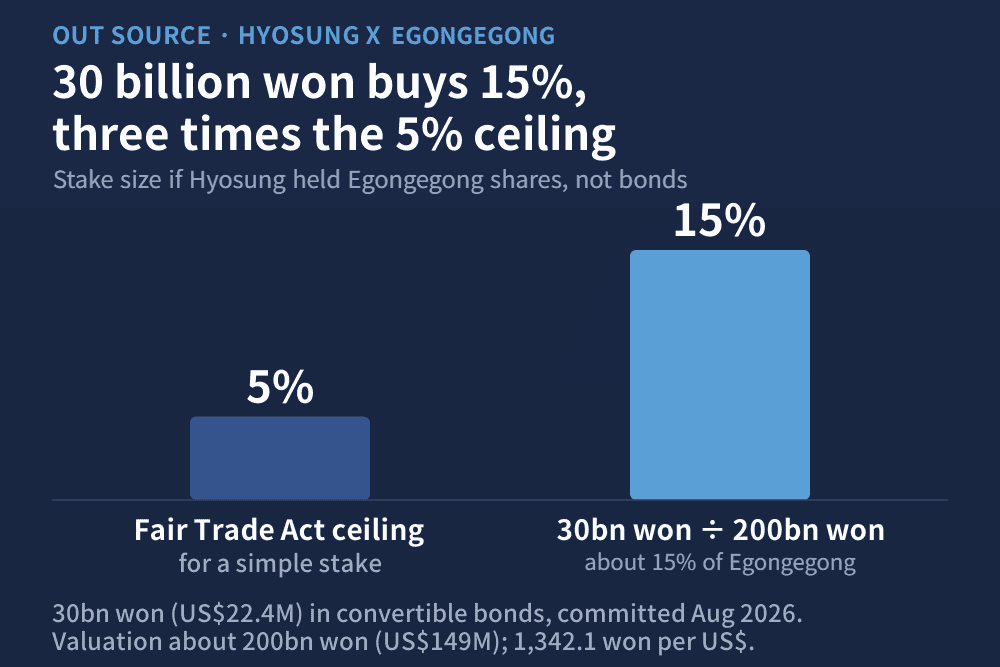
Korea's Fair Trade Act restricts a holding company that invests as a simple financial investor to no more than 5% of another company's issued shares, according to the report on the deal. Thirty billion won (US$22.4 million) buys roughly 15% of a company valued at about 200 billion won (US$149 million). That is three times the ceiling.
A convertible bond postpones the problem. Until conversion, Hyosung is a lender, and a lender holds no shares. The reported paths after that are conversion into common stock, additional investment, or bringing Egongegong into the group as an affiliate. Hyosung plans to watch the IPO's progress before choosing.
The structure also prices the option. A bond that is not converted is repaid like a loan. A bond that is converted becomes equity at the price agreed in advance. Hyosung pays for the right to decide after the IPO, when the listing market has set a value.
Why does Amazon distribution matter to an industrial group?
Egongegong is a channel into U.S. e-commerce, with about 90 distribution channels in the United States according to the report. The chain from ingredient to consumer has four links: an ingredient supplier, a brand, a distributor and a platform. Hyosung holds a position at the ingredient end through Pioneertech, which holds patents on an ingredient that improves skin delivery and supplies premium Korean brands, and at the distribution end through Egongegong.
The brand sits in the middle of that chain. It is the one link Hyosung does not own, and it is the link that decides which ingredients get used and which products ship. Positions at both ends put the group in front of orders from both directions without the product risk of the middle.
What does the 50 billion won fund add?
A fund turns individual deals into a portfolio. Hyosung Corp.'s 30 billion won (US$22.4 million) commitment equals the size of its Egongegong bond, and outside capital of 20 billion won (US$14.9 million) brings other investors into the same thesis. A portfolio gives the group a standing pipeline instead of a string of one-off bets.
Industry sources describe a pipeline of candidates for group-level investments and acquisitions, with control of a cosmetics company among the options. A 50 billion won (US$37.3 million) fund fits minority positions. A control deal for a cosmetics company needs more capital than that.
The timing sets the order of events. The ingredient stake came in February, the skin-data stake in May, the Egongegong bond in August, and the fund is in preparation now. The sequence runs from the supply end toward the market end, one layer at a time.
What does the structure leave Hyosung free to do?
Every position is small or contingent. The bond can be repaid or converted. The fund has not yet closed. None of them obliges Hyosung to run a brand, build a factory or carry inventory.
That is the cheapest way for an outsider to learn a category. Positions across the chain show which ingredients get ordered, which brands get distributed and which U.S. channels respond. The next decision, whether to buy a brand, a manufacturer or nothing, gets made with that information in hand.
What does the Hyosung route mean for the rest of the industry?
Brand buyers pay for a story. Pipe buyers get paid when any story works. Capital from outside beauty is entering at the layer where volume accumulates, not at the layer where taste is tested.
For a distributor, a strategic investor's convertible bond brings capital and a future shareholder without an immediate change in ownership. For an ingredient maker, Hyosung is an investor that also holds a stake in a channel. For brands, the lesson is simpler: the companies around them are being bought as infrastructure, while the brand remains the one link priced as a bet.