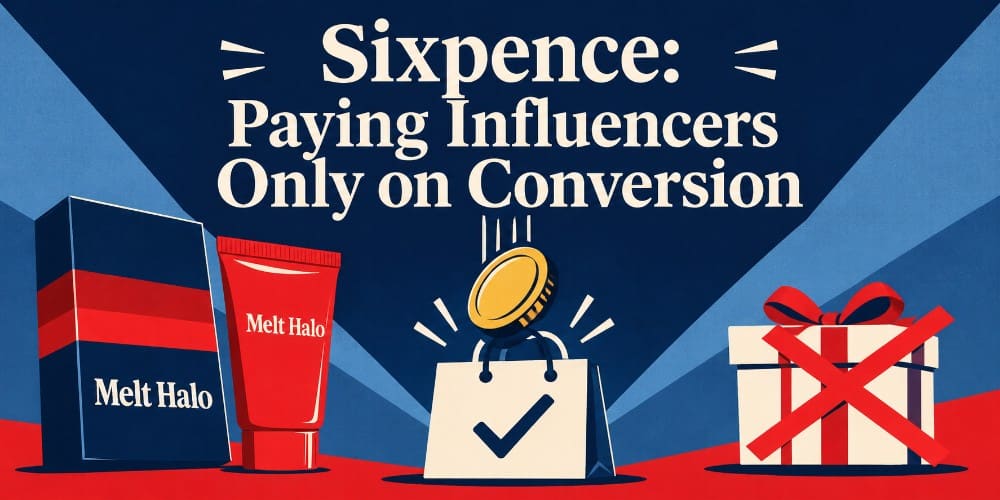
On August 6, 2026, Sixpence, a K-beauty brand led by a former chief marketing officer of Round Lab, announced a seed round of 2 billion won, about US$1.5 million at 1,335 won per dollar on November 16, 2026. The notable line is not the amount but the marketing budget the brand does not spend. Sixpence sends no free product to influencers in exchange for posts. It pays a commission when a post produces a sale, and it reads conversion and repurchase rates as its product roadmap.
What did Sixpence announce on August 6, 2026?
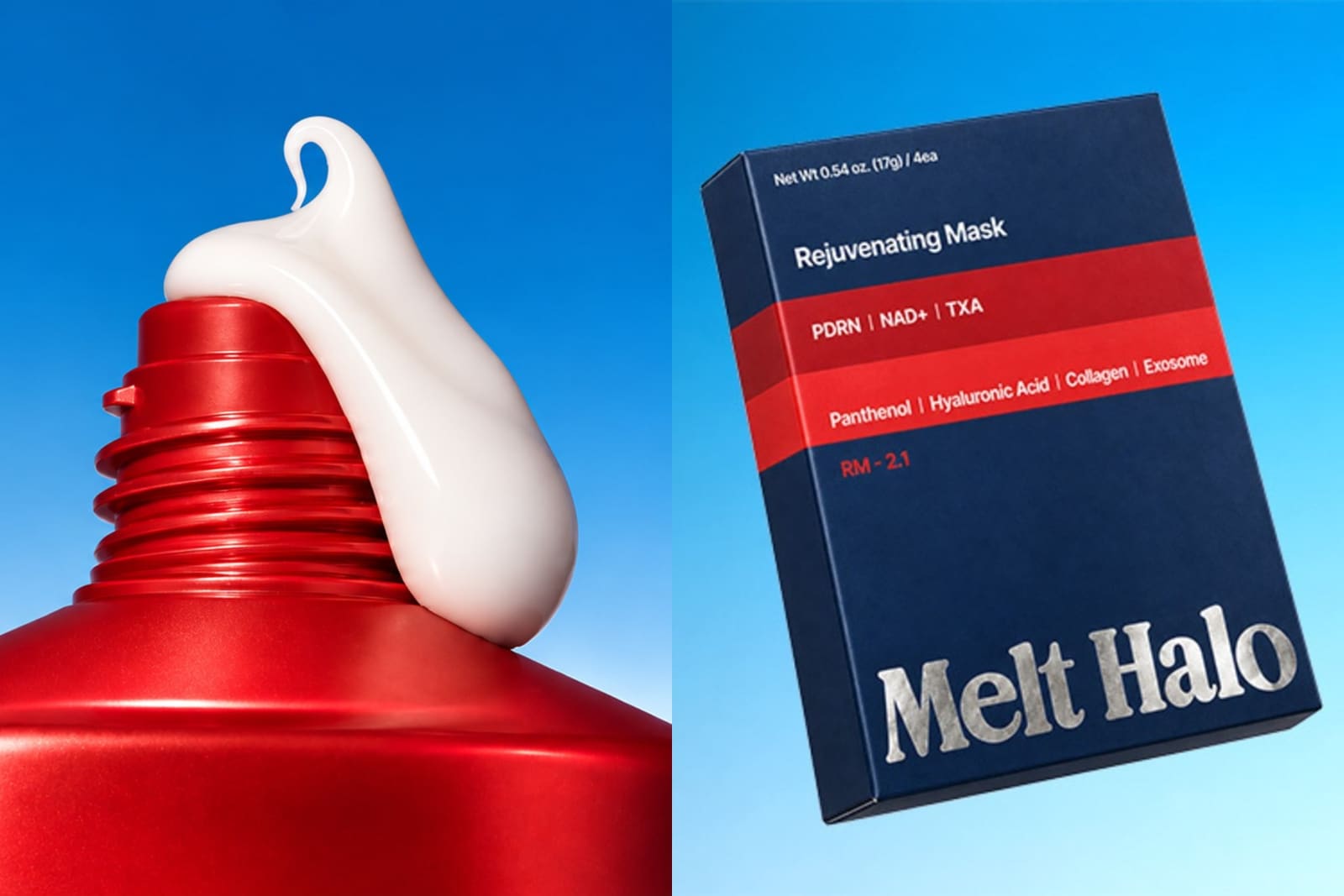
Sixpence raised a seed round of 2 billion won, led by Kakao Ventures, with Amorepacific as a strategic investor and K2 Investment as a co-investor. The brand's flagship line is Melt Halo, which it is using to test early market response before expanding the lineup. The funds go to brand competitiveness and global marketing.
Chief executive Hong Jin-seok started at LG Household & Health Care, then led marketing and domestic e-commerce at Mediheal, and later served as chief marketing officer and head of global B2C channels at Round Lab. A senior investment manager at Kakao Ventures, Ahn Hye-won, pointed to the team's experience at both large beauty companies and indie brands, and to its use of influencer channels to test market response quickly.
What is seeding, and what does it cost a brand?
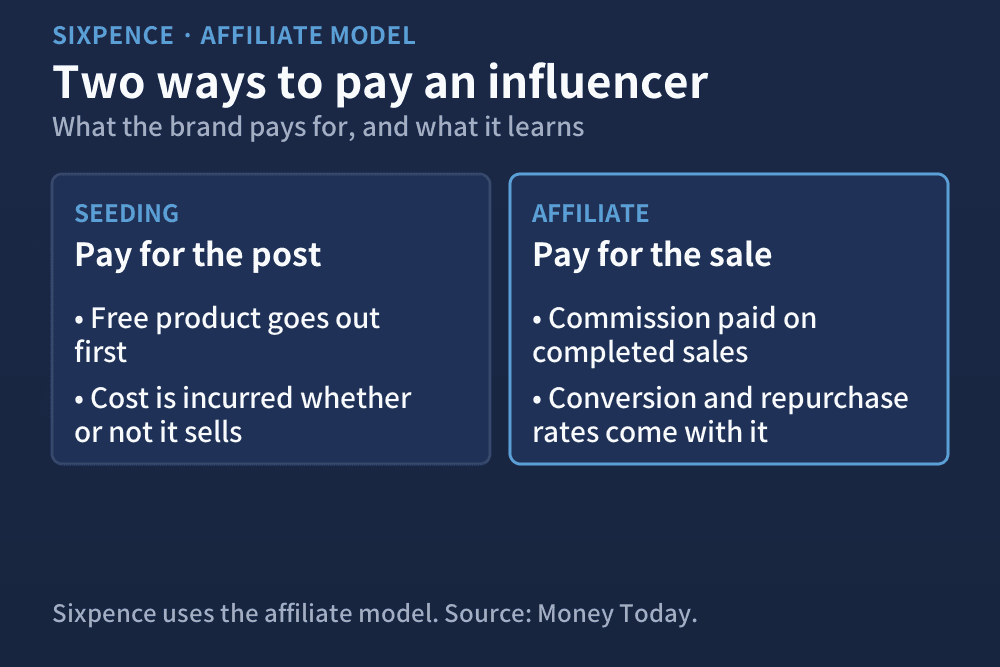
Seeding is the practice of sending free product to influencers in the hope that they post about it. The brand pays in product, shipping and the staff time to manage the program, and it pays whether or not any post produces a sale. Seeding buys exposure, and exposure is a cost that is fixed before the result is known.
That fixed cost favors brands with room to absorb misses. A seeded product that produces nothing is a sunk expense, and the brand learns what failed only through impressions, a count of how many times a post was shown, which says little about who bought.
How does an affiliate model change the economics?
Affiliate marketing pays a commission when a sale is traced to a partner's link or code. Social selling applies the same idea to creators on social platforms. Sixpence uses both and ties compensation to sales instead of posts.
The change is where the risk sits. Under seeding the brand carries the risk that content fails. Under an affiliate model the creator carries it, because a post that does not convert earns nothing. A commission is a cost that exists only when revenue exists, which turns marketing from a budget line into a share of sales.
Cash timing changes too. A commission is paid after the sale, so the brand's marketing outlay follows its cash inflow instead of preceding it. A brand that seeds spends before it earns, and a brand that pays commission spends after.
The model also changes who participates. A creator who expects a payout from sales chooses products by whether they will sell, so the brand's roster of creators filters itself toward audiences that buy.
Why does conversion data matter more than reach?
A conversion rate is the share of people who see an offer and buy. A repurchase rate is the share of buyers who buy again. Sixpence uses these two numbers, not follower counts or views, to pursue product-market fit, the point at which a product sells repeatedly to a defined group of buyers.
Reach measures attention, and attention is cheap to rent. Conversion measures a decision and repurchase measures satisfaction, and both are expensive to fake. A brand that reads those two numbers learns which creator, which message and which product earn a second order.
How does a sale become a product decision?
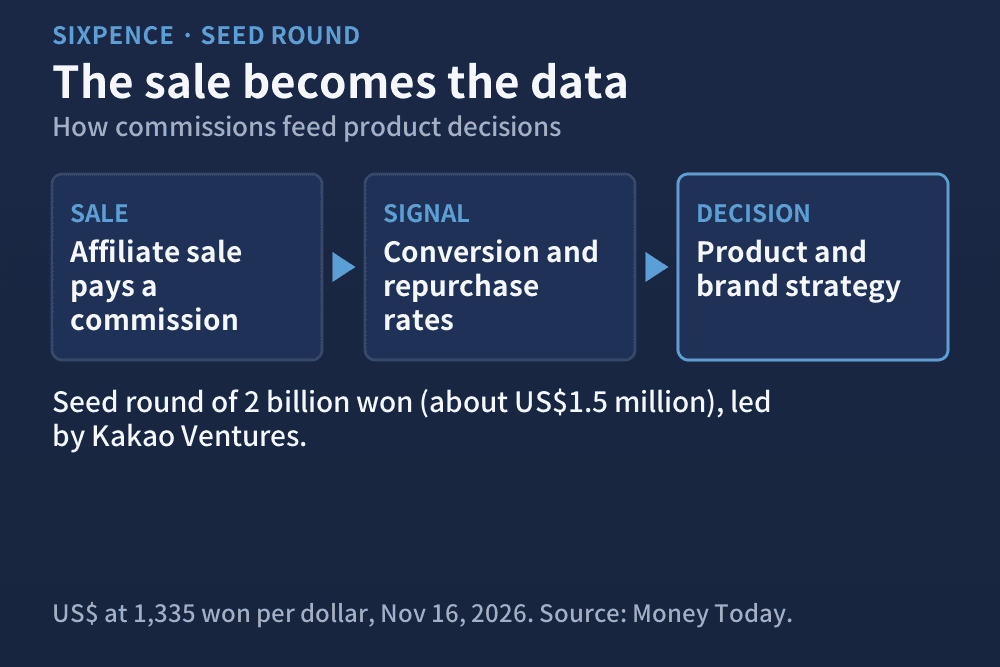
The loop has three steps. An affiliate sale pays a commission. The sale leaves a record of conversion and repurchase. The record feeds decisions about the product and the brand. The brand pays for the first step and receives the second and third as by-products.
Melt Halo is the test case. Sixpence launched a flagship line to test early market response before widening the lineup, so the first products are instruments as much as products. Each affiliate sale answers whether the line should widen, and in which direction.
Why build for global markets from the first day?
Sixpence was designed for overseas markets from the start instead of validating in Korea first. It plans to grow in its existing export markets and in countries where K-beauty is still early. Social selling and affiliate channels are its route into those markets.
A commission model suits that plan for a structural reason. A fixed local marketing team costs money in every market it enters, and a new market with no sales is pure expense. An affiliate channel costs nothing in a market until a sale occurs, so a brand can open many small markets at once and let the sales data choose where to stay.
What does the founder's résumé say about the model?
Hong's career covers three layers of the beauty business: a large household-products group, a brand's marketing and domestic e-commerce operation, and the global channels of a fast-growing indie brand. The affiliate model draws on all three skill sets, because it combines brand planning, channel operations and data reading.
Hong described the team as agile enough to bridge product planning, marketing, B2B sales and channel sales. In an affiliate-first company those functions share one feedback loop, so a sales signal reaches the product team without waiting for a quarterly review.
Why does a strategic investor sit in a seed round?
Amorepacific joined as a strategic investor, and the two companies plan a phased open-innovation collaboration. A strategic investor differs from a financial one: it brings a channel for cooperation along with capital, and it gains early sight of how a young brand performs.
For a large beauty group, a seed investment in a brand built on conversion data is a low-cost window into how that model performs. For the brand, it is a route to a large company's resources, opened at the earliest stage.
The financial lead matters in a different way. Kakao Ventures led the round, and its investment manager framed the case around the team's ability to turn influencer response into product improvement, which places the thesis on the loop, not on the lineup.
What does Sixpence change about the cost of launching a brand?
A seeding-based launch front-loads marketing: product, content and distribution are paid for before the first reliable sales data exists. An affiliate-first launch moves marketing cost behind the sale. The brand still pays for formulation, packaging and inventory, but the largest discretionary cost scales with revenue.
That changes what a seed round buys. Two billion won (about US$1.5 million) funds the product and the system that reads its sales, and the commission pool grows only as the brand does. The round is a bet on the loop, not on a media plan.
The model has a counterpart cost. A brand that pays only on conversion competes for creators' attention with brands that pay up front, and a creator chooses where to post by expected payout. The brand has to offer a product that converts well enough to earn its place on the creator's feed.
For platforms, creators and retailers, the model creates a counterparty that pays for outcomes. For investors, it shortens the time between spending and learning. The brand that wins in this structure is the one that reads its data faster than it spends its cash.