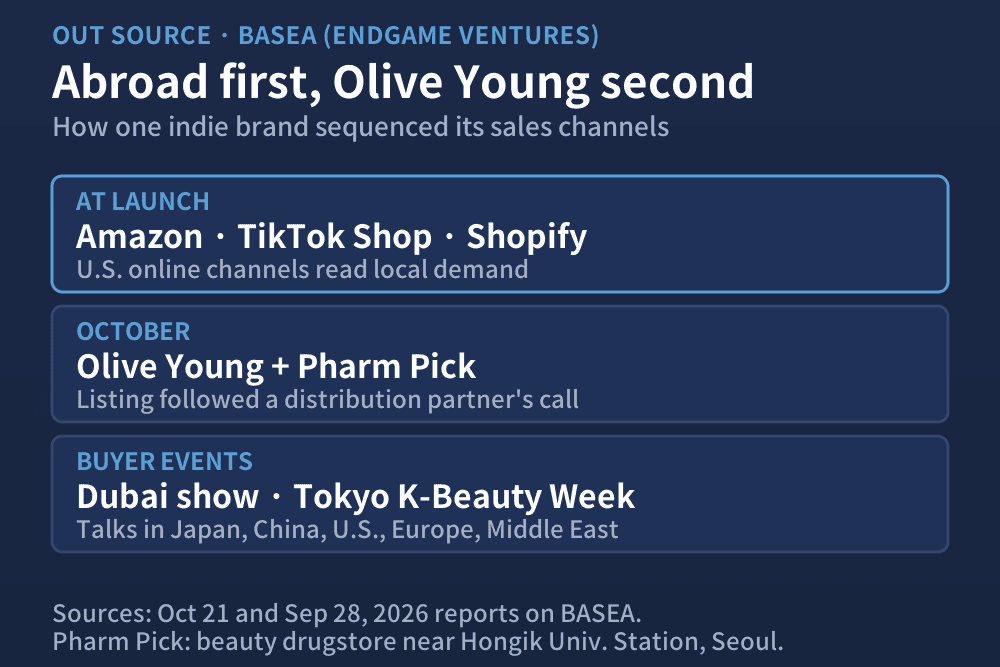
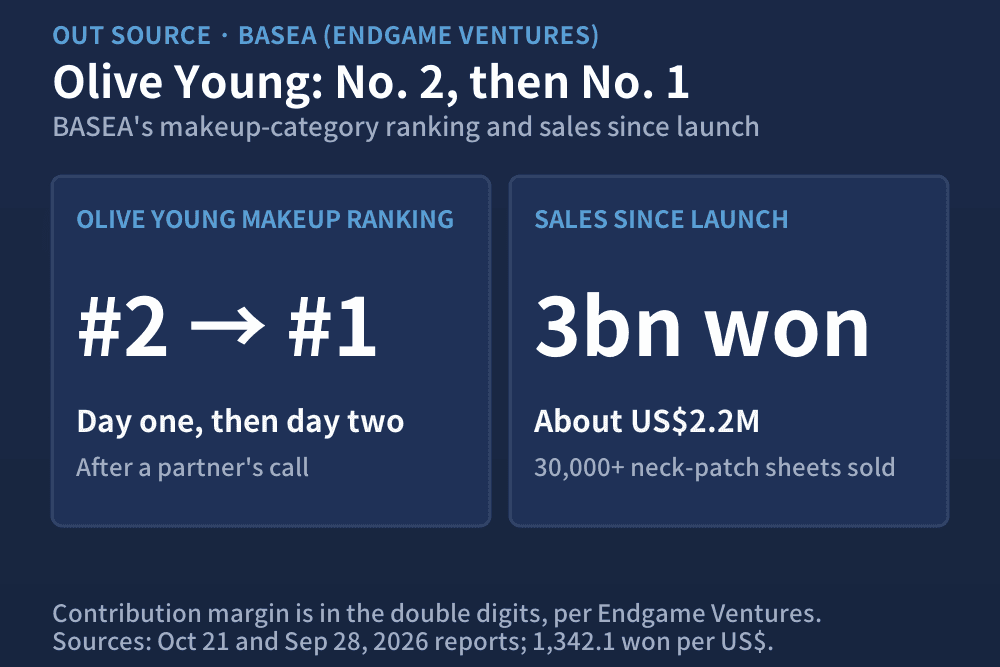
BASEA, a base-makeup brand run by Endgame Ventures, opened its sales on Amazon, TikTok Shop and Shopify in the United States. Olive Young came afterward: on a distribution partner's call, BASEA listed there in October and ranked second in the makeup category on day one and first on day two. Endgame reports about 3 billion won (US$2.2 million) in sales since launch. The usual K-beauty ladder starts in Korea and climbs abroad. BASEA climbed it in reverse.
What did BASEA open with?
BASEA is a base-makeup brand that combines makeup with skincare ingredients. It belongs to Endgame Ventures, whose co-CEOs are Hong Yu-ri and Ahn So-hyun. According to a September 28 report, the brand entered Amazon, TikTok Shop and Shopify as it launched.
An October 21 report says BASEA runs those online channels in the United States to read local consumer reactions. Seed investors in Endgame Ventures are The Ventures and Haim Venture Investment.
The line covers a foundation stick, a pore-blurring primer, a concealer-blusher and a one-month neck-patch kit. The assortment is built around base makeup, the category where shade, texture and wear decide whether a customer buys again.

Won figures below convert at 1,342.1 won per dollar, the Seoul closing rate on November 5, 2026.
Why is global first the unusual order?
The standard K-beauty ladder starts in Korea. A brand wins a place on a domestic retail shelf, proves itself there, and carries that proof to distributors abroad. Domestic retail is both the test and the credential.
BASEA skipped the credential. U.S. online channels need no distributor, no minimum order and no shelf negotiation. A brand pays for content and inventory, and it receives price, creative and conversion data within days. Global online is a low-cost place to find out whether a product sells.
The three platforms also differ from one another. Amazon rewards search demand, TikTok Shop rewards video, and Shopify turns a brand's own traffic into a customer file. A brand on all three learns which of the three sources of demand works for its product, and it learns that with one stock of inventory.
How did Olive Young come into the picture?
The October 21 report says BASEA received a call from a distribution partner and completed its Olive Young listing. The brand ranked second in the makeup category on its first day on the platform and first the next day.
The Korean door opened by pull. A distribution partner called BASEA, and the listing followed. The brand did not apply for a shelf and wait for a verdict.
It also listed at Pharm Pick, a beauty drugstore near Hongik University Station that sees a constant flow of foreign visitors. That choice puts the brand in front of foreign shoppers, the same audience its export channels serve.
What do the sales numbers show?
Endgame reports sales of about 3 billion won (US$2.2 million) since BASEA's launch and a contribution margin in the double digits. Contribution margin is the profit left after variable costs such as product, shipping and advertising, before fixed overhead. A neck-patch kit has passed 30,000 sheets sold.
The sales figure is small. The margin is the point. A new brand that clears its variable costs, advertising included, with a double-digit margin is paying for its own growth. In a brand's first months, advertising spend usually outruns sales. A positive margin at that stage means the model pays for itself.
Who makes the content?
Endgame works with four exclusive creators whose combined subscribers total about 2.55 million, and uses them for content and marketing for its own brands. It also runs a creator MCN unit, Jisung Atelier. An MCN, a multi-channel network, is a company that manages creators and sells their output.
BASEA's campaign ambassador is the actress and singer Hyeri, who has about 11 million Instagram followers. Campaign content featuring her has passed 10 million views.
Content is a fixed cost here, not a rented one. A conventional indie brand buys advertising from outside, pays more for every additional impression and owns nothing afterward. A brand with its own creators and its own network owns the output and can run it on every channel it sells through.
What did the founders bring from their last company?
Hong and Ahn founded One Taker, the operator of the underwear brand The Jam, which recorded cumulative revenue of more than 50 billion won (US$37.3 million) before they sold it to a Korean textile company in 2024. They later worked at an advertising agency and a beauty brand. A former Amorepacific global marketer on the team leads global business.
Endgame currently runs three businesses: BASEA, a healthcare brand called Lolly, and the Jisung Atelier MCN unit. The company states a goal of becoming a K-wellness group. The founders' earlier e-commerce company and Endgame's creator network give BASEA an operating base that a first-time founder builds from zero.
Reuse is the point of a studio model. Each new brand draws on the same creators, the same operations and the same buyer contacts, and each launch lowers the cost of the next. A brand studio, in the sense used here, is a company that builds several brands on one shared engine.
How far is the brand from distribution deals abroad?
BASEA exhibited at Beautyworld Middle East in Dubai and is following up with the contacts it made there. The October 26–30 K-Beauty Week in Tokyo carried a BASEA slot in its HELLO, COSME program, which introduces brands to Japanese consumers and industry buyers.
The company is in talks with buyers and partners in Japan, China and Hong Kong, the United States, Europe, the Middle East, Taiwan and Turkey, covering samples, evaluation and trade terms. The sequence is consumer data first, buyer meetings second. Buyers meet the brand with an online record behind it.
Dubai and Tokyo play a different role from the U.S. online channels. They put the brand in front of buyers who place wholesale orders, which is a different business from direct online sales. A brand that holds both sets its own price in the first and negotiates it in the second.
The order protects cash. A brand that starts with direct online sales commits inventory only to the channel that reports sales fastest. Wholesale stock follows after the online record shows which products and shades move.
What does BASEA's sequence change for small brands?
Reversing the order reverses the risk. The traditional path puts the biggest unknown, a domestic retail verdict, first and the data after. BASEA collects data first and lets the retail verdict arrive as confirmation.
Domestic retail becomes a reward and stops being a prerequisite. A creator team becomes a fixed asset in place of a variable cost. A serial founder's previous company becomes the launch infrastructure. A new brand's first year is no longer a bet on one shelf.