Unlockt Brands raised 32 billion won (US$23.9 million) in a Series B announced on November 22, 2026, at a post-money valuation of 230 billion won. Its revenue is set to go from about 45 billion won in 2025 to about 210 billion won in 2026. It is a distributor, not a brand. It buys stock from about 20 K-beauty labels and places it in roughly 2,000 Target stores and more than 4,000 Walmart stores. The investors priced the shelf, not the label.
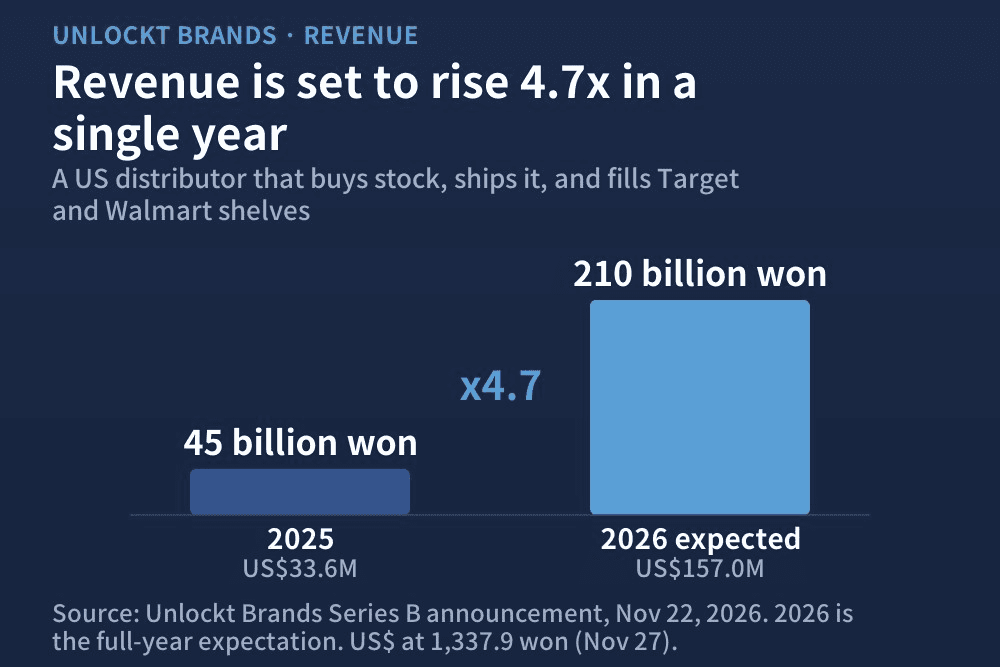
▲ Unlockt Brands expects revenue of 210 billion won in 2026, 4.7 times its 45 billion won in 2025.
What did Unlockt Brands raise, and from whom?
Unlockt Brands closed a Series B of 32 billion won, or US$23.9 million at 1,337.9 won per dollar, the Seoul close on November 27, 2026. The round values the company at 230 billion won (US$171.9 million) after the new money. That figure is a post-money valuation: the worth of the company immediately after the cash arrives.
Three earlier backers returned: Korea Investment Partners, Bonangels and CJ Investment. Atinum Investment and Hana Ventures joined as new investors. The company said it is weighing an initial public offering among its future financing options.
CEO Jang Seong-man founded the company in California in 2022. It reached a 210 billion won revenue expectation within four years of incorporation, which makes the round a bet on speed of volume rather than on a product.
What does a distributor like this actually sell?
Unlockt sells access. It selects about 20 K-beauty brands, among them Medicube, Dr. Melaxin, Round Lab, Skin1004, Amuse, Dr. Elsia and Ohora, and carries them into American stores. Its own website describes the job as retail strategy, store entry, logistics and reorders, run by teams in both Korea and the US.
The customers on the other side are big-box retailers, the chains that operate thousands of stores, Target and Walmart among them. Their buyers do not negotiate with a brand's social media following. They negotiate with a supplier that meets delivery windows and compliance rules every week.
That is the product. A brand supplies demand. Unlockt supplies the repeatable act of arriving on time, in volume, with the paperwork a retailer requires.
Why does a warehouse sit at the center of a US retail entry?
Unlockt operates its own warehouse in the US of about 5,059 pyeong. A pyeong is the Korean unit of floor area, about 3.3 square meters, so the building is roughly 16,700 square meters, or 180,000 square feet. The company built it to ship in bulk and to meet the delivery deadlines and rules that large retailers set.
A retailer treats a missed delivery window as the supplier's failure. A Korean brand shipping from Seoul cannot absorb that discipline. A warehouse on American soil turns a Korean production run into a domestic supply line.
The Series B money goes to three places: working capital to buy inventory, upgrades to warehouse operations, and stronger support for sales after a brand lands on a retailer's shelf. None of the three is advertising.
How does revenue grow 4.7 times in one year?
From about 45 billion won in 2025 to about 210 billion won in 2026 is a multiple of 4.7. Spread across about 20 brands, the 2026 figure averages 10.5 billion won, or US$7.8 million, per brand.
The multiplier sits in the store network, not in any single label. Roughly 2,000 Target stores and more than 4,000 Walmart stores give every added brand a shelf count that a single brand cannot reach by itself in one year. Each new brand multiplies against a network that is already built.
Inside that network, the distributor decides which brand goes to which retailer and in what order. A portfolio of about 20 brands lets it match a brand to a store format, and it lets one retailer relationship carry several labels at once.
A distributor that buys inventory books the wholesale value of every case it sells to a retailer. Its revenue measures shelf volume, not consumer spending.
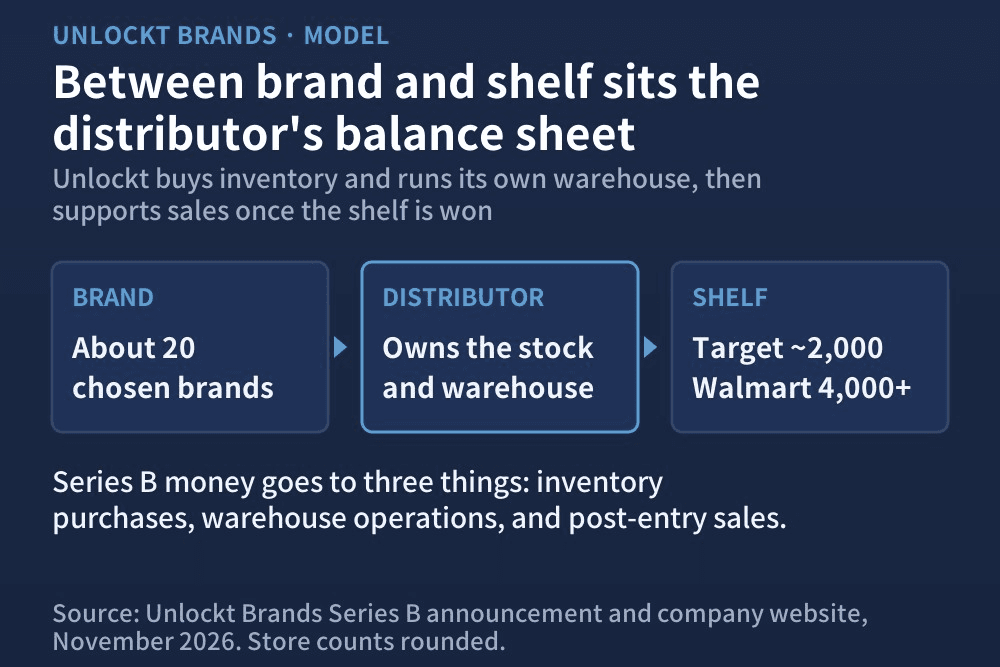
▲ Unlockt buys the stock, runs the warehouse, and fills about 2,000 Target stores and more than 4,000 Walmart stores.
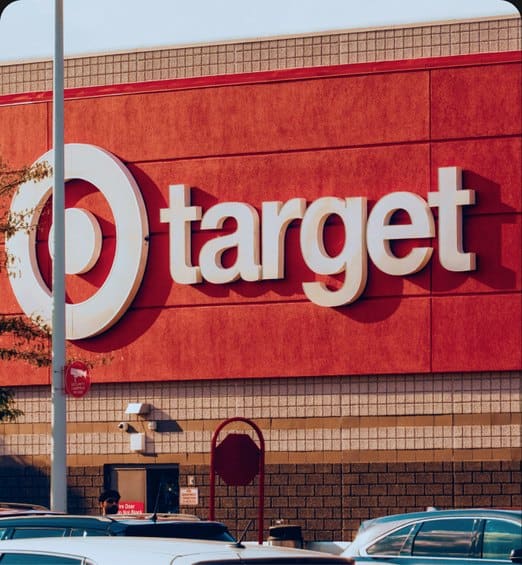
▲ Unlockt places K-beauty brands in roughly 2,000 Target stores. Image: Unlockt Brands
Why are Target and Walmart opening shelves to K-beauty now?
Target replaced its former Ulta Beauty shops inside stores with a format called Beauty Studio, which carries more than 1,600 products from 90 brands. Target said it quadrupled its K-beauty assortment, adding more than 150 products and more than 10 brands. Medicube entered more than 1,500 Target stores in April, and Sephora opened Olive Young displays in about 580 stores.
The pattern has changed from brand-by-brand entry to multi-brand programs. A retailer assembling a dozen Korean brands at once needs one counterpart that can supply them together, and the counterpart has to hold stock.
Unlockt was already inside that logic. A January 25, 2025 report described it launching a K-beauty section across about 1,600 Target stores from the first week of February 2025, with brands including Beauty of Joseon and Round Lab. Target has about 2,000 stores in total, which puts the network's Target count at nearly the whole chain.
What does a brand give up when it goes through a distributor?
It gives up direct control of inventory and price. Daniella Jung, founder and CEO of Muskat Beauty, another K-beauty distributor serving Target, said US expansion requires inventory control and price control, not just social media virality. A distributor holds both levers.
In return the brand gets a supplier relationship with the buyer that it cannot build alone, and a reorder cycle managed by someone else. The exchange is margin and control for access and continuity.
The brand also gives up information. The distributor sees the retailer's reorder pattern first and decides how fast new stock moves. A brand with its own team in the US keeps that picture. A brand without one reads it secondhand.
Jung added that brands without Sephora or Ulta exclusivity found it easier to get into Target. Shelf access is shaped by who else holds the brand, and the distributor's role is partly to manage those conflicts.
Can a small brand copy this structure?
The barrier is the balance sheet, not the introduction. Inventory bought ahead of a retailer's orders is cash spent before it is earned. The stated purpose of the Series B is working capital to buy that inventory, which shows where the weight of the model sits.
A seed-stage brand cannot carry that weight, so it copies the division of labor instead: the brand makes, the distributor stocks, the retailer sells. The gate is selection. A distributor that carries about 20 brands says no to most.
The structure is repeatable in principle and scarce in practice, because the scarce input is the capital that sits between a factory in Korea and a shelf in a US store.
What does a 230 billion won valuation price?
At 230 billion won, the valuation is 1.1 times the 2026 revenue expectation and 5.1 times 2025 revenue. The 32 billion won raised equals about 15 percent of expected 2026 revenue. The price sits close to the revenue line.
That is how a business built on throughput is valued. Investors are paying for volume moved through a fixed network of stores and a warehouse, not for a consumer name that can fade. The asset is the pipe.
A brand's valuation rests on how many shoppers choose it. A distributor's valuation rests on how reliably retailers choose to keep ordering through it.
What does this say about how K-beauty reaches American shelves?
Korean brands won shoppers first on Amazon and TikTok Shop. Physical retail came next, one brand at a time, and now arrives in bundles. Each step moved the decisive skill further from marketing and closer to logistics and capital.
The brand creates demand. The distributor converts demand into a delivery. The retailer hands the shelf to whoever delivers. The 32 billion won round is the market putting a price on the middle step.