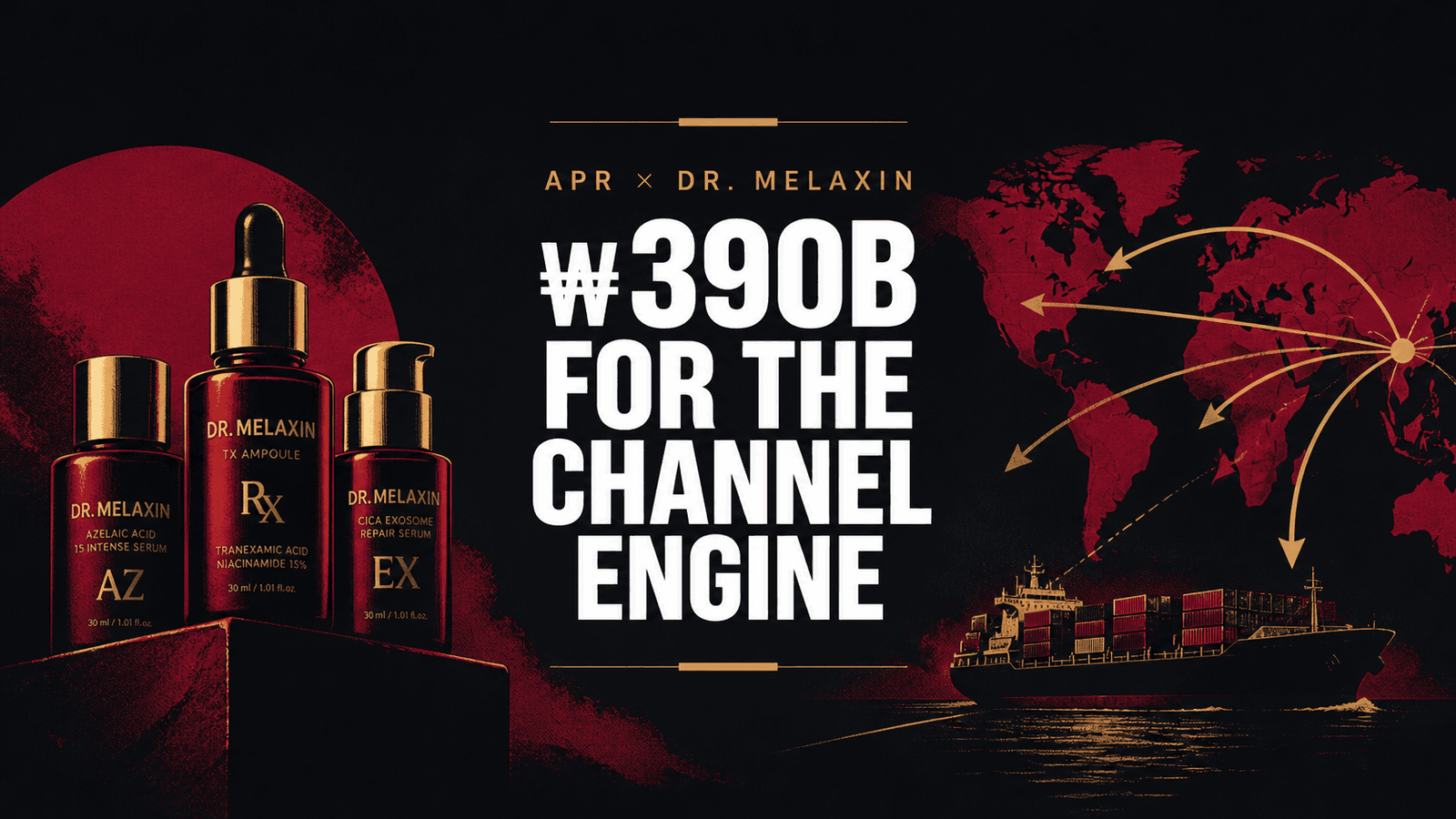
APR is paying 390 billion won (about US$290 million at 1,342.7 won per dollar, the November 26, 2026 close) for 87.3% of Brand501, the operator of Dr. Melaxin. Only 70 billion won of that reaches the company; the other 320 billion won goes to sellers. The brand it buys held second place among US TikTok Shop beauty sellers in the first half of 2026, but its second-quarter sales there fell 16% while APR's own Medicube rose 42%. The price buys a brand. The deal is about the channels around it.
▲ APR and Brand501 corporate identities. APR announced the 87.3% acquisition on November 26, 2026. Image: APR
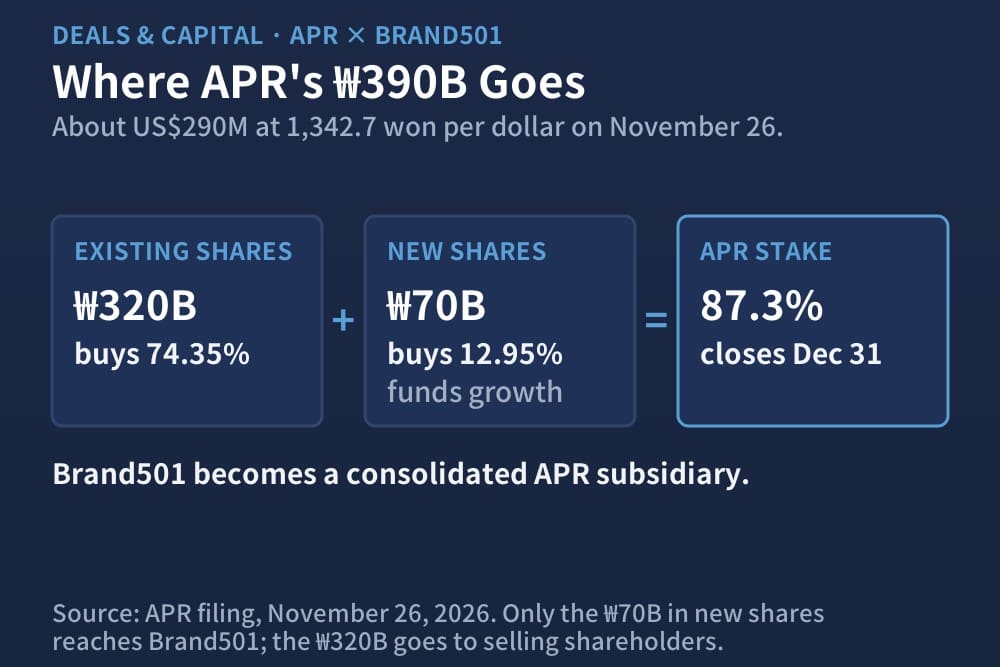
▲ APR's ₩390B buys 74.35% in existing shares and 12.95% in new shares; only the ₩70B in new shares reaches Brand501.
What does APR actually buy for 390 billion won?
APR agreed on November 26, 2026 to take 87.3% of Brand501 in two pieces. The first is 74.35% of existing shares for about 320 billion won (US$238 million). The second is 12.95% in newly issued shares for about 70 billion won (US$52 million), sold through a third-party allotment, a capital increase in which a chosen buyer takes the new shares instead of every shareholder getting a pro-rata offer. Closing is scheduled for December 31, after which Brand501 becomes a consolidated subsidiary, meaning its results are added line by line to APR's own financial statements.
Divide 390 billion by 0.873 and the whole company comes out at roughly 447 billion won (US$333 million) on a straight-line basis. That is 1.9 times Brand501's 2025 revenue of 233.7 billion won and about 1.4 times its first-half 2026 revenue of more than 330 billion won. Against APR's own earnings, the price equals 2.4 times third-quarter operating profit of 160.6 billion won, and about 77% of nine-month operating profit of 503.5 billion won. The check is written out of one profit cycle.
How much of the money reaches Brand501 itself?
Seventy billion won, about 18% of the price. APR's filing says the new-share proceeds go to expanding Brand501's business. The remaining 320 billion won pays the shareholders who sell, so 82% of the cash leaves the company on the day of closing.
The split sets the incentives. Existing management keeps a stake and stays in place, which means a share of their wealth remains tied to what happens after the transaction instead of being converted to cash at once. The new money matters for a different reason: a brand that nearly tripled its revenue in a year carries inventory, advertising spend and receivables from every new channel it opens, and growth at that pace consumes cash before it produces any.
What does Brand501's revenue curve say about the price?
Brand501 was established in 2017, and Dr. Melaxin launched in 2023. Revenue that year was 28.7 billion won (US$21 million). It reached about 80 billion won in 2024 and 233.7 billion won (US$174 million) in 2025, nearly triple the year before. In the first half of 2026 it passed 330 billion won (US$246 million), already above the full 2025 figure, and the brand has set a 2026 target of 1 trillion won.
The profile is an export business. Of the 161.6 billion won Brand501 booked in the first quarter of 2026, 154.5 billion won, or 96%, came from overseas. APR's overseas share in the third quarter was 94%. The buyer and the target are the same shape, which is why the integration is described as sharing infrastructure instead of building it.
Margin is where they differ. Brand501 reported first-quarter operating profit of 21 billion won (US$16 million) on that revenue, a 13% margin. APR's third-quarter margin was 21%. The eight-point gap is the space the shared distribution, marketing and operations are meant to work in.
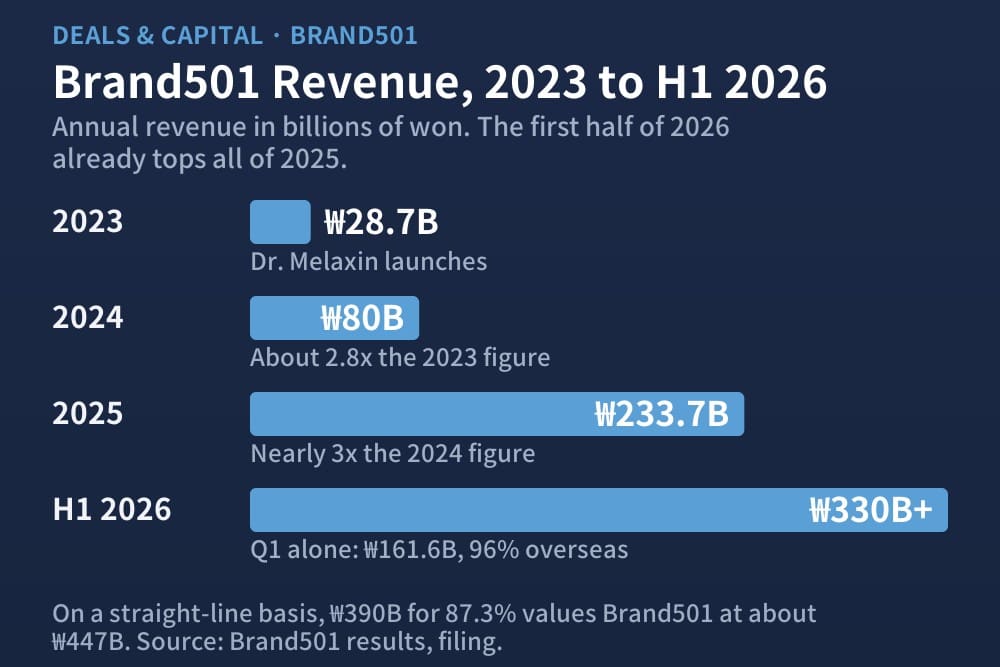
▲ Brand501 revenue rose from ₩28.7B in 2023 to ₩233.7B in 2025, and passed ₩330B in the first half of 2026.
Why does a TikTok Shop brand need another channel?
TikTok Shop is the in-app store inside the short-video platform, and Charm.io tracks its sales as gross merchandise value (GMV), the total value of goods sold. US beauty GMV on the platform reached $980 million in the second quarter of 2026, up 82% from the prior year and up 6% from the first quarter. Dr. Melaxin led the beauty ranking in the first quarter with $46.3 million. In the second quarter it sold $38.8 million, down 16%, and dropped to second behind Medicube at $62.8 million.
The platform grew while the brand shrank on it. A brand whose sales depend on one feed's recommendations has no control over that feed, so the useful question is what else the brand already sells through. Brand501's cumulative Amazon sales from January to September 2026 rose about five times from the year before, and Dr. Melaxin already stands in Ulta Beauty, Costco and Boots.
APR's announced plan reads in that order: Amazon and other online platforms first, then physical retail and markets outside North America in stages. The brand is already moving that way. What APR adds is the machinery to move faster.
What does Medicube already do that Dr. Melaxin needs?
Medicube is APR's flagship, and the group's third quarter shows what the machinery produces. Revenue was 773.1 billion won (US$576 million), up 100.3% from a year earlier, with operating profit of 160.6 billion won (US$120 million). North America and Europe together supplied 69% of revenue, up from 47% a year earlier. Nine-month revenue of 2.134 trillion won (US$1.59 billion) had already passed the full 2025 total.
The structure announced on November 26 divides the work cleanly. Dr. Melaxin keeps its own brand identity, product development and sales strategy. Global distribution, marketing and operations are shared with Medicube. The name, the formulas and the price on the shelf stay separate; the parts a shopper never sees are pooled.
The combined effect shows in the platform data. In the second quarter Medicube and Dr. Melaxin sold $101.6 million between them, about 10% of the $980 million US TikTok Shop beauty total. Two brands run under one operating base now hold the first and second positions on that ranking.
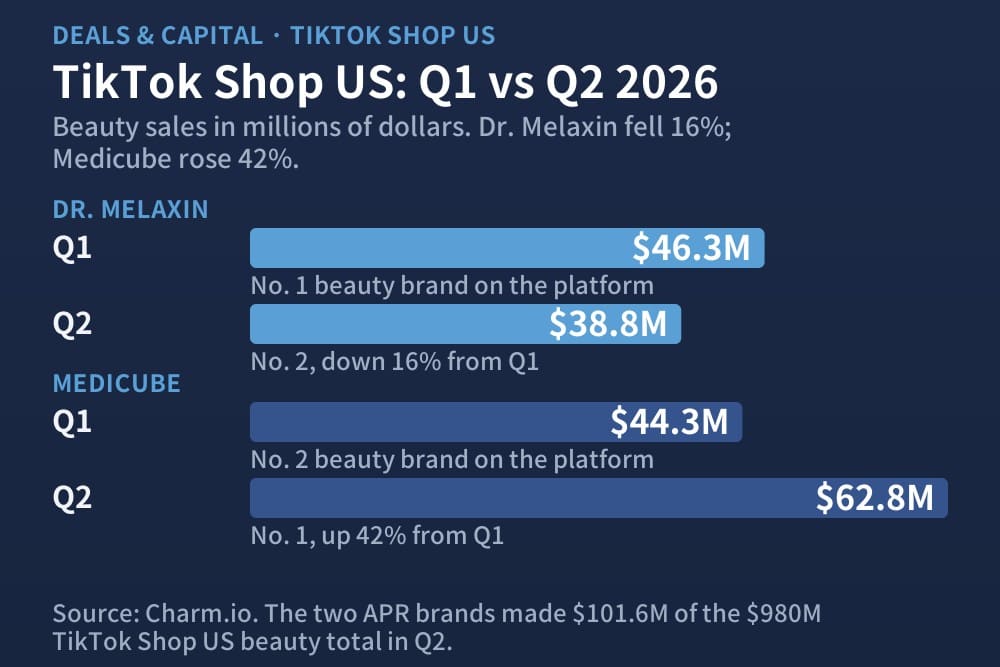
▲ Dr. Melaxin's TikTok Shop US sales fell from $46.3M to $38.8M between Q1 and Q2 2026 while Medicube's rose from $44.3M to $62.8M.
Why buy a brand that sells in the same channels as the flagship?
Dr. Melaxin sells dermatology skincare built around skin concerns such as wrinkles, pigmentation and excess sebum, with a calcium line as its signature and extensions into sun care, body care and shampoo. Medicube sells skincare through the same two channels, TikTok Shop and Amazon. Analysts framed the purchase as a way to reduce APR's reliance on Medicube and broaden its skincare range.
The build-or-buy arithmetic favors buying. Brand501 took three years from launch to more than 330 billion won in half-year revenue. A second APR-built brand would have to repeat that climb from zero, and the 1.9 times revenue multiple pays for those years.
What the deal diversifies is brands, not channels. Both brands built their US business on TikTok Shop and Amazon, so a change in either platform's recommendation logic, fee structure or ad auction reaches both at once. The concentration moves from one brand to one channel pair.
What does a December 31 closing do to APR's reported numbers?
A closing on the last day of the year puts Brand501 on APR's year-end balance sheet but leaves its 2026 revenue out of APR's 2026 income statement, because results are consolidated from the date control passes. Brand501's first full year inside the group is 2027.
The step-up is large. APR's first-half 2026 revenue works out to about 1.361 trillion won, the nine-month total less the third quarter. Brand501's first-half revenue of more than 330 billion won equals about 24% of that. APR is buying an entity with roughly a quarter of its own revenue scale, and the 2027 comparison base will absorb it in one move.
What does the deal say about where K-beauty value sits now?
A brand's rank on a platform is an asset only while the platform's feed keeps it there. APR is paying 1.9 times revenue for a position that slipped 16% in a quarter, and it is wagering that distribution it already runs holds the position better than Brand501's own reach did.
For the sellers, three years of compounding became cash on 74.35% of the equity and a continuing stake in the rest. For the buyer, a second engine arrived already running at a quarter of the buyer's own size. The formula in the jar was never the line item. The shelf was.