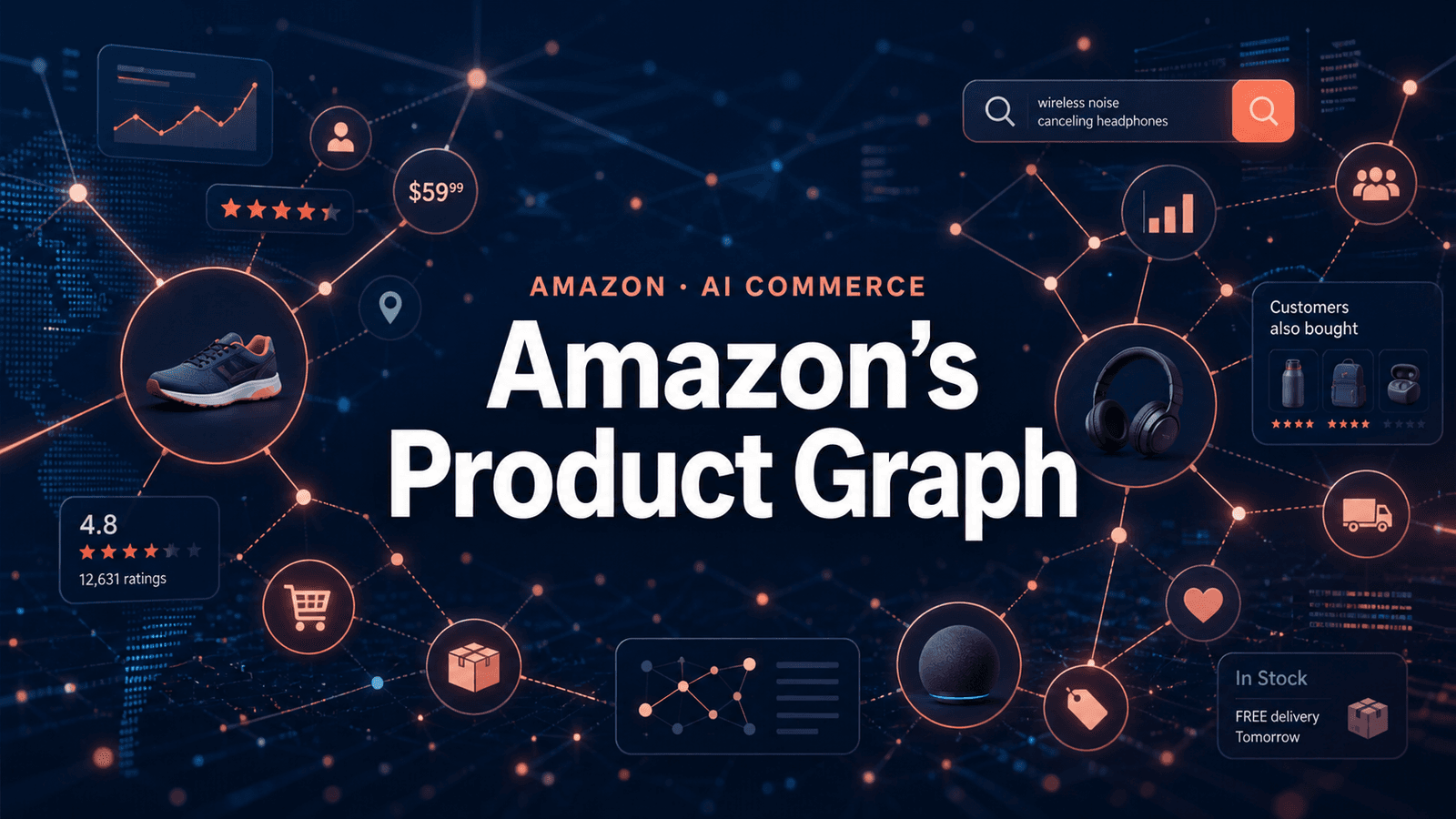
An internal Amazon document reviewed by Reuters describes a World Product Graph: a database covering nearly every item sold anywhere, including goods Amazon does not stock. It sets an aspirational release date of October 1, 2027. Its logic sits in two numbers from a 2025 Morgan Stanley report: 57% of online shoppers begin product research on Google, and 16% on Amazon. The graph is an attempt to bring the research step onto Amazon's own site before an AI shopping agent takes it elsewhere.
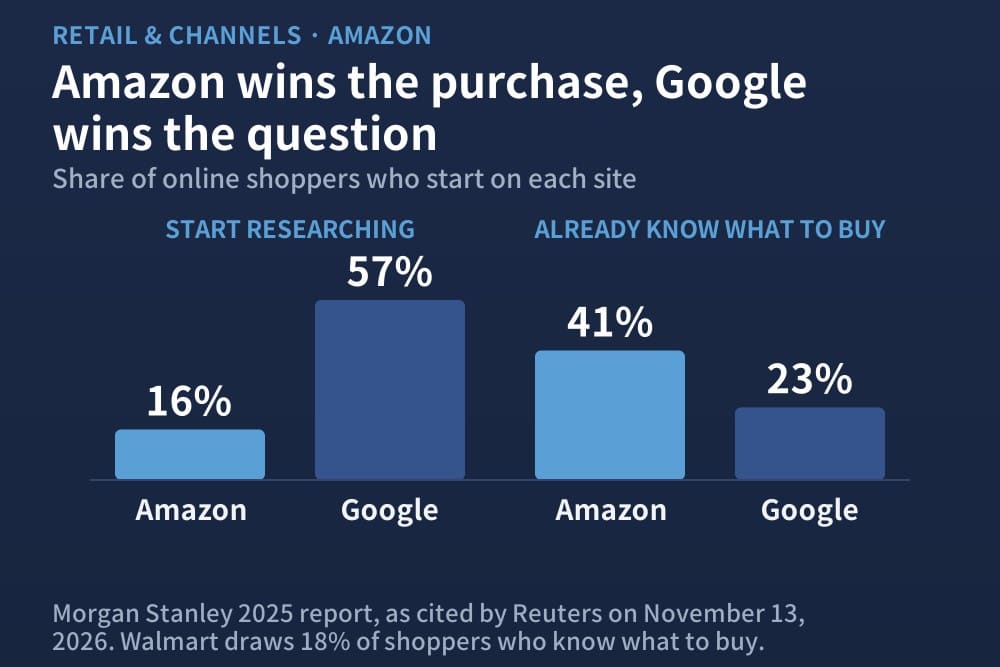
▲ Google starts 57% of online shoppers' research and Amazon 16%; once shoppers know what to buy, 41% start on Amazon and 23% on Google.
What is a World Product Graph?
A product graph is a database that links each product to its attributes and to other products. Amazon's version, according to the document, would hold data on nearly every item sold anywhere, whether or not Amazon stocks it. The idea sits in Amazon's Selection & Catalog Systems unit, organized under vice president Robert Tekiela, and employees describe it as an extension of existing services called Buy for Me and Shop Direct.
The format of the document matters. It is a PR/FAQ, Amazon's internal planning memo, written as a press release followed by questions and answers about the product. The release date it sets, October 1, 2027, is the date the team writes toward, and the memo's job is to make the case for the business.
The ambition is stated in terms of shopper behavior. Amazon wants shoppers to never need to leave its site to research a purchase, which would let it compete with Google in search and with Walmart in e-commerce at once. The product graph is the infrastructure for that goal: a catalog wide enough that every question about a product has an answer inside Amazon.
Where would the data come from?
Brands and retailers would contribute product data continuously. Coca-Cola and Bayer have signed up to contribute, and Procter & Gamble is in a trial that included a CEO-level summit with Amazon. Amazon would also crawl other retailers' websites for product information.
The document says the project depends on discovering how brands organize their products on their own websites. A brand's own site, built to sell to shoppers, becomes raw material for a database that answers shoppers elsewhere.
Continuous contribution is the operative phrase. A one-time catalog upload ages the day it is finished, while a feed stays current as formulas, sizes and packaging change. A brand that signs up takes on an ongoing data job, and the party receiving the feed sets the format.
Why does Amazon want this now?
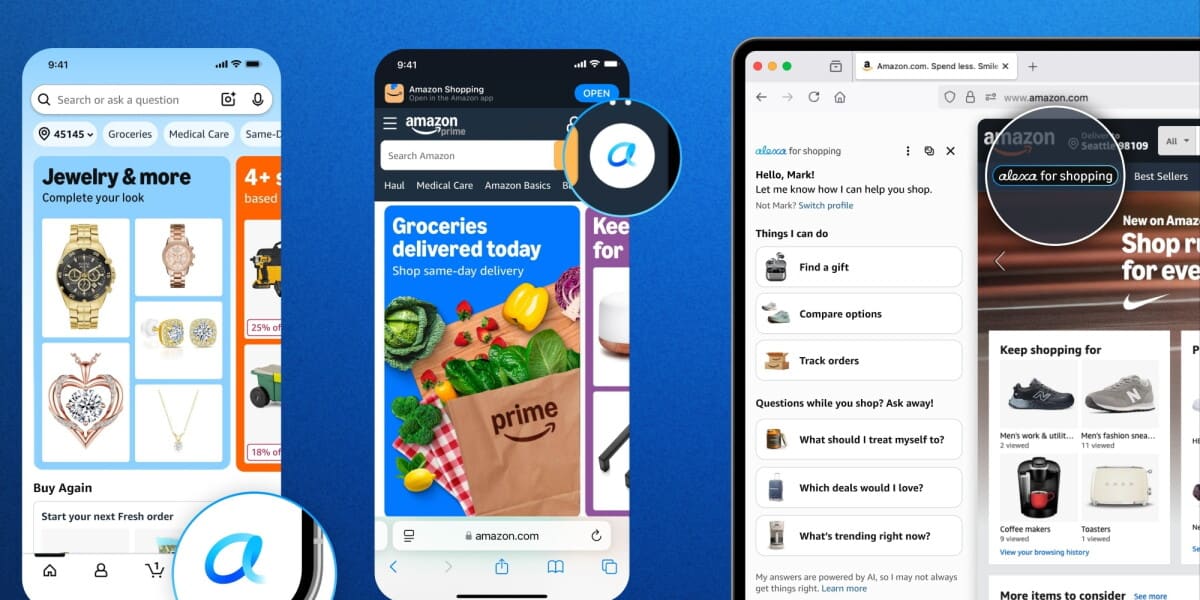
▲ Amazon Alexa for Shopping interface, bringing together Rufus product expertise and personalized context. Image: Amazon
The reason is its AI assistant. Rufus, renamed Alexa for Shopping in May, handles about 83 million searches a week, which the document calls expensive. The document says many Rufus answers are factually wrong or incomplete and that customers lack the expertise to detect the errors. Amazon puts the accuracy of Alexa for Shopping at roughly 97% globally, and CEO Andy Jassy said more than 400 million people used it in the past year.
More complete product data lets Amazon answer from facts instead of inference, and the document ties that completeness to cost: richer data allows cheaper models. Data completeness substitutes for model size, so every product fact Amazon owns lowers the price of the answers built on it.
What was Amazon saying in public the same day?
On November 13, 2026, the day of the Reuters report, Amazon's newsroom published two items on Alexa for Shopping: one introducing it as a personalized, agentic AI assistant, and one describing a way to use it by text message. Agentic means the software acts on the shopper's behalf rather than only answering questions.
The public message is about the assistant. The internal document is about what the assistant reads. The assistant is the storefront and the graph is the stockroom, and a storefront with a thin stockroom answers badly. Amazon's own memo makes that point about Rufus.
How do AI shopping agents change the funnel?
A 2025 Morgan Stanley report found that 16% of online shoppers begin product research on Amazon, against 57% on Google. When shoppers already know what they want to buy, 41% start on Amazon, 23% on Google and 18% on Walmart. Amazon wins shoppers who have decided. Google wins shoppers who are still asking.
AI shopping agents threaten the second group's habit. The document says Amazon cannot be the go-to destination for every shopping mission if customers must leave to do their research, and Amazon executives worry that agents send traffic to whichever sites hold the most complete product data. Meta's Muse agent gained more than 10 million users in the United States and Canada after its September launch, and Amazon blocked it from its site the same month. Jassy said on the third-quarter earnings call that few customers are doing much shopping this way yet.
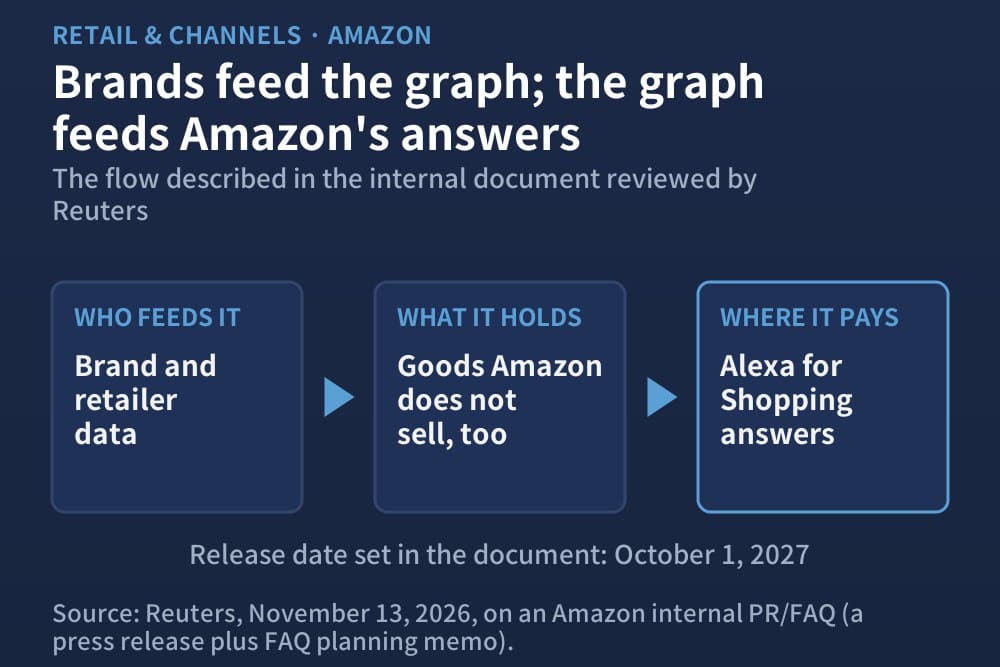
▲ Brand and retailer data feeds a graph that covers goods Amazon does not sell, and the graph feeds the answers inside Alexa for Shopping.
Why catalog goods Amazon does not sell?
A shopping agent answers a question before it picks a store. If the facts about a product live on Google, a brand site or a retailer, the agent's answer starts there, and so does the traffic. If the facts live on Amazon, the answer starts on Amazon even for a product Amazon does not stock. The graph is a bet that the factual layer matters more than the inventory layer.
The document frames this as defense. Owning product data steers agents toward Amazon.com and protects its advertising business, which depends on shoppers arriving at Amazon to compare products. Product data that answers the comparison elsewhere removes the reason to arrive.
From the shopper's side, the graph is invisible. A shopper asks an assistant whether a serum suits sensitive skin and gets an answer, and whether it came from the brand's site, a retailer's listing or Amazon's graph does not show. The party that controls the source controls the wording.
What changes for a brand's own website?
A brand site has served two jobs: telling the brand's story and holding the facts. The graph pulls the second job out. For a beauty brand the facts are ingredient lists, sizes, shades and usage claims, the content that shoppers and agents compare. A brand that feeds them to Amazon continuously gains a place in Amazon's answers and gives up part of the reason shoppers visit its own pages.
The brand also loses control of sequence. On its own site, a shopper reads the story first and the facts second. In an agent's answer, the facts come first and the story arrives only if the agent decides to repeat it.
Who benefits when the answer layer is centralized?
Three parties meet at the product fact. Amazon wants it to answer inside its own store. Agent builders want to read it wherever it sits, and Amazon blocked one of them. Brands hold the original and decide where it flows. The graph asks brands to choose, product by product, which of the three gets the cleanest copy.
Retailers other than Amazon face a different choice. A retailer that contributes data supports the graph that answers shoppers who would otherwise visit it, and a retailer that withholds data depends on shoppers and agents finding its own pages.
The product page used to be where a brand told its story. The product graph is where a machine decides whether to repeat it.