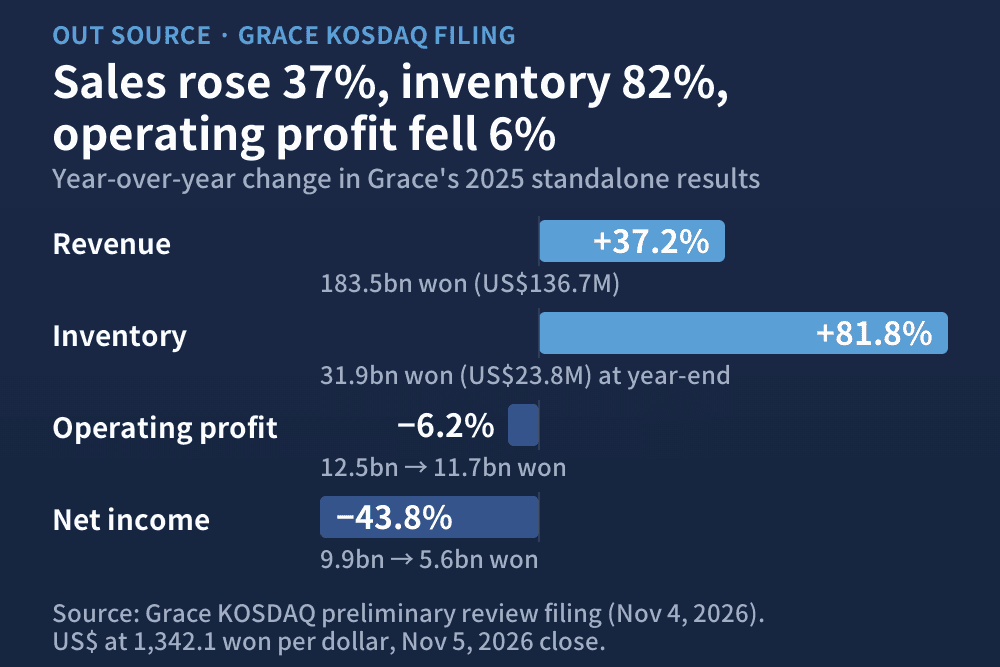
Grace, a Korean cosmetics distributor founded in 1991, filed for a KOSDAQ listing on November 4. Its 2025 standalone revenue rose 37.2% to 183.5 billion won (US$136.7 million). One customer bought 124.1 billion won (US$92.5 million) of it, 67.6% of the total, and supplied 73% of the growth. Operating margin fell from 9.3% to 6.4%, inventory rose 81.8%, and operating cash flow turned negative. The filing's headline is sales growth. Its story is who the sales went to and what it cost to stock them.
What did Grace file on November 4?
Grace filed for a preliminary listing review with the Korea Exchange on November 4, 2026. KOSDAQ is the exchange's board for smaller and growth companies, and the preliminary review is the first gate a company clears before it registers shares with regulators. The lead underwriters are Korea Investment & Securities and Eugene Investment & Securities.
The filing lists 13,543,800 shares for listing and 2 million shares for the public offering. Grace was founded in 1991. It distributes cosmetics and household goods, brings foreign brands into the Korean market, and sells Korean brands abroad.

Won figures below convert at 1,342.1 won per dollar, the Seoul closing rate on November 5, 2026. Revenue and profit figures are standalone, meaning the parent company alone, without its subsidiaries.
How concentrated is Grace's revenue?
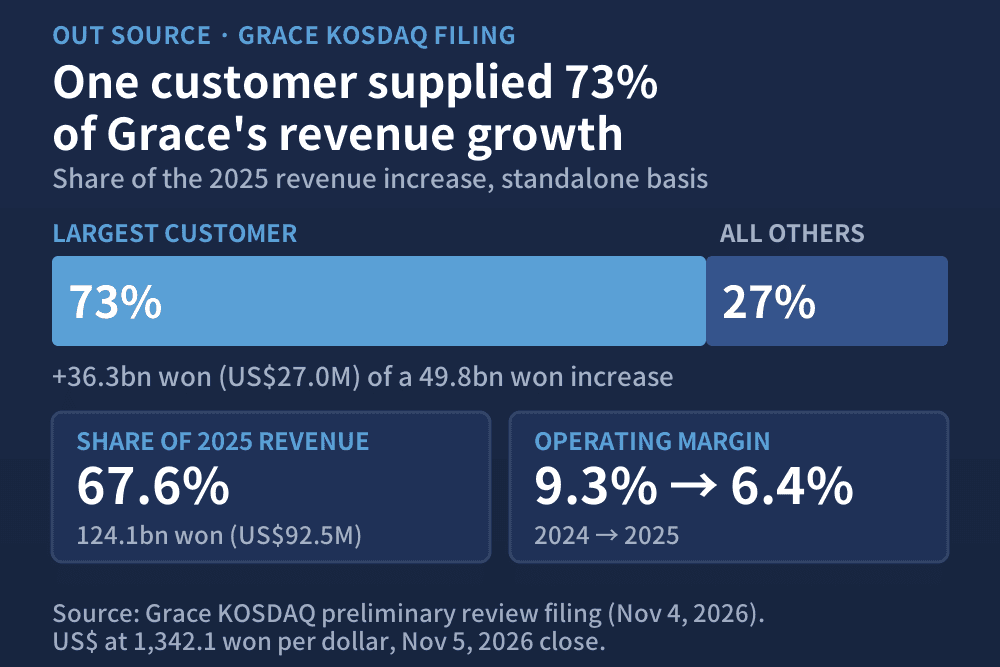
Grace's largest customer bought 124.1 billion won (US$92.5 million) of goods in 2025. That is 67.6% of standalone revenue of 183.5 billion won (US$136.7 million). The customer's purchases rose 36.3 billion won (US$27.0 million) from a year earlier.
Total revenue grew about 49.8 billion won (US$37.1 million), so that one customer supplied 73% of the increase. Backing the 2024 base out of the 37.2% growth rate, the same customer already accounted for about 65.6% of sales a year earlier. Its share moved up two points in a single year.
Every other customer combined bought 59.4 billion won (US$44.3 million), up about 29%. That is fast growth for a long tail of smaller accounts. It supplied the remaining 27% of the increase, and the whole tail is less than half the size of the largest buyer.
Why did operating margin fall while revenue rose 37%?
Operating profit slipped from 12.5 billion won (US$9.3 million) to 11.7 billion won (US$8.7 million), a 6.2% decline. Operating margin dropped from 9.3% to 6.4%. The extra 49.8 billion won (US$37.1 million) of revenue added no operating profit at all.
The margin fell in the same year the largest customer's share of sales rose. The pattern is the usual one in wholesale: the biggest buyer gets the best terms, and the distributor keeps less of each won that passes through.
Net income fell 43.8% to 5.6 billion won (US$4.2 million). It includes a non-cash loss of about 1.8 billion won (US$1.3 million) on redeemable convertible preferred shares (RCPS), investor-held preferred stock that converts into common shares or is redeemed. The loss is booked when the value placed on those shares rises. Add it back and net income still falls about 25%. The accounting explains part of the decline, not most of it.
Why did inventory grow twice as fast as sales?
Year-end inventory reached 31.9 billion won (US$23.8 million), up 81.8%. Revenue grew 37.2%. Inventory expanded at more than twice the pace of sales.
The audit report's cash-flow note puts about 15.3 billion won (US$11.4 million) of cash drain on the inventory build. Operating cash flow swung from an inflow of 3.9 billion won (US$2.9 million) in 2024 to an outflow of 3.7 billion won (US$2.8 million) in 2025. A distributor that grows by stocking more is growing on its own balance sheet.
A distributor opening new channels buys stock before it books the sales. Grace set up a Japanese subsidiary in 2023 and a U.S. subsidiary in 2025, and began supplying Costco and Ulta Beauty in 2026. Inventory built for those channels shows up first as cash out and later as revenue.
What does the listing have to pay for?
The consolidated balance sheet shows equity of 37.3 billion won (US$27.8 million) against liabilities of 71.9 billion won (US$53.6 million), a debt ratio of 192.75%. Cash at year-end was 8.7 billion won (US$6.5 million).
Those figures describe a business that funds growth with borrowed money and pays for inventory with cash its operations do not produce. A listing converts that dependence into equity. The 2 million offered shares are the mechanism, and the sales growth is the argument for the price.
At the end of 2025, Cho Shin-il held 48.27% of common stock and Lee Mi-young held 16.75%. Four funds, S&S-Pactus No. 3, the DS Cheongdam K-Beauty New Technology Fund No. 1, the Pactus-Hanwha New Technology Fund No. 2 and the Shinsegae-KDBC Atelier Investment Fund, held 23.8% combined. Two individuals and four funds own nearly 89% of the common shares that the IPO will dilute.
What does one dominant customer mean for the brands in the portfolio?
A brand that signs with a distributor buys access to that distributor's customers. At Grace, two-thirds of purchases run through one buyer. For a brand in the portfolio, that buyer is the market. The other 32.4% of sales is the diversification, and it is where a brand's own negotiating leverage sits.
The terms a distributor carries into every brand negotiation, margin, payment timing and return rights, are the terms its biggest buyer gave it. A distributor with a 6.4% operating margin has little room to absorb a brand's request for faster payment.
Brands read a distributor's list of labels and its overseas store count. The better signals are the customer table and the inventory line. The first shows whom the distributor depends on. The second shows how much of its own cash it spends to carry the brands' goods.
What will the next filing show?
Grace began supplying Costco and Ulta Beauty in 2026, after the year the filing measures. When those orders reach the customer table, the largest-customer line either falls as a share of revenue or keeps rising. That single line decides whether the overseas channels diversify Grace or add volume under the same dependence.
The 6.4% operating margin sets the second test, because a distributor that sells into U.S. retail on the retailer's terms sees margin move with the mix. Inventory sets the third. If stock keeps outrunning sales after the new channels open, the build was a habit and not a launch.
Two balance-sheet numbers frame the result. Equity of 37.3 billion won (US$27.8 million) against liabilities of 71.9 billion won (US$53.6 million) leaves little cushion if a channel launch slips by a quarter. A listing that raises capital before the orders arrive gives the distributor room to wait for them.
What does the filing say about distribution as a business?
Distribution scales in a straight line only while the customer table stays flat. Grace's 2025 shows the other path: revenue up 37.2%, operating profit down, cash out. The filing turns a distributor's greatest strength, access to the largest channel, into a ratio anyone can read.
A listed distributor sells stock to the market the same way it sells stock to a retailer: on the strength of the next order. The customer table is the order book in plain sight. Revenue says how much was sold. The top customer's share says to whom. Inventory and cash flow say who paid for it.