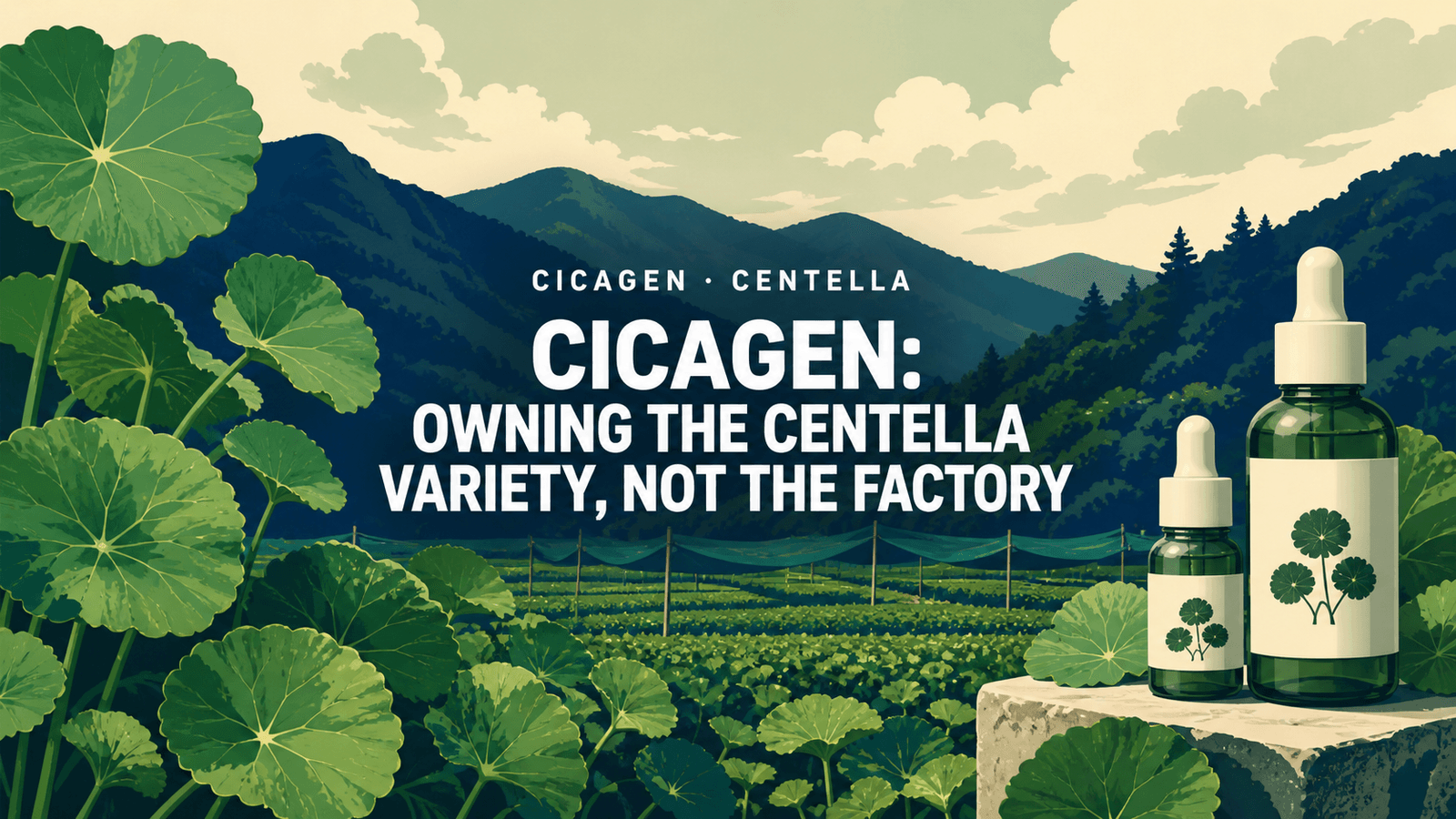
Cicagen, a skincare company in Cheonan, grew 40 tons of centella itself in 2025. In 2026 it moved all supply to contract farms and raised volume to 100 tons, 2.5 times the year before. Two farm operators grow the crop, and outside OEM specialists make the finished products, while Cicagen keeps the variety, the growing method, and the R&D. Its first Lotte Home Shopping broadcast airs on November 30.
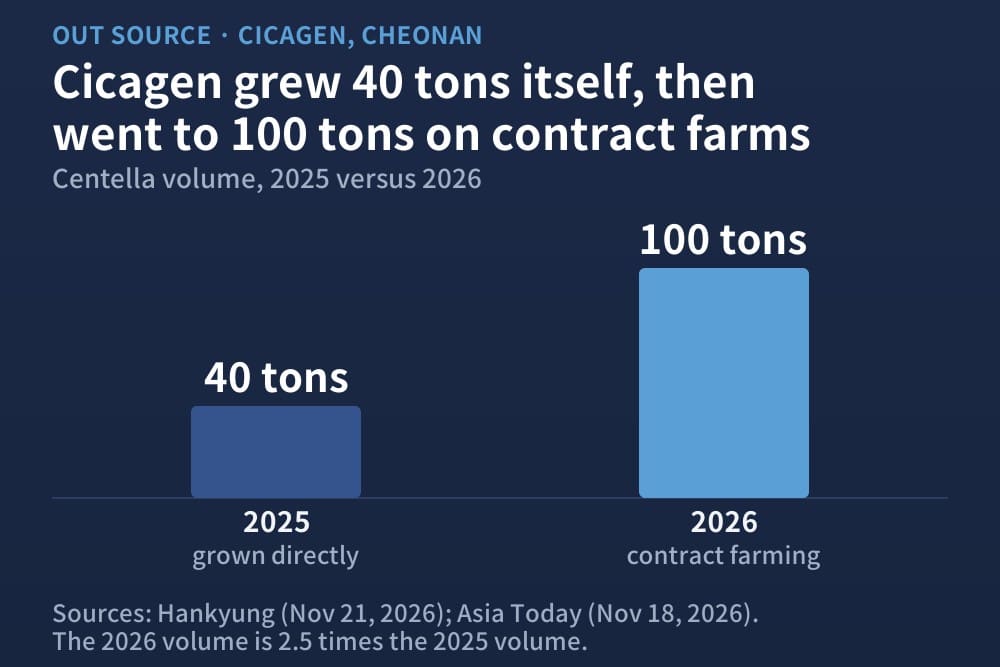
▲ Cicagen grew 40 tons of centella directly in 2025. In 2026 it sources 100 tons through contract farming, 2.5 times the volume.
What does Cicagen sell, and from what?
Cicagen is a skincare maker based in Cheonan, South Chungcheong Province, led by CEO Lee Young-jong. Its flagship is the Fresh Cica 90% Ampoule, launched in 2025. A fresh cica essence and a cream followed and are sold online.
The 90 percent in the name refers to the blend ratio of fresh centella juice concentrate, not to a standard centella extract or a leaf count. The centella is grown without pesticides on domestic farms. The company registered the ingredient name Centella Asiatica Leaf/Stem Juice with the International Nomenclature of Cosmetic Ingredients (INCI), the global naming standard for cosmetic ingredients.
Cica is the K-beauty shorthand for products built on centella asiatica, a common ingredient across Korean skincare. When the ingredient is common, supply of the raw plant and the story of how it is grown become the points of difference.
How did 40 tons become 100 tons?
In 2025, Cicagen grew 40 tons of centella directly. In 2026, output reaches 100 tons, about 2.5 times the previous year, and every ton comes from contract farming. The shift from self-grown to contracted happened in the same year the volume more than doubled.
The contract farms sit in four areas of South Chungcheong Province: Sinchang-myeon, Baebang-eup, and Songak-myeon in Asan, and Godae-myeon in Dangjin. Two farm operators work across those areas.
The division of labor is explicit. The farms grow the raw material, and the company handles R&D and productization. Contract farming lets supply scale without the company holding land or field labor on its own books.
Supply and distribution are expanding in the same year. In 2026 the brand adds contract farms, a TV slot, and an in-flight channel to a base of online, pharmacy, department store, and duty-free sales.
Who supplies the plants and the method?
Cicagen supplied the farm operators with a new centella variety and cultivation methods it developed. The farms grow a crop that Cicagen specified. The company controls what is planted and how it is tended.
That arrangement gives the buyer its lever. A farmer growing a variety the buyer supplied has one natural customer for the harvest. The brand's differentiation sits in the seed and the method, which stay with the company, while the field and the labor sit with the farmer.
The structure concentrates supply. Two operators across four areas carry the entire 100 tons. The variety and method protect the brand's position, and the small number of growers defines the supply base it depends on.
What does Cicagen own, and what does it contract out?
Cicagen owns the variety, the cultivation method, the ingredient registration, the formulas, and the brand. It contracts the growing to two farm operators. It outsources finished-product manufacturing to external specialist firms on an OEM basis, meaning the products are made by contract manufacturers and sold under Cicagen's name.
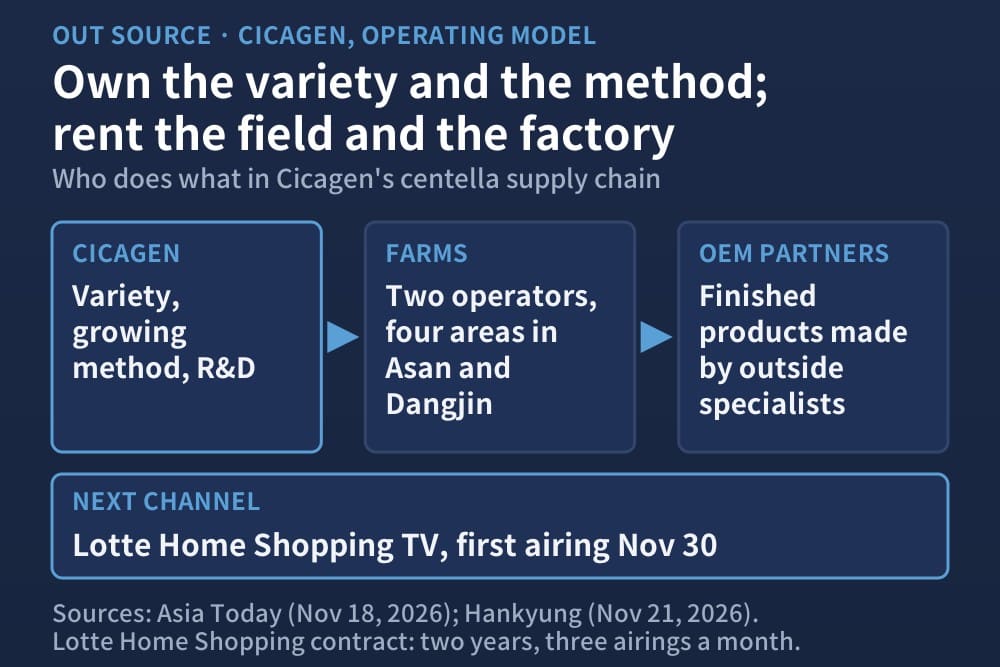
▲ Cicagen keeps the variety, the growing method, and R&D. Two farm operators in four areas grow the crop, and outside OEM specialists make the finished products.
This is an asset-light chain with the scarce asset kept in-house. Land and factories take capital and time to scale. A variety and a method stay with the company even as the acreage grows.
The model also divides roles. In this arrangement, growing and yield sit with the farms, production lines and capacity sit with the OEM partners, and brand, formula, and channel sit with Cicagen.
Where does control weaken when the crop is contracted?
A buyer that supplies the variety and the method controls what is grown but not who grows it. Whoever holds the field holds the harvest calendar. Contract farming moves the company's control from ownership to specification and purchase commitments.
The 100 tons is this year's volume, and the farms plant against it. When the volume the brand sells falls short of the volume the farms plant, the surplus is the brand's problem. When sales run ahead, the next harvest is the limit. In both cases the contract, not the company's own land, sets the pace.
The first TV broadcast tests exactly this link. Television turns demand into spikes, while a crop arrives on a seasonal schedule. The distance between the two is where the contract farming model meets the channel strategy.
How do channels widen from online to television?
Cicagen sells today through online beauty platforms, large pharmacies, department stores, and airport duty-free shops. Lotte Home Shopping is the newest channel. The first TV broadcast is a live special at 9:45 p.m. on November 30, featuring the Fresh Cica 90% Ampoule, under a two-year vendor contract.
The contract targets three broadcasts a month, and later airings depend on sales performance and market conditions. A November 21 report added Jin Air's in-flight store as a channel from year-end.
A two-year vendor contract ties both sides. Lotte Home Shopping commits airtime to a brand whose flagship launched in 2025, and Cicagen commits to a broadcast cadence it must keep stocked. The contract turns a one-off promotion into a recurring demand line, and recurring demand is what contract farming is built to feed.
Each channel runs on its own rhythm. Online, pharmacy, department store, and duty-free sales draw stock continuously. Television and in-flight sales concentrate demand around a broadcast or a flight schedule, with inventory in place before it starts.
What does a television slot demand from the supply chain?
About 30,000 ampoules had shipped from the company since launch as of the November 21 report. The company is preparing 60,000 more, 30,000 already in stock and 30,000 in production, which is twice the volume shipped to date.
Those are shipments from the company, not units sold to consumers. They show the scale of the stock that has to sit behind a broadcast cadence. Three airings a month is a cadence, and each airing needs finished stock in place before it goes live. Finished goods are the part that outside OEM partners make.
The product on the first broadcast is the ampoule, the brand's flagship. A TV slot concentrates the brand's demand on one item, and the supply chain behind that item runs from two farm operators through the OEM line to the studio.
What does the model say about brands built on a raw material?
Cicagen shows a pattern for a brand that starts from an ingredient. It holds the variety and the method, contracts the growing, outsources the making, and spends its own effort on formula, brand, and channel. Volume grew 2.5 times in one year without the company adding a field or a factory.
The positions split by role. Farms gain a buyer and a planting plan. OEM partners gain a brand with rising volume and channels that schedule demand. The brand holds the scarce asset, and its exposure is the narrow base of growers and the flagship product.
The brand owns the seed, not the field. The field decides how fast the seed can grow.